

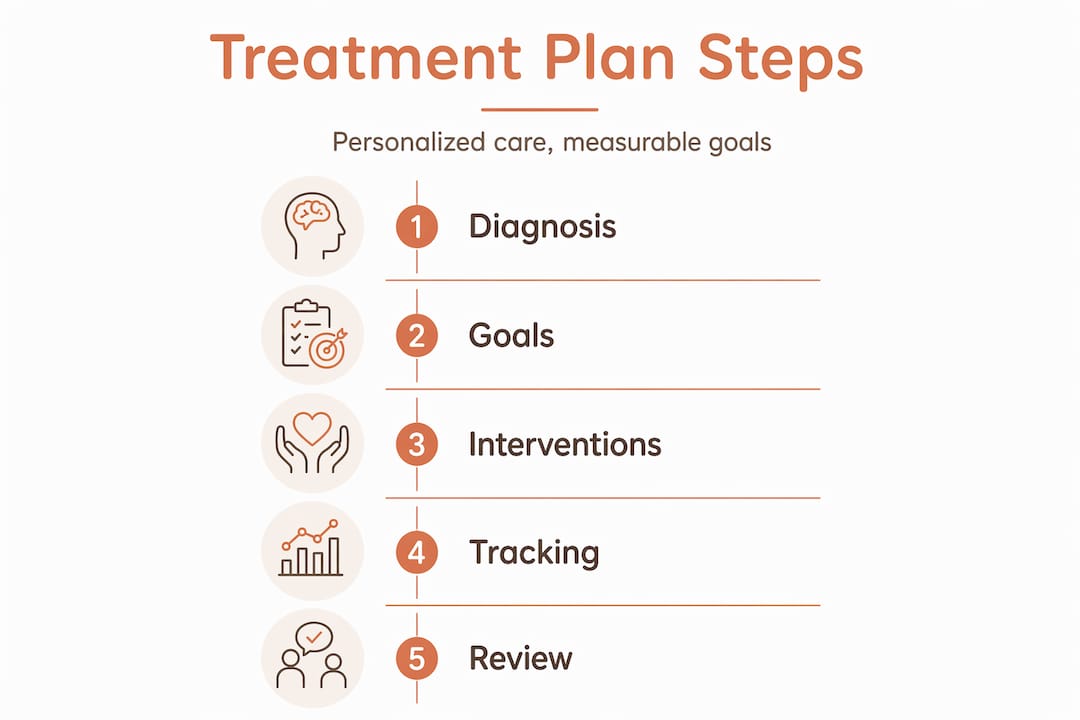
Your Structured Mental Health Treatment Plan Guide
Starting mental health care without a clear, written plan often means spinning your wheels. You see a provider, get a diagnosis, maybe start a medication, and then wonder why nothing feels organized or measurable. A structured mental health treatment plan guide changes that experience completely. It gives you and your provider a shared roadmap with defined goals, chosen interventions, and built-in checkpoints so you can actually see progress. Whether you are managing ADHD, anxiety, or depression, the difference between vague care and a structured plan is the difference between guessing and knowing.
Table of Contents
- Key takeaways
- Core components of a structured mental health treatment plan
- Writing effective SMART goals for your plan
- Selecting evidence-based interventions and virtual care options
- Tracking progress and keeping your plan current
- My honest take on structured plans
- Start your structured plan with Journeymhw
- FAQ
Key takeaways
| Point | Details |
|---|---|
| Structure creates measurable progress | A formal plan with SMART goals lets you and your provider track real changes instead of relying on memory. |
| Plans are living documents | Effective plans update every 4 to 8 sessions to reflect what is working and what needs adjusting. |
| Interventions should be combined | Therapy, medication, and lifestyle strategies work together in one plan rather than as separate, disconnected pieces. |
| Virtual care fits into any plan | Telehealth options maintain continuity and expand access without sacrificing the quality of structured care. |
| Patient involvement drives outcomes | When you help write your own goals, you are more likely to follow through and stay engaged with treatment. |
Core components of a structured mental health treatment plan
A mental health plan framework is only as useful as the elements it contains. Understanding what belongs in a complete plan helps you ask better questions during appointments and hold providers accountable for thoroughness.
Well-designed treatment plans include the following components as a baseline standard:
- Intake and demographic information. Your full name, age, insurance details, and any referral sources are recorded at the start. This grounds the plan in your specific situation.
- Presenting problems in your own words. Good providers write down how you describe your struggles, not just clinical summaries. This creates a patient-centered foundation.
- Primary and secondary diagnoses. These follow standardized criteria and inform every other decision in the plan.
- Relevant medical history and current medications. Thyroid conditions, sleep disorders, and existing prescriptions all affect how mental health conditions present and respond to treatment.
- SMART goals and objectives with timelines. Each goal is Specific, Measurable, Achievable, Relevant, and Time-bound. More on this in the next section.
- Chosen interventions and modalities. These include therapy types, medication management, and any adjunctive treatments.
- Progress tracking methods. Standardized rating scales, session notes, and symptom logs all count.
- Crisis management protocol. The plan should clearly state what to do, and who to contact, if symptoms escalate.
- Discharge or step-down criteria. Knowing what success looks like in measurable terms is just as important as knowing how to start.
Pro Tip: Ask your provider to walk you through each section of your plan at your first or second appointment. If they cannot point to each component above, that is a signal to request a more thorough document.
Here is a quick reference for the structure:
| Component | Purpose | Example |
|---|---|---|
| Presenting problem | Captures your experience | “I have not been able to focus at work for six months” |
| Primary diagnosis | Clinical framework | Generalized Anxiety Disorder |
| SMART goal | Measurable target | Reduce panic episodes from 5 to 2 per week within 8 weeks |
| Intervention | Treatment method | CBT with weekly 50-minute sessions |
| Progress metric | Tracks change | GAD-7 score reviewed every 4 sessions |
Writing effective SMART goals for your plan
Most people have heard of SMART goals. Fewer people have seen them written correctly in a mental health context. The difference between a vague goal and a well-formed one is significant, both for your motivation and for the legal and billing requirements your provider must meet.
Here is how to break down the SMART criteria in practice:
- Specific. Name the exact symptom or functional area. “Feel less anxious” is not specific. “Reduce the frequency of anxiety-related avoidance behaviors at work” is specific.
- Measurable. Attach a number. SMART goals include measurable targets within defined timeframes, such as reducing a symptom from a score of 18 to 10 on a validated scale within 8 weeks.
- Achievable. Set a target that is realistic given your current functioning level and treatment history. Cutting a PHQ-9 score in half within two weeks is not achievable for most people.
- Relevant. Connect the goal to your actual life. If your main struggle is ADHD affecting your job performance, a goal about social anxiety may be misaligned.
- Time-bound. Set a deadline. “Within 12 weeks” gives both you and your provider a checkpoint to evaluate progress.
The goal-writing process also protects you during care transitions. Vague objectives without measurable outcomes fail documentation reviews and create friction when you switch providers or need your records reviewed for insurance purposes.
Pro Tip: Write your goals in first-person language with your provider. Instead of “Patient will reduce depressive symptoms,” try “I will attend three social activities per week within six weeks.” That language shift makes the goal feel like yours, not a clinical checkbox.

A strong set of objectives typically covers three domains: symptom reduction (what you feel), functional improvement (what you can do), and coping skills (how you manage). Covering all three gives you a fuller picture of recovery than symptom scores alone.
Selecting evidence-based interventions and virtual care options
Once your goals are written, the next step in developing a mental health strategy is choosing the interventions that will get you there. This is where guidelines for mental health treatment become practical rather than theoretical.
Evidence-based therapy options to discuss with your provider include:
- Cognitive Behavioral Therapy (CBT). The most researched approach for anxiety and depression. It targets the connection between thoughts, feelings, and behaviors.
- Dialectical Behavior Therapy (DBT). Particularly effective for emotional dysregulation and co-occurring conditions.
- EMDR (Eye Movement Desensitization and Reprocessing). Used for trauma that underlies or complicates anxiety and depression.
- Behavioral Activation. A structured therapy approach for depression that focuses on increasing engagement with meaningful activities.
Medication management often runs alongside therapy in a well-designed plan. For depression that does not respond to standard antidepressants, esketamine is integrated with psychotherapy and careful monitoring rather than used as a standalone treatment. That integration is a clear example of why structured plans matter. Without a written framework, it is easy for advanced treatments to be administered without sufficient supporting context.
For depression specifically, supervised moderate-intensity exercise is recognized as an effective first-line therapy alongside psychotherapy, with research recommending 30 to 40 minutes of activity three to four times weekly for a minimum of 9 weeks.
Virtual therapy expands access and maintains care continuity for people who cannot or prefer not to attend in-person sessions. Telehealth delivery of behavioral health treatment follows the same structured plan model as in-person care, meaning your goals, interventions, and review schedules remain equally rigorous.
| Intervention | Best suited for | Can be delivered virtually |
|---|---|---|
| CBT | Anxiety, depression, ADHD | Yes |
| Medication management | ADHD, depression, anxiety | Yes |
| DBT skills groups | Emotional dysregulation | Partially |
| Esketamine | Treatment-resistant depression | No (requires supervision) |
| Behavioral Activation | Mild to moderate depression | Yes |
Tracking progress and keeping your plan current
A plan that never changes is a plan that stops working. The structured treatment plan mental health field has converged on a clear standard: plans must be updated every 4 to 8 sessions or every 30 to 90 days, whichever comes first, to reflect actual progress or a plateau that requires a different approach.
Effective progress tracking looks like this:
- Standardized rating scales. Tools like the GAD-7, PHQ-9, and Adult ADHD Self-Report Scale give you a number to compare over time instead of relying on how you feel in the moment.
- Session note linkage. Session documentation must link explicitly to specific goals with recorded data changes. If your notes just say “patient discussed anxiety,” they are not useful for tracking. Notes that say “patient reports panic episodes reduced from 4 to 1 this week, consistent with GAD-7 score drop from 14 to 9” are trackable.
- Collaborative review conversations. At each review interval, you and your provider should read the original goals together and decide what stays, what changes, and what gets retired.
- Documentation of plateaus. If a goal has not moved in two consecutive review periods, the plan should reflect a modified strategy, not a repetition of the same approach.
Pro Tip: Keep your own copy of your treatment plan and rate yourself on each goal the day before your provider review. Bringing your self-assessment to the appointment makes the conversation more specific and productive.
Measurable, patient-centered goals improve accountability and create a foundation for shared decision-making. When you can point to a number that has changed, or has not changed, you hold real power in directing your own care. Treatment stops being something done to you and becomes something you are actively part of.
My honest take on structured plans
Over the years, I have seen one pattern repeat itself without fail. The treatment plans that fail are not the ones with the wrong diagnosis or the wrong medication. They are the ones where nobody wrote down what success actually looks like. You cannot work toward a vague target, and neither can your provider.
What I have come to believe strongly is that the plan itself is a form of treatment. When you sit down and write, “I want to be able to sit through a one-hour meeting without leaving due to anxiety within the next 10 weeks,” something shifts. You have made a commitment. You have created something measurable. You have given yourself a reason to come back next session with real information.
I have also seen how virtual care, when it is built on the same structured plan model as in-person care, works just as well for most people. The platform changes. The rigor should not. Integrating medication management with therapy in a written, goal-driven plan is where I have consistently seen the best outcomes for ADHD, anxiety, and depression.
The biggest misconception I encounter is that flexibility and structure are opposites. They are not. A well-written plan is flexible by design. It includes scheduled review points precisely so you can change course. Treating the plan as a living document rather than a filed form is what separates care that moves forward from care that just fills an appointment slot.
— Jamie
Start your structured plan with Journeymhw
At Journeymhw, we build treatment plans the right way from the start. Every plan includes a thorough psychiatric evaluation, clearly written SMART goals, and integrated medication management options alongside therapy. We serve adults in Texas and Colorado through virtual appointments, which means you can access the same quality of structured care from home that you would expect in a clinical office. Whether you are managing ADHD, anxiety, or depression, our providers work with you directly to create a plan you understand, agree with, and can track over time. Getting started is straightforward: complete a brief online assessment and schedule your first appointment within days.
FAQ
What is a treatment plan in mental health care?
A mental health treatment plan is a written document that outlines your diagnosis, measurable goals, chosen interventions, and a schedule for reviewing progress. It is created collaboratively between you and your provider to guide and track your care.
How often should a mental health treatment plan be updated?
Plans should be reviewed and updated every 4 to 8 sessions or every 30 to 90 days. Updates reflect progress, plateaus, or changes in your condition, keeping the plan relevant and effective.
What makes a goal “SMART” in a treatment plan?
A SMART goal is Specific, Measurable, Achievable, Relevant, and Time-bound. For example, “reduce panic episodes from five to two per week within eight weeks” meets all five criteria and gives both you and your provider a clear target.
Can I follow a structured mental health plan through virtual care?
Yes. Virtual therapy and telehealth medication management follow the same structured plan model as in-person care. Goals, review schedules, and progress tracking work identically whether you meet in a clinic or online.
How does a structured plan help with ADHD specifically?
For ADHD, a structured plan breaks care into functional targets such as improving task completion rates or reducing missed deadlines, alongside medication management adjustments. The structured approach helps address the concrete, day-to-day impacts of ADHD rather than just managing symptoms broadly.
Recommended
- The Benefits of Virtual Mental Health Care for Depression, Anxiety and ADHD your guide – Journey Mental Health
- Your guide to navigating mental health treatment options – Journey Mental Health
- Your Mental Health Care Checklist for the First Appointment – Journey Mental Health
- ADHD – Journey Mental Health