

Why ADHD treatment improves daily function in adults
Most adults with ADHD assume treatment is mainly about paying attention better. That belief keeps a lot of people stuck. Understanding why ADHD treatment improves daily function means recognizing that medication and behavioral support work together to change how your brain manages tasks, emotions, time, and relationships, not just focus. If you live in Texas or Colorado and have been putting off getting evaluated because you think treatment offers limited returns, this article will show you exactly what structured care can change, and why online psychiatric services make it easier than ever to start.
Table of Contents
- How ADHD disrupts daily function in adults
- The science behind ADHD treatment improving daily function
- Why combining medication with behavioral therapies boosts functioning
- How stress and emotional factors influence treatment effectiveness
- Practical strategies to maximize daily functioning with ADHD treatment
- Rethinking ADHD treatment: Beyond symptom control to system support
- Get personalized ADHD treatment online in Texas and Colorado
- Frequently asked questions
Key Takeaways
| Point | Details |
|---|---|
| ADHD treatment targets executive function | Effective ADHD treatment improves task initiation, organization, impulse control, and emotional regulation in daily life. |
| Medication normalizes brain signaling | Stimulant medications enhance dopamine and norepinephrine function to support attention and executive processes. |
| Combination therapy works best | Pairing medication with behavioral therapies yields stronger, sustained improvements in daily functioning. |
| Stress and emotions affect outcomes | Managing co-occurring anxiety and stress is important to maximize treatment benefits. |
| Active management maximizes gains | Adjusting dose timing, tracking progress, and using structured supports help optimize daily functioning improvements. |
How ADHD disrupts daily function in adults
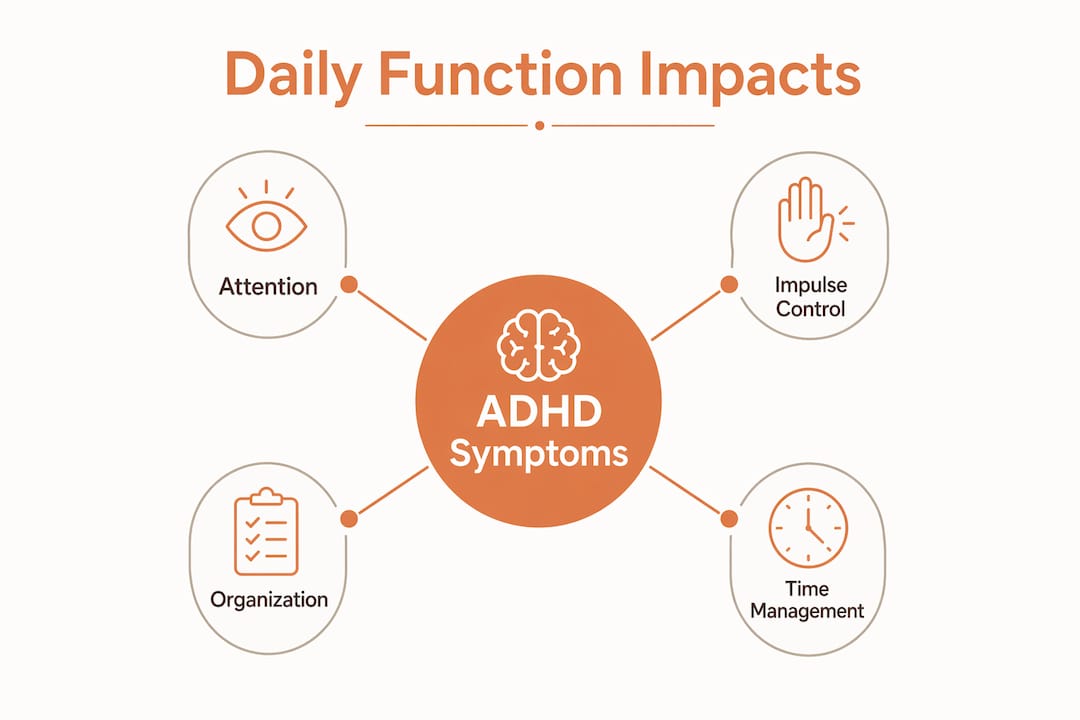
Before you can appreciate what treatment does, it helps to understand what ADHD is actively taking from you. ADHD does not just make it hard to read for long stretches. It disrupts the entire network of mental skills psychologists call executive functions, the system your brain uses to plan, initiate, monitor, and complete tasks.
According to adult ADHD research, ADHD creates executive function bottlenecks affecting task initiation, sustained effort, planning, and organization. In practical terms, that means starting a work project can feel physically impossible even when you know it is due. It means your kitchen is clean on Saturday but completely overwhelmed by Tuesday, not because you stopped caring but because the maintenance system in your brain does not fire reliably.
Here is how those impairments show up day to day for adults with ADHD:
- Task initiation problems: Knowing what you need to do but being unable to start, often for hours
- Inconsistent attention: Hyperfocusing on something engaging while critical tasks go ignored
- Impulsivity: Making quick financial or social decisions you later regret
- Poor time perception: Consistently underestimating how long things take, missing deadlines
- Emotional dysregulation: Reacting intensely to frustration or criticism, straining relationships
- Working memory gaps: Losing track of what you were doing mid-task, forgetting instructions
Each of these impairs your daily efficiency at work, at home, and in your social life. Understanding ADHD symptoms in adults this clearly is what allows treatment to target the right areas rather than just quieting surface-level restlessness.
The science behind ADHD treatment improving daily function
ADHD is primarily a neurochemical issue. The prefrontal cortex, the brain region responsible for planning, impulse control, and working memory, relies on two neurotransmitters: dopamine and norepinephrine. In adults with ADHD, the signaling efficiency in those circuits is reduced. Intentions form, but the signal to act on them loses strength before it completes.
Stimulant medications work by increasing the availability of dopamine and norepinephrine in prefrontal circuits. Research shows that stimulants normalize dopamine and norepinephrine signaling in the brain pathways responsible for attention and behavioral control. The practical result is that the gap between “I need to do this” and actually doing it gets smaller. For many adults, this is the first time in their lives that intention leads reliably to action.

ADHD medication benefits extend beyond just sitting still or reading without getting distracted. Stimulants also enhance working memory and task efficiency, two functions that have direct impact on your ability to manage projects, hold conversations, and follow through on plans.
Key neurological improvements you can expect from well-managed medication include:
- Faster and more reliable task initiation
- Improved ability to stay on one task until completion
- Reduced impulsive decision-making
- Better emotional tolerance under pressure
- More consistent short-term memory during conversations and work
Pro Tip: Medication response is individual. Some adults respond better to amphetamine-based stimulants while others do better on methylphenidate-based options. Tracking your daily function carefully during the first few weeks gives your provider the data they need to find the right fit faster.
Why combining medication with behavioral therapies boosts functioning
Medication creates a window of opportunity. Behavioral therapies are what you build through that window. This distinction matters a lot for understanding ADHD daily functioning, because many adults plateau after starting medication and wonder why their life has not reorganized itself.
Behavioral therapies yield better functional improvements than medication alone, specifically because they target organizational skills, coping strategies, and emotional regulation in ways that pills cannot replicate. Think of medication as turning the volume down on your symptoms. Behavioral therapy teaches you what to do with the quieter room.
Here is how the two approaches compare:
| Approach | What it targets | Limitations alone |
|---|---|---|
| Medication | Attention, impulse control, working memory | Does not build missing skills or habits |
| Behavioral therapy (CBT) | Organization, time management, coping, emotional regulation | Takes time; harder to engage without symptom control |
| Combined treatment | Full spectrum of executive function and daily functioning | Requires commitment from both patient and provider |
Effective ADHD management, as reinforced by structured treatment guidelines, requires pairing medication with counseling, skill-building, and structured supports to achieve real functional gains. The combination also allows lower effective medication doses over time, which reduces side effects.
Behavioral strategies that make the most measurable difference in daily life with ADHD include:
- CBT for ADHD: Targets distorted thinking patterns like “I work better under pressure” and builds realistic planning habits
- Time management training: Teaches external strategies like time-blocking and visible timers to compensate for poor time perception
- Emotional regulation skills: Reduces reactive behavior at work and in relationships
- Task-sequencing practice: Breaks large projects into actionable steps with built-in checkpoints
Pro Tip: Ask your provider specifically about medication and therapy options that can be coordinated through telehealth. In Texas and Colorado, many adults access both medication management and behavioral coaching through the same online platform, which cuts down on scheduling friction significantly.
How stress and emotional factors influence treatment effectiveness
Here is a detail most articles skip. Even with good medication and solid behavioral strategies, high stress can visibly reduce how well treatment works. This is not a sign that treatment is failing. It is a sign that treatment needs to account for your full mental health picture.
Anxiety and mood disorders frequently coexist with adult ADHD. When these conditions go unaddressed, comorbid emotional conditions worsen daily function and undercut the gains you would otherwise see from ADHD treatment. In fact, many adults seeking ADHD care discover that what they assumed was a focus problem is actually a focus problem compounded by significant anxiety.
From a medication standpoint, the research is clear: emotional and stress-related benefits from stimulants are smaller, more variable, and influenced by your stress level and the timing of your doses. A stimulant that works excellently at 9 AM may feel completely ineffective by 6 PM if you have been managing high psychosocial stress all day.
Practical ways to strengthen your treatment outcomes under real-life stress:
- Work with your provider to adjust dose timing if you experience consistent afternoon or evening wear-off
- Address co-occurring anxiety through integrated treatment for ADHD and anxiety, rather than treating each one separately
- Use therapy to develop specific coping strategies for your highest-stress contexts, whether that is work deadlines, parenting, or financial pressure
- Prioritize sleep, because sleep deprivation mimics and amplifies ADHD symptoms regardless of medication
Recognizing when stress is driving your symptoms, and when anxiety and ADHD overlap, is one of the most valuable things a thorough psychiatric evaluation can reveal.
Practical strategies to maximize daily functioning with ADHD treatment
Treatment is not a passive process. The adults who see the most meaningful improvements in their daily functioning are the ones who actively work their treatment plan. Here are the steps that consistently make the biggest difference.
-
Time your medication strategically. Work with your provider to ensure your medication is active during your most demanding hours. Adjusting dose timing and pairing with CBT directly improves real-world function, especially for adults with demanding work schedules.
-
Use external structure, not just willpower. Calendars, phone alarms, visual task boards, and habit trackers compensate for unreliable internal systems. Your brain does not need motivation; it needs reliable cues. Executive skill supports and environmental accommodations are clinically recognized as effective tools for improving daily functioning.
-
Add behavioral therapy to your care plan. Even four to six sessions of CBT focused on ADHD can meaningfully change how you approach organization, planning, and emotional reactions. It is not indefinite therapy; it is skill-building with a clear endpoint.
-
Track your functioning, not just your symptoms. Ask yourself each week: Am I completing more tasks? Am I less reactive? Am I showing up more consistently at work and home? This kind of tracking gives your provider actionable information instead of general impressions.
-
Get a proper evaluation before assuming your current plan is the best one. If you have never had a structured ADHD evaluation and support plan, you may be managing on a treatment approach that was never optimized for your specific profile.
Pro Tip: If you are in Texas, accessing ADHD care through an online provider means you can schedule evaluations and follow-ups without taking time off work or traveling. That removes one of the biggest practical barriers adults face when trying to stay consistent with treatment.
Rethinking ADHD treatment: Beyond symptom control to system support
We want to say something that most articles will not. Medication is not a fix. It is an input into a system that also includes your habits, your environment, your stress load, and your skills. Expecting medication alone to reorganize your life sets you up for disappointment and, often, for abandoning treatment that could genuinely help you.
The most frustrated adults we see are those who tried one medication, felt partial improvement, and concluded that treatment was not for them. What they needed was not a different medication. They needed a treatment model that recognized their executive-function deficits as persistent impairments requiring functional skill-building and environmental support, not just chemical correction.
Your daily challenges with ADHD are unique. Your work environment, your family demands, your emotional history, and your existing coping habits all shape what kind of support will move the needle for you. A provider who helps you map that picture and build a comprehensive care approach around it will deliver far better outcomes than one who simply prescribes and monitors.
The mindset shift is this: treatment is not something that is done to you. It is a structure you actively participate in. When you approach it that way, functional improvements are not just possible. They are consistent.
Get personalized ADHD treatment online in Texas and Colorado
If this article has clarified something for you, the next step is finding care that matches the full picture we have described. Effective treatment means more than a prescription. It means evaluation, medication management, and behavioral support, all coordinated and accessible.
At Journey Mental Health, we provide online ADHD treatment in Texas and online ADHD treatment in Colorado through a structured telehealth platform built for adults with demanding lives. Our providers offer psychiatric evaluations, medication management services, and coordinated behavioral support, all from your home. Appointments are available quickly, scheduling is flexible, and our care pathways are designed to reduce the delays that keep adults from getting the help they need. You do not have to keep managing this alone.
Frequently asked questions
How does ADHD treatment improve daily function in adults?
ADHD treatment improves daily function mainly by normalizing brain signaling for attention, impulse control, and organization, which translates directly to more consistent task completion and steadier emotional responses across the day.
Why is medication alone often not enough to improve daily functioning?
Medication reduces core symptoms effectively but does not build the organizational habits and coping skills that adults with ADHD are often missing. Pairing medication with structured supports and behavioral therapy fills those gaps and sustains functional gains over time.
How do stress and emotional conditions affect ADHD treatment outcomes?
Stress and co-occurring anxiety can reduce how reliably stimulant medication works, making improvements more variable. Stimulant benefits under stress are smaller and more dependent on dose timing, which is why integrated treatment that addresses both ADHD and emotional conditions produces the most consistent outcomes.
What are practical ways to maximize benefits from ADHD treatment?
Working with your provider to refine medication timing, adding CBT, using environmental supports like schedulers and reminders, and tracking real-world function weekly gives your care team the information needed to keep improving your treatment plan.
Can I access effective ADHD treatment online in Texas and Colorado?
Yes. Specialized online psychiatric services in Texas and Colorado offer full ADHD evaluations, medication management, and behavioral therapy coordination, giving adults access to the same quality of structured care they would find in a traditional clinic, without the commute or the waiting room.