

Why ADHD Misdiagnosis Happens in Adults: What to Check
Adult ADHD is frequently misdiagnosed because its symptoms overlap with dozens of common psychiatric and medical conditions, because brief screening tools produce high rates of false positives, and because many providers rely on checklists rather than the comprehensive evaluations the evidence supports. Research shows that 20–30% of adults report elevated ADHD-like symptoms on screening tests at some point in their lives, and nearly 90% of those are false positives. Separately, about 75% of adults who do have ADHD carry at least one other psychiatric diagnosis, meaning the clinical picture is almost never clean. The result: both missed diagnoses and incorrect ones are common, and the difference often comes down to how thorough the evaluation was.
Key reasons adult ADHD misdiagnosis occurs:
- High false-positive screening rates. Brief screens flag far more adults than actually have ADHD; nearly 90% of those elevated scores are false positives.
- High comorbidity. When depression, anxiety, or another condition is present alongside ADHD, the more visible disorder tends to absorb clinical attention.
- Diagnostic-process shortfalls. Checklist-only assessments, no collateral history, and no medical workup all increase the chance of error.
If you are concerned your diagnosis may be wrong, the most protective step is requesting a full evaluation that includes a semi-structured interview, collateral history from someone who knew you as a child, and a targeted medical workup. The sections below explain exactly why errors happen and what a better process looks like.
Table of Contents
- Why adult ADHD gets missed or misdiagnosed: core clinical reasons
- Which psychiatric conditions most commonly mimic ADHD in adults?
- Medical and neurological causes that should be ruled out first
- Why screening tools like the ASRS can mislead you
- Why childhood history is so hard to verify in adults
- How provider training gaps and bias increase misdiagnosis risk
- What a high-quality adult ADHD diagnostic assessment should include
- How you can reduce your own risk of misdiagnosis
- Timeline, cost, and insurance considerations in the U.S.
- Signs your current diagnosis might be wrong
- Key evidence on screening accuracy, comorbidity, and assessment quality
- When to trust your diagnosis and what to do next
- Key Takeaways
- What I think patients most often get wrong about this process
- Journeymhw provides structured adult ADHD evaluations in Texas and Colorado
- Useful sources and further reading
Why adult ADHD gets missed or misdiagnosed: core clinical reasons
Adults with ADHD rarely present the way children do. The rambunctious, desk-climbing behavior that makes childhood ADHD visible is largely absent. Instead, adults tend to show up with executive dysfunction: chronic disorganization, difficulty prioritizing, missed deadlines, and an inability to start tasks they find unstimulating. Those complaints look nearly identical to what a clinician sees in generalized anxiety disorder, major depression, or burnout.

Symptom overlap is the single biggest driver of diagnostic error. Inattention, restlessness, and impulsivity appear across the entire DSM-5. Concentration difficulties are actually the second most common symptom listed across all DSM-5 conditions, which means a clinician who does not probe carefully can easily attribute those complaints to whichever condition they see most often.
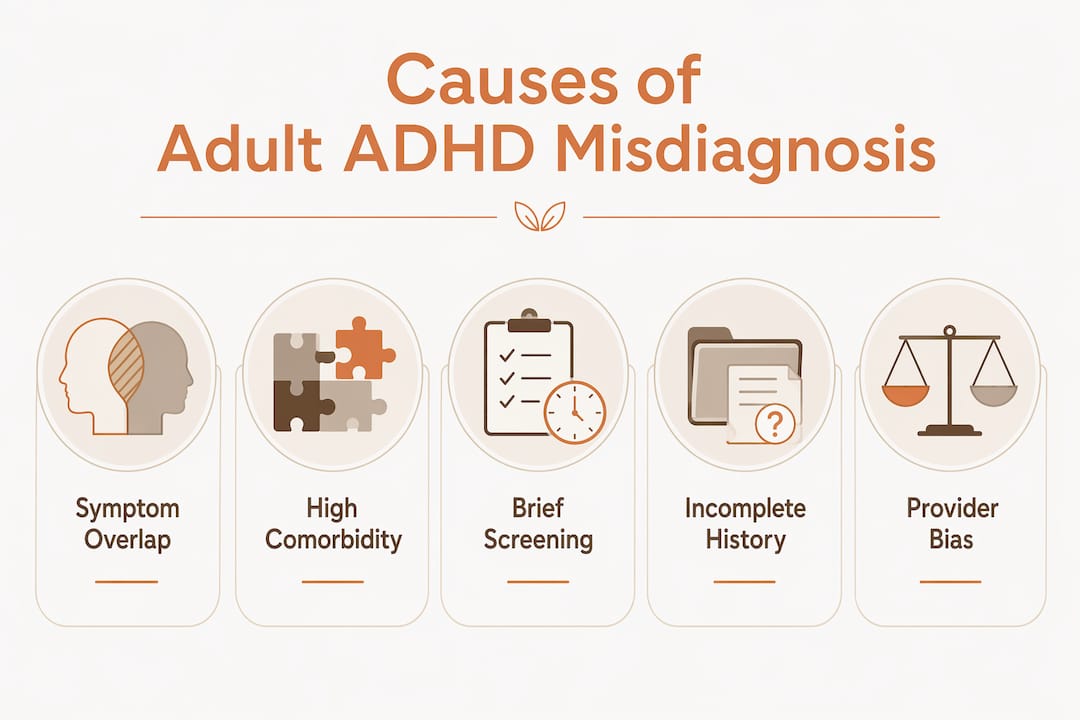
Comorbidity compounds the problem. When a prominent mood or anxiety disorder is present, it tends to dominate the clinical picture. A patient who is visibly depressed and also has ADHD may receive only a depression diagnosis, because the ADHD symptoms are attributed to low mood rather than recognized as a separate, coexisting condition.
Masking and compensation are equally important and often underestimated. Many adults have spent decades building workarounds: choosing careers that reward hyperfocus, relying on a highly organized partner, or using rigid routines to compensate for working memory gaps. On a brief assessment, these strategies can make impairment invisible. A clinician may read high functioning as the absence of ADHD rather than as evidence of extraordinary coping. Adults who present this way are at particular risk of a missed diagnosis, and ADHD masking is especially well-documented in women.
Statistic to know: 20–30% of adults report elevated ADHD-like symptoms on screening tests at some point; nearly 90% of those elevated scores are false positives.
Which psychiatric conditions most commonly mimic ADHD in adults?
Several common psychiatric diagnoses produce symptoms that are nearly indistinguishable from ADHD on a brief screen. Knowing the distinguishing features helps both patients and clinicians ask the right questions. You can also explore the overlap between ADHD, anxiety, and depression in more detail.
- Major depressive disorder (MDD). Concentration problems, low energy, and slowed processing are core MDD symptoms. The key distinction is episodicity: MDD symptoms typically worsen during depressive episodes and improve between them, while ADHD symptoms are trait-like and persistent across the lifespan.
- Generalized anxiety disorder (GAD). Restlessness, distractibility, and difficulty completing tasks appear in both GAD and ADHD. GAD tends to be driven by worry content (specific fears, catastrophizing), whereas ADHD inattention is more random and not tied to anxious thought patterns.
- Bipolar disorder. Elevated energy, impulsivity, and racing thoughts during hypomanic or manic phases can look like ADHD. The episodic course, mood elevation, and decreased need for sleep are the clearest distinguishing features.
- Borderline personality disorder (BPD). Emotional dysregulation, impulsivity, and relationship instability overlap with ADHD. BPD typically involves intense, reactive mood shifts tied to interpersonal triggers, whereas ADHD emotional dysregulation is more diffuse and less context-dependent.
- Substance use disorder (SUD). Stimulant and cannabis use can produce inattention, impulsivity, and sleep disruption that mimic ADHD. Timing matters: symptoms that appear only during active use or withdrawal are more likely substance-related.
| Condition | Onset pattern | Episodic or persistent? | Typical cognitive profile |
|---|---|---|---|
| ADHD | Childhood (symptoms present before age 12) | Persistent, trait-like | Inattention, working memory gaps, variable focus |
| Major depressive disorder | Any age; often episodic | Episodic | Slowed processing, concentration loss during episodes |
| Bipolar disorder | Late teens to early adulthood | Episodic (cycling) | Elevated cognition in mania; slowed in depression |
| Generalized anxiety disorder | Often childhood or early adulthood | Persistent but worry-driven | Concentration disrupted by intrusive worry |
| Borderline personality disorder | Early adulthood | Persistent, reactive | Impulsivity tied to emotional states |
About 75% of adults with ADHD have at least one comorbid psychiatric diagnosis, so these conditions are not always either/or. When comorbidity is present, the standard approach is to treat the most acute or impairing condition first while keeping the full diagnostic picture in view. Treating only one condition and ignoring the other typically produces incomplete improvement.
Medical and neurological causes that should be ruled out first
Several medical conditions produce cognitive and behavioral symptoms that are clinically indistinguishable from ADHD without targeted testing. A systematic medical clearance that includes routine labs and focused screening is recommended before finalizing any ADHD diagnosis.

| Symptom pattern | Suggested initial test or referral |
|---|---|
| Fatigue, weight changes, cold intolerance | TSH (thyroid-stimulating hormone) |
| Fatigue, pallor, poor concentration | CBC with iron studies (ferritin) |
| Daytime sleepiness, snoring, morning headaches | Sleep study (polysomnography) |
| Unexplained attention lapses, staring spells | EEG (rule out absence seizures) |
| Fatigue, increased thirst, concentration problems | Hemoglobin A1c, fasting glucose |
| Post-injury cognitive changes | Neurological evaluation, cognitive screen |
Sleep-disordered breathing deserves particular attention. Obstructive sleep apnea (OSA) disrupts restorative sleep, and the resulting daytime inattention, irritability, and poor working memory are nearly identical to ADHD symptoms. Some studies show higher OSA prevalence in patients already diagnosed with ADHD, which raises the question of whether the sleep disorder is contributing to, or even causing, the presentation. A polysomnography referral is appropriate when a patient reports significant daytime sleepiness, snoring, or witnessed apneas.
Thyroid dysfunction, iron-deficiency anemia, and glycemic instability are all detectable with a standard blood panel. Most of these mimics can be ruled out in a single lab visit, which makes skipping this step difficult to justify. When a clinician moves straight to an ADHD diagnosis without ordering basic labs, that is a meaningful gap in the assessment process.
Why screening tools like the ASRS can mislead you
Screening tools are designed to identify who needs a deeper evaluation, not to confirm a diagnosis. The Adult ADHD Self-Report Scale (ASRS) is the most widely used brief screen in the U.S., and it does that job reasonably well. The problem arises when a positive screen is treated as a diagnosis.
The ASRS asks about symptom frequency over the past six months. Situational stress, sleep deprivation, a recent life disruption, or an active mood episode can all push scores into the “positive” range for someone who does not have ADHD. That is precisely why nearly 90% of elevated screening scores are false positives. A positive ASRS result means “this person warrants a full evaluation,” not “this person has ADHD.”
Pro Tip: If a provider offers you a diagnosis based primarily on a completed ASRS or similar checklist without conducting a detailed interview, collecting collateral history, or ordering any medical tests, ask directly: “What else will be part of this evaluation?” A screen is the starting point, not the finish line.
One specific misconception deserves direct attention: a positive response to stimulant medication does not confirm an ADHD diagnosis. Stimulants can improve focus and mood in people without ADHD, so feeling better on medication tells you nothing definitive about whether ADHD is the correct diagnosis. Providers who prescribe stimulants as a diagnostic trial and then continue prescribing based on the patient’s reported improvement are substituting treatment response for a proper evaluation.
Why childhood history is so hard to verify in adults
DSM-5 requires that several ADHD symptoms were present before age 12. For an adult presenting at 35 or 45, verifying that criterion depends almost entirely on retrospective recall, and retrospective recall is unreliable. Adults tend to reinterpret past experiences through their current understanding of ADHD, which can inflate or deflate symptom reports depending on how motivated they are to receive or avoid the diagnosis.
Compensation strategies make this even harder to untangle. An adult who chose a career in a high-stimulation field, who relies on a partner to manage household logistics, or who has developed rigid productivity systems may have functioned adequately for years without recognizing the effort those adaptations required. By the time they seek evaluation, the impairment may not be obvious from the outside.
Clinicians who conduct thorough evaluations rely on collateral sources rather than memory alone. Documents and informants that strengthen a childhood history claim include:
- Elementary and middle school report cards (comments about attention, behavior, and effort are often more informative than grades)
- Standardized test score records showing performance variability
- Childhood medical or psychological records
- Interviews with a parent, sibling, or other adult who knew the patient well before age 12
- Teacher evaluations or special education records
- College transcripts showing inconsistent performance across subjects
When none of these sources are available, a skilled clinician looks for patterns: Did the patient consistently underperform relative to their apparent intelligence? Did they describe compensating heavily in structured environments? Those patterns carry diagnostic weight even without a paper trail.
How provider training gaps and bias increase misdiagnosis risk
Structural and clinician-level factors are major contributors to adult ADHD misdiagnosis, and they are often invisible to the patient. The U.S. has no single national guideline for diagnosing ADHD in adults, and standardized best practices are inconsistently applied across clinical settings. Primary care providers, psychiatrists, and psychologists have historically received minimal training in adult ADHD, and that gap persists today.
Bias in ADHD diagnosis is well-documented and consequential. Gender and racial biases influence both recognition and diagnostic labeling. Women are more likely to be diagnosed with anxiety or depression when ADHD is the correct or co-occurring diagnosis. Black and Hispanic patients are more likely to receive behavioral disorder diagnoses rather than ADHD. Adults with high IQs are often told they “did too well in school” to have ADHD. Older adults face prescription hesitancy. Rural patients face a shortage of trained clinicians altogether. These are not edge cases — they are documented patterns that affect diagnostic outcomes across the country.
Consider a common scenario: a woman in her late 30s presents with chronic disorganization, difficulty finishing projects, and low self-esteem. She has been managing these symptoms for decades through careful scheduling and avoidance of situations that expose her difficulties. Her clinician, seeing a composed, articulate adult, attributes her complaints to anxiety and prescribes an SSRI. The ADHD goes unrecognized. This pattern is particularly well-documented in women, where masking behaviors are reinforced by social expectations.
System-level pressures amplify individual clinician gaps. A 15-minute primary care appointment is structurally incompatible with a thorough ADHD evaluation. Insurance reimbursement for behavioral health services in primary care is limited. Wait times to see a psychiatrist can range from three to six months in many U.S. markets. These constraints push clinicians toward shortcuts, and shortcuts in ADHD diagnosis tend to produce errors in both directions.
What a high-quality adult ADHD diagnostic assessment should include
A thorough adult ADHD evaluation is not a single appointment with a checklist. Experts recommend a semi-structured interview, collateral history, developmental timeline, targeted medical workup, and careful differential diagnosis as the core components. The direct contact time for a quality assessment is typically at least two hours, often spread across multiple sessions.
Diagnostic checklist: what to look for in your provider’s process
- Semi-structured clinical interview. Open-ended questions with follow-up probing for real-life examples, not a closed yes/no checklist.
- Developmental and childhood history. Explicit review of symptoms before age 12, with documentation of how they presented across settings.
- Collateral history. Input from a parent, partner, or close contact who can corroborate symptom patterns.
- Differential diagnosis review. Systematic consideration of depression, anxiety, bipolar disorder, personality disorders, and substance use.
- Medical workup. At minimum, TSH, CBC, and Hemoglobin A1c; sleep screening when indicated.
- Functional impairment assessment. Evidence that symptoms cause at least moderate impairment in two or more life domains (work, relationships, education, daily tasks).
- DSM-5 criteria mapping. Explicit documentation of which criteria are met and how.
What to bring to your evaluation
- Previous psychiatric or psychological evaluations
- Current and past medication lists
- School records (report cards, teacher comments, standardized test scores)
- A written symptom timeline you prepared in advance
- Contact information for a collateral informant (parent, sibling, or long-term partner)
For more detail on what the testing process looks like step by step, the adult ADHD testing guide covers the full protocol.
When is neuropsychological testing appropriate?
Neuropsychological testing and continuous performance tests (CPTs) can clarify specific cognitive deficits when the clinical history is ambiguous, or when a learning disability, intellectual disability, or traumatic brain injury needs to be ruled out. They are not required for most adult ADHD evaluations and should not be used as a substitute for a clinical interview. Objective testing adds information but cannot confirm ADHD on its own.
How you can reduce your own risk of misdiagnosis
Patients who prepare thoroughly before an evaluation get better diagnostic outcomes. That is not a platitude; it is a practical reality. A clinician working from a well-organized symptom history, supported by collateral input and relevant records, has far more to work with than one relying solely on what you can recall in a 45-minute appointment.
Before your evaluation, collect and organize the following:
- A written log of your three to five most impairing symptoms, with specific examples from the past six months
- A sleep log covering at least two weeks (bedtime, wake time, sleep quality, daytime energy)
- A substance use history (current and past alcohol, cannabis, stimulant, or other drug use)
- Any previous diagnoses and the treatments you received for them
- A list of situations where your symptoms are worst and situations where they are minimal
- School records or any documentation of childhood academic or behavioral difficulties
Pro Tip: Write out two or three concrete, time-stamped examples of each symptom before your appointment. “I often lose focus” is easy to dismiss; “On March 3rd I missed a work deadline because I spent four hours unable to start the report despite sitting at my desk” is clinical evidence.
Questions to ask your provider
- “What will this evaluation include beyond a symptom checklist?”
- “Will you be collecting any collateral history?”
- “What medical conditions will you rule out before making a diagnosis?”
- “How will you distinguish ADHD from anxiety or depression if both seem present?”
Red flags for a poor assessment process
- Diagnosis offered after a single brief appointment with only a self-report screen
- No questions about childhood history or functioning before age 12
- Stimulant prescription offered as a “diagnostic trial” before a full evaluation is complete
- No mention of differential diagnosis or medical workup
- No request for collateral information
If you notice these patterns, requesting a second opinion is reasonable and appropriate. Bring your records, your symptom log, and any previous evaluations to that appointment.
Timeline, cost, and insurance considerations in the U.S.
A quality adult ADHD evaluation typically spans two to four appointments over two to six weeks, depending on the complexity of the case and how quickly collateral information can be gathered. A straightforward psychiatric evaluation with a single provider may be completed in two sessions. Cases involving significant comorbidity or ambiguous childhood history often take longer.
Cost varies considerably by provider type and setting:
- A psychiatric evaluation (two to three sessions) in a private-pay setting typically ranges from a few hundred to over a thousand dollars total, depending on the provider’s fees and geographic market.
- Multi-hour neuropsychological testing, when ordered, adds substantially to that cost and is often not covered by insurance.
- Telehealth psychiatric evaluations tend to be more accessible in terms of both cost and scheduling.
Insurance considerations to address before your first appointment:
- Call your insurer and ask specifically whether psychiatric evaluations for ADHD are covered under your plan.
- Ask about the CPT codes your provider will use (common codes for psychiatric evaluation include 90791 and 90792).
- Ask whether preauthorization is required for the initial evaluation or for any follow-up visits.
- Confirm that your provider is licensed in your state, particularly for telehealth services. Telehealth providers must hold an active license in the state where you are located at the time of the appointment.
- Ask whether the provider bills insurance directly or requires you to submit claims for reimbursement.
Primary care evaluations are typically shorter and less comprehensive than specialty psychiatric evaluations. If your primary care provider diagnosed you quickly based on a brief screen, that is worth discussing with a psychiatrist or psychologist who specializes in adult ADHD.
Signs your current diagnosis might be wrong
A few specific patterns suggest the diagnosis you received may be incomplete or incorrect. None of these alone proves misdiagnosis, but each one warrants a closer look.
- Your diagnosis was based on a single self-report screening tool with no follow-up interview
- No one asked about your childhood functioning or symptoms before age 12
- You received a stimulant prescription at or shortly after your first appointment, framed as a “trial to see if it helps”
- No medical tests were ordered before the diagnosis was made
- Your symptoms are episodic rather than persistent (they come and go with mood or stress rather than being consistently present)
- You have significant daytime sleepiness, snoring, or disrupted sleep that was never evaluated
- Your mood swings are intense and tied to specific events or relationships, suggesting a mood or personality disorder rather than ADHD
- Your symptoms appeared or worsened significantly after a major life stressor, injury, or substance use
If several of these apply, seeking a second opinion from a psychiatrist or psychologist with specific adult ADHD experience is a reasonable next step. Bring your original evaluation records, your symptom history, and any school or medical records you can locate. A good re-evaluation will not simply repeat the original process; it will probe the areas the first evaluation missed.
For a practical comparison of how ADHD and anxiety present differently, that distinction alone resolves a significant number of misdiagnosis cases.
Key evidence on screening accuracy, comorbidity, and assessment quality
The clinical case for thorough adult ADHD evaluation rests on a small set of well-replicated findings.
| Finding | Figure | Source |
|---|---|---|
| Adults reporting elevated ADHD-like symptoms on screening | 20–30% of all adults at some point | NCBI Bookshelf (Chamberlain et al.; Sibley et al.) |
| False-positive rate among elevated screening scores | ~90% | NCBI Bookshelf |
| Adults with ADHD who have at least one comorbid psychiatric diagnosis | ~75% | BJPsych Advances / PMC |
These figures carry important caveats. The 20–30% and 90% figures come from population-level screening studies; rates vary by the specific tool used, the population screened, and the diagnostic threshold applied. The 75% comorbidity figure reflects clinical samples, which tend to include more complex presentations than community samples. Both directions of error (over- and underdiagnosis) are real and clinically significant.
What these numbers mean in practice: a positive screen is a reason to investigate further, not a diagnosis. And a diagnosis made without accounting for comorbidity is almost certainly incomplete.
When to trust your diagnosis and what to do next
Trust a diagnosis that followed best-practice components: a semi-structured interview, collateral history, developmental review, differential diagnosis, and at minimum a basic medical workup. Seek re-evaluation when your assessment was brief, checklist-based, or skipped any of those elements.
Three immediate steps if you have concerns:
- Collect your records. Request the written report from your original evaluation, including which criteria were documented as met.
- Request collateral history. If your evaluation did not include input from someone who knew you as a child, ask your current provider whether that can be added, or bring it to a re-evaluation.
- Ask for medical clearance. If no labs were ordered, ask your primary care provider for a TSH, CBC, and Hemoglobin A1c at minimum. If you have sleep symptoms, ask about a sleep study referral.
If your provider is not receptive to these requests, that itself is useful information. A clinician confident in their diagnostic process will welcome the opportunity to document it.
Key Takeaways
Adult ADHD misdiagnosis is most often caused by symptom overlap, high comorbidity rates, reliance on brief screens, and inconsistent assessment quality rather than any single factor.
| Point | Details |
|---|---|
| Screening tools are not diagnoses | Nearly 90% of elevated ADHD screening scores are false positives; a positive screen triggers evaluation, not a diagnosis. |
| Comorbidity is the rule, not the exception | About 75% of adults with ADHD have at least one other psychiatric diagnosis; treating only one condition typically leaves the other unaddressed. |
| Medical mimics must be ruled out | Thyroid dysfunction, iron deficiency, sleep apnea, and absence seizures all produce ADHD-like symptoms and are detectable with routine labs or targeted testing. |
| A quality evaluation takes time | A thorough adult ADHD assessment requires at least two hours of direct contact, a semi-structured interview, collateral history, and a differential diagnosis review. |
| Journeymhw offers structured re-evaluation | Journeymhw provides virtual psychiatric evaluations for adults in Texas and Colorado, following a structured process that includes clinical interview, differential diagnosis, and medical workup referrals. |
What I think patients most often get wrong about this process
Most people who suspect misdiagnosis focus on whether they “really have ADHD.” That is understandable, but it is the wrong question to lead with. The more useful question is: “Was the process that produced my diagnosis thorough enough to be trusted?”
A diagnosis built on a 20-minute appointment and a self-report checklist is not reliable, regardless of whether the conclusion happens to be correct. And a diagnosis that correctly identifies ADHD but misses a comorbid anxiety disorder or an untreated sleep condition will still leave you functioning poorly, because you are only treating part of the picture.
What the evidence consistently shows is that the adults most likely to be misdiagnosed are those who compensate well, those who present with prominent mood or anxiety symptoms, and those whose providers did not have the training or time to conduct a thorough evaluation. If you fall into any of those categories, the appropriate response is not to dismiss your diagnosis outright, but to ask whether the evaluation behind it was complete.
The common misdiagnoses of ADHD, anxiety, and depression are well-documented and correctable. Getting a second opinion from a clinician who specializes in adult ADHD is not an accusation against your original provider; it is a reasonable step when the stakes are high and the first evaluation was brief.
Journeymhw provides structured adult ADHD evaluations in Texas and Colorado
Getting a thorough evaluation should not require months on a waiting list or a stack of paperwork you have to navigate alone. Journeymhw offers virtual psychiatric evaluations for adults in Texas and Colorado, with a structured process designed around the best-practice components this article describes: a clinical interview that goes beyond a checklist, differential diagnosis review, collateral history requests, and referrals for medical workup when indicated.
For adults who received a quick diagnosis and are not sure it was complete, or who have been told they have anxiety or depression but still feel like something is missing, Journeymhw’s adult ADHD evaluation is a concrete next step. The platform also supports comorbid presentations, including ADHD treatment alongside anxiety or depression care, so you are not left managing one condition while the other goes unaddressed.
If you are in Texas, the ADHD treatment in Texas page outlines availability and how to get started. Appointments are available online, and the intake process is designed to be straightforward so you spend your time on the evaluation, not the logistics.
This article provides general clinical information and is not a substitute for professional medical advice. Please consult a qualified clinician for guidance specific to your situation.
Useful sources and further reading
- Impact of Misdiagnosis, Bias, and Stigma — NCBI Bookshelf: The primary source for the 20–30% screening prevalence figure, the ~90% false-positive rate, and the discussion of stimulant response as a non-diagnostic indicator. Essential reading for clinicians and informed patients.
- Misdiagnosis and missed diagnosis of adult ADHD — BJPsych Advances / PMC: Source for the 75% comorbidity figure, the role of compensation and masking, and the inconsistent application of diagnostic guidelines in U.S. practice.
- ADHD Misdiagnosis: Why Medical Evaluation Should Be Part of Assessment — PubMed: Supports the recommendation for routine labs (TSH, CBC, Hemoglobin A1c) and targeted sleep and seizure screening before finalizing an ADHD diagnosis.
- ADHD Misdiagnosis: Medical Evaluation — MDPI Brain Sciences: Detailed review of medical mimics including thyroid dysfunction, iron deficiency, sleep-disordered breathing, and absence seizures, with guidance on when to order objective testing.
- Assessments for adult ADHD: what makes them good enough? — PMC: Practical framework for what constitutes a high-quality adult ADHD assessment, including the semi-structured interview standard and the risks of checklist-only approaches.
- Barriers to ADHD Diagnosis in Adults — ASPE/HHS: Qualitative study documenting provider training gaps, systemic barriers, and the lack of U.S. adult ADHD diagnostic guidelines; useful for understanding why access and quality vary so widely.