

Why ADHD and Anxiety Feel So Similar: Key Differences
If you’ve ever wondered why ADHD anxiety feel similar, you’re not alone. Millions of people live with symptoms that blur the line between the two conditions. You might feel restless, distracted, overwhelmed, and unable to settle your thoughts. Whether you have ADHD, anxiety, or both, those experiences can feel nearly identical from the inside. Understanding why these conditions overlap at a neurological and practical level is not just reassuring. It’s the first step toward getting care that actually addresses what’s going on for you.
Table of Contents
- Key takeaways
- Understanding ADHD and anxiety: what each condition actually is
- Why ADHD and anxiety feel similar: the brain science
- Key differences between ADHD anxiety and primary anxiety
- How ADHD and anxiety compound each other
- Practical steps for self-awareness and getting the right support
- My take on the overlap, and why diagnosis is harder than it looks
- Getting the right support through Journeymhw
- FAQ
Key takeaways
| Point | Details |
|---|---|
| Overlapping symptoms are real | Restlessness, poor focus, and racing thoughts appear in both ADHD and anxiety for distinct neurological reasons. |
| Different brain origins | ADHD anxiety stems from prefrontal cortex dysfunction, while primary anxiety originates in the amygdala. |
| Co-occurrence is common | Up to 70% of adults with ADHD have a comorbid condition, including anxiety disorders. |
| Avoidance differs by condition | ADHD avoidance comes from task initiation failure; anxiety avoidance is driven by fear of specific outcomes. |
| Accurate diagnosis matters | Treating only one condition often leaves significant symptoms unresolved, especially when both are present. |
Understanding ADHD and anxiety: what each condition actually is
Before exploring the ADHD and anxiety connection, it helps to understand what each condition involves on its own terms.
ADHD, or Attention-Deficit/Hyperactivity Disorder, is a neurodevelopmental condition. It affects the brain’s executive functions, which include planning, organizing, starting tasks, regulating attention, and managing impulses. People with ADHD don’t lack intelligence or motivation. Their brain simply processes regulation and prioritization differently, especially in the prefrontal cortex.
Anxiety disorders are driven by a different mechanism. They involve the brain’s threat detection system, centered in the amygdala, becoming overactive or hypersensitive. This leads to persistent worry, physical tension, avoidance of feared situations, and a sense that something bad is about to happen.
Both conditions share a cluster of symptoms that cause real confusion:
- Difficulty concentrating or staying on task
- Restlessness or physical tension
- Sleep problems
- Irritability
- Feeling overwhelmed by responsibilities
- Racing thoughts
The critical distinction is this: similar symptoms of ADHD arise from a breakdown in executive regulation, while anxiety symptoms arise from an overactive fear response. The output looks the same. The input is different.
Why ADHD and anxiety feel similar: the brain science
This is where the ADHD and anxiety connection becomes genuinely fascinating, and where understanding it most helps you.

ADHD-related anxiety is not caused by fear of a specific threat. It comes from the brain’s inability to predict future outcomes reliably due to prefrontal cortex dysfunction. When your brain can’t organize time, anticipate consequences, or hold a plan together, uncertainty fills the gap. That uncertainty produces a state that feels almost identical to anxious dread.
Primary anxiety disorders, by contrast, involve amygdala hyperreactivity driving that fear response. The brain perceives threats where few or none exist and generates fight-or-flight reactions accordingly.
Several specific mechanisms explain why do ADHD and anxiety overlap in felt experience:
- Working memory overload. Anxiety worsens working memory deficits in ADHD, creating a kind of mental whiteboard that fills up with worried thoughts and leaves no room for the task at hand.
- Time blindness. ADHD creates a poor sense of time passing. Not knowing how long something will take, or whether you’ll get it done, generates low-level dread that mirrors free-floating anxiety.
- Emotional dysregulation. Emotional dysregulation is a core feature of ADHD often misdiagnosed as generalized anxiety disorder. Rapid mood shifts, difficulty self-calming, and emotional flooding look and feel like anxiety from the outside.
- Racing thoughts. In ADHD, racing thoughts come from a disregulated attention system jumping between stimuli. In anxiety, they stem from repetitive worry loops. Both feel like a mind that won’t stop.
Pro Tip: If your racing thoughts tend to jump between unrelated topics rapidly, that pattern leans ADHD. If your thoughts return repeatedly to the same feared outcome, that pattern leans anxiety. Noticing the quality and direction of your thoughts gives you useful data.
Masking adds another layer to this picture. Many adults with ADHD develop compensatory strategies to hide their struggles, such as over-preparing, checking work repeatedly, and maintaining rigid routines. Those strategies look and feel exactly like anxiety hypervigilance, even though they’re a response to ADHD deficits underneath.
Key differences between ADHD anxiety and primary anxiety
Knowing why ADHD anxiety feel similar is only half the picture. The other half is learning to tell them apart. These differences matter because treatment approaches are not identical.
| Feature | ADHD-related anxiety | Primary anxiety disorder |
|---|---|---|
| Source of worry | Diffuse, future-oriented, no clear fear object | Focused on specific threats, situations, or outcomes |
| Avoidance trigger | Task initiation failure, cognitive overwhelm | Fear and dread about negative consequences |
| Physical symptoms | Less prominent unless co-occurring anxiety is present | Often includes pronounced symptoms like rapid heartbeat, sweating, chest tightness |
| Onset pattern | Present since childhood, linked to executive function demands | May develop at any age, often tied to life stressors or trauma |
| Response to structure | Significant improvement with external structure and support | Structure helps but core fear response still needs direct treatment |
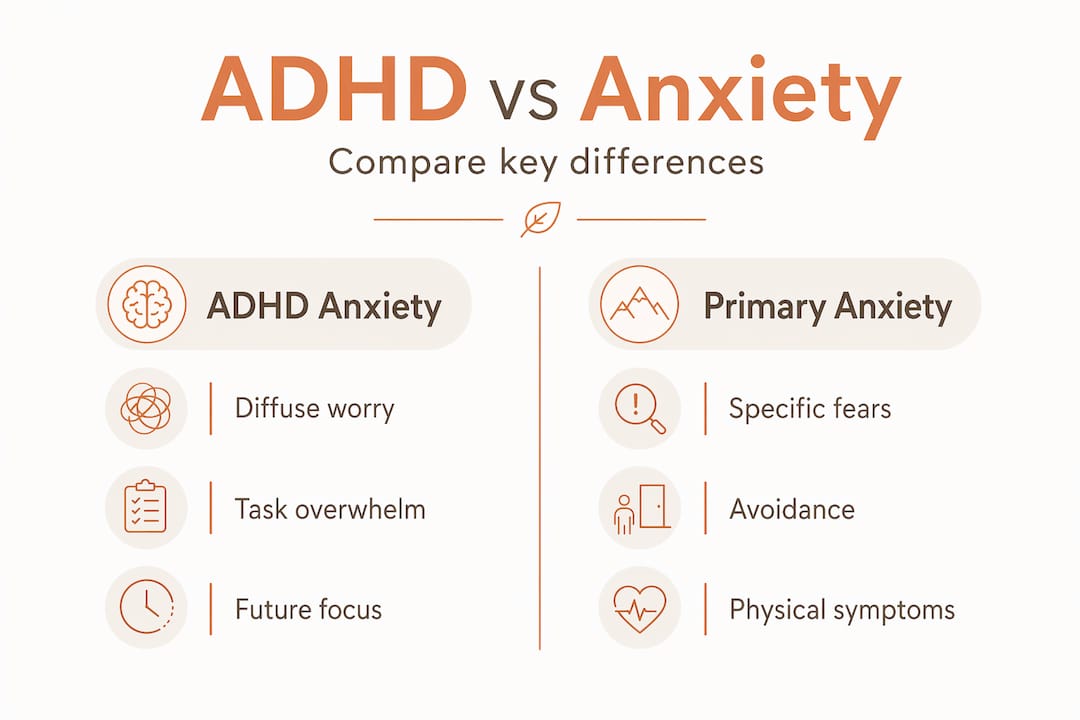
ADHD avoidance is generally caused by task initiation failure and cognitive overwhelm, whereas anxiety avoidance is driven by fear and dread. This is a key clinical distinction. A person with ADHD who avoids a task isn’t usually afraid of it. They simply cannot get their brain to start it.
Primary anxiety disorders often feature physical symptoms that feel very bodily and acute. Anxiety before a presentation might involve a pounding heart and difficulty breathing. ADHD-related distress before a presentation more commonly looks like an inability to prepare, last-minute chaos, and a sense of time collapsing.
Adults who have masked their ADHD for years can develop what is sometimes called secondary anxiety. Years of excessive compensatory effort create a persistent state of hypervigilance and emotional burnout that is real anxiety, but it wouldn’t exist without the underlying ADHD driving it. You can explore more about ADHD vs. anxiety distinctions and how they are evaluated clinically.
How ADHD and anxiety compound each other
Understanding ADHD and anxiety as separate conditions is useful. Understanding how they fuel each other is where things get clinically significant.
Up to 70% of adults with ADHD have a comorbid condition, with anxiety being one of the most common. That’s not a coincidence. The same executive dysfunction that drives ADHD makes people more vulnerable to developing anxiety over time.
Here’s how the cycle typically unfolds:
- ADHD causes missed deadlines, forgotten responsibilities, and difficulty managing relationships.
- Those outcomes create real consequences and social friction.
- The brain learns to anticipate failure and begins generating anxiety as a preparatory response.
- That anxiety then further impairs working memory and concentration, making ADHD symptoms worse.
Adults with anxiety and untreated ADHD suffer greater functional impairment and more frequent setbacks compared to those with either condition alone. Work performance suffers. Relationships become strained. Self-esteem takes repeated hits, which in turn feeds both the anxiety and the ADHD-related emotional dysregulation.
Pro Tip: If you notice that your anxiety seems to spike specifically around tasks, deadlines, and organization, rather than social situations or health concerns, that pattern is worth discussing with a clinician. It may point to ADHD as the primary driver.
Medication choices also carry real consequences when both conditions are present. Stimulant medication for ADHD can sometimes worsen anxiety, while antidepressants prescribed for anxiety might not address ADHD’s core deficits at all. This is why treating one condition without evaluating for the other often provides only partial relief. For a deeper look at how comorbid presentations are managed clinically, the resource on comorbid ADHD and anxiety offers useful context.
Practical steps for self-awareness and getting the right support
Coping with ADHD and anxiety effectively starts with clarity about what you’re actually dealing with. Here is a practical sequence for moving from confusion to understanding.
-
Track your symptoms with specificity. For two weeks, write down when you feel anxious, overwhelmed, or distracted. Note what triggered it, what time it happened, and what you were trying to do. Patterns in that log will reveal whether your distress is task-triggered (pointing toward ADHD) or threat-triggered (pointing toward anxiety).
-
Look for the signs of adult ADHD beyond inattention. Most people think ADHD only means distraction. Emotional sensitivity, chronic lateness, impulsive decisions, and poor follow-through on intentions are equally telling.
-
Seek a comprehensive psychiatric evaluation. A clinician who evaluates for both conditions simultaneously is far more likely to give you an accurate picture than one who addresses only the presenting complaint. Self-diagnosis has limits, especially when symptoms overlap this significantly.
-
Be honest about your history. ADHD symptoms typically begin in childhood, even if they weren’t recognized. Primary anxiety can develop at any point. Sharing your full history with a clinician, including school performance, relationships, and how long symptoms have been present, gives them critical diagnostic information.
-
Recognize that effective treatment may need to address both. Treating ADHD effectively often resolves secondary anxiety more than treating anxiety alone. But when a true anxiety disorder co-exists, both need direct attention. Expect treatment to be a process of adjustment, not a single fix.
-
Practice self-care that supports both conditions. Regular sleep, aerobic exercise, and reducing caffeine intake help regulate both the executive system and the threat-response system. These aren’t cures, but they lower the baseline load your brain is carrying.
My take on the overlap, and why diagnosis is harder than it looks
I’ve spent years reading case files, reviewing evaluations, and talking with people who came in certain they had anxiety, only to leave with an ADHD diagnosis, or vice versa. What strikes me most is how often people have been living with the wrong explanation for their own experience.
The most common pattern I see is someone who has been treated for generalized anxiety disorder for years with modest results. They’re highly functional, very organized, but exhausted all the time. They’ve built elaborate systems to manage their life, and those systems are working, but at an enormous personal cost. When you look closer, the anxiety is real, but it’s secondary. The scaffolding they built to manage undiagnosed ADHD created the anxiety.
The other pattern I see is the opposite: someone with a clear anxiety disorder who also has attention difficulties, and everyone assumes the anxiety is causing the focus problems. Treating the anxiety helps somewhat, but the focus problems persist. That’s usually the signal that ADHD is also in the picture.
My honest view is that the label matters less than the understanding behind it. What matters is knowing which symptoms are driving the most impairment and starting there. Patience with the diagnostic process isn’t just a virtue. It’s clinically necessary. Rushing to a single explanation often means years more of partial treatment.
If you’re reading this and recognizing yourself in multiple places, that’s not a sign you’re confused. It’s a sign you’re paying attention to something genuinely complex.
— Jamie
Getting the right support through Journeymhw
If you’ve been trying to figure out whether what you’re experiencing is ADHD, anxiety, or both, you don’t have to sort through it alone. At Journeymhw, we specialize in exactly this kind of nuanced evaluation. Our virtual psychiatric care is available in Texas and Colorado, and our clinicians are trained to assess overlapping conditions together, not in isolation.
Whether you’re exploring ADHD treatment in Texas, looking into anxiety treatment options, or simply not sure where to start, Journeymhw offers a structured, accessible path to clarity. You can start an evaluation from home, without long waits or complicated referrals. See the full range of conditions we treat and take the first step toward understanding what’s actually driving your symptoms.
FAQ
Why do ADHD and anxiety feel the same?
ADHD and anxiety produce overlapping symptoms because both affect attention, emotional regulation, and physical calm, but through different brain mechanisms. ADHD disrupts the prefrontal cortex’s ability to regulate and plan, while anxiety overstimulates the amygdala’s threat response.
Can ADHD cause anxiety?
Yes. ADHD frequently leads to secondary anxiety because ongoing executive dysfunction creates real consequences like missed deadlines and relationship strain, which the brain learns to anticipate with dread. Up to 70% of adults with ADHD have a comorbid mental health condition, and anxiety is among the most common.
How do I know if my anxiety is from ADHD or a separate disorder?
If your anxiety centers on tasks, organization, and deadlines rather than specific feared outcomes or social situations, ADHD may be the primary driver. A comprehensive psychiatric evaluation is the most reliable way to distinguish between the two.
Does treating ADHD help with anxiety?
Treating ADHD effectively often reduces secondary anxiety significantly, more so than treating anxiety alone in cases where ADHD is the root cause. When a true co-occurring anxiety disorder is present, both conditions typically need direct treatment for full relief.
Can you have both ADHD and an anxiety disorder at the same time?
Absolutely. Research shows that at least 50% of people with ADHD also have a co-occurring anxiety disorder. Having both is the rule for many adults, not the exception, which is why accurate, integrated evaluation and treatment planning matter so much.