

What Is Non-Stimulant ADHD Treatment? Your Clear Guide
If you’ve been exploring options beyond Adderall or Ritalin, you’ve probably asked yourself what is non-stimulant ADHD treatment and whether it actually works. The short answer: yes, it does. Non-stimulant ADHD treatment refers to a category of prescription medications and evidence-based therapies that address ADHD symptoms without activating the central nervous system the way stimulants do. These options matter because not everyone responds well to stimulants, and some people actively need to avoid them. This guide covers the types, mechanisms, benefits, and practical steps to help you have a more informed conversation with your provider.
Table of Contents
- Key Takeaways
- What non-stimulant ADHD treatment actually means
- Benefits and clinical considerations
- Non-pharmacological options that support ADHD management
- Practical guidance for choosing and managing your treatment
- My perspective on non-stimulant treatment
- How Journeymhw supports your non-stimulant ADHD care
- FAQ
Key Takeaways
| Point | Details |
|---|---|
| Non-stimulants are real medications | Non-stimulant ADHD medications are FDA-approved prescription drugs, not just lifestyle changes or supplements. |
| Different brain mechanism | They target norepinephrine signaling rather than flooding the brain with dopamine and norepinephrine simultaneously. |
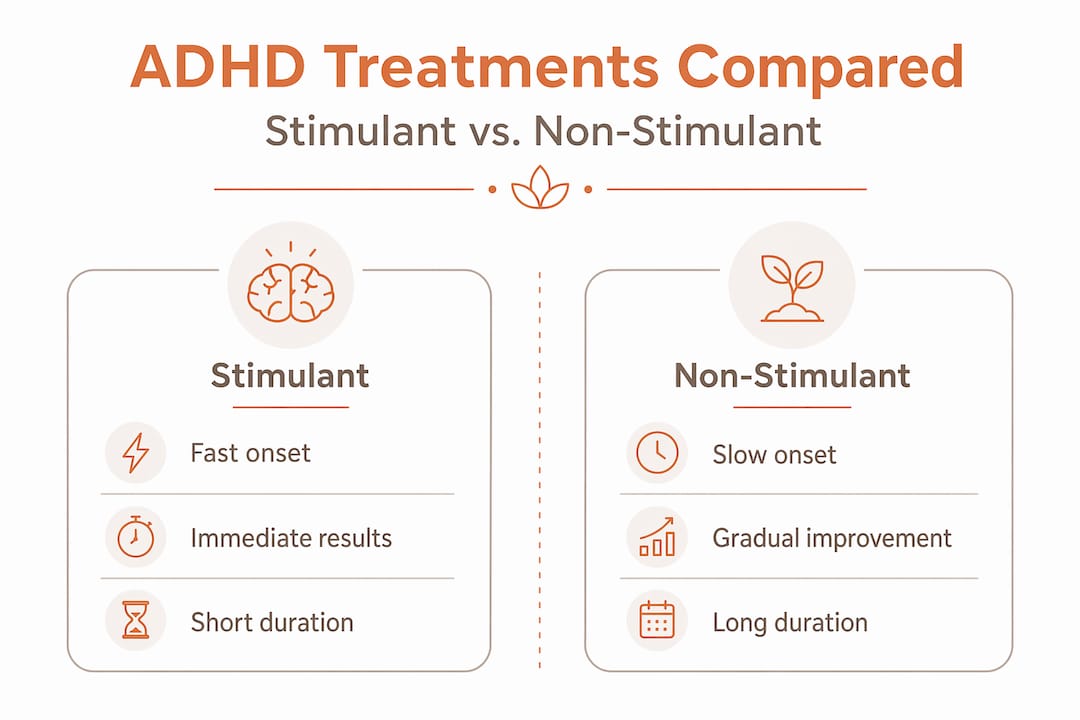
| Slower onset, longer coverage | Non-stimulants typically take 2–6 weeks to reach full effect but provide more consistent symptom coverage throughout the day. |
| Suited for specific situations | They are often preferred when stimulants cause side effects, when misuse risk is present, or when comorbid conditions complicate care. |
| Best used in combination | Combining medication with behavioral approaches like CBT produces stronger outcomes than either alone. |
What non-stimulant ADHD treatment actually means
There is a widespread misconception that “non-stimulant” means non-medication, or that it refers to lifestyle strategies like exercise and mindfulness. It does not. Non-stimulant medications are prescription drugs that act on the brain’s norepinephrine pathways without producing the stimulant effects associated with amphetamines or methylphenidate. This distinction matters because conflating the two can lead adults to underestimate how clinically effective these medications can be.
The two primary classes are:
- Norepinephrine reuptake inhibitors (NRIs): Atomoxetine (Strattera) and viloxazine extended-release (Qelbree) belong here. They work by blocking the reuptake of norepinephrine in the prefrontal cortex, the part of your brain most responsible for attention, impulse control, and working memory.
- Alpha-2 adrenergic agonists: Guanfacine extended-release (Intuniv) and clonidine extended-release (Kapvay) fall into this group. They bind to alpha-2 receptors in the prefrontal cortex and reduce excessive neuronal firing, which improves attention and reduces hyperactivity.
What separates these from stimulants is the mechanism, not the goal. Stimulants rapidly increase both dopamine and norepinephrine. Non-stimulants act more selectively on norepinephrine signaling and do so without producing a stimulant effect or the accompanying “peak and crash” pattern many people experience with short-acting stimulant formulations.
Beyond these FDA-approved non-stimulants, off-label options like bupropion and tricyclic antidepressants exist as third-line choices. These have longer histories of use in psychiatry but less robust ADHD-specific evidence compared to atomoxetine or viloxazine.
Pro Tip: If your provider mentions “non-stimulant,” ask specifically whether they mean a norepinephrine-based medication or an adjunctive drug. The conversation becomes much more productive when you both know exactly what category you are discussing.
Benefits and clinical considerations
Understanding the benefits of non-stimulant treatment helps you recognize when they are the right choice rather than a fallback option. Several situations make non-stimulants a strong first consideration rather than a second-line option.

| Factor | Stimulants | Non-stimulants |
|---|---|---|
| Onset of action | 30–60 minutes | 2–6 weeks for full effect |
| Duration of coverage | 4–12 hours depending on formulation | 24 hours with extended-release formulations |
| Addiction potential | Present (Schedule II controlled substances) | None. No addictive properties |
| Best suited for | Acute symptom control, flexible dosing | Comorbid anxiety, substance misuse history, intolerance to stimulants |
| Common side effects | Appetite suppression, insomnia, increased heart rate | Fatigue, nausea, mild sedation (guanfacine), headache (viloxazine) |
Atomoxetine was approved in 2002 and remains the most studied non-stimulant for adults. Viloxazine extended-release received FDA approval in 2021 and shows clinical benefit within 2–3 weeks with common side effects including insomnia and headache. Guanfacine and clonidine extended-release were approved in 2009 and 2010 respectively and are used either as standalone treatments or as adjuncts to stimulants.
One honest clinical note: atomoxetine is less well tolerated than placebo in some adult populations, meaning side effects are real and need to be monitored closely. This does not mean you should avoid it. It means working with a provider who will titrate your dose carefully and check in regularly.
On dosing: atomoxetine typically starts at 40 mg daily, increasing to 80 mg after three days, with a maximum of 100 mg per day. Guanfacine extended-release starts at 1 mg once daily and can be adjusted to a maximum of 4 mg per day. Slow titration within these ranges is not optional. It is how you minimize side effects and stay on the medication long enough to actually evaluate whether it helps.
Pro Tip: Give any non-stimulant medication a full 4–8 weeks before concluding it isn’t working. Slow titration within the approved dose range is what separates a well-managed trial from a failed one.
Non-pharmacological options that support ADHD management
These approaches are not non-stimulant medications. They are behavioral, psychological, and neurological tools that work alongside medications or serve as the primary strategy when someone chooses to manage symptoms without any prescription drugs. Knowing the difference matters for setting realistic expectations.
Evidence-based non-pharmacological approaches for adults with ADHD include:
- Cognitive Behavioral Therapy (CBT): The most studied behavioral intervention for adults. CBT addresses the thought patterns, avoidance behaviors, and organizational deficits that medication alone does not fully correct. It is particularly effective when paired with any medication regimen.
- Mindfulness-based interventions: Mindfulness training improves attention regulation and emotional reactivity in adults with ADHD. The benefits are modest on their own but meaningful as part of a broader treatment plan.
- Neurofeedback: This technique trains brain activity patterns through real-time feedback. Evidence is growing but still considered supplemental rather than a replacement for medication.
- Transcranial magnetic stimulation (TMS) and other neurostimulation: Still in earlier stages of research for ADHD specifically, but emerging findings suggest potential benefits for treatment-resistant cases.
Research from the University of Southampton found that non-drug interventions show more consistent benefits in clinician-rated outcomes than in patient self-reports. That gap matters. Your own experience of feeling better may lag behind what a clinician observes, or vice versa. Both perspectives are valid and worth tracking.
For those exploring ADHD management without medication, these approaches can be meaningful, especially when combined with structured support.
Practical guidance for choosing and managing your treatment
Making a real decision about non-stimulant ADHD options requires more than reading about medication names. It requires a plan. Here is a practical framework for adults and caregivers navigating this process.
-
Start with a comprehensive evaluation. Symptoms, history, comorbid conditions, and substance use history all shape whether a stimulant or non-stimulant is the better starting point. You can explore attention evaluations to understand what that process looks like.
-
Set realistic goals with your provider. Understand what “working” means before you start. Is it better focus at work? Reduced impulsivity at home? Clearer working memory? Specific goals make it much easier to track whether the medication is doing its job.
-
Track symptoms across multiple sources. Clinician and self-rated outcomes often differ. Use both a structured self-report tool and clinician check-ins to get a complete picture. Apps, journals, or even a simple weekly note can make a significant difference over time.
-
Discuss the option of combining stimulants and non-stimulants. Non-stimulants can be used as adjunctive therapy alongside stimulants, allowing lower stimulant doses and more consistent coverage throughout the day. This is a clinically supported strategy, not a workaround.
-
Ask your provider these three questions: What are we measuring to know this is working? What side effects should I report immediately? At what point do we reconsider the approach?
-
Know your timeline. Non-stimulants are not fast. If you expect results within a few days and do not get them, you may stop a medication that would have helped if given adequate time. Understanding the expected 4–8 week window upfront protects you from premature decisions.
Understanding how treatment improves daily function for adults is one of the most useful frames for evaluating whether your current approach is on the right track.
Pro Tip: Bring a written list of your top three daily impairments to every provider appointment. It focuses the conversation and creates a baseline for tracking real improvement.
My perspective on non-stimulant treatment
By Jamie
I’ve spent years watching adults with ADHD dismiss non-stimulants before giving them a real trial. Usually, the story goes the same way: stimulants didn’t work or caused problems, someone suggests a non-stimulant, and the person assumes it must be a weaker or less serious option. That assumption costs people months of unnecessary suffering.
What I’ve learned is that equal consideration of both treatment paths is not just good clinical practice. It is essential. Stimulants are not inherently superior. They are faster, yes. But for adults with anxiety, a history of misuse, or significant cardiovascular concerns, a well-managed atomoxetine or guanfacine regimen can produce better overall function with fewer complications.
The other thing I consistently see underestimated is the power of pairing any medication with behavioral work. Medication creates capacity. CBT and structured habits fill that capacity with actual skills. Neither alone does what both can do together.
Looking ahead, research into neurotransmitter targets beyond norepinephrine is genuinely exciting. We may be a decade away from non-stimulant medications with faster onset and better tolerability profiles. But the options available right now are already more effective than most people realize. Give them the time and structure they require.
— Jamie
How Journeymhw supports your non-stimulant ADHD care
Finding the right ADHD treatment takes more than a prescription. It takes a provider who listens, evaluates thoroughly, and adjusts as your needs change. That is exactly what Journeymhw is built to provide.
At Journeymhw, we offer telehealth-based ADHD evaluations and medication management for adults in Texas and Colorado, including personalized treatment plans that account for both stimulant and non-stimulant options. Whether you are newly diagnosed, reconsidering a current medication, or looking for a provider who takes a whole-person approach, we are here. Our ADHD treatment in Texas and ADHD treatment in Colorado services give you structured psychiatric care from the convenience of your home, with online prescriptions and follow-up support built in. You deserve a treatment plan that fits your life. We are here to help you build one.
FAQ
What is non-stimulant ADHD medication exactly?
Non-stimulant ADHD medications are FDA-approved prescription drugs, including atomoxetine, viloxazine, guanfacine, and clonidine, that improve ADHD symptoms by targeting norepinephrine signaling without stimulating the central nervous system.
How long does a non-stimulant ADHD medication take to work?
Most non-stimulants require 2–6 weeks to reach full clinical effect, which is significantly longer than stimulants. Titrating the dose slowly within the approved range improves tolerability and gives the medication the time it needs.
Who is a good candidate for non-stimulant ADHD options?
Adults with a history of substance misuse, sensitivity to stimulant side effects, comorbid anxiety, or cardiovascular concerns are often better candidates for non-stimulant medications than those who tolerate stimulants well.
Can non-stimulants be used with stimulants?
Yes. Non-stimulant medications like guanfacine extended-release are clinically used as adjunctive therapy alongside stimulants, which can lower the required stimulant dose while extending consistent symptom coverage throughout the day.
Are natural ADHD treatments enough on their own?
Non-pharmacological approaches like CBT and mindfulness can meaningfully reduce symptoms, particularly when used alongside medication. For most adults, they work best as part of a broader treatment plan rather than as a standalone approach.