

ADHD Symptom Checklist: A Guide to Screening for ADHD
An ADHD symptom checklist is a brief screening tool that lists DSM-based symptoms of inattention and hyperactivity-impulsivity to help you recognize patterns that might point to ADHD. It’s not a diagnosis. Clinicians use frameworks like the DSM-5 and the Adult ADHD Self-Report Scale (ASRS) as the actual diagnostic standard, and a checklist only tells you whether it’s worth having that conversation.
Here’s what a checklist does and doesn’t do:
- It flags patterns worth discussing with a licensed professional, not a condition you can confirm on your own.
- It borrows its language from DSM-5, so the items you check reflect real diagnostic criteria, not guesswork.
- A high score means one thing: if you’re marking off multiple symptoms that have lasted six months or longer and are affecting your work, relationships, or daily function, the next move is a professional evaluation. Not a Google search. Not another quiz.
Key Takeaways
An ADHD symptom checklist screens for patterns worth a clinical conversation, but only a full evaluation against DSM-5 criteria confirms a diagnosis.
| Point | Details |
|---|---|
| Checklist role | It flags possible ADHD symptoms for discussion; it never replaces a clinical evaluation. |
| Adult threshold | DSM-5 requires five or more symptoms lasting six months, starting before age 12. |
| ASRS Part A | Four or more shaded responses on the six-item Part A signals a screener worth following up. |
| Watch for confounders | Anxiety, depression, and poor sleep can mimic ADHD symptoms and need ruling out. |
| Prepare for evaluation | Bring your checklist, concrete examples of impairment, and prior mental health records. |
Table of Contents
- What Is an ADHD Symptom Checklist Measuring?
- What Is the ASRS v1.1 and Why Does Part A Matter?
- How Do You Score and Interpret a Symptom Checklist?
- When Should You See a Professional, and What Should You Bring?
- Who’s Behind This Guide, and Where Can You Get Evaluated?
- How Reliable Are ADHD Symptom Checklists, Really?
- What Other ADHD Checklists Exist Besides the ASRS?
- Do Symptoms Look Different Across Gender and Culture?
- How Do Checklists Differ for Kids Versus Adults?
- What Should You Actually Take Away From a Symptom Checklist?
- Frequently Asked Questions
- Sources
What Is an ADHD Symptom Checklist Measuring?
A checklist built on DSM-5 criteria splits symptoms into two domains: inattention and hyperactivity-impulsivity. For adults, the wording shifts from the child-oriented examples (squirming in a classroom seat) to real adult situations, but the underlying criteria are the same ones the CDC and NIMH reference.
Inattention items typically include:
- Making careless mistakes at work or missing details on tasks you’d normally catch.
- Trouble sustaining attention during meetings, reading, or long conversations.
- Not listening closely even when someone is speaking directly to you.
- Failing to follow through on instructions, leaving projects half finished.
- Poor organization, missed deadlines, and a habit of losing track of your own belongings.
- Avoiding tasks that require sustained mental effort, like paperwork or long reports.
- Losing items you need daily, such as keys, your phone, or your wallet.
- Getting distracted by unrelated thoughts or your surroundings mid task.
- Forgetting appointments, bills, or errands without reminders.
Hyperactivity-impulsivity items for adults look less like bouncing off the walls and more like:
- A restless, “on edge” feeling even when you’re sitting still.
- Difficulty staying seated in situations that call for it, like long meetings.
- Talking excessively or feeling like you can’t slow your speech down.
- Interrupting others or finishing their sentences before they’re done.
- Trouble waiting your turn, whether in line or in conversation.
- Blurting out answers or reactions before fully thinking them through.
- Feeling driven by an inner motor, as if you’re always “on.”
- Making impulsive decisions, like large purchases or job changes, without weighing consequences.
- Intruding on others’ conversations or activities without being invited.
These map to three recognized presentations: predominantly inattentive, predominantly hyperactive-impulsive, and combined presentation, where both symptom clusters show up. Most adults diagnosed later in life land in the inattentive or combined category, since childhood hyperactivity often settles into internal restlessness rather than visible fidgeting.
Pro Tip: Don’t just check boxes. Next to each symptom you mark, jot one specific example from the past month. “Poor organization” becomes concrete when you write “missed the mortgage payment because I forgot it existed.” That detail is exactly what a clinician will ask you for anyway.
What Is the ASRS v1.1 and Why Does Part A Matter?
The Adult ADHD Self-Report Scale (ASRS-v1.1) is an 18-item screening tool developed with input from the World Health Organization and Harvard Medical School researchers, and it’s one of the most widely used self-report checklists in adult ADHD screening. Most people finish it in about five minutes.
The tool splits into two parts:
- Part A contains the six most predictive items, covering things like finishing details on projects, organizing tasks, and remembering appointments.
- Part B includes the remaining 12 items, which add clinical detail but carry less predictive weight on their own.
Clinicians frequently use Part A alone as a rapid screener, because those six questions carry most of the diagnostic signal in the full instrument. The scoring convention flags a response pattern of four or more answers in the shaded, higher-frequency range as a signal that “symptoms may be consistent with ADHD in adults,” according to the tool’s own scoring guide.
A positive Part A result is a prompt, not a verdict. It tells you and your clinician that a full diagnostic interview is worth scheduling, the same way a positive result on the six predictive items is treated in practice: as a reason to dig deeper, never as a stand-alone diagnosis.
How Do You Score and Interpret a Symptom Checklist?
Filling out a checklist well takes more discipline than it looks like. Rushing through it, or answering based on a particularly bad week, skews the results in ways that don’t hold up under clinical review.
- Answer for the past six months, not the past few days. ADHD criteria require persistence, and a rough week at work isn’t the same as a chronic pattern.
- Think across settings. Note whether each symptom shows up at work, at home, in relationships, or in social situations. DSM-5 requires impairment in two or more settings, not just one context where things happen to be stressful right now.
- Count your symptoms honestly. Adults need at least five symptoms from either domain (or both) to meet the DSM-5 threshold, compared to six for children, and those symptoms need to trace back before age 12.
- Watch for confounders. Anxiety, depression, sleep deprivation, and even certain medications can produce symptoms that look a lot like ADHD, from poor concentration to restlessness. A clinician’s job is to sort out which condition is actually driving what you’re experiencing, and that’s a job a checklist alone cannot do.
Pro Tip: If your scores look high but you’re also dealing with a major life stressor, a new medication, or chronic sleep loss, mention that up front. It changes how a clinician weighs your results, and it saves you a second round of questions.
When Should You See a Professional, and What Should You Bring?
Certain patterns are worth acting on rather than monitoring further. If your checklist shows five or more persistent symptoms, clear interference with work or relationships, and a history that traces back to childhood, it’s time to book an evaluation rather than wait for things to improve on their own.
Different providers offer different pieces of the puzzle:
- Psychiatrists can diagnose ADHD and manage medication, often the most direct path for adults who suspect they’ll need treatment.
- Psychologists typically handle diagnostic testing and therapy, sometimes working alongside a prescriber.
- Primary care providers can screen and refer, though many prefer to hand off diagnosis and medication management to a specialist.
Walk in prepared. Bring your completed checklist, specific examples of missed deadlines or strained relationships, any prior mental health records, and a list of medications or therapies you’ve tried. Concrete examples move an evaluation forward faster than vague impressions.
Who’s Behind This Guide, and Where Can You Get Evaluated?
This guide draws on DSM-5 criteria and the ASRS v1.1 screening framework to keep the checklist above grounded in the same standards clinicians actually use, not a simplified internet version of them.
- Jamie, who covers ADHD diagnostic frameworks and testing processes for Journeymhw, wrote this guide with an emphasis on matching checklist language to clinical criteria.
- Journeymhw provides telehealth psychiatric evaluations and ongoing ADHD treatment for adults, built around the same diagnostic thresholds referenced throughout this piece.
- If you want the full picture of what an evaluation involves, Journeymhw’s guide to the ADHD testing process walks through what happens after you screen positive.
- Because anxiety so often mimics ADHD symptoms, it’s worth reading how the two conditions overlap in adults before you assume a high checklist score means ADHD alone.
How Reliable Are ADHD Symptom Checklists, Really?
Checklists built on DSM-5 language and validated instruments like the ASRS carry real clinical weight, but that reliability has limits worth understanding before you put too much faith in a single score.
The ASRS v1.1 was developed and tested with input from the World Health Organization and Harvard researchers, which is part of why it’s become a standard screening tool rather than a homemade quiz. Its structure, six predictive items in Part A backed by 12 additional items in Part B, reflects years of validation work aimed at identifying which questions actually predict a later ADHD diagnosis. That’s meaningfully different from a checklist someone assembled from general symptom descriptions without testing which items separate ADHD from ordinary distraction or stress.
Reliability breaks down at the edges, though. Self-report tools depend on the person answering honestly and accurately, and adults often underreport childhood symptoms simply because they don’t remember them clearly. That’s part of why clinicians sometimes ask about school records or talk to parents when confirming that symptoms started before age 12, rather than relying solely on adult recall.
No checklist, however well validated, replaces a comprehensive evaluation that looks at history, functioning across settings, and other conditions that might explain the same symptoms. Treat a strong checklist result as a well-supported hunch, not a verified fact.
What Other ADHD Checklists Exist Besides the ASRS?
The ASRS v1.1 dominates adult self-screening, but it’s far from the only tool clinicians and researchers use. Several other checklists show up regularly in clinical settings, each with a slightly different focus.
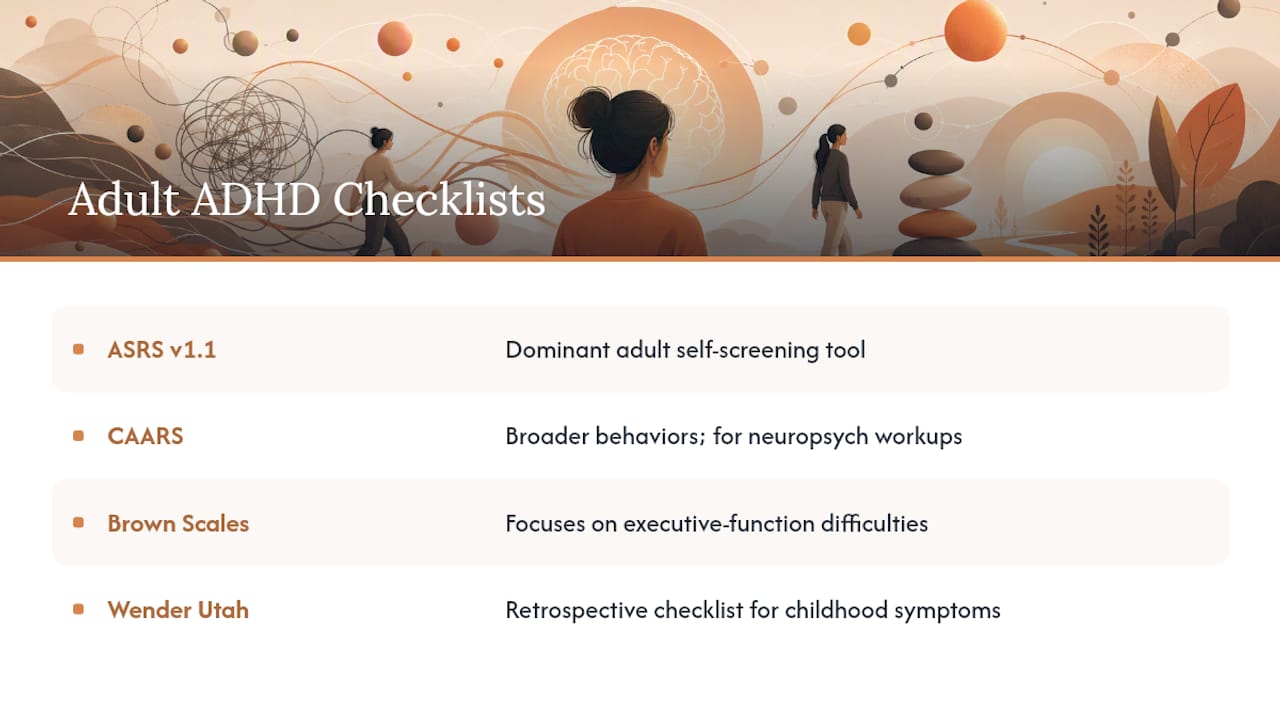
The Conners’ Adult ADHD Rating Scales (CAARS) cover a broader set of behaviors than the ASRS and are often used in more formal neuropsychological workups rather than quick self-screening. The Brown Attention-Deficit Disorder Scales focus heavily on executive function difficulties, things like organizing tasks and regulating emotion, which fits the adult presentation Mayo Clinic describes as problems with time management and organization rather than obvious hyperactivity. The Wender Utah Rating Scale takes a retrospective approach, asking adults to recall childhood symptoms specifically, which helps address that before-age-12 requirement DSM-5 builds into the diagnosis.
None of these compete with DSM-5 itself, which remains the actual diagnostic standard behind every one of these instruments. They’re different lenses on the same underlying criteria, built for slightly different clinical purposes: some faster, some more detailed, some more focused on childhood recall than current function. If a clinician hands you an instrument you haven’t seen before, it’s likely one of these rather than something invented on the spot.
Do Symptoms Look Different Across Gender and Culture?
Symptom checklists assume a fairly universal presentation of ADHD, but the way symptoms show up, and get noticed, varies more than most checklists account for.
Women and girls are frequently underdiagnosed because their ADHD symptoms tend to lean inattentive rather than hyperactive. Internal restlessness, daydreaming, and quiet disorganization don’t draw the same attention that a fidgety, disruptive presentation does, so those symptoms get chalked up to anxiety or personality rather than flagged for evaluation. That pattern feeds directly into a broader issue: symptoms that overlap with anxiety and depression are exactly the confounders a checklist can’t sort out on its own.
Cultural context matters too. What counts as “excessive talking” or “restlessness” carries different social weight depending on cultural norms around communication style, directness, and behavior in professional settings. A symptom that reads as impairing in one cultural context might be unremarkable in another, and clinicians trained to recognize this nuance will ask about context rather than taking a checkbox at face value.
None of this means checklists are useless across these groups. It means a low score on a standard checklist shouldn’t be treated as reassurance if your own experience says otherwise, particularly if you’re a woman whose inattentive symptoms have gone unnamed for years, or someone whose cultural background shapes how your symptoms present to others.
How Do Checklists Differ for Kids Versus Adults?
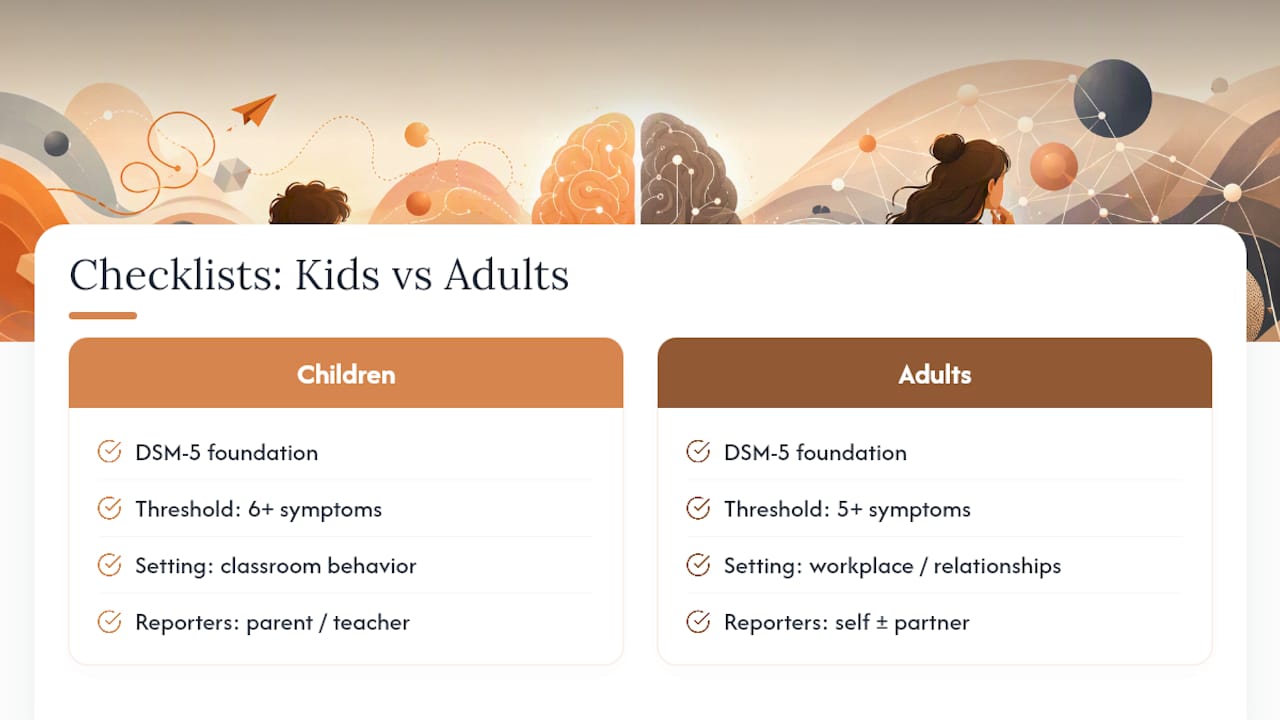
Child and adult ADHD checklists share the same DSM-5 foundation, but the threshold and the wording shift in ways that matter.
Children need six or more symptoms from either domain to meet the diagnostic threshold, compared to five for adults aged 17 and older, a distinction the NIMH lays out directly. That’s not because adult ADHD is “milder.” It reflects the fact that adults have often developed coping strategies that mask some symptoms, so the bar accounts for that adaptation.
The wording itself changes too. Child-focused checklists describe classroom behavior: leaving a seat during class, running or climbing excessively, difficulty playing quietly. Adult checklists like the ASRS translate those same underlying criteria into workplace and relationship terms: fidgeting during meetings, feeling restless during downtime, interrupting conversations. Instruments like the Vanderbilt ADHD Diagnostic Rating Scale and the Conners’ Rating Scales for children are built specifically for parent and teacher reporting, since young children often can’t self-report reliably.
That’s an important distinction for parents screening a child versus adults screening themselves: a child’s checklist typically involves input from a parent or teacher who can observe behavior across settings, while an adult checklist relies mostly on self-report, sometimes supplemented by a partner or close family member’s perspective. If you’re trying to trace your own symptoms back to childhood for a DSM-5 evaluation, that’s often the moment old school records or a parent’s memory become useful evidence.
Ready to move from checklist to answers? Journeymhw’s ADHD treatment program offers virtual psychiatric evaluations for adults in Texas and Colorado, with medication management and structured care plans built around the same DSM-5 criteria this guide references. If you’re also weighing whether anxiety might be part of the picture, a resource like this family mental health checklist is a useful starting point for framing that conversation with people close to you. When you’re ready to take the next step, you can book an evaluation directly.
What Should You Actually Take Away From a Symptom Checklist?
Most advice on ADHD checklists treats them as either a party trick, “take this quiz and find out if you have ADHD,” or dismisses them entirely as internet noise. Both miss what’s actually useful here. A checklist built on DSM-5 wording and validated against instruments like the ASRS is a legitimate clinical tool. It’s just a tool with one job: starting the right conversation.
The piece people skip past is Part A’s predictive weight. Clinicians don’t wade through all 18 ASRS items with equal attention. Six questions carry most of the signal, and if you’re going to spend five minutes on self-reflection, spend it there. The rest is context.
What I’d prioritize differently than most guides: stop treating your score as a verdict and start treating your specific examples as the real data. “I score high on inattention” tells a clinician almost nothing. “I missed three deadlines this quarter and forgot my anniversary” tells them everything they need to start a real evaluation.
Frequently Asked Questions
What is an ADHD symptom checklist used for? It’s a self-report tool that lists DSM-5-based symptoms of inattention and hyperactivity-impulsivity, helping you identify patterns worth discussing with a clinician. It’s a starting point for conversation, not a diagnostic result on its own.
How many symptoms indicate ADHD in adults? Adults aged 17 and older generally need at least five symptoms of inattention and/or hyperactivity-impulsivity, persisting for six months, with onset before age 12, per DSM-5 criteria. Children need six or more.
What does a high score on the ASRS mean? A pattern of four or more higher-frequency responses on Part A’s six items suggests symptoms consistent with adult ADHD, according to the screener’s own guidance. That result should prompt a full clinical evaluation, not a self-diagnosis.
Can anxiety or depression cause a false positive on an ADHD checklist? Yes. Poor concentration, restlessness, and disorganization show up in anxiety, depression, and sleep deprivation as well as ADHD. A clinician’s job during evaluation is distinguishing which condition, or combination of conditions, is actually driving your symptoms.
Are checklists different for children and adults? Yes. Children need six or more qualifying symptoms rather than five, and checklist wording shifts from classroom behavior to adult contexts like work performance and relationships. Child checklists also often rely on parent or teacher input rather than self-report alone.
When should I see a professional about my checklist results? If you’re marking five or more persistent symptoms that interfere with work, relationships, or daily function, and you can trace some of this back to childhood, it’s time to schedule an evaluation with a psychiatrist, psychologist, or primary care provider rather than continue self-screening.
This article is general information, not a substitute for advice from a qualified doctor. Consult a qualified healthcare professional about your own circumstances before acting on anything here.
Sources
- Attention-Deficit/Hyperactivity Disorder: What You Need to Know - NIMH
- Adult attention-deficit/hyperactivity disorder (ADHD) - Mayo Clinic