

What Is a Mental Health Care Pathway? A 2026 Guide
A mental health care pathway is a standardized, multidisciplinary system that guides a patient through coordinated care, from the moment of referral all the way through treatment and discharge. Think of it as the institutional blueprint that answers three questions for every provider involved: who does what, when, and how. According to the National Council for Mental Wellbeing, care pathways map ideal patient steps and assign responsibility, including workflows and criteria for communications and outcome monitoring.
At its core, a mental health care pathway includes:
- Clinical workflows such as screening, therapy protocols, and prescribing guidelines
- Administrative steps including documentation, billing, and data review
- Interprofessional responsibilities that clarify which provider acts at each stage
- Treatment sequencing that moves patients through care in a logical, evidence-based order
The pathway’s goal is straightforward: improve care coordination, reduce gaps between services, and produce better outcomes for the people it serves.
Table of Contents
- Why do mental health care pathways exist?
- What are the key stages of a mental health care pathway?
- Who is involved in a mental health care pathway?
- How does a care pathway differ from an individual treatment plan?
- What are the real benefits of using care pathways?
- What does a mental health care pathway look like in practice?
- How do care pathways support culturally sensitive, patient-centered care?
- How do care pathways improve continuity across services?
- Journeymhw offers structured virtual care for ADHD, anxiety, and depression
- Key Takeaways
Why do mental health care pathways exist?
Care pathways exist because fragmented care causes real harm. When providers operate in silos, patients fall through the cracks between referrals, appointments, and follow-ups. A structured pathway solves this by standardizing who, what, and when across every touchpoint in the patient’s care.
The primary objectives of a mental health care pathway include:
- Delivering timely interventions at the right level of care intensity
- Establishing clear responsibilities so no step is left to assumption
- Supporting interdisciplinary communication between all providers
- Reducing duplication of services, which lowers cost and patient burden
- Engaging patients and families as active participants in care decisions
Pro Tip: The most effective pathways are recovery-oriented and personalized. Standardized guidelines should serve as a flexible framework, not a rigid script, so each patient’s strengths, preferences, and cultural context can shape how the pathway unfolds.
What are the key stages of a mental health care pathway?
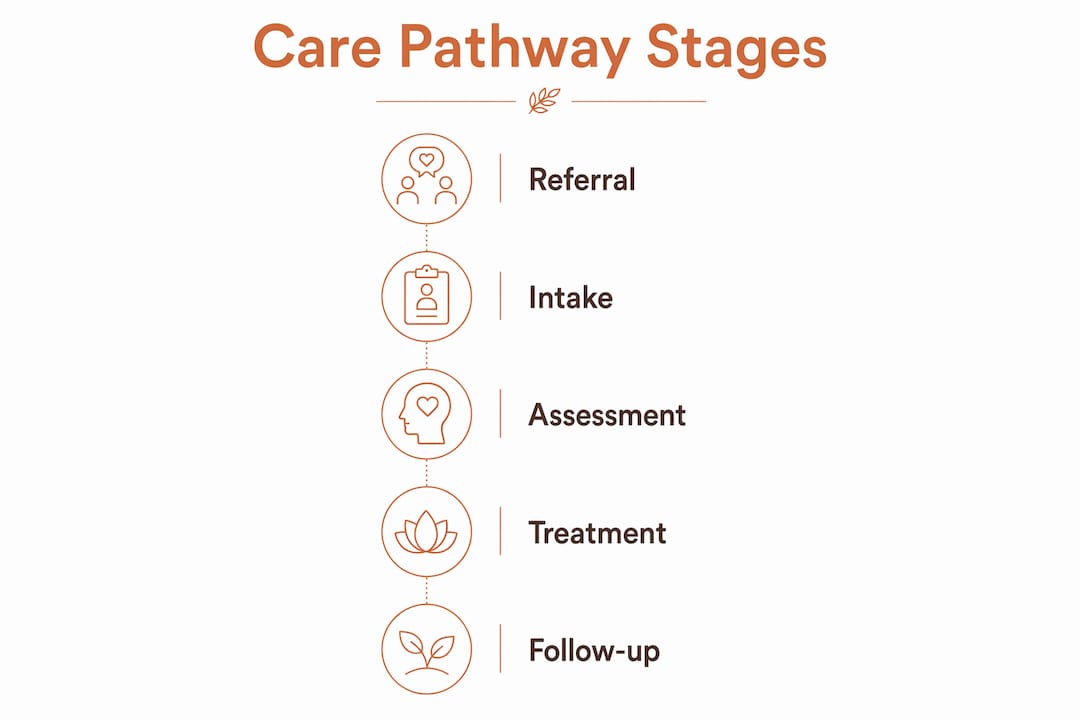
Care pathways typically encompass intake, assessment, treatment, monitoring, discharge, and transitions to foster continuity of care. Each stage carries specific clinical and administrative tasks.
- Intake: Initial referral is received, eligibility is confirmed, and the patient is connected to the right level of care.
- Assessment: Clinicians use validated screening tools to evaluate symptom severity, functioning, and risk factors.
- Diagnosis: A formal diagnosis is established, forming the clinical basis for all subsequent decisions.
- Treatment: Evidence-based interventions begin, whether therapy, medication management, or a combination, with defined targets for improvement.
- Monitoring: Progress is tracked against those targets on a regular schedule, and the care plan adjusts when progress stalls.
- Discharge: Clear criteria determine when a patient is ready to step down or exit the pathway.
- Transitions: Handoffs to primary care, community services, or other providers are coordinated to prevent relapse or loss of contact.
A care pathway workflow includes clinical, financial, and administrative steps, ensuring efficient, value-driven care delivery across all health needs. Documenting each stage in a standardized format is what makes the pathway replicable and measurable.
Who is involved in a mental health care pathway?
Mental health professionals collaborating in a care pathway include psychiatrists, psychologists, counselors, nurses, social workers, general practitioners, and case managers. Each brings a distinct function.
- Psychiatrists manage diagnosis, medication evaluation, and complex clinical decisions.
- Psychologists and licensed counselors deliver evidence-based therapies such as cognitive behavioral therapy.
- Nurses monitor physical health, administer medications, and support patient education.
- Social workers address social determinants of health, connect patients to community resources, and coordinate family involvement.
- Case managers oversee care coordination, track progress across providers, and manage transitions.
- General practitioners (GPs) often serve as the entry point, making referrals and maintaining oversight of overall health.
- Family members and caregivers play a supporting role, particularly in recovery planning and crisis prevention.
Coordination between onsite staff and offsite providers is built into the pathway structure, so information sharing happens reliably rather than by chance. You can learn more about what to expect at your first mental health appointment and how the care process typically unfolds.
How does a care pathway differ from an individual treatment plan?
This distinction matters more than most people realize. Confusing the two can undermine how effectively both tools work.
A care pathway is the system-level framework. It defines the institutional process, the sequence of services, the criteria for moving between stages, and the responsibilities of each provider type. It applies to a defined population of patients with similar conditions.
A mental health treatment plan, by contrast, is a personalized, patient-level document. As Valant’s clinical resources describe it, a treatment plan contains a specific diagnosis, SMART goals, and a timeline created within the care pathway. It is built collaboratively between the clinician and the patient, and it evolves as progress is made or circumstances change.
Put simply: the care pathway is the system map from referral to discharge; the treatment plan is the dynamic, individual document focused on personal goals and progress updates.
Key distinction: Treatment plans must comply with HIPAA and state confidentiality laws, and they contain clear goals and review schedules required for payer authorization. Without a compliant treatment plan inside the pathway, insurance reimbursement is at risk.
For a deeper look at how these two tools work together, Journeymhw’s guide on mental health treatment plans explains the structure in plain terms.
What are the real benefits of using care pathways?
Care pathways help patients and families navigate services more easily, reduce workload through less duplication, and encourage effective communication across the care team. For providers, the benefits are equally concrete.
- Improved coordination means fewer dropped handoffs between services.
- Standardized workflows reduce variability in care quality across different providers or locations.
- Patients experience less confusion about what comes next in their care.
- Families are more engaged when the pathway makes their role explicit.
- Ongoing monitoring creates a feedback loop that catches problems early.
Care pathways also require continuous review and iterative improvement to maintain value-based care and reduce overall care intensity over time. A pathway that was designed two years ago and never updated is not serving its patients as well as it could.
What does a mental health care pathway look like in practice?
A concrete example makes the structure easier to grasp. Consider a patient referred by their primary care physician for moderate depression.

Under a structured care pathway, the process might look like this: the referral triggers an intake call promptly, where a care coordinator confirms eligibility and schedules an initial psychiatric evaluation. At that evaluation, a validated tool such as the PHQ-9 is used to assess symptom severity. A diagnosis is established, and a personalized treatment plan is created with SMART goals, such as reducing symptom severity within a defined timeframe.
The patient begins a combination of medication management and weekly therapy. At the four-week mark, a scheduled check-in reviews progress against the target. If the patient is not improving, the pathway protocol triggers a medication review or an increase in therapy frequency. At discharge, the pathway specifies a follow-up call within two weeks and a warm handoff to a community support group.
This sequence is not improvised. Every step, every timeline, and every responsibility is defined in advance, which is precisely what makes it a pathway rather than a loosely coordinated series of appointments. Personalized therapy approaches that incorporate flexible, recovery-focused care within this kind of structure tend to produce the strongest outcomes.
How do care pathways support culturally sensitive, patient-centered care?
Successful care pathways are recovery-oriented and personalized while using standardized guidelines for flexible, patient-centered care. Standardization and personalization are not opposites here. The pathway sets the structure; the patient’s identity, values, and preferences shape how that structure is applied.
Patient-centered care pathways build in specific practices to honor this balance. Patients are involved in setting their own recovery goals. Cultural and linguistic needs are assessed at intake and factored into provider matching and communication styles. Family members or nominated support persons are included when the patient chooses. Shared decision-making is embedded at every stage where treatment options exist.
In the United States, where racial and ethnic disparities in mental health access are well-documented, culturally responsive pathways are not optional. A pathway that does not account for a patient’s background, language, or community context will produce worse engagement and worse outcomes.
How do care pathways improve continuity across services?
Mental health care rarely happens in one place. A patient might see a psychiatrist, a therapist, a primary care physician, and a peer support specialist, sometimes in the same week. Without a coordinating structure, each of those providers operates with incomplete information.
A care pathway solves this by defining care coordination between onsite staff and offsite providers to ensure information sharing and smooth transitions of care. Transition protocols specify what information must be communicated, to whom, and by when, whether that is a discharge summary sent to a GP or a warm handoff call to a community program.
The result is a care experience that feels connected rather than fragmented, which matters enormously for patients managing conditions like ADHD, anxiety, or depression across multiple providers and settings.
Journeymhw offers structured virtual care for ADHD, anxiety, and depression
Knowing how a mental health care pathway works is the first step. Taking action within one is the next.
Journeymhw is a telehealth platform built around exactly this kind of structured, coordinated care. We specialize in virtual psychiatric evaluations and medication management for ADHD, anxiety, and depression, with care plans designed to move you through a clear process rather than leaving you to figure out the next step on your own. Appointments are available quickly, the process is straightforward, and you can access care from home in Texas or Colorado.
If you have been trying to understand how mental health care is supposed to work, and you want to experience a process that actually follows through on that structure, book your first appointment with Journeymhw today.
Key Takeaways
A mental health care pathway is the system-level framework that coordinates every provider, stage, and handoff in a patient’s care, while the individual treatment plan is the personalized document that lives inside it.
| Point | Details |
|---|---|
| Care pathway definition | A standardized, multidisciplinary system guiding patients from referral through discharge across all providers. |
| Seven core stages | Intake, assessment, diagnosis, treatment, monitoring, discharge, and transitions form the pathway’s backbone. |
| Pathway vs. treatment plan | The pathway is the institutional framework; the treatment plan is the patient-level, SMART-goal document within it. |
| Cultural responsiveness | Effective pathways build patient values, language needs, and family involvement into every stage, not as an add-on. |
| Journeymhw | Offers structured virtual care for ADHD, anxiety, and depression with clear care pathways and fast appointment access. |
Recommended
- Your guide to navigating mental health treatment options – Journey Mental Health
- The Benefits of Virtual Mental Health Care for Depression, Anxiety and ADHD your guide – Journey Mental Health
- Affordable Mental Health Care Access: Your Practical Guide – Journey Mental Health
- What Is a Mental Health Treatment Plan? – Journey Mental Health