

What Happens During an ADHD Diagnostic Test
An ADHD diagnostic test is a structured clinical evaluation, not a single scan or blood draw, designed to confirm whether your symptoms meet the criteria set by the DSM-5-TR. The process draws on interviews, standardized rating scales, medical exams, and input from people who know you well. Clinicians follow guidelines from the American Psychiatric Association and the CDC to rule out other causes and confirm that symptoms appear across multiple areas of your life. Understanding what happens during an ADHD diagnostic test removes the uncertainty and helps you show up prepared.
What happens during an ADHD diagnostic test?
An ADHD diagnostic test is a multi-step clinical evaluation that gathers evidence from several sources before any diagnosis is made. No single interview, questionnaire, or brain scan can confirm ADHD on its own. Diagnosis relies on convergent clinical assessment using interviews, rating scales, and collateral information. That convergence is what makes the process reliable.
The evaluation typically unfolds across these core steps:
- Clinical interview. Your clinician asks about your current symptoms, how long they have been present, and how they affect your daily life at home, work, or school.
- Developmental and childhood history. You will be asked about early school performance, behavior reports, and whether symptoms were present before age 12.
- Standardized rating scales. You complete validated questionnaires such as the ASRS, Conners, Vanderbilt, or Brown scales. These tools quantify symptom severity and create a documented baseline.
- Medical examination. A physical exam, including hearing and vision tests, rules out sensory or medical conditions that can mimic ADHD symptoms.
- Collateral information. Your clinician may contact or request written input from a parent, partner, teacher, or employer to confirm symptoms across settings.
- Neuropsychological testing (when needed). Some evaluations include cognitive tasks that measure memory, attention, and processing speed.
Pro Tip: Bring a written summary of your symptoms, including specific examples from work or school, to your first appointment. Clinicians rely on concrete behavioral evidence, not general impressions.
A thorough evaluation spans multiple appointments and several hours of total assessment time. Quick, single-session diagnoses are less reliable and more likely to miss co-occurring conditions.

How does the ADHD diagnostic criteria work in practice?
The DSM-5-TR sets the clinical standard that every clinician follows during the evaluation. Understanding these criteria helps you see why each part of the process exists.
The core requirements are:
- Duration. Symptoms must be present for at least 6 months with significant functional impairment.
- Age of onset. Evidence of symptoms must exist before age 12, even if the diagnosis comes in adulthood.
- Symptom count for adults. Adults 17 and older must show at least 5 symptoms in either the inattentive or hyperactive/impulsive cluster.
- Multiple settings. Symptoms must appear in two or more environments, such as home and work, not just one context.
- Functional impairment. Symptoms must cause measurable problems in daily life, not just occasional difficulty.
- Differential diagnosis. The clinician must rule out anxiety, depression, sleep disorders, and learning disabilities that share overlapping symptoms.
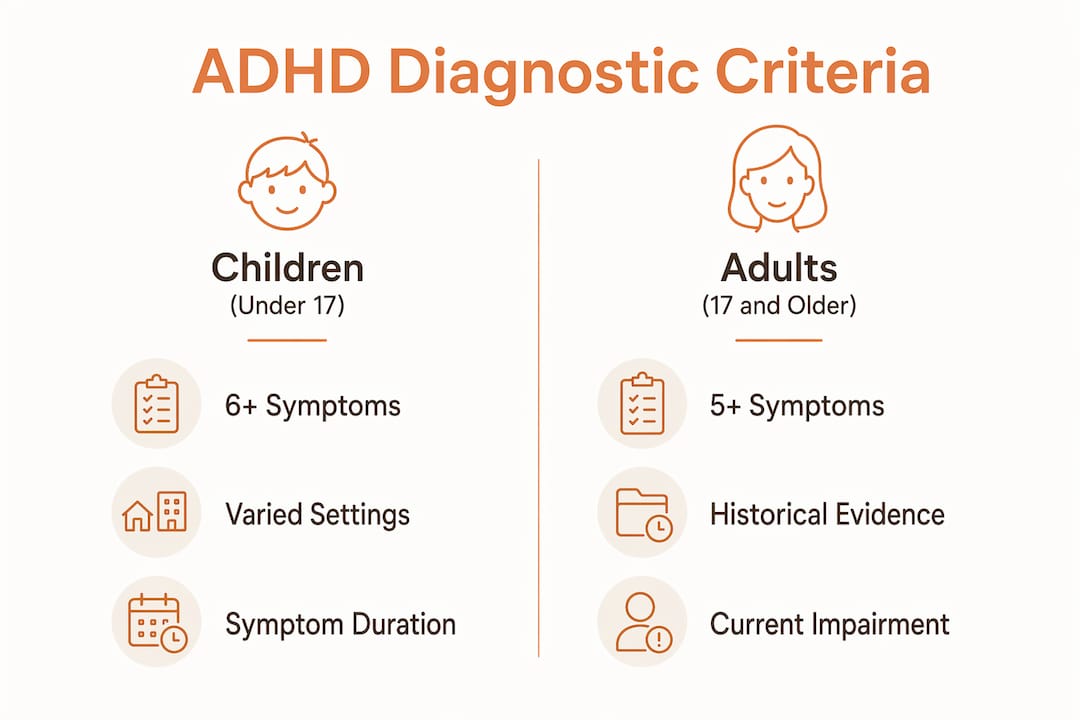
The table below shows how the criteria apply differently by age group.
| Criteria | Children (under 17) | Adults (17 and older) |
|---|---|---|
| Symptom count required | 6 or more per cluster | 5 or more per cluster |
| Age of onset | Before age 12 | Before age 12 (confirmed by history) |
| Duration | At least 6 months | At least 6 months |
| Settings required | Two or more | Two or more |
| Informant input | Parents and teachers | Partners, employers, or family |
Ruling out other conditions is not a detour in the process. It is a safeguard that protects you from a misdiagnosis and ensures the treatment plan actually fits your needs. The overlap between ADHD and anxiety is one of the most common diagnostic challenges clinicians face.
What is neuropsychological ADHD testing and when is it used?
Neuropsychological testing is a specialized component that some evaluations include when the clinical picture is unclear. It measures cognitive functions directly linked to ADHD, including working memory, processing speed, sustained attention, and executive function. These tests help distinguish ADHD from learning disabilities, traumatic brain injury, or other cognitive conditions that produce similar symptoms.
Common tasks used in neuropsychological evaluations include:
- Continuous performance tests. These measure how well you sustain attention over a set period and flag response patterns associated with inattention or impulsivity.
- Working memory tasks. These assess how much information you can hold and manipulate in your mind at once.
- Processing speed measures. These evaluate how quickly and accurately you complete simple cognitive tasks under timed conditions.
- Executive function batteries. These test planning, cognitive flexibility, and inhibition, which are core areas of difficulty in ADHD.
Neuropsychological testing complements clinical interviews and rating scales but does not replace them. A clinician who relies only on cognitive test scores without a full clinical interview is not following best practice. The test results add a layer of objective data, especially when a patient’s self-report and collateral input conflict.
Pro Tip: Ask your clinician upfront whether neuropsychological testing is included in your evaluation. If your case involves a possible learning disability or prior head injury, request it specifically.
What should you expect during the ADHD testing process?
Expect the full evaluation to take several hours spread across more than one appointment. A single 30-minute visit is not a complete ADHD assessment. The process is thorough by design because accuracy depends on depth.
Here is what a typical evaluation sequence looks like:
- Intake session. You complete intake forms covering your medical history, current medications, mood, sleep, and substance use. Bring any prior records, school reports, or previous psychological evaluations.
- Structured clinical interview. Your clinician asks detailed questions about childhood behavior, academic performance, relationships, and work history. Expect this to take 60 to 90 minutes.
- Rating scale completion. You fill out standardized questionnaires. A family member, partner, or close colleague may be asked to complete a separate version independently.
- Medical review. Your clinician reviews your physical health, current medications, and any conditions that could explain your symptoms.
- Feedback session. After all data is gathered, your clinician reviews findings with you, explains the diagnosis or lack of one, and outlines next steps.
Bringing a trusted person who knows you well to at least one appointment can significantly strengthen the accuracy of your evaluation. Clinicians weigh collateral input heavily because ADHD symptoms are often more visible to others than to the person experiencing them.
Common pitfalls to avoid include underreporting symptoms because you have learned to compensate, or focusing only on current struggles without connecting them to childhood patterns. Clinicians need the full picture to apply the DSM-5-TR criteria accurately. If you are concerned about common misdiagnoses like anxiety or depression being confused with ADHD, raise that directly with your evaluator.
Key Takeaways
An accurate ADHD diagnosis requires convergent evidence from clinical interviews, standardized rating scales, medical review, and collateral input across multiple settings.
| Point | Details |
|---|---|
| No single test confirms ADHD | Diagnosis relies on multiple sources: interviews, rating scales, medical exams, and collateral input. |
| DSM-5-TR sets the standard | Adults need 5 or more symptoms lasting at least 6 months, with onset before age 12. |
| Ruling out mimics is required | Anxiety, depression, and sleep disorders must be excluded before an ADHD diagnosis is confirmed. |
| Neuropsychological testing is optional | It adds cognitive data in complex cases but does not replace the clinical interview. |
| Preparation improves accuracy | Bringing records, examples, and an informed collateral contact strengthens the evaluation. |
Why a thorough ADHD evaluation is worth the time
I have seen what happens when people accept a rushed diagnosis. They get a treatment plan built on incomplete information, and when it does not work, they blame themselves instead of the process. A proper evaluation takes time because ADHD is a clinical syndrome defined by behavioral patterns, not a lab finding. There is no biological marker that confirms it, which means the quality of the diagnosis depends entirely on the quality of the information gathered.
The part most people underestimate is the differential diagnosis step. Anxiety, depression, and sleep deprivation can all look like ADHD on the surface. Skipping that step does not speed up care. It redirects you toward the wrong treatment. I have found that patients who come in with written examples of their symptoms, school records, and a willing collateral contact get far more accurate results than those who rely on memory alone during a single session.
My honest advice: push back if a clinician offers a diagnosis after one short appointment without rating scales or collateral input. A thorough evaluation protects you. It is the foundation everything else is built on.
— Jamie
Getting an ADHD evaluation through Journeymhw
Journeymhw offers structured psychiatric evaluations for ADHD conducted by experienced clinicians who apply DSM-5-TR criteria across every assessment. The process covers clinical interviews, standardized rating scales, and differential diagnosis to give you a clear, accurate picture of what is driving your symptoms.
Whether you are seeking an ADHD evaluation and treatment plan or looking for care specific to your state, Journeymhw provides virtual appointments in Texas and Colorado with quick scheduling and no long waitlists. Patients in Texas can access focused attention evaluations designed to match the full diagnostic standard. If you are ready to get a clear answer about your symptoms, Journeymhw makes the next step straightforward.
FAQ
What does an ADHD diagnostic test actually involve?
An ADHD diagnostic test involves a clinical interview, standardized rating scales such as the ASRS or Conners, a medical exam, and collateral input from people who know you well. No blood test or brain scan can confirm ADHD.
How long does an ADHD evaluation take?
A thorough ADHD evaluation typically spans several hours across multiple appointments. Single-session diagnoses are generally incomplete and less reliable.
Can adults be diagnosed with ADHD if symptoms started in childhood?
Yes. Adults can receive an ADHD diagnosis as long as there is evidence that symptoms were present before age 12, even if the formal evaluation happens decades later.
What is the difference between ADHD testing in adults vs. children?
Adults require at least 5 symptoms in either the inattentive or hyperactive/impulsive cluster, while children under 17 require 6 or more. Collateral input for adults typically comes from partners or employers rather than parents and teachers.
Does neuropsychological testing always happen during an ADHD evaluation?
Neuropsychological testing is not required for every evaluation. Clinicians use it when the diagnosis is unclear or when a co-occurring learning or cognitive disorder needs to be ruled out.