

What Causes ADHD Executive Dysfunction: 2026 Guide
ADHD executive dysfunction is defined as a neurological impairment in the brain’s ability to plan, initiate, and regulate goal-directed behavior, caused primarily by disrupted dopamine and norepinephrine signaling in the prefrontal cortex. This is not a character flaw or a motivation problem. It is a measurable difference in how the brain’s command center communicates with itself. Understanding what causes ADHD executive dysfunction gives adults with ADHD, parents, and educators a clearer path toward realistic support, accurate diagnosis, and effective treatment.
What causes ADHD executive dysfunction at the neurological level?
The root cause of ADHD executive function issues lies in the prefrontal cortex and its connections to the striatum, a network known as the prefrontal-striatal pathway. This circuit governs working memory, impulse control, planning, and attention regulation. When dopamine and norepinephrine signaling in this circuit is disrupted, the entire system underperforms.
In ADHD brains specifically, dopamine transporters clear dopamine too quickly, preventing the sustained prefrontal activation needed to stay focused on low-stimulation tasks. The result is not a steady attention deficit but an erratic one. People with ADHD can hyperfocus intensely on high-interest tasks while struggling to initiate routine ones. This inconsistency is a direct product of unstable dopamine availability, not inconsistent effort.

Norepinephrine plays an equally important role. It modulates signal-to-noise ratio in the prefrontal cortex, helping the brain filter distractions and hold relevant information in mind. When norepinephrine signaling is weak, the brain treats irrelevant stimuli as equally important as the task at hand. This explains why a person with ADHD can be derailed by a sound, a passing thought, or a minor discomfort that others would filter out automatically.
ADHD brains also show elevated theta-beta ratios and impaired Default Mode Network suppression, both measurable via EEG and fMRI. The Default Mode Network is the brain’s “idle” state. In neurotypical brains, it shuts down during focused tasks. In ADHD brains, it intrudes during task performance, producing the mind-wandering episodes that disrupt sustained attention.
Pro Tip: If you or someone you support has ADHD, understanding that attention lapses are neurological events, not choices, changes how you respond to them. Frustration and pressure rarely improve performance because they do not fix the underlying dopamine signaling problem.
How ADHD executive dysfunction shows up in daily life
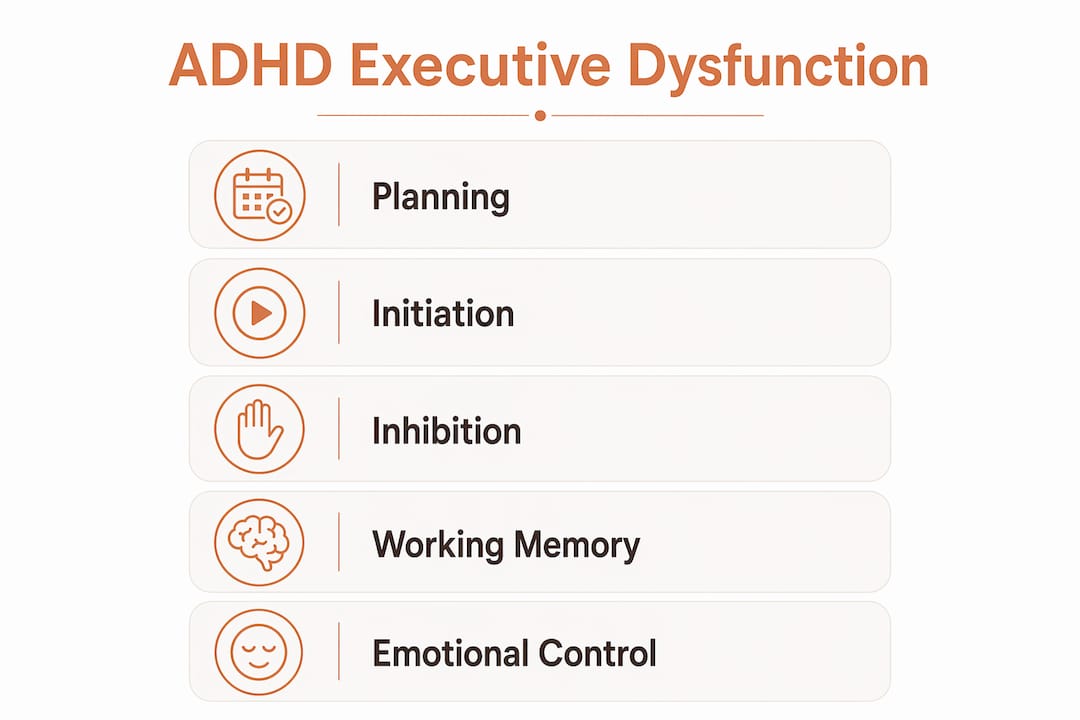
Executive dysfunction in ADHD impairs at least five core systems, each of which creates distinct and recognizable challenges in daily functioning. Recognizing these domains helps adults, parents, and educators respond with the right kind of support rather than the wrong kind of pressure.
-
Task initiation. Often called ADHD paralysis, this is the inability to start a task despite knowing it needs to be done. The brain does not generate the neurochemical signal required to shift from intention to action. A student who sits at their desk for an hour without opening a textbook is not being defiant. Their prefrontal cortex is not producing the activation needed to begin.
-
Working memory. Working memory functions like a mental whiteboard, holding information in mind while you use it. In ADHD, this whiteboard erases too quickly. A person may forget what they walked into a room to do, lose track of a conversation mid-sentence, or miss steps in a multi-part task. This is not forgetfulness in the traditional sense. It is a failure of active information maintenance.
-
Emotional regulation. Prefrontal cortex under-stimulation weakens the brain’s emotional brakes, causing intense and prolonged reactions to stress, criticism, or rejection. This is not a personality trait. A child who melts down over a minor change in plans, or an adult who feels devastated by a small piece of negative feedback, is experiencing a neurological response, not an overreaction.
-
Time perception. ADHD time blindness is the inability to perceive time as divisible into usable segments. People with ADHD often experience time as two states: now and not now. This causes chronic procrastination until a deadline becomes urgent enough to trigger a stress response that substitutes for dopamine-driven motivation.
-
Task switching and cognitive flexibility. Shifting from one task to another requires the prefrontal cortex to disengage from one context and re-engage with another. In ADHD, this transition is slow and effortful. A person may become stuck on an activity even when they want to stop, or struggle to adapt when plans change unexpectedly.
Each of these domains affects daily function in adults in ways that compound over time, affecting careers, relationships, and self-esteem.
Is executive dysfunction unique to ADHD?
Executive dysfunction is not exclusive to ADHD. It also occurs in autism, depression, anxiety, PTSD, and traumatic brain injury. This overlap is one reason accurate diagnosis matters so much. The same surface symptom, such as difficulty concentrating or completing tasks, can have very different underlying causes requiring very different treatments.
The table below outlines the key clinical differences between ADHD-related executive dysfunction and dysfunction arising from other conditions.
| Condition | Nature of executive dysfunction | Primary treatment approach |
|---|---|---|
| ADHD | Persistent neurological trait present across all emotional states | Stimulant medication, ADHD coaching, behavioral systems |
| Depression | Fluctuates with mood; improves as depression lifts | Antidepressants, psychotherapy |
| Anxiety | Driven by threat-focused rumination and avoidance | Cognitive behavioral therapy, anxiety-specific medication |
| PTSD | Linked to hypervigilance and trauma response patterns | Trauma-focused psychotherapy |
| Autism | Related to cognitive rigidity and sensory processing differences | Behavioral support, occupational therapy |
The most clinically significant distinction is that ADHD executive dysfunction is persistent, present regardless of emotional state, while mood disorder-related dysfunction fluctuates. An adult with depression may regain executive function when their mood stabilizes. An adult with ADHD will continue to struggle with task initiation and working memory even on their best days. This distinction directly shapes treatment decisions.
Understanding the overlap between ADHD and anxiety is particularly relevant because both conditions produce attention difficulties, yet the mechanisms differ enough that treating one without addressing the other produces incomplete results. Professional evaluation is the only reliable way to identify which condition, or combination of conditions, is driving executive function difficulties.
Why executive dysfunction is a performance problem, not a skill problem
One of the most important and least understood aspects of ADHD is this: ADHD is a deficit in reliably converting intentions into actions, not a deficit in knowing what to do. This distinction changes everything about how we support people with ADHD.
Most adults with ADHD know how to use a planner. They know they should break tasks into steps. They understand time management concepts. The problem is not knowledge. The problem is that the neurological system responsible for executing that knowledge does not fire consistently. On some days, with the right conditions, everything clicks. On other days, the same person cannot start a task they genuinely want to complete.
This is why willpower-based approaches fail. Telling someone with ADHD to “just try harder” is like telling someone with poor eyesight to “just look more carefully.” The underlying biology does not respond to effort alone. What does work is building external systems that compensate for the inconsistency of internal neurological processes.
Effective external scaffolding strategies include the following:
- Timers and time cues. Visual timers like Time Timer make time concrete and perceivable, directly compensating for time blindness.
- Environmental design. Placing materials in visible locations removes the working memory demand of remembering where things are.
- Body doubling. Working alongside another person, even silently, provides enough external stimulation to sustain prefrontal activation.
- Written checklists. Offloading task sequences to paper reduces the working memory load required to hold multi-step processes in mind.
- Structured routines. Automating recurring decisions reduces the number of times the prefrontal cortex must initiate action from scratch.
External scaffolding systems are not workarounds or crutches. They are legitimate compensatory tools that work precisely because they bypass the neurological bottleneck rather than demanding it perform differently.
Pro Tip: When building systems for someone with ADHD, prioritize visibility and simplicity. A checklist on the wall works better than an app buried in a phone. The best system is the one that requires the least executive function to use.
Key takeaways
ADHD executive dysfunction is a neurological condition rooted in disrupted dopamine and norepinephrine signaling, not a deficit in skill, effort, or motivation.
| Point | Details |
|---|---|
| Neurochemical root cause | Overactive dopamine transporters reduce prefrontal activation, causing attention lapses and task initiation failure. |
| Five impaired systems | Task initiation, working memory, emotional regulation, time perception, and task switching are all affected. |
| Persistent, not fluctuating | ADHD executive dysfunction is present across all emotional states, unlike mood disorder-related dysfunction. |
| Performance gap, not skill gap | People with ADHD know what to do but cannot reliably execute it due to inconsistent neurological signaling. |
| External systems work | Timers, checklists, and structured routines compensate for internal neurological inconsistency effectively. |
What working with executive dysfunction has taught me
I have spent years reading the clinical literature on ADHD and speaking with people who live with it every day, and the single most damaging misconception I encounter is that executive dysfunction reflects a lack of caring. Parents assume their child does not care about school. Employers assume an employee does not care about their job. Adults with ADHD internalize the message that they do not care enough about their own lives.
The neuroscience tells a completely different story. These individuals often care deeply. The problem is that caring, on its own, does not generate dopamine. And without dopamine, the prefrontal cortex cannot reliably execute the behaviors that would demonstrate that care to the outside world.
What I have found genuinely useful is shifting the conversation from “why won’t you do this” to “what would make this easier to start.” That reframe moves the focus from blame to design. It acknowledges the neurological reality and asks a practical question. The answer is almost always some form of external support: a visual cue, a shorter first step, a different environment, or a structured accountability system.
Compassion and structure are not opposites. The most effective support for ADHD executive dysfunction combines both. Understanding the neurobiology removes the stigma. Building practical systems addresses the functional gap. Neither alone is enough.
— Jamie
How Journeymhw supports adults with ADHD executive dysfunction
If you recognize these patterns in yourself, your child, or a student you support, the right next step is a professional evaluation. Understanding the cause is the foundation of effective treatment.

At Journeymhw, we provide virtual psychiatric evaluations, medication management, and personalized care plans for adults with ADHD in Texas and Colorado. Our structured process is designed to reduce delays and get you into treatment quickly. Whether you are seeking a diagnosis for the first time or looking to improve an existing treatment plan, we can help. Explore our ADHD treatment options to see how structured, evidence-based care can improve your daily functioning. You can also learn more about our full range of services at our mental health treatment page.
FAQ
What is the main cause of ADHD executive dysfunction?
ADHD executive dysfunction is caused by disrupted dopamine and norepinephrine signaling in the prefrontal cortex and prefrontal-striatal circuits. Overactive dopamine transporters clear dopamine too quickly, reducing the sustained activation the brain needs for planning, focus, and task initiation.
How does ADHD executive dysfunction differ from laziness?
ADHD executive dysfunction is a measurable neurological impairment, not a motivational failure. People with ADHD often know exactly what they need to do but cannot reliably convert that intention into action due to inconsistent dopamine signaling.
Can executive dysfunction occur without ADHD?
Yes. Executive dysfunction also occurs in depression, anxiety, autism, PTSD, and traumatic brain injury. The key difference is that ADHD-related dysfunction is persistent across all emotional states, while dysfunction from mood disorders tends to fluctuate with emotional condition.
Does medication fix ADHD executive dysfunction?
Stimulant medications like amphetamine salts and methylphenidate increase dopamine and norepinephrine availability in the prefrontal cortex, which directly addresses the neurochemical cause. Medication is often most effective when combined with behavioral systems and structured support.
What can parents and educators do to support executive dysfunction in ADHD?
The most effective approach is building external scaffolding: visual timers, written checklists, structured routines, and simplified task steps. These tools compensate for the neurological inconsistency rather than demanding the brain perform differently through willpower alone.