

Meet HIPAA's 30 Day Deadline to Move Psychiatric Records Online (U.S.)
The fastest lawful way to transfer psychiatric records online is through your provider’s secure patient portal or a signed authorization that directs a direct EHR-to-EHR exchange between providers. HIPAA requires a response within 30 calendar days, and psychotherapy notes are typically excluded from what gets sent unless you request them specifically and your provider agrees to release them.
TL;DR:
- Accurate completion of authorization forms with full personal details, specific records, and a clear recipient is crucial to avoid delays in record transfer.
- Secure provider-to-provider electronic exchanges and encrypted portals are the most protected methods, while unencrypted email is broadly discouraged.
- Most psychiatric records include diagnoses, treatment summaries, medication history, progress notes, and testing results, but psychotherapy notes are usually excluded unless explicitly requested.
- Requests are legally due within 30 days, with possible extensions, but processing time varies from same-day digital requests to several weeks for paper-based methods.
- State-specific laws may impose stricter rules on psychiatric records, especially for minors or substance-use treatment, requiring careful inquiry before submitting requests.
Table of Contents
- How Do You Request and Transfer Psychiatric Records Online?
- What Are the Secure Electronic Options for Sending Records?
- What Psychiatric Records Can You Actually Access?
- How Long Does It Take and What Does It Cost?
- Do Substance-Use Records Follow Different Rules?
- What If a Provider Delays or Refuses Your Request?
- Can You Correct Mistakes in Your Psychiatric Records?
- Do State Laws Add Extra Protections Beyond HIPAA?
- How Should You Handle Records Requests in an Emergency or Legal Case?
- What If Your Provider Doesn’t Offer Electronic Transfer?
- How Do You Verify Identity Before Records Get Sent?
- How Does a Telehealth Psychiatry Practice Typically Handle Incoming Records?
- Why the “Just Email It” Instinct Is the Wrong Reflex
- Sources
How Do You Request and Transfer Psychiatric Records Online?
Getting your psychiatric records moved from one provider to another comes down to paperwork accuracy and knowing who to send it to. Skip a field on the release form and you’ll be waiting weeks for a resubmission instead of days for a transfer.
Start by identifying who holds your records: the psychiatrist’s office, a hospital behavioral health department, or a telehealth platform. Call or check their website for a Record Release/Authorization form, or log into their patient portal if they offer one, since many practices now let you initiate the request digitally without ever calling the front desk.
Your authorization form needs specific details to avoid getting bounced back:
- Your full legal name and date of birth
- Exact dates of service for the records you’re requesting
- The specific records you want (full chart, medication history, discharge summary, testing results)
- The receiving party’s name, address, and preferred electronic format
- An expiration date for the authorization (most states cap this at one year)
- Your signature and the date
- A copy of your photo ID to verify identity
Once the form is complete, you have a few submission paths:
- Upload it directly through the provider’s patient portal if one exists
- Use a secure upload link the records department emails you
- Fax it with a cover sheet noting the number of pages and your contact information
- Send it by certified mail if the office only accepts paper originals
If you’re pulling records from more than one provider, submit separate requests to each rather than bundling them into one form. Keep a simple log with the date you sent each request, who you sent it to, and any confirmation number you received. That log becomes invaluable if a request stalls past the 30-day window.
What Are the Secure Electronic Options for Sending Records?
Not every digital method carries the same protection, and providers are increasingly strict about which ones they’ll accept. Patient portals and provider-to-provider EHR exchanges, sometimes powered by a “share code” or connectivity network between systems, remain the gold standard because the data moves through encrypted, authenticated channels the entire way. Healthit confirms that patients can generally access and share their records electronically through these federally recognized methods.
When a direct portal-to-portal connection isn’t available, acceptable alternatives include:
- Encrypted PDF attachments with a separately communicated password
- Password-protected download links that expire after a set time
- Secure file-transfer services designed for healthcare use
Standard, unencrypted email is discouraged industry-wide because it travels through multiple servers with no guaranteed protection. Some providers will refuse to send records that way unless you sign a written waiver acknowledging the risk. Compliancy Group’s overview of HIPAA-compliant document sharing lays out why encrypted portals and direct EHR exchange remain the preferred route to email attachments. Features like secure upload and share codes, common on modern telehealth platforms, make this step far less painful than it used to be.
Pro Tip: Before sending anything, ask the sender to confirm the file was encrypted and request a delivery confirmation once it lands with the recipient. That two-step check catches most transfer failures before they become a missing-records problem.
What Psychiatric Records Can You Actually Access?
Most requests return a fuller picture than people expect. Your designated record set typically includes:
- Diagnoses and treatment summaries
- Medication history and prescribing notes
- Progress notes from regular visits
- Psychological or cognitive testing results
- Hospitalization or discharge records
Psychotherapy notes are the exception. These are a therapist’s private process notes, kept separate from the main chart, and HHS is explicit that patients generally don’t have an automatic right to them under HIPAA. If you specifically need these notes, for a legal proceeding or a new therapist who wants deeper context, ask the practice directly whether they’ll release them and under what authorization. Providers can decline if disclosure might cause harm or if the notes were never meant to leave that clinician’s private files. Asking about this exception early, before you assume a full chart pull includes everything, saves a frustrating follow-up call later.
How Long Does It Take and What Does It Cost?
HIPAA gives covered entities 30 calendar days to provide access once you submit a valid request. If they need more time, they can take one 30-day extension, but only if they notify you in writing with a reason and a new expected date.
Fees are limited by design. Providers can charge a reasonable, cost-based amount for copying and delivery (think paper, postage, or the digital media used) but cannot bill you for the staff time spent searching for or retrieving your file.
Real-world timing varies more than the legal deadline suggests:
- Portal-based requests: often same-day to about a week
- Manual, paper-based processing: commonly two to six weeks depending on the office’s staffing and backlog
Document every request as you send it, and if you haven’t heard back after two weeks, a polite check-in call or email referencing your submission date keeps things moving without escalating too soon.
Do Substance-Use Records Follow Different Rules?
Yes, and this trips people up constantly. Records tied to substance-use disorder treatment often fall under 42 CFR Part 2, a federal rule stricter than standard HIPAA in some respects, requiring its own specific authorization language rather than a generic release form.
Before submitting anything to a facility that treated substance use alongside psychiatric care, ask their records office directly:
- Whether the records fall under Part 2 protections
- Which exact authorization form they require
- Whether a general HIPAA release will be rejected
Some state-run systems add another layer of complexity. New York’s PSYCKES system, for example, uses organizational access controls that differ from a typical private-practice release. If your care touched a state psychiatric information system, ask which agency actually holds the file before assuming your provider’s office can send it directly.
What If a Provider Delays or Refuses Your Request?
Start documenting from the moment you submit your first request. Keep copies of every release form, the date you sent it, the names of any staff you spoke with, portal confirmation screenshots, and any written denial you receive.
- At the two-week mark, send a brief follow-up referencing your original submission date and asking for a status update.
- If you’re past 30 days with no response or extension notice, request a written explanation for the delay.
- If the provider issues a formal denial you believe is improper, ask them to cite the specific HIPAA provision they’re relying on.
- If the issue remains unresolved, you can file a complaint with the HHS Office for Civil Rights, which oversees HIPAA compliance enforcement.
- For complex denials involving custody disputes, guardianship, or litigation, consult an attorney familiar with health information law.
Can You Correct Mistakes in Your Psychiatric Records?
Yes. HIPAA gives you the right to request an amendment if you believe something in your chart is inaccurate or incomplete, and this applies to psychiatric records the same way it applies to any medical file.
Submit your amendment request in writing to the provider who created the record, and be specific about what you want changed and why. Vague complaints like “this isn’t accurate” rarely move anywhere; a request that says “the visit note from March 3 lists a diagnosis that was later revised on March 20, and I’d like the record updated to reflect that” gives staff something concrete to act on.
The provider has 60 days to respond, with one 30-day extension allowed if they notify you in writing. They can accept the amendment, which means adding the correction while keeping the original entry intact (records aren’t erased, they’re supplemented), or deny it if they believe the record is accurate as written.
If they deny your request, you have the right to submit a written statement of disagreement, which becomes a permanent part of your file alongside the original entry. Any future disclosure of that record should include your statement. This matters more than people realize: if an inaccurate diagnosis or outdated medication note follows you into a new provider’s hands, your statement of disagreement travels with it and gives the next clinician context they’d otherwise miss.
Do State Laws Add Extra Protections Beyond HIPAA?
HIPAA sets the federal floor, but plenty of states layer on stricter protections for mental health records specifically, and these can affect how fast you get records or what authorization language is required.
Some states require a distinct, separate consent form for mental health or psychiatric records rather than allowing them to be swept into a general medical records release. Others set shorter response windows than HIPAA’s 30-day maximum, or place additional restrictions on redisclosure, meaning the provider receiving your records can’t automatically pass them along to a third party without your separate consent.
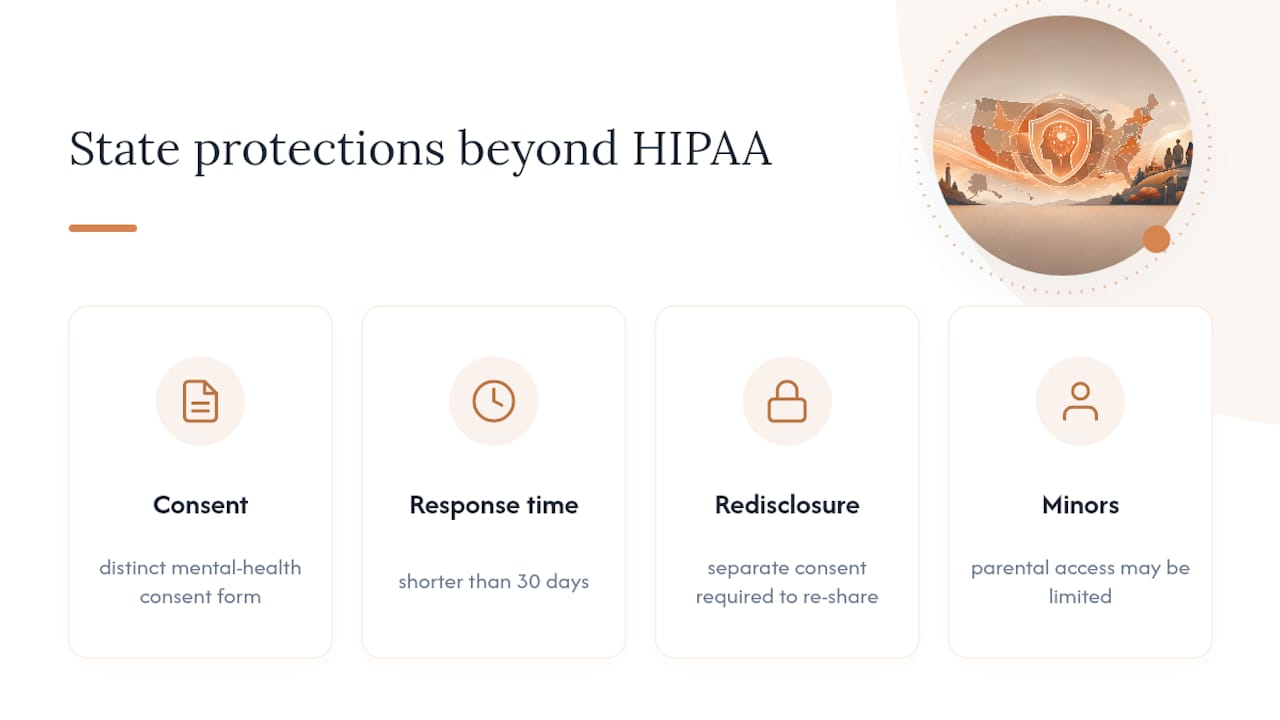
Minors’ records add another layer of variation. Depending on the state, a parent’s access to a teenager’s psychiatric records may be limited once the minor reaches a certain age or once certain types of treatment (like outpatient therapy sought independently) come into play.
Because these rules genuinely differ by state, the most reliable move is to ask the records office directly: “Does your state require anything beyond a standard HIPAA authorization for psychiatric records?” A records custodian who handles these requests daily will know immediately whether your state adds extra steps, and that one question can save you a rejected form and another 30-day wait.
How Should You Handle Records Requests in an Emergency or Legal Case?
Crisis situations change the calculus. If someone is in active danger, HIPAA permits providers to share relevant psychiatric information with treating clinicians, family members involved in care, or emergency personnel without a signed release, when doing so is necessary to prevent serious harm. If you’re the patient and able to communicate, still provide verbal consent when possible so the process moves faster.
Legal situations are different and slower by design. Court orders, subpoenas, and custody proceedings each carry their own authorization standards, and psychiatric records, especially psychotherapy notes, get extra scrutiny before release. A subpoena alone often isn’t enough; many providers will require a court order specifically compelling disclosure, or a signed authorization from the patient, before they release anything.
If you’re an authorized representative acting under a power of attorney or guardianship, bring the legal documentation establishing that authority along with your records request. Providers verify this carefully, and rightly so, since releasing psychiatric information to the wrong party is a serious liability for everyone involved. Build in extra time for legal requests: the verification step alone can add several days beyond the standard 30-day window.
What If Your Provider Doesn’t Offer Electronic Transfer?
Plenty of smaller practices and older clinicians still run on paper charts with no portal in sight. That doesn’t mean you’re stuck faxing forms into the void.
Start by asking directly whether they can scan and email an encrypted PDF, even if they don’t have a formal portal. Many offices can do this manually even without dedicated patient-facing technology. If that’s genuinely not an option, request that they mail a physical copy to your new provider’s records department rather than to you directly. This keeps the chain of custody clean and often satisfies the receiving provider’s intake requirements faster than a copy that passes through your hands first.
You can also ask your new, receiving provider for help. Practices that field this request often have relationships with legacy record-keeping systems and know exactly which form a specific hospital or clinic wants. Some care coordination teams will handle the outreach on your behalf once you’ve signed a release.
If a provider has closed entirely, records are usually transferred to a state medical board, a successor practice, or a commercial record-retrieval service. A quick search of the state licensing board’s website typically tells you where closed-practice records land.
How Do You Verify Identity Before Records Get Sent?
Every extra step here protects you, not just the provider covering their compliance obligations. Before any office releases your psychiatric records, they should confirm that the person requesting them actually has the right to receive them.
Expect to provide a government-issued photo ID, either in person, via a secure upload, or through a video verification call for fully remote practices. If you’re requesting records on someone else’s behalf, whether as a parent, guardian, or someone holding power of attorney, bring the legal documentation establishing that role, not just a signed note from the patient.
On the receiving end, confirm the destination is legitimate before records leave the sending office. Double-check the receiving provider’s fax number or upload portal against their official website rather than trusting a number given over the phone, since transposed digits on a fax cover sheet are a real and preventable source of misdirected psychiatric information. If a records office ever hesitates or asks extra verification questions before releasing your file, that’s the system working as intended, not an obstacle.
How Does a Telehealth Psychiatry Practice Typically Handle Incoming Records?
We find intake moves fastest when patients send PDFs or portal exports labeled clearly, patient name and date range in the filename works well, rather than a folder of unlabeled scans. Some telehealth providers accept most common electronic record formats through secure upload, so you don’t need special software before your first visit. A short cover note listing which files you’re sending and the date ranges they cover helps our clinicians get oriented before you ever log in. If you’re preparing for an initial appointment, sending records this way sets the visit up to actually use your history instead of starting from scratch.
Getting your psychiatric records into a new provider’s hands doesn’t have to mean weeks of uncertainty. If you’re starting ADHD, anxiety, or depression treatment and want a practice built around fast, secure intake, explore ADHD treatment options through Journeymhw and bring your records with you from day one.
Why the “Just Email It” Instinct Is the Wrong Reflex
Here’s what most guides underplay: the biggest delay in psychiatric record transfers usually isn’t HIPAA’s 30-day clock. It’s patients defaulting to whatever feels easiest, forwarding a scanned PDF from a personal email account, calling a records office without the right form ready, or assuming a “release of information” signed for one provider automatically covers a new one. None of that is malicious. It’s just untrained instinct meeting a system that rewards precision.
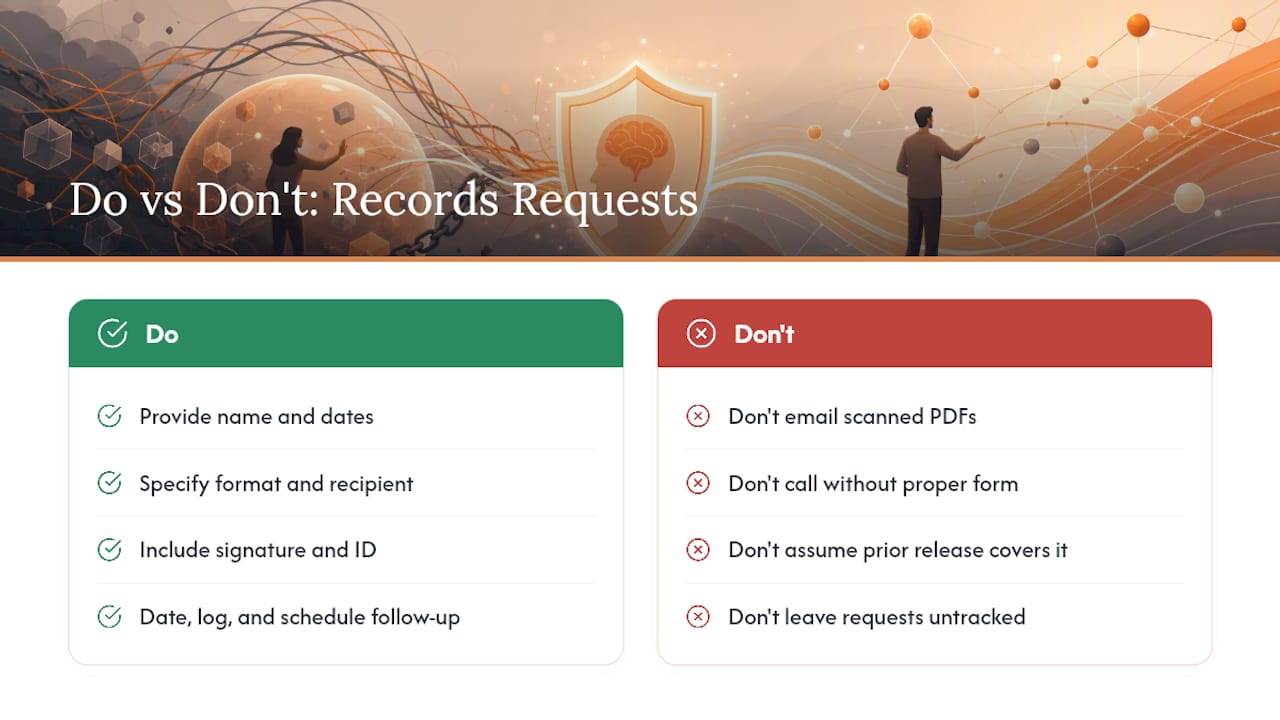
The providers who make this smooth aren’t necessarily the ones with the flashiest portals. They’re the ones who tell you exactly what to include on day one: name, dates, format, recipient, signature, ID. That specificity is the actual unlock, more than any particular technology. A signed release with every field filled correctly moves through a fax machine from 1997 faster than a vague email moves through the most modern EHR exchange.
If there’s one habit worth building, it’s treating your own records request the way a paralegal treats a filing: dated, logged, and followed up on a schedule rather than left to chance. That single shift in mindset, not a fancier tool, is what actually gets your file where it needs to go.
— Jamie
This article is general information, not a substitute for advice from a qualified doctor. Consult a qualified healthcare professional about your own circumstances before acting on anything here.
Sources
- PMC — HIPAA access and fee rules (journal summary)
- Healthit
- HHS — Your medical records (HIPAA for individuals)