

How to Safely Taper Off an SSRI: A Practical Guide
If you want to stop an SSRI, the single most important step is planning a slow, shared taper with your prescriber. “Slower is better” is not a platitude — it is the core principle behind every credible clinical guideline on antidepressant discontinuation. Small, reversible dose reductions, agreed on in advance with your clinician, minimize withdrawal risk and give you a clear path forward.
Before your first taper step, do three things:
- Do not stop suddenly. Abrupt discontinuation significantly raises the risk of withdrawal symptoms, sometimes severe ones.
- Schedule a clinician visit or telehealth appointment to review your current dose, how long you have been on the medication, and your reason for stopping.
- Write down your baseline: current drug name, dose, how many months or years you have been taking it, and any prior attempts to reduce.
NCBI’s Therapeutics Letter confirms there is no single validated tapering schedule — the evidence supports individualized, often hyperbolic (proportionate) tapers with monitoring every 1–4 weeks. Harvard Health adds that gradual tapering over weeks to months lowers the risk of discontinuation symptoms, and that switching to a longer-acting drug such as fluoxetine can smooth the final washout for some patients.
Red flags that require urgent contact with your prescriber or emergency services:
- Suicidal thoughts or urges to self-harm
- Severe chest pain or difficulty breathing
- New or rapidly worsening psychosis
- Inability to eat, drink, or function
If withdrawal symptoms become severe at any point, the clearest clinical response is to resume your previous tolerated dose. Symptoms typically ease quickly, and you can reattempt a slower taper once you are stable.
Key Takeaways
Tapering off an SSRI safely requires a slow, individualized, prescriber-supervised plan — proportionate dose reductions with regular monitoring and a documented plan to pause or reverse if withdrawal symptoms emerge.
| Point | Details |
|---|---|
| Slower is always better | Proportionate (percent-based) reductions minimize withdrawal risk more than fixed milligram cuts. |
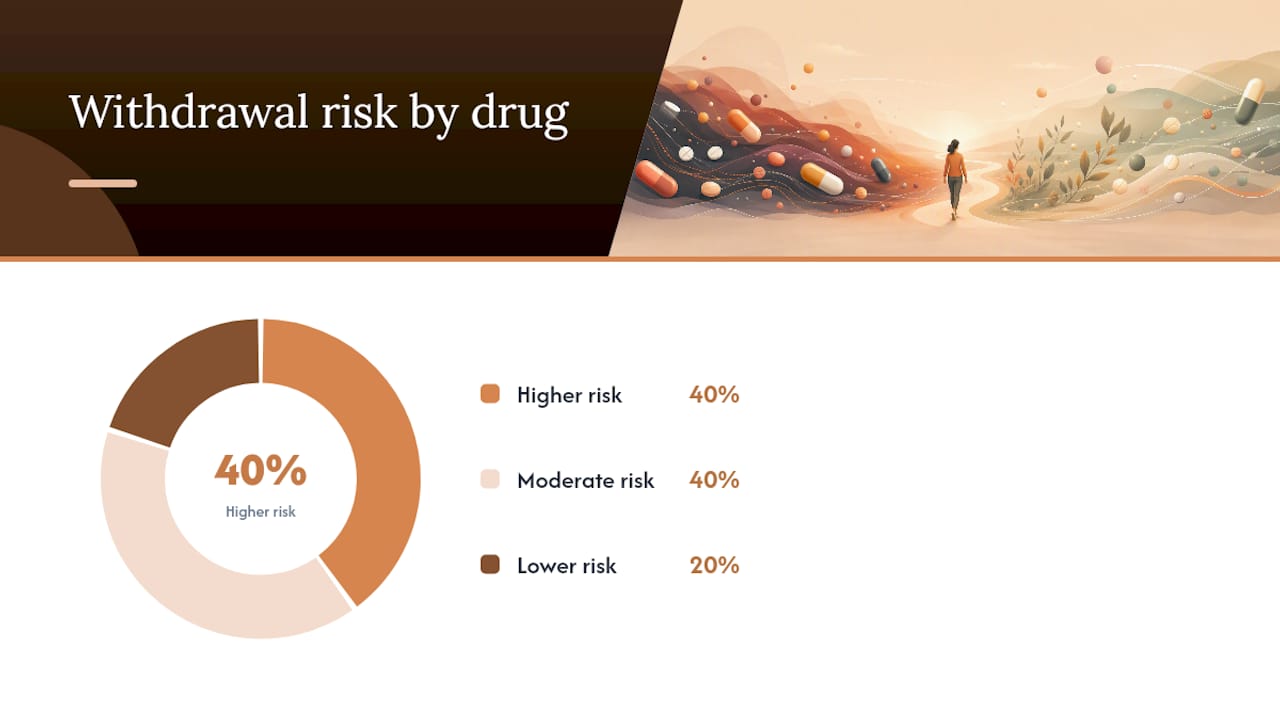
| Half-life determines risk | Paroxetine and venlafaxine carry higher withdrawal risk; fluoxetine’s long half-life makes it a cross-taper option for some patients. |
| Monitor every 1–4 weeks | Check in with your prescriber at each taper step; use a daily mood and symptom diary to track patterns. |
| Resume the prior dose if needed | Restarting at the previously tolerated dose is the clearest clinical response to severe withdrawal — not a failure. |
| Journeymhw offers supervised support | Adults in Texas and Colorado can access virtual medication management and structured taper follow-up through Journeymhw. |
Table of Contents
- What is antidepressant discontinuation syndrome?
- Which SSRIs and SNRIs are harder to stop?
- What are the core principles for tapering an SSRI safely?
- Practical taper templates you can discuss with your prescriber
- How to manage withdrawal symptoms during a taper
- When should you contact your prescriber or seek urgent care?
- What does a good follow-up schedule look like?
- How Journeymhw can support a safe taper
- A clinician’s perspective on what matters most in tapering
- Supervised taper support is available through Journeymhw
- Sources
What is antidepressant discontinuation syndrome?
Antidepressant discontinuation syndrome (ADS) is a cluster of physical and psychological symptoms that can occur when an SSRI or SNRI dose is reduced or stopped. It happens because the brain has adapted to a steady level of serotonin modulation — a process called neuroadaptation — and needs time to recalibrate when that level drops. It is not addiction, but it is a real physiological response that affects a meaningful portion of people who stop these medications.
Common symptom clusters
Symptoms tend to fall into recognizable groups:
- Vestibular and sensory: dizziness, “brain zaps” (brief electrical-shock sensations), tingling, visual disturbances
- Flu-like: fatigue, muscle aches, sweating, chills, nausea
- Sleep disturbance: vivid dreams, insomnia on antidepressants is common during reduction, early waking
- Emotional: anxiety, irritability, mood swings, tearfulness
- Cognitive: difficulty concentrating, confusion, feeling detached
British Journal of General Practice data show that withdrawal is common in primary care, with many patients experiencing protracted or severe discontinuation symptoms — a finding that has shifted clinical consensus toward longer, patient-tailored tapers.
How to tell withdrawal from relapse
This distinction matters clinically, and the clues are usually timing and symptom type.
Withdrawal symptoms tend to appear within days of a dose reduction (especially with short half-life drugs), include physical symptoms not typical of depression (brain zaps, nausea, dizziness), and resolve quickly if the previous dose is resumed. Relapse, by contrast, develops more gradually over weeks, mirrors the original depressive or anxiety symptoms, and does not resolve with a dose reinstatement in the same rapid way.
A simple withdrawal diary helps enormously here. Log the date, symptom name, severity on a 1–10 scale, and whether it appeared within days of a dose change. That pattern of data is exactly what your prescriber needs to make a confident call.

Which SSRIs and SNRIs are harder to stop?
Half-life is the key variable. A drug with a short half-life clears the body quickly, so plasma levels drop steeply after a dose reduction or missed dose. That steep drop is what triggers withdrawal. A drug with a long half-life tapers itself, in effect, because it leaves the system slowly.
Cleveland Clinic’s clinical review notes that short half-life antidepressants — paroxetine and venlafaxine in particular — carry a higher and earlier risk of withdrawal, while fluoxetine’s long half-life generally causes fewer immediate discontinuation problems, though it may delay symptom onset if they do occur.
| Drug (brand) | Half-life notes | Relative withdrawal risk | Clinical note |
|---|---|---|---|
| Fluoxetine (Prozac) | Very long (active metabolite: days to weeks) | Lower immediate risk; possible delayed symptoms | Often used as a cross-taper target for high-risk patients |
| Sertraline (Zoloft) | Moderate half-life | Moderate | Gradual taper usually well tolerated |
| Citalopram (Celexa) | Moderate half-life | Moderate | Similar profile to sertraline; step-down taper recommended |
| Paroxetine (Paxil) | Short half-life (no active metabolite) | Higher | Among the most challenging; slower taper often needed |
| Venlafaxine (Effexor) | Short half-life (parent plus active metabolite) | Higher | Extended-release formulation helps but does not eliminate risk |
Practical implication: When a patient on paroxetine or venlafaxine is struggling to taper, some clinicians cross-taper to fluoxetine first. Because fluoxetine and its active metabolite norfluoxetine have very long half-lives, stopping fluoxetine after the switch acts as a natural, gradual washout. This strategy requires careful prescriber oversight to manage drug interactions and overlapping serotonergic effects, but it can make the final discontinuation phase significantly more manageable for some patients.
For people on SSRIs for anxiety, the same half-life principles apply — the drug name matters more than the original diagnosis when planning a taper.
What are the core principles for tapering an SSRI safely?
The phrase “slower is better” has a pharmacological basis. SSRIs follow a hyperbolic dose-response curve, meaning the difference in receptor occupancy between 20 mg and 10 mg of a drug is far larger than the difference between 10 mg and 5 mg. Cutting from 20 mg to 10 mg is a much bigger neurological step than cutting from 5 mg to 2.5 mg, even though the milligram drop is the same. Horowitz et al. make this case directly: proportionate reductions — taking a percentage of the most recent dose rather than a fixed milligram amount — reduce withdrawal risk compared with fixed-step cuts.
Tapering pace and monitoring
Australian Prescriber guidance recommends individualized taper speeds: low-risk patients may tolerate 25–50% reductions over 2–6 weeks, while higher-risk or long-term patients often need much smaller proportional drops with 1–4 week monitoring intervals and access to mini-doses or compounding.
A test-reduction approach works well in practice: make one small reduction, monitor for 1–4 weeks, then continue or revert based on how you feel. This gives you and your prescriber real data before committing to the next step.
Risk factors that call for a slower taper
- Long duration of use (more than 1–2 years)
- Higher starting dose
- Short half-life drug (paroxetine, venlafaxine)
- Prior withdrawal history
- Older age or medical comorbidities
- Pregnancy or postpartum status
- Comorbid anxiety disorder (which can amplify withdrawal sensations)
People managing comorbid ADHD and depression may need additional monitoring during a taper, since ADHD symptoms can intensify when mood stability is disrupted.
Shared decision-making before you start
Before the first reduction, you and your prescriber should agree in writing on three things: the starting dose and planned reduction steps, the criteria for pausing or reversing a step (e.g., any symptom rated above 6/10 for more than three days), and who to contact if symptoms escalate. PMC research on shared decision-making links this kind of documented plan to better taper experiences and fewer safety events.
Cross-tapering and fluoxetine substitution
Cross-tapering means gradually introducing a new drug while reducing the original one. Switching to fluoxetine is the most common version of this strategy for high-risk patients on short half-life drugs. The risks include serotonin syndrome if the overlap is not managed carefully, so this is a prescriber-led decision, not a self-managed one.
Pro Tip: *When discussing taper speed with your prescriber, frame it around your personal risk profile.
Practical taper templates you can discuss with your prescriber
No two tapers look identical, but three broad templates cover most clinical situations. These are starting frameworks, not prescriptions — your clinician will adjust based on your history.
Template 1: Faster taper over a period suitable for lower-risk patients
Suited for patients who have been on an SSRI for a short course (under 6 months), at a low dose, with no prior withdrawal history, and on a moderate or long half-life drug.
- Reduce by 25–50% of the current dose.
- Hold for 1–2 weeks and monitor.
- Reduce again by 25–50% of the new dose.
- Stop after the final small dose if symptoms remain mild.
This is the approach Australian Prescriber describes for lower-risk, shorter-course patients.
Template 2: Moderate taper over a period suitable for typical patients with moderate risk
For patients on a typical course (6 months to 2 years) at standard doses, with moderate risk.
- Reduce by 10–25% of the current dose.
- Hold for 2–4 weeks and assess symptoms.
- Continue reducing by 10–25% of the most recent dose at each step.
- Slow down or hold if symptoms emerge; resume when stable.
Template 3: Very slow / hyperbolic taper over a prolonged period, often several months or more
For long-term users (more than 2 years), high doses, prior difficult withdrawal, or short half-life drugs. This is where Horowitz et al.'s hyperbolic tapering model becomes most relevant.
- Start with a 10% reduction of the current dose.
- Hold for 4 weeks.
- At each subsequent step, reduce by 10% of the most recent dose — not the original dose.
- As the dose gets very low (e.g., below 5 mg for sertraline), the absolute milligram drops become tiny. This is intentional.
- The final steps may involve doses of 1–2 mg or less, which require liquid formulations or compounding.
Example: venlafaxine 150 mg hyperbolic taper sketch
- Month 1: 150 mg → 135 mg (10% reduction)
- Month 2: 135 mg → 121.5 mg (10% of 135)
- Month 3: 121.5 mg → 109 mg
- Continue at this pace, slowing further in the lower dose range
- Final phase may require a liquid or compounded preparation to achieve doses below commercially available tablet sizes
Dosage technique options
When commercial tablet sizes are too large for the reductions you need, several options exist:
- Liquid formulations: Some SSRIs are available as oral solutions, allowing precise small-dose measurement. Ask your pharmacist which drugs come in liquid form.
- Compounding pharmacies: A compounding pharmacy can prepare custom-strength capsules or solutions. This is the most precise option for very low doses, though it may require prior authorization and is often an out-of-pocket cost.
- Tablet splitting: Useful for moderate reductions on scored tablets. Not appropriate for extended-release formulations.
- Opening capsules and counting beads: Some extended-release capsules (including certain venlafaxine formulations) contain beads that can be counted and reduced. This requires pharmacist guidance to confirm safety for the specific product.
SPS guidance on crushing and dispersing tablets notes that not all formulations are safe to split or open — always confirm with your pharmacist before altering a tablet or capsule.
Pro Tip: Use a mood and withdrawal calendar during your taper. Rate your mood, sleep, anxiety, and any physical symptoms daily on a 1–10 scale. If any symptom hits 7 or above for three consecutive days, that is a signal to pause the taper and contact your prescriber — not to push through.
How to manage withdrawal symptoms during a taper
Most withdrawal symptoms are uncomfortable but not dangerous, and they respond well to a combination of self-care and a temporary pause or reversal of the taper. The goal is not to white-knuckle through — it is to find a pace your nervous system can tolerate.
Self-care strategies that help
- Sleep hygiene: Keep a consistent sleep schedule, limit screens before bed, and avoid caffeine after noon. SSRI sleep problems during tapering are common; a structured routine reduces their impact.
- Hydration and nutrition: Nausea is a frequent withdrawal symptom. Small, frequent meals and consistent hydration help.
- Gradual exercise: Light aerobic activity — walking, swimming — supports mood regulation and can reduce the intensity of anxiety symptoms during reduction.
- Relaxation techniques: Diaphragmatic breathing, progressive muscle relaxation, and mindfulness-based practices can reduce the emotional amplification that often accompanies withdrawal.
- Peer support: Online communities and support groups for people tapering antidepressants can normalize the experience and provide practical tips, though they should not replace clinical guidance.
For behavioral strategies that complement tapering, the approaches outlined for high-functioning depression — structured routines, sleep prioritization, and social connection — apply directly.
Symptomatic medicines your prescriber may consider
Some clinicians use short-term symptomatic treatments to ease specific withdrawal symptoms. These are clinical decisions, not over-the-counter recommendations:
- Short-course sleep aids for severe insomnia
- Anti-nausea medications for persistent nausea
- Antihistamines or low-dose clonidine for some autonomic symptoms (prescriber-led)
When to resume the previous dose
The balance here is real: reintroducing the medication means restarting the process, but it also means you can reattempt the taper with a better-calibrated schedule. Many patients successfully discontinue on a second or third attempt with a slower approach.
When should you contact your prescriber or seek urgent care?
Some symptoms during a taper require immediate action. Do not wait for your next scheduled appointment if any of the following occur.
Seek emergency care immediately for:
- Suicidal thoughts or urges to harm yourself or others
- Severe chest pain or shortness of breath
- New or rapidly worsening psychosis (hallucinations, paranoia, disorganized thinking)
- Inability to eat, drink, or maintain basic function
- Uncontrollable vomiting lasting more than 24 hours
Contact your prescriber within 24–48 hours for:
- Withdrawal symptoms that are worsening or have persisted for more than one week
- New severe anxiety or panic attacks
- Significant new insomnia lasting more than a few days
- Any symptom pattern that feels like your original depression or anxiety is returning
- Confusion about whether to pause, hold, or reverse your taper
Call-prep checklist
When you contact your prescriber, have this information ready:
- Current medication name, dose, and formulation
- Exact date of your last dose change
- Symptom onset date and current severity (use your 1–10 diary ratings)
- Any prior withdrawal history and what helped
- Any new medications, supplements, or over-the-counter drugs started recently
- Whether you have already resumed the previous dose
Ask specifically for an urgent medication management review and a documented plan for resuming your previous dose if symptoms are severe. Telehealth appointments can often be scheduled within 24–48 hours for urgent reviews, which makes them particularly useful during an active taper.
What does a good follow-up schedule look like?
Monitoring during a taper is not optional — it is the mechanism that makes the taper safe. Without regular check-ins, there is no way to distinguish a temporary symptom spike from a genuine relapse, or to catch a problem before it becomes a crisis.
Recommended check-in cadence
- During active taper steps: Check in with your prescriber every 1–4 weeks, depending on your risk level. Higher-risk patients (long duration, short half-life drug, prior withdrawal) should check in at the shorter end of that range.
- After the final dose: Schedule at least one follow-up appointment 4 weeks after stopping completely.
- Extended monitoring: For patients with a history of recurrent depression, monthly check-ins for 3–6 months after discontinuation are reasonable.
What to track between appointments
A simple daily log covers the essentials:
- Mood rating (1–10)
- Sleep quality and hours
- Anxiety level (1–10)
- Physical symptoms (type and severity)
- Suicidality screen (any thoughts, even passive)
- Date and dose of any change
Bring this log to every appointment. The pattern over time is more informative than any single data point.
Distinguishing relapse from withdrawal in longitudinal data
Withdrawal symptoms tend to spike within days of a dose change and then plateau or improve. Relapse looks different: a progressive worsening of mood over weeks, returning to the symptom profile that originally led to treatment, without a clear link to a specific dose change.
If your diary shows a steady downward trend in mood over three or more weeks — not tied to a recent dose reduction — that is a signal worth discussing with your prescriber as a possible relapse rather than withdrawal.
Contingency planning
Your written taper plan should include: the name and contact number of who to call if symptoms worsen, the specific symptom threshold that triggers a call, and the agreed dose to resume if needed. BJGP guidance recommends that clinicians document these agreed triggers in the medical record and provide patients with a simple written version to keep at home.
How Journeymhw can support a safe taper
Tapering an SSRI safely requires more than a schedule — it requires access to a prescriber who can monitor your symptoms, adjust the plan, and act quickly if something changes. That is exactly what Journeymhw’s telehealth medication management service is designed to support.
Journeymhw offers virtual psychiatric evaluations and ongoing medication management for adults in Texas and Colorado. For patients in a taper, that means rapid appointment scheduling, structured follow-up visits, and the ability to resume a prior dose quickly if withdrawal becomes severe — without waiting weeks for an in-person slot.
What to bring to your first telehealth appointment
- Full medication list with current doses and formulations
- Start date of your current SSRI and the original reason it was prescribed
- Any prior taper attempts and what happened
- A baseline mood and symptom score (use your diary if you have started one)
- Your reason for wanting to stop now
Availability and clinical limits
Journeymhw’s licensed prescribers currently serve patients in Texas and Colorado. Clinical decisions — including taper speed, dose adjustments, and whether to cross-taper — are individualized and require a full prescriber assessment. The service does not replace emergency care; if you are experiencing a mental health crisis, contact 988 (Suicide and Crisis Lifeline) or your nearest emergency department.
For patients managing depression treatment alongside a taper, Journeymhw’s structured care model includes both the psychiatric evaluation and the follow-up visits needed to monitor for relapse.
A clinician’s perspective on what matters most in tapering
The most common mistake we see is not starting the taper too slowly — it is starting it without a safety net. Patients who do best are the ones who come in with a clear reason for stopping, a realistic timeline, and an agreement in place about what to do if things get hard. That agreement is not a formality. It is the thing that prevents a difficult week from turning into a crisis.
Start slow. Listen carefully to what your body is telling you at each step. Be prepared to pause, hold, or reverse — and know that doing so is not a setback. It is the plan working as intended. Many patients successfully discontinue with careful planning, but some genuinely need tapers that stretch over a year or more, and that is a legitimate clinical path, not a failure.
Document everything: the agreed triggers, the contact plan, the dose to resume. A patient who knows exactly what to do if symptoms worsen is a patient who is far less likely to end up in an emergency room.
Supervised taper support is available through Journeymhw
Stopping an antidepressant without clinical oversight is one of the most avoidable sources of unnecessary suffering in mental health care. Journeymhw offers a structured, telehealth-based path for adults in Texas and Colorado who want to taper safely, with a prescriber who can monitor their progress and adjust the plan in real time.

The service covers virtual psychiatric evaluations, ongoing medication management visits, and rapid follow-up scheduling — the three things a safe taper actually requires. You are not handed a schedule and left alone. Your prescriber reviews your symptom diary, adjusts your reduction pace, and has a documented plan ready if you need to pause or resume.
To get started, visit Journeymhw’s medication management page and book an initial evaluation. Bring your current medication list, your taper goals, and any prior withdrawal history. If you are in Texas or Colorado and ready to taper with clinical support, this is where to begin. For urgent mental health concerns, contact 988 or your nearest emergency department first.
Sources
These sources are worth bookmarking and bringing to your prescriber:
- How to stop antidepressants - Therapeutics Letter - NCBI - NIH
- Going Off Antidepressants - Harvard Health Publishing
- Tapering of SSRI treatment to mitigate withdrawal symptoms - MA Horowitz et al.
- Withdrawing from SSRI antidepressants: advice for primary care | British Journal of General Practice
- Discontinuing Antidepressants: Pearls and Pitfalls - Cleveland Clinic
- Stopping antidepressants: when and how - Australian Prescriber
This article provides general information about antidepressant tapering and is not a substitute for professional medical advice. Always consult a licensed prescriber before making any changes to your medication. If you are in crisis, contact the 988 Suicide and Crisis Lifeline or your nearest emergency department.
Recommended
- Antidepressant Medications Explained Phase 3 – Journey Mental Health
- How Anxiety Medication Works: A Clear, Honest Guide – Journey Mental Health
- Medication Management for Mental Health: A Practical Guide – Journey Mental Health
- Why Untreated Depression Worsens: Risks You Should Know – Journey Mental Health