

Structured mental health care benefits: your guide
If you’ve been living with ADHD, anxiety, or depression and feel like getting real help takes too long, you’re not imagining it. The structured mental health care benefits of virtual programs are changing that reality for adults in Texas and Colorado, offering faster access to evaluation, coordinated treatment teams, and measurable progress tracking from home. This guide explains exactly what structured care looks like, how it compares to standard therapy, what your insurance likely covers, and how to get started without the usual delays.
Table of Contents
- What is structured mental health care and why does it matter?
- Key benefits of structured virtual mental health care
- Understanding insurance coverage and parity protections for mental health care
- Choosing the right level of structured mental health care
- How to access structured virtual mental health care in Texas and Colorado
- Why structured virtual mental health care is a game changer for adults with ADHD, anxiety, and depression
- Start your structured mental health care journey today with Journey Mental Health
- Frequently asked questions
Key Takeaways
| Point | Details |
|---|---|
| Structured care levels | Partial Hospitalization Programs and Intensive Outpatient Programs offer different intensities of structured mental health support tailored to symptom severity. |
| Insurance parity | Marketplace plans cover mental health with protections ensuring benefits are not more restrictive or costly than medical care. |
| Virtual benefits | Technology-enabled virtual care improves symptom tracking, personalizes treatment, and increases accessibility for adults with ADHD, anxiety, and depression. |
| Choosing care | Selecting the right care intensity depends on symptom severity, functional impairment, and lifestyle needs, with virtual programs accommodating flexible options. |
| Access steps | Start with online evaluation tools, understand your insurance coverage, and engage with coordinated virtual care teams for effective treatment. |
What is structured mental health care and why does it matter?
Most people picture mental health care as a weekly 50-minute session with a therapist. That model works for mild symptoms, but it often falls short for adults managing moderate to severe ADHD, anxiety, or depression. Structured mental health care refers to programs with defined intensity, coordinated teams, and consistent clinical oversight built into the design.
The two most recognized levels are Partial Hospitalization Programs (PHP) and Intensive Outpatient Programs (IOP). These sit between standard outpatient therapy and inpatient hospitalization, filling a gap that weekly therapy simply cannot cover.
Here is how the levels compare:
| Care level | Hours per week | Best suited for |
|---|---|---|
| Standard outpatient | 1 to 3 hours | Mild symptoms, maintenance |
| Intensive Outpatient (IOP) | 9 to 19 hours | Moderate impairment, outpatient plateau |
| Partial Hospitalization (PHP) | 20+ hours | Significant impairment, step-down from inpatient |
Key features of structured care programs include:
- Group and individual therapy scheduled multiple times per week
- Medication management integrated with therapy, not siloed
- Symptom tracking using validated tools before and after sessions
- Coordinated care teams including psychiatrists, therapists, and case managers
- Clear treatment goals with measurable milestones
PHP programs provide structured care at 20 or more hours per week, combining group therapy, individual sessions, and medication management specifically for anxiety and depression. This intensity level is what produces clinical results that weekly outpatient therapy often cannot replicate.
You can explore mental health treatment in Texas and Colorado to understand what condition-specific programs look like in practice, and how medication management and online care fit into a structured approach.
Pro Tip: If you have tried standard therapy for 8 to 12 weeks without meaningful improvement, that is often a clinical signal that a higher level of structured care may be appropriate. You do not need to wait for a crisis to qualify.
Having clarified what structured mental health care entails, let’s explore the proven benefits this approach offers to individuals managing ADHD, anxiety, or depression.
Key benefits of structured virtual mental health care
Structured virtual mental health care is not simply therapy moved to a screen. The programs that produce the best outcomes combine technology, clinical coordination, and real-time data to adjust your treatment as you progress.

One of the most important tools in these programs is measurement-based care. Before each session, you complete brief validated assessments such as the PHQ-9 for depression or the GAD-7 for anxiety. Your care team reviews those scores and adjusts your treatment plan accordingly. This is fundamentally different from a therapist relying solely on memory and conversation.
Adults in technology-enabled teletherapy with measurement-based care showed reliable improvement in both depression and anxiety symptoms. That is not a minor distinction. It means your treatment is being calibrated continuously, not just at intake.
The benefits extend beyond symptom scores:
- Fewer hospital admissions because intensive virtual support catches deterioration early
- Faster access to evaluation and treatment compared to traditional in-person waitlists
- Coordinated teams including psychiatrists, therapists, and sometimes nutritionists working from the same clinical picture
- Convenience that allows you to receive structured care without rearranging your work schedule or arranging transportation
- Accountability built into the program through regular check-ins and progress reviews
“Virtual coordinated care achieves over 50% symptom reduction in treatment-resistant patients within 2 to 3 months.” This kind of outcome is especially relevant for adults in Texas and Colorado who have tried standard outpatient treatment without sufficient relief.
For adults with ADHD specifically, the structured nature of these programs provides external accountability that compensates for the executive function challenges the condition creates. You can read more about online depression treatment expectations and what structured online anxiety treatment in Texas actually involves.
Pro Tip: When evaluating any virtual mental health program, ask specifically whether they use measurement-based care tools like PHQ-9 or GAD-7 at each session. If they do not, the program lacks a key component of structured care quality.
With these benefits in mind, let’s examine how mental health insurance plans support structured mental health services and ensure access parity.
Understanding insurance coverage and parity protections for mental health care
Many adults avoid structured mental health care because they assume it will be unaffordable. The reality is more favorable than most people realize, particularly because of federal parity protections that apply in both Texas and Colorado.
All Marketplace health plans cover mental health services as essential health benefits, including psychotherapy, inpatient care, and substance use disorder treatment. Parity protections mean your insurer cannot impose stricter limits or higher costs on mental health benefits than they apply to comparable medical benefits.
What parity protections actually cover for you:
- Prior authorization rules must be no more restrictive for mental health services than for comparable medical procedures
- Network adequacy requirements mean your plan must provide sufficient mental health providers
- Out-of-pocket costs such as copays and deductibles cannot be disproportionately higher for mental health care
- Utilization management practices like session limits must be applied equally to mental and medical benefits
- Annual and lifetime dollar limits are prohibited for essential mental health benefits
Enforcement is tightening. MHPAEA requires comparative analyses for non-quantitative treatment limits, with current enforcement focused on prior authorization and utilization management practices. This means insurers are being held more accountable for denying mental health claims on grounds they would not apply to medical claims.
If your insurer denies coverage for a PHP or IOP program, you have the right to appeal and to request a comparative analysis showing how the denial decision was made. Understanding this process can save you significant out-of-pocket costs.
You can review mental health treatment guidance for condition-specific information, or learn more about Journey Mental Health and how we work with patients navigating insurance.
Having clarified coverage protections, it’s important to understand how structured care levels differ and how to choose the right care for your needs.
Choosing the right level of structured mental health care
Selecting the appropriate care intensity is one of the most important decisions in your treatment. Too little structure and you plateau. Too much intensity without the right fit and you disengage. Here is how to think through the decision.
Step 1: Assess your current level of functional impairment. Are you able to work, maintain relationships, and manage daily tasks? If not, PHP-level care is likely appropriate.
Step 2: Review your treatment history. If standard outpatient therapy has not produced meaningful improvement after two to three months, IOP is a reasonable next step.
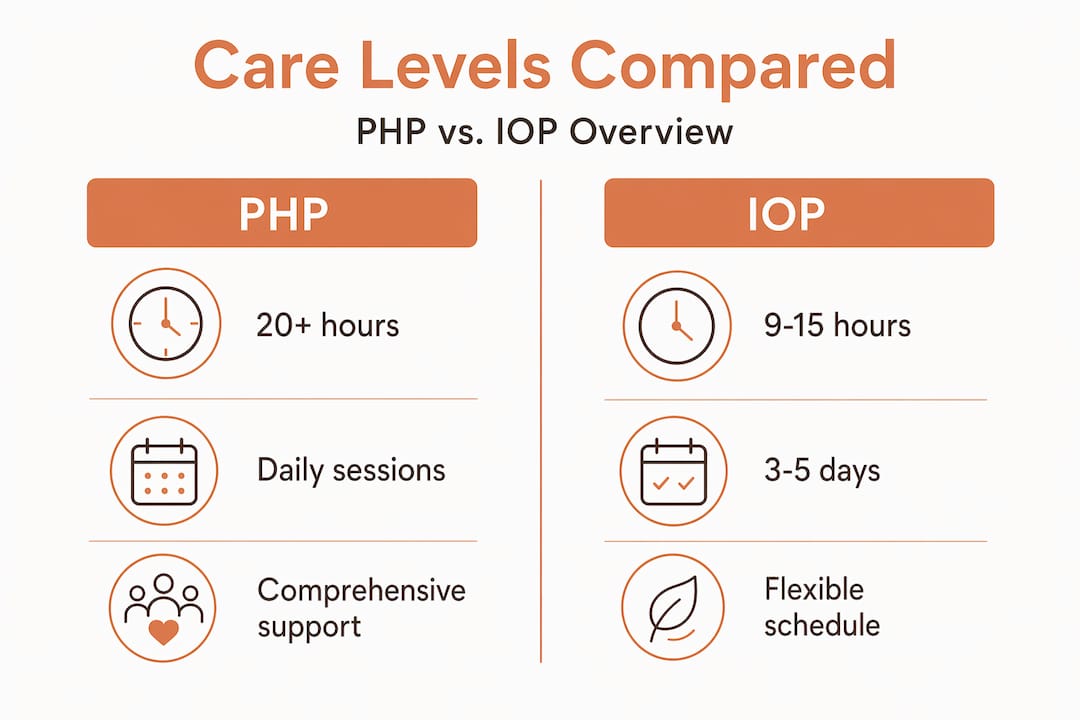
Step 3: Consider your schedule and support system. PHP requires a significant daily time commitment. IOP, typically three to five days per week, offers more flexibility.
Step 4: Consult with a clinician. A proper evaluation using validated tools will help confirm which level fits your clinical picture.
Step 5: Verify insurance coverage. Confirm that your plan covers the recommended level of care before committing.
| Program type | Weekly hours | Typical schedule | Best for |
|---|---|---|---|
| Standard outpatient | 1 to 3 | Weekly sessions | Mild, stable symptoms |
| IOP | 9 to 19 | 3 to 5 days/week | Moderate impairment |
| PHP | 20+ | Daily, half-day | Significant impairment |
PHP provides 20 or more hours per week of structured care including group therapy and medication management, while IOP offers 9 to 19 hours per week as a step-down option. Both IOP and PHP fill critical gaps between outpatient therapy and inpatient care, making them ideal for stabilizing ADHD, anxiety, and depression without hospitalization.
Virtual programs can match these intensity levels to your schedule. You can explore ADHD treatment options in Texas and Colorado, or review depression treatment online to understand what a structured virtual program looks like for your specific condition.
Pro Tip: Do not self-select a lower level of care to avoid the time commitment. Undertreatment is the most common reason adults cycle through multiple rounds of therapy without lasting improvement.
After understanding which care level fits your situation, let’s explore how to start with virtual evaluation and treatment in Texas and Colorado.
How to access structured virtual mental health care in Texas and Colorado
Getting started is more straightforward than most people expect. Here is the practical path from where you are now to active structured care.
-
Complete an online evaluation. Use a platform that administers validated tools like the PHQ-9 and GAD-7 during intake. These scores guide your initial care placement and become your baseline for tracking progress.
-
Confirm your insurance benefits. Call your insurer or use their online portal to verify coverage for IOP or PHP services. Ask specifically about prior authorization requirements and your cost-sharing responsibility.
-
Select a program with measurement-based care. Measurement-based virtual therapy uses PHQ-9 and GAD-7 before each session to guide real-time treatment adjustments. This is a non-negotiable feature of quality structured care.
-
Engage your coordinated care team. Your team should include at minimum a prescriber for medication management and a therapist for structured sessions. Ask how they communicate with each other about your progress.
-
Track and update your symptom assessments regularly. Your scores should be reviewed at each session and used to decide when to step up or step down your care intensity.
You can start with attention evaluations in Texas if ADHD is your primary concern, or explore medication management options to understand how prescribing fits into a structured virtual program.
Pro Tip: Before your first appointment, write down your three most disruptive symptoms and how long you have experienced them. This gives your evaluating clinician the clearest possible starting point and often reduces the number of sessions needed to establish an accurate diagnosis.
Why structured virtual mental health care is a game changer for adults with ADHD, anxiety, and depression
Here is something most mental health content will not say directly: traditional weekly outpatient therapy was designed for a different era of mental health need. It works well for people with mild symptoms and strong baseline functioning. For adults managing ADHD alongside anxiety or depression, it often does not provide enough support to create lasting change.
The problem is not the therapist. It is the structure. One hour per week leaves six days and 23 hours where symptoms continue without clinical support, monitoring, or adjustment. Dropout rates in traditional outpatient therapy are high precisely because progress feels slow and the connection between sessions is thin.
Structured virtual care corrects this by building in frequency, measurement, and team coordination. When your prescriber and therapist share the same clinical data and communicate regularly, your care becomes coherent rather than fragmented. When your symptoms are measured before every session, your treatment responds to where you actually are, not where you were three weeks ago.
We also believe virtual delivery is not a compromise. For adults in Texas and Colorado managing busy work schedules, family obligations, or geographic distance from specialized providers, virtual structured care is often the only realistic path to the intensity of support they need. The evidence on online depression treatment consistently shows outcomes comparable to in-person care when measurement-based practices are used.
The future of mental health treatment is not choosing between convenience and quality. It is building programs that deliver both, with technology serving clinical decision-making rather than replacing it.
Start your structured mental health care journey today with Journey Mental Health
You have spent time understanding the benefits of structured mental health care. Now the next step is finding a provider who actually delivers it. Journey Mental Health specializes in virtual structured care for adults with ADHD, anxiety, and depression in Texas and Colorado, with programs built around fast access, coordinated teams, and measurement-based treatment.
We offer comprehensive online evaluations, evidence-based therapy, and medication management and treatment coordinated by a team that communicates across your care. Flexible scheduling means you can access structured support without putting your life on hold. Whether you are just beginning to explore your options or have been through treatment before without the results you needed, we are ready to help you find the right path. Explore treatment options or go directly to ADHD treatment in Texas to get started today.
Frequently asked questions
What types of mental health services are covered by insurance in Texas and Colorado?
All Marketplace health plans cover mental health services as essential health benefits, including psychotherapy and inpatient services, with parity protections ensuring these benefits have fair limits compared to medical benefits.
How intensive are Partial Hospitalization Programs (PHP) and Intensive Outpatient Programs (IOP)?
PHP provides 20 or more hours per week of structured therapy including group and individual sessions, while IOP offers 9 to 19 hours per week as a lower intensity step-down from PHP.
What advantages does virtual structured mental health care offer?
Virtual structured care programs combine frequent symptom measurement, coordinated care teams, and remote access to improve outcomes, and virtual coordinated care achieves over 50% symptom reduction with fewer inpatient admissions for adults with anxiety, depression, or ADHD.
How can adults in Texas and Colorado start accessing structured virtual mental health care?
Begin by completing an online evaluation, confirm your insurance coverage and parity protections, then select programs that use PHQ-9 and GAD-7 measurement tools before each session to guide real-time treatment adjustments.