

Stimulant Refill Schedule Telehealth: What US Patients Can Expect
Yes, you can get a stimulant prescription refilled through telehealth in the United States right now, but the rules are tighter than most people assume. Federal flexibilities let DEA-registered clinicians prescribe Schedule II stimulants like Adderall and Ritalin through telehealth without a prior in-person exam, and that permission runs through December 31, 2026. The catch: Schedule II drugs carry no automatic refills. Every fill requires a brand-new prescription, which means you can’t skip follow-up visits and expect your medication to keep coming.
Your state’s laws and your telehealth provider’s own controlled-substance policy can narrow that federal permission further, sometimes significantly.
- Federal law allows teleprescribing of Schedule II stimulants through Dec 31, 2026
- Each refill needs a new prescription tied to a follow-up visit
- Your state and your provider’s platform policy can add requirements federal law doesn’t
Federal fact check: the Fourth Temporary Extension keeps telemedicine prescribing of Schedule II through V controlled substances legal nationwide through the end of 2026, but that’s a floor, not a guarantee.
If you need a refill soon, start by confirming two things: what your state actually permits, and whether your telehealth provider treats stimulant management as part of its normal scope of care.
Key Takeaways
Stimulant refills via telehealth are federally legal through 2026, but Schedule II rules require a new prescription at every fill, and state or platform policy can add further limits.
| Point | Details |
|---|---|
| Federal window runs through 2026 | The Fourth Temporary Extension permits telehealth prescribing of Schedule II stimulants through December 31, 2026. |
| No standing refills exist | Every stimulant fill requires a fresh prescription, so follow-up visits are functionally mandatory, not optional. |
| States can add requirements | New Jersey’s law requires an in-person visit within 30 days and quarterly contact, a model other states may follow. |
| Pharmacy friction is common | Shortages and chain-specific policies can block a valid prescription, so having backup pharmacy options helps. |
| Journeymhw builds in compliance | Journeymhw structures ADHD care in Texas and Colorado around documented follow-ups that support ongoing stimulant prescriptions. |
Primary Sources and Further Reading
- Telehealth
- DEA Announces Three New Telemedicine Rules
- New Jersey Telemedicine Rules Analysis | Nixon Peabody
- Telemedicine recommendations for substance use disorders
This article is general information, not a substitute for advice from a qualified doctor. Consult a qualified healthcare professional about your own circumstances before acting on anything here.
Table of Contents
- What Federal Rules Actually Allow for Stimulant Refill Schedules on Telehealth
- Why Stimulant Refills Work Differently Than Other Prescriptions
- How Does State Law Change Your Telehealth Refill Schedule?
- What Will a Telehealth Provider Ask Before Refilling Your Stimulant Prescription?
- Why Won’t My Pharmacy Fill My Stimulant Prescription?
- Step-by-Step: Getting a Stimulant Refill Through Telehealth
- Getting a DEA Waiver or Special Registration for Telehealth Prescribing
- How the Ryan Haight Act Still Shapes Telehealth Stimulant Prescribing
- Will Insurance Cover a Telehealth Stimulant Refill?
- Legal and Compliance Risks Providers Face With Telehealth Stimulant Prescribing
- How Journeymhw Approaches Compliant Stimulant Refills
- What Actually Determines Whether You Get Your Refill on Time
- Journeymhw for Ongoing Stimulant Management in Texas and Colorado
- Sources
What Federal Rules Actually Allow for Stimulant Refill Schedules on Telehealth
The federal government has extended pandemic-era telehealth flexibilities four times now, and the current version keeps the door open through the end of 2026. Under the Fourth Temporary Extension, a DEA-registered practitioner can prescribe Schedule II through V controlled substances, including amphetamine-based stimulants, via telemedicine without requiring an initial in-person visit.
Telehealth confirms this applies broadly as long as the prescriber meets DEA registration and state licensing requirements in the patient’s location. The DEA’s own January 2025 announcement framed these extensions as a bridge, not a permanent fix, while it works through a proposed rule creating “special registrations” for telehealth prescribers of controlled substances.
Three things to keep in mind about this federal baseline:
- It’s permissive, not mandatory. States and individual platforms can still impose tighter rules.
- The special-registration rulemaking is still pending, so what happens after December 31, 2026 remains genuinely uncertain.
- Federal permission covers whether a prescription is legal. It says nothing about whether a given pharmacy will fill it or a given telehealth company will offer it.
Why Stimulant Refills Work Differently Than Other Prescriptions
Ordinary prescriptions often come with automatic refills built in. Schedule II stimulants don’t work that way, and understanding why explains almost everything else in this article.
Federal law treats Schedule II drugs as having the highest abuse potential of any prescribable substance. That classification means no standing refills are allowed, ever, regardless of delivery method. Each time you need more medication, your prescriber has to write a fresh prescription. There’s no auto-renew button, no 90-day supply that quietly reorders itself.
That legal reality shapes how clinicians structure care. A common pattern looks like this:
- An initial evaluation and prescription, often followed by a check-in around the 30-day mark to confirm the medication and dose are working.
- Quarterly follow-up visits after that, spaced to catch side effects, tolerance changes, or emerging misuse concerns.
- A PDMP query (your state’s prescription drug monitoring program) before most new stimulant prescriptions, letting the clinician see your recent controlled-substance fill history.
The core figure to remember: federal rules permit telehealth stimulant prescribing through December 31, 2026, but that permission never removes the requirement for a new prescription at every fill.
How Does State Law Change Your Telehealth Refill Schedule?
Federal rules set the outer limit of what’s legal. States can pull that limit in tighter, and several have.
New Jersey offers the clearest recent example. Under Assembly Bill No. 4852, adult patients can start stimulant treatment with a telehealth-only exam, but the law requires an in-person visit within 30 days of that first prescription. After that, the statute calls for quarterly contact between patient and prescriber, plus at least one in-person visit every year. It’s a hybrid model: telehealth gets you in the door, but it doesn’t replace the exam room entirely.
If you’re a fully remote patient, that kind of sequencing matters. A provider licensed in a state with these rules can’t simply keep renewing your prescription over video calls indefinitely. Practically, this means:
- Ask upfront whether your state requires any in-person component, and when
- Ask how your provider schedules and tracks those required visits
- Don’t assume “I found a telehealth doctor” settles the question. Your state’s medical board and your provider’s own licensing team both matter.
Pro Tip: Call your telehealth provider’s records or compliance team directly and ask, “What does your protocol require for stimulant patients in my state?” A generic FAQ page often won’t reflect state-specific sequencing rules like New Jersey’s.
What Will a Telehealth Provider Ask Before Refilling Your Stimulant Prescription?
Clinicians managing controlled substances remotely tend to ask for more, not less, documentation than a typical primary care visit. Expect requests for prior psychiatric or ADHD evaluation records, a recent medication history, and sometimes a symptom log covering the weeks before your visit.
During the visit itself, most prescribers will walk through a fairly consistent checklist:
- A review of side effects and how the current dose is functioning
- Screening questions about substance use, since misuse risk is the core reason Schedule II rules exist
- A PDMP check against your state’s database
- Occasionally, a request for labs or an in-person exam if something in your history raises a flag
Some telehealth companies decline to manage stimulants at all, even where it’s legal, simply because of the compliance overhead and liability involved. That’s a real pattern worth knowing about before you sign up somewhere expecting ongoing ADHD care. Titration visits in particular tend to require more frequent contact early in treatment, which is normal and not a sign something’s wrong.
Why Won’t My Pharmacy Fill My Stimulant Prescription?
A legally valid prescription doesn’t guarantee a filled bottle. Stimulant shortages have been common in recent years, and some pharmacy chains restrict which electronically transmitted controlled prescriptions they’ll accept, independent of whether the prescriber did everything right.
A few tactics reduce the odds of a wasted trip:
- Call the pharmacy before your appointment to confirm they’re currently stocking your medication and dose.
- Ask your provider whether they can transmit to a backup pharmacy if the first one can’t fill it.
- If a pharmacy refuses a valid script, ask to speak with the pharmacy manager. Sometimes it’s a policy question that a manager can resolve on the spot.
If none of that works, your prescriber may need to reissue the prescription to a different pharmacy entirely.
Pro Tip: Keep a running list of two or three pharmacies near you that have filled your stimulant prescription before. Chain policies shift, and having options saves you from a stressful gap in medication.
Step-by-Step: Getting a Stimulant Refill Through Telehealth
Getting through a refill visit smoothly comes down to preparation on both ends.
Before your appointment:
- Confirm your state’s rules for telehealth stimulant prescribing, including any in-person requirement.
- Ask your provider whether stimulant management is within their normal scope, and how they handle prescription transmission.
- Gather prior records, your current dose and pharmacy, and a note on how the medication has been working.
During the visit:
- Be ready to describe any symptom changes or side effects since your last prescription
- Answer substance-use screening questions honestly. This is standard practice, not an accusation.
- Confirm the follow-up cadence (often ~30 days, then quarterly) and how the prescription will be sent to your pharmacy
After the visit:
- Call your pharmacy to confirm the e-prescription arrived and can be filled
- Schedule your next check-in before you leave the portal or call
- Save your visit summary and any PDMP-related documentation your provider shares
Getting a DEA Waiver or Special Registration for Telehealth Prescribing
Right now, individual patients don’t apply for anything called a “DEA waiver.” That confusion is common, but the special registration process is a provider-facing mechanism, not a patient one.
The DEA has proposed creating a formal “special registration” category that would let qualified telehealth practitioners prescribe Schedule II through V controlled substances under a defined, ongoing framework, rather than relying on repeated temporary extensions. As the DEA’s January 2025 press release describes it, the goal is a permanent pathway that preserves telehealth access once the emergency-era extensions eventually end.
Until that rule is finalized, practitioners rely on the standing DEA registration they already hold, combined with the temporary telemedicine flexibilities extended through December 31, 2026. For a clinic or provider group, staying compliant during this period generally means:
- Confirming state licensure in every state where patients are treated
- Maintaining DEA registration current and accurate
- Documenting each encounter as though the eventual special-registration rule were already in force, since that documentation discipline is exactly what the proposed framework is expected to require
For patients, the practical takeaway is simpler: if a provider mentions a “waiver,” ask what they mean specifically. It’s more likely they’re describing their own DEA registration status and state compliance work than something you’d need to request yourself.
How the Ryan Haight Act Still Shapes Telehealth Stimulant Prescribing
The Ryan Haight Online Pharmacy Consumer Protection Act, passed in 2008, is the reason telehealth controlled-substance prescribing has any restrictions at all. The law was written to stop rogue online pharmacies from prescribing controlled substances after nothing more than an online questionnaire. Its core requirement was blunt: a prescriber generally needed to conduct at least one in-person medical evaluation before prescribing a controlled substance, with a narrow set of exceptions.
That in-person requirement is exactly what the COVID-era flexibilities, and now the Fourth Temporary Extension, temporarily suspend. Without that suspension, telehealth-only stimulant prescribing for a new patient would not be legal under federal law at all.
This history matters for one practical reason: it explains why the current rules feel temporary, because they are. Ryan Haight’s in-person requirement remains the default federal position. Every extension since 2020 has been a deliberate, time-limited exception layered on top of a law that otherwise assumes a face-to-face exam. If the special-registration rulemaking stalls or a future extension doesn’t get renewed, the Ryan Haight default snaps back into place, and telehealth-only prescribing for new stimulant patients would become far more limited overnight.
That’s the single biggest reason providers and patients alike shouldn’t treat the current flexibilities as permanent. Build a relationship with a provider capable of transitioning you to compliant in-person or hybrid care if the rules tighten again.

Will Insurance Cover a Telehealth Stimulant Refill?
Coverage for telehealth psychiatric visits has become far more standard than it was even a few years ago, but it’s not universal, and stimulant management specifically can trigger extra scrutiny from insurers.
Most major insurers now reimburse telehealth evaluation and medication management visits similarly to in-person visits, particularly for established patients. Where costs tend to surface:
- Prior authorization. Some insurers require prior approval before covering certain stimulant formulations, which can delay a fill even after a valid prescription is written.
- Out-of-network providers. A telehealth psychiatrist licensed in your state but outside your insurance network can mean paying cash rates, which vary widely.
- Cash-pay and subscription models. Many telehealth mental health platforms, including annual or bundled care plans, offer flat-rate pricing that covers evaluation plus a set number of follow-ups, which can be more predictable than fee-for-service insurance billing.
If cost is a concern, ask any prospective provider directly whether they’re in-network with your plan, what a self-pay visit costs if they’re not, and whether prior authorization is something their staff handles or something you’ll need to manage yourself with your pharmacy.
Legal and Compliance Risks Providers Face With Telehealth Stimulant Prescribing
Prescribers who manage stimulants remotely carry real legal exposure, and the risks tend to cluster around a few recurring pitfalls.
The most common one is treating federal permissiveness as a substitute for standard-of-care documentation. Legal analysis of the New Jersey stimulant telehealth law makes this point directly: federal flexibility around where a visit happens doesn’t lower the bar for what a visit has to document. A provider still needs to show the same evaluation depth, monitoring, and follow-up planning that would be expected in person.
Other frequent compliance pitfalls include:
- Failing to check the PDMP before issuing a new stimulant prescription, even when the platform’s software doesn’t force the step
- Prescribing across state lines without confirming licensure in the patient’s actual location, not just the provider’s home state
- Skipping documented informed consent specific to telehealth controlled-substance prescribing
- Losing track of state-specific sequencing rules, like mandatory in-person visits, when scaling a fully virtual practice quickly
A workflow that builds in state-law checks, PDMP documentation, explicit consent, and pre-scheduled follow-ups closes most of these gaps before they become a problem. For patients, a provider that visibly follows this kind of structure, rather than treating every visit as a one-off transaction, is generally a signal of a more compliant and durable telehealth relationship. Reference material like the consent-to-telehealth framework used across the telemedicine industry shows what that documented consent process typically covers.
How Journeymhw Approaches Compliant Stimulant Refills
Journeymhw builds stimulant management around the same structure that keeps telehealth care compliant: an initial evaluation, a documented follow-up cadence, and clear communication about pharmacy transmission before you ever need a refill. In Texas and Colorado, our clinicians check state requirements and platform policy before your first visit, so you’re not left guessing about what’s needed between appointments.
Our typical cadence follows the pattern clinical guidance recommends: an early check-in after starting or adjusting a stimulant, then regular follow-ups to support each new prescription without unnecessary gaps. If you’re wondering whether you qualify, our ADHD medication management page for Texas and Colorado adults walks through eligibility and next steps, and you can check availability directly through our ADHD treatment page.
What Actually Determines Whether You Get Your Refill on Time
The rules around stimulant refills sound bureaucratic until you’re the one waiting on a medication you actually need, and then every technicality suddenly matters. Here’s what most explainers get wrong: they treat the federal extension as the headline story, when for most patients, it’s the least likely thing to disrupt their care.
The federal flexibility through December 31, 2026 is genuinely important, but it’s also the layer with the fewest surprises. It’s public, it’s documented, and it applies uniformly. What actually derails people is the layer nobody talks about enough: platform policy. A telehealth company can be operating entirely within federal and state law and still decline to manage your stimulant prescription, simply because the compliance overhead isn’t worth it to them at scale. That’s not a legal problem. It’s a business decision dressed up as a policy.
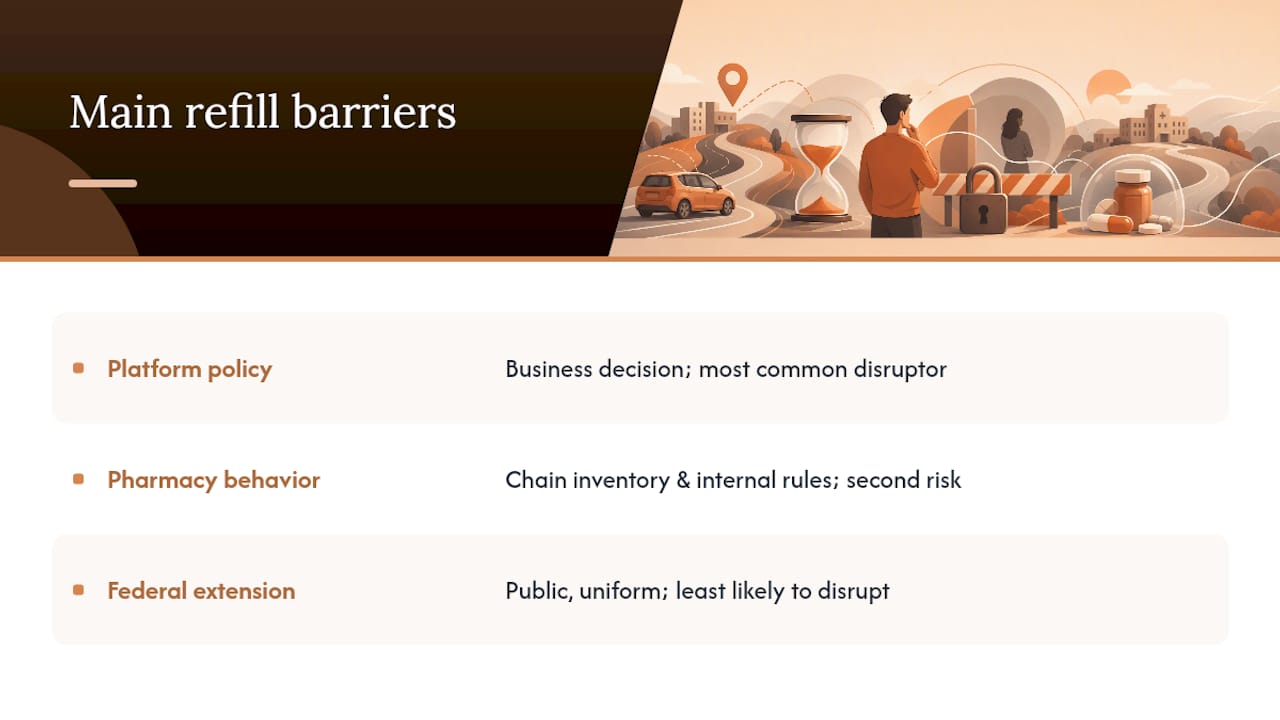
The second underestimated factor is pharmacy behavior, which has nothing to do with your prescriber’s competence and everything to do with chain-level inventory and internal controlled-substance policies that shift without notice. A patient can do everything right, follow every follow-up visit, pass every PDMP check, and still hit a wall at the counter.
If there’s one piece of advice worth taking seriously, it’s this: pick a telehealth provider that treats stimulant management as a core service with a built-in follow-up structure, not an occasional accommodation. That structural commitment matters more than any single rule on the books.
— Jamie
Journeymhw for Ongoing Stimulant Management in Texas and Colorado
Journeymhw exists for exactly the situation this article covers: patients in Texas and Colorado who need reliable, compliant access to stimulant medication management without navigating DEA rulemaking and state statutes on their own. Where a general telehealth search leaves you guessing whether a platform even handles Schedule II prescribing, Journeymhw builds its ADHD care around it, with documented follow-ups already scheduled so you’re not left improvising a refill request at the last minute.
If you’re a Texas resident, our Texas ADHD treatment page covers what to expect. Colorado residents can check the same details on our Colorado ADHD treatment page. Either way, the next step is the same: book an evaluation and get a clear answer on your eligibility and follow-up schedule before your current supply runs low.
Sources
- Telehealth
- DEA Announces Three New Telemedicine Rules that Continue to Open Access to Telehealth Treatment while Protecting Patients
- New Jersey expands Telemedicine Rules for Schedule II controlled drug substances | Nixon Peabody LLP
Recommended
- ADHD Medication Titration: What Patients and Caregivers Should Expect – Journey Mental Health
- Common Telehealth Platform Features for Mental Health – Journey Mental Health
- Combining SSRIs and Stimulants: Safety for ADHD Adults – Journey Mental Health
- Examples of Virtual Psychiatric Treatment Plans – Journey Mental Health