

How to Start Psychiatric Care Quickly: 7 Practical Steps
Starting psychiatric care quickly comes down to three immediate actions: get emergency help if you’re in crisis, contact a behavioral health provider and ask for the earliest available slot or a telehealth option, and gather your ID, insurance card, medication list, and a brief symptom summary before that first call. Those three steps cover the core of what you need to move forward today.
Here’s a quick-start checklist you can work through right now:
- If you’re in crisis: Call 911 or go to the nearest emergency department. If you’re having thoughts of suicide or harming yourself, call or text 988 for free, confidential support.
- Call a behavioral health provider and specifically ask: “Do you have any cancellation openings this week?” and “Do you offer telehealth appointments?”
- Gather key documents: photo ID, insurance card, current medication list with doses, and a one-paragraph note on your main symptoms and when they started.
- Check your insurance: call the member services number on your card and ask for in-network psychiatrists or behavioral health providers.
- Book the first available slot, even if it’s a telehealth visit with a provider you haven’t met. You can always switch later.
Key Takeaways
Starting psychiatric care quickly requires triage first: emergency resources for crises, expedited outpatient routes for distressing but non-dangerous symptoms, with telehealth and cancellation lists as the fastest paths to a first evaluation.
| Point | Details |
|---|---|
| Crisis comes first | Call 911 or go to the ED for active suicidal ideation; call or text 988 for immediate confidential support. |
| Telehealth shortens wait times | Broader clinician pools and same-day slots make telehealth the fastest route for most non-emergency evaluations. |
| Prepare before you call | Have your ID, insurance card, medication list, and a brief symptom summary ready before contacting any provider. |
| Insurance can slow you down | Call your insurer first to check referral requirements; self-pay for the first visit is often faster when prior auth is a barrier. |
| Journeymhw offers same-week care | Adults in Texas and Colorado can book a virtual psychiatric evaluation at journeymhw.com, often within the same week. |
Table of Contents
- Is your situation an emergency, or can you pursue outpatient care?
- What are the fastest ways to see a psychiatrist?
- How do insurance and referrals affect how fast you can start?
- How to prepare for your first psychiatric appointment
- What happens at your first visit, and when does treatment start?
- What can you do while waiting for an appointment?
- How Journeymhw can help you start psychiatric care fast
- Why moving quickly actually matters
- Faster psychiatric care starts with one phone call
- Sources
Is your situation an emergency, or can you pursue outpatient care?
Knowing which path fits your situation saves time and gets you the right level of care.
Go to the emergency department or call 911 if you are:
- Actively suicidal or have a plan to harm yourself or others
- Experiencing a psychotic episode (hallucinations, severe disorganization, inability to recognize reality)
- Unable to care for yourself due to a mental health crisis
- In immediate physical danger
Call or text 988 when you need immediate emotional support but are not in physical danger. The 988 Lifeline connects you to a trained counselor 24 hours a day, 7 days a week, at no cost and with full confidentiality. SAMHSA confirms that 988 also links callers to local crisis teams and community resources, so it’s not just a listening line.
988 is the right first call for distress, not just emergencies. You don’t need to be suicidal to call. Feeling overwhelmed, panicked, or unable to cope qualifies.
Pursue expedited outpatient care when your symptoms are distressing but not immediately dangerous. Same-day telehealth, cancellation-list appointments, and community mental health centers can often get you seen within days, not weeks.
What are the fastest ways to see a psychiatrist?
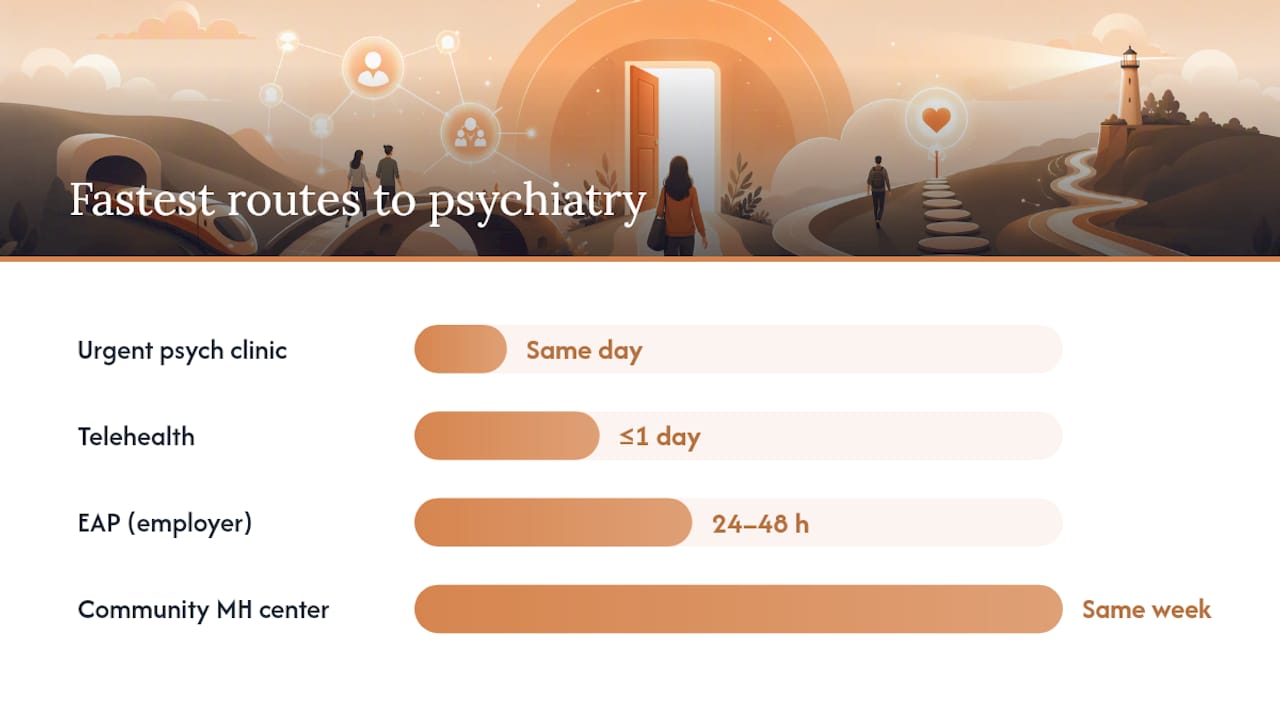
Several routes can shorten the time between today and your first psychiatric evaluation. Each has a different speed advantage.
- Telehealth platforms: Broader clinician pools mean more available slots, including same-day or next-day appointments. Telehealth also removes geography as a barrier, so you’re not limited to providers within driving distance.
- Your primary care physician (PCP): A PCP can often prescribe short-term psychiatric medications while you wait for a specialist, and internal referral networks sometimes unlock faster scheduling than calling a psychiatrist cold.
- Community mental health centers: Federally qualified health centers (FQHCs) and community mental health centers typically offer same-week triage appointments and sliding-scale fees. Search Findtreatment to locate one near you.
- Employee Assistance Programs (EAPs): If your employer offers an EAP, it usually provides free, immediate access to mental health sessions, sometimes within 24–48 hours.
- Student health centers: College and university counseling services often have urgent mental health slots reserved for students in distress.
- Urgent behavioral health clinics: Some cities have walk-in psychiatric urgent care clinics that operate similarly to medical urgent care.
A clinical scheduling guide recommends contacting multiple providers simultaneously, asking each about cancellation lists and telehealth availability, and confirming referral and insurance rules upfront so nothing delays your first visit.
Pro Tip: Tell every provider you contact that you’re flexible on timing and can accept short-notice slots. Providers fill cancellations with patients who are easy to reach and available on short notice. Offering daytime availability dramatically increases your chances of getting in within the week.
How do insurance and referrals affect how fast you can start?
Insurance logistics are one of the most common reasons people delay care. A few quick steps can clear the path.
Call your insurer first. Ask specifically: “Do I need a referral to see a psychiatrist?” and “Which behavioral health providers are in-network near me?” Some plans require a PCP referral before they’ll cover a specialist visit; others allow direct access. Knowing this before you call a psychiatrist saves a round trip.
Prior authorization is the other common slowdown. Some insurers require pre-approval before covering psychiatric medication or certain evaluations. If your provider says prior auth is needed, ask how long it typically takes and whether they can start the process the same day you schedule.
If insurance is slowing you down, self-pay for the first visit is often faster. Many telehealth providers offer transparent flat-rate pricing for an initial evaluation. You can submit the receipt to your insurer afterward for potential out-of-network reimbursement.
For Medicaid and Medicare patients: Both programs cover mental health services, but in-network availability varies by state. Community mental health centers and FQHCs are usually the most reliable in-network options for Medicaid recipients. Medicare Part B covers outpatient mental health services, including telehealth.
Sliding-scale and low-cost options exist at most community mental health centers and through the Open Path Collective, which connects patients with therapists at reduced rates. For affordable mental health care access, payment plans and community resources can make care reachable even without insurance.
How to prepare for your first psychiatric appointment
A well-prepared first visit moves faster and produces a more useful evaluation. MHA recommends bringing a trusted person if you feel very anxious, and having your information organized before you arrive.
Bring or have ready:
- Photo ID and insurance card
- Current medication list (name, dose, frequency, prescribing doctor)
- List of any supplements or over-the-counter medications
- Names of any previous mental health providers and approximate dates of treatment
- Relevant medical records or lab results if you have them
- A written symptom summary (see below)
Your one-page symptom summary should cover:
- Your main concern in one or two sentences
- When symptoms started and whether they’ve gotten better or worse
- How symptoms affect your daily life (sleep, work, relationships)
- Any previous diagnoses, hospitalizations, or medications tried
- Family history of mental health conditions, if known
- A brief safety note: any current thoughts of self-harm (yes or no)
Logistics: Complete any intake forms the provider sends before your appointment. Arrive or log in 10–15 minutes early. If you’re bringing a support person, confirm with the provider in advance that this is welcome. For a detailed first appointment checklist, Journeymhw’s resource covers exactly what to prepare.
What happens at your first visit, and when does treatment start?
A standard initial psychiatric evaluation typically lasts about an hour to an hour and a half. The clinician will review your symptom history, psychiatric and medical background, current medications, and safety status. Expect questions about sleep, mood, energy, concentration, and any past treatment. Goal-setting, meaning what you most want to improve, is usually part of the conversation too.

NIMH notes that treatment typically includes therapy, medication, or both, and that the right combination depends on your diagnosis and personal goals. NAMI confirms that combining therapy and medication often produces better outcomes for conditions like depression and anxiety.
Medication can start the same day in many telehealth models, when clinically appropriate. A follow-up visit to check response and adjust dosing is usually scheduled within a few weeks later. Therapy progress tends to build more gradually, with meaningful change often noticeable after several sessions. If you need faster symptom relief while waiting for therapy to take hold, discuss that directly with your prescriber at the first visit.
For choosing the right psychiatric care plan, whether that’s medication management alone, therapy alone, or combined care, Journeymhw’s guide walks through the decision clearly.
What can you do while waiting for an appointment?
The gap between scheduling and being seen doesn’t have to be passive.
- Build a safety plan: Write down your warning signs, coping strategies, and two people you can call if things get worse. Keep the 988 number saved in your phone.
- Track your symptoms daily: A simple note in your phone (mood, sleep hours, energy level, any significant events) gives your clinician useful data and helps you describe your experience accurately.
- Maintain structure: Consistent sleep and wake times, brief daily movement, and regular meals have a measurable stabilizing effect on mood, even before medication or therapy begins.
- Use peer support: NAMI’s free peer support groups and warmlines (non-crisis emotional support lines) are available in most states and can reduce isolation while you wait.
- Contact your EAP or student health center for interim sessions if your formal appointment is more than two weeks out.
Pro Tip: If your wait is longer than two weeks and your symptoms are worsening, call back and ask to be placed on a cancellation list or request a brief check-in call with a nurse or care coordinator. Most practices can accommodate this.
Financial barriers are real. Sliding-scale clinics, self-pay first visits, and community mental health centers are all practical options covered in detail in Journeymhw’s affordable care guide.
How Journeymhw can help you start psychiatric care fast
Journeymhw is a telehealth platform built for adults in Texas and Colorado who need structured psychiatric care without a long wait. The process is straightforward: complete an online intake form, schedule a virtual evaluation with a licensed clinician, receive a personalized treatment plan, and attend follow-up visits from home.
For adults managing ADHD, anxiety, or depression, Journeymhw offers virtual ADHD evaluations and treatment, anxiety care, and depression treatment, all via secure telehealth. State licensure covers Texas and Colorado; if you’re outside those states, the resources in the next section can help you find a licensed provider in your area.
Pricing is available for both insured and self-pay patients. The structured annual care plan covers evaluations, follow-ups, and medication management in one place, which removes the coordination burden that often slows care down.
Why moving quickly actually matters
The conventional wisdom says “take your time finding the right provider.” That’s reasonable advice for someone in a stable situation. But for someone whose symptoms are affecting work, relationships, or safety, waiting for the perfect fit before starting care is a false economy.
Starting with a good-enough provider, getting an evaluation, and beginning treatment creates momentum. You learn what works for you. You get data. And if the fit isn’t right, switching providers mid-treatment is far less disruptive than waiting months for a first appointment with someone you’ve never met.
Clinical psychologists note that the therapeutic relationship is one of the strongest predictors of treatment success. That’s worth taking seriously. But the relationship can only develop if you start. A first visit with a telehealth provider this week beats a perfect match six months from now.
Open communication matters too. Tell your provider what’s working and what isn’t. If you feel unheard after two or three visits, say so directly, or find someone else. The goal is care that actually helps you function better, not loyalty to a provider who isn’t moving you forward.
Faster psychiatric care starts with one phone call
Adults in Texas and Colorado can access virtual psychiatric evaluations, ADHD testing, and medication management through Journeymhw without a referral or a long wait. The online intake takes minutes, and first appointments are typically available within the same week.
Whether you’re managing ADHD in Texas, depression, or anxiety, Journeymhw’s licensed clinicians deliver structured, personalized care entirely by telehealth. Insurance billing and self-pay options are both available. Visit Journeymhw to check availability and book your first evaluation.
If you need immediate help right now, call or text 988 or call 911.
This article provides general health information and is not a substitute for professional medical advice. Confirm current coverage, licensing, and treatment options with a qualified clinician or your insurer.
Sources
These organizations provide authoritative information, provider locators, and immediate support.
988 Suicide and Crisis Lifeline: Call or text 988 anytime, 24/7, for free and confidential emotional support and connection to local crisis resources. Available by phone, text, and online chat at 988lifeline.
- NIMH — Find Help
- SAMHSA — 988 Lifeline
- NAMI — Treatments and approaches
- How to See a Psychiatrist Quickly: Options and Next Steps
- Choosing a mental health provider: A step-by-step guide | Mental Health America
- 988 Lifeline