

How DSM-5 Shapes an Accurate ADHD Diagnosis
The DSM-5 (and its updated version, the DSM-5-TR) requires a persistent pattern of inattention and/or hyperactivity-impulsivity lasting at least six months, present in two or more settings, causing clear functional impairment, and with several symptoms traceable to before age 12. That framework, published by the American Psychiatric Association, is the clinical standard clinicians use to determine whether someone meets criteria for ADHD. Understanding the role of DSM-5 in ADHD diagnosis matters because the manual’s specific thresholds, wording, and age-adjusted rules directly shape who gets diagnosed, how, and with what level of confidence.
Two symptom domains are evaluated: inattention and hyperactivity-impulsivity. Children and adolescents up to age 16 must meet six or more symptoms in the relevant domain; adults aged 17 and older need only five. According to the PMC summary of DSM-5-TR ADHD criteria, those symptoms must be inconsistent with the person’s developmental level, not better explained by another condition, and documented across multiple life settings. Diagnosis is always clinical. No blood test, brain scan, or online quiz can replace a structured evaluation by a qualified clinician.
Quick-reference thresholds:
| Criterion | Children/Adolescents (≤16) | Adults (17+) |
|---|---|---|
| Symptoms required (per domain) | ≥6 | ≥5 |
| Duration | ≥6 months | ≥6 months |
| Age of onset | Before age 12 | Before age 12 |
| Settings required | 2 or more | 2 or more |
What a complete DSM-5 ADHD evaluation must establish:
- Symptom count meets the age-adjusted threshold in at least one domain
- Symptoms have persisted for six months or longer
- Symptoms were present before age 12
- Impairment is documented in two or more settings (home, school, work, social)
- Symptoms are not better explained by another mental health condition
- A clinician has gathered collateral evidence, not just a self-report
Key Takeaways
The DSM-5-TR provides the diagnostic framework for ADHD, but an accurate diagnosis always requires a clinician-led, multi-step evaluation with cross-setting evidence, not a checklist alone.
| Point | Details |
|---|---|
| Age-adjusted symptom thresholds | Children need ≥6 symptoms per domain; adults aged 17+ need only ≥5, reflecting developmental changes. |
| Four criteria must all be met | Symptoms must last ≥6 months, begin before age 12, appear in 2+ settings, and cause functional impairment. |
| Rating scales are adjuncts | Vanderbilt, Conners, ASRS, and ADHD-RS-5 support clinical judgment but cannot replace a structured interview. |
| Differential diagnosis is required | Anxiety, depression, sleep disorders, ASD, and learning disabilities all share symptom overlap with ADHD. |
| Journeymhw offers telehealth evaluation | Adults in Texas and Colorado can access DSM-5-TR-based psychiatric evaluations and medication management virtually. |
Table of Contents
- The role of DSM-5 in ADHD diagnosis: full criteria breakdown
- How DSM-5 and DSM-5-TR differ from DSM-IV
- How clinicians apply DSM-5 criteria in a real diagnostic process
- Expert tips and common diagnostic pitfalls to watch for
- Limits of the DSM-5 diagnostic approach and areas of controversy
- What to expect in the assessment timeline and cost considerations
- Common rating scales, screening tools, and trusted resources
- When to seek a specialist evaluation and which specialist fits
- Why DSM-5 criteria are necessary but not the whole story
- Telehealth ADHD evaluation through Journeymhw
- Sources
The role of DSM-5 in ADHD diagnosis: full criteria breakdown
The DSM-5-TR organizes ADHD symptoms into two lists. A clinician scores each one against the patient’s reported and observed behavior, then applies the age-adjusted threshold.
Inattention symptoms (9 total)
| Symptom | How it typically presents |
|---|---|
| Fails to give close attention to details or makes careless mistakes | A child loses points on math tests; an adult submits reports with recurring errors |
| Has difficulty sustaining attention in tasks or play | A child can’t finish a worksheet; an adult loses focus in long meetings |
| Does not seem to listen when spoken to directly | Appears distracted even without an obvious external cause |
| Does not follow through on instructions; fails to finish tasks | Starts chores or work projects but rarely completes them |
| Has difficulty organizing tasks and activities | Missed deadlines, cluttered workspace, poor time management |
| Avoids tasks requiring sustained mental effort | Puts off paperwork, homework, or lengthy reading |
| Loses things necessary for tasks | Keys, phones, notebooks, tools |
| Easily distracted by extraneous stimuli | In adults, this often includes internal thoughts, not just external noise |
| Forgetful in daily activities | Misses appointments, forgets to return calls |
Hyperactivity-impulsivity symptoms (9 total)
| Symptom | How it typically presents |
|---|---|
| Fidgets with hands or feet, or squirms in seat | Tapping, leg bouncing, inability to sit still |
| Leaves seat in situations where remaining seated is expected | A child leaves the classroom; an adult gets up repeatedly during meetings |
| Runs or climbs in inappropriate situations | In adults, often reported as a subjective feeling of restlessness |
| Unable to play or engage in leisure activities quietly | Constant movement or noise during downtime |
| “On the go,” acting as if driven by a motor | Adults describe feeling unable to slow down or relax |
| Talks excessively | Interrupts conversations, dominates discussions |
| Blurts out answers before a question is completed | Difficulty waiting for one’s turn in conversation |
| Has difficulty waiting their turn | In lines, conversations, or group activities |
| Interrupts or intrudes on others | Butts into games, conversations, or others’ tasks |
The NCBI Bookshelf diagnostic thresholds table clarifies that the six-versus-five rule reflects how symptom expression changes with development. Many adults present with internalized restlessness rather than visible hyperactivity, which is why the adult threshold and the adult-specific symptom examples in the DSM-5-TR matter so much in practice.
Additional required criteria (all four must be met):
- Symptoms have been present for at least six months.
- Several symptoms were present before age 12.
- Symptoms are present in two or more settings (e.g., home and work, or school and social situations).
- Symptoms cause clear impairment in social, academic, or occupational functioning, and are not better explained by another mental disorder.
Three presentations are specified: predominantly inattentive, predominantly hyperactive-impulsive, and combined. For a deeper look at how the combined presentation is defined, the ADHD combined presentation overview from Journeymhw walks through the distinctions in plain language.
How DSM-5 and DSM-5-TR differ from DSM-IV
The shift from DSM-IV to DSM-5 in 2013 was not cosmetic. Several changes directly affected who could receive a diagnosis, particularly adults.
| Dimension | DSM-IV | DSM-5 / DSM-5-TR |
|---|---|---|
| Age-of-onset criterion | Symptoms before age 7 | Symptoms before age 12 |
| Adult symptom threshold | Same as children (≥6) | Reduced for ages 17+ (≥5) |
| Comorbidity with ASD | Excluded (could not diagnose both) | Allowed (both diagnoses can coexist) |
| Symptom examples | Child-focused language | Adult-adapted examples added |
| Number of subtypes | Three subtypes | Three presentations (terminology change) |
The age-of-onset change from 7 to 12 was designed to better capture adults whose impairing symptoms were less obvious in early childhood. Many adults with genuine ADHD couldn’t reliably recall symptoms before age 7, which caused the DSM-IV criterion to exclude people who likely met the clinical picture. Raising the threshold to age 12 improved sensitivity for adult diagnosis without meaningfully increasing false positives.
The adult symptom-count reduction from six to five is equally significant. Hyperactivity symptoms tend to diminish with age, and requiring the same count as a child would systematically undercount adults with real impairment. The Frontiers in Psychiatry analysis of DSM-5-TR changes notes that the DSM-5-TR retained the same operational structure as DSM-5 while adding clarifying language and updated examples, particularly for adult presentations.
Key practical consequences of these changes:
- Adults who previously did not qualify under DSM-IV may now meet DSM-5 criteria
- Clinicians can now diagnose ADHD alongside ASD when both are clearly present
- Adult-adapted symptom examples reduce the risk of clinicians dismissing internalized symptoms as “not ADHD”
- The wording changes in DSM-5-TR are largely clarifying, not threshold-altering
How clinicians apply DSM-5 criteria in a real diagnostic process
A checklist alone does not make a diagnosis. The CDC’s guidance on diagnosing ADHD is explicit: accurate diagnosis requires a comprehensive evaluation of medical, developmental, and psychosocial history, observer reports, and standardized rating scales, with symptoms confirmed across multiple settings. Here is what that process typically looks like in practice.
Step-by-step diagnostic workflow:
- Initial clinical interview. The clinician takes a detailed history covering symptom onset, duration, and functional impact across home, work or school, and social settings. For adults, this includes asking about childhood symptoms and school records.
- Collateral history. Reports from parents, teachers, partners, or close family members are gathered to verify cross-setting impairment. In telehealth evaluations, this step often involves structured questionnaires sent to informants before the follow-up visit.
- Standardized rating scales. Clinicians use validated instruments to quantify symptom severity and compare scores to normative data.
- Medical rule-outs. A physical exam and relevant labs (thyroid function, vision, hearing) help exclude medical causes of attention or behavior problems.
- Psychological or neuropsychological testing. Ordered when the clinical picture is unclear, when a learning disorder is suspected, or when treatment resistance suggests a missed diagnosis.
- Functional impairment assessment. The clinician documents how symptoms affect daily life: academic performance, job retention, relationships, finances, and safety.
- Diagnostic formulation. The clinician integrates all data against DSM-5-TR criteria, determines the presentation type, notes any comorbidities, and documents the clinical reasoning.
Common rating scales used in ADHD evaluations
| Scale | Age range | Completed by | Primary use |
|---|---|---|---|
| Vanderbilt Assessment Scales | 6–12 | Parents, teachers | Pediatric screening and symptom severity |
| Conners’ Rating Scales (Conners 3) | 6–18 | Parents, teachers, self | Symptom severity and comorbidity screening |
| Adult ADHD Self-Report Scale (ASRS) | 18+ | Self | Adult symptom screening |
| ADHD Rating Scale-5 (ADHD-RS-5) | 5–17 (child); adult version available | Parents, teachers, self | DSM-5-aligned symptom count |

Per CHADD’s stepwise diagnostic process guidance, rating scales are adjuncts. They help gather cross-setting information efficiently, but a clinician who relies on scale scores alone, without a structured interview and collateral history, is not following best practice.
For a patient-facing walkthrough of what to expect during an evaluation, the Journeymhw guide on what happens during an ADHD diagnostic test covers the process in plain, accessible terms.
Pro Tip: Before your evaluation, gather three to five concrete examples of how your symptoms have interfered with work, school, or relationships in the past six months. Written examples are more useful to a clinician than general descriptions, and they speed up the collateral-verification step considerably.
Expert tips and common diagnostic pitfalls to watch for
Even experienced clinicians can fall into patterns that compromise diagnostic accuracy. Knowing these pitfalls helps you ask better questions and advocate for a thorough evaluation.
- Over-reliance on rating scales. A high score on the ASRS or Vanderbilt does not equal a diagnosis. CDC clinical care guidance warns explicitly against using checklists as standalone tools. Scales quantify symptoms; they do not establish cross-setting impairment, rule out other conditions, or confirm developmental history.
- Single-informant evaluations. When a clinician relies only on the patient’s self-report, symptoms in other settings go unverified. For adults, this is especially risky because self-perception of attention difficulties can be distorted by anxiety, depression, or compensatory strategies built up over years. Gathering reliable collateral history often means contacting partners, family members, or long-term friends.
- Missing comorbidities. Anxiety, depression, sleep disorders, learning disabilities, and ASD all share symptom overlap with ADHD. The Merck Manual’s clinical summary stresses that attention to coexisting disorders is non-negotiable in a complete evaluation. Missing a comorbidity can lead to partial treatment response and ongoing impairment. For a closer look at how these conditions overlap, the Journeymhw article on overlapping symptoms of ADHD, anxiety, and depression is a useful reference.
- Cultural and contextual misinterpretation. Symptom expression varies across cultural contexts, and behaviors that look like inattention or hyperactivity in one setting may reflect language barriers, trauma responses, or environmental stressors. Clinicians should contextualize symptom reports before attributing them to ADHD.
- Anchoring on the referral diagnosis. When a patient arrives with a prior label, clinicians sometimes confirm rather than evaluate. An independent, fresh clinical interview is the standard, regardless of prior documentation.
- Skipping the developmental history for adults. The age-of-onset criterion requires evidence of symptoms before age 12. For adults, this means asking about childhood school performance, report cards, and early behavioral patterns, not just current symptoms.
Pro Tip: If you suspect your evaluation was incomplete, ask your clinician directly: “Were collateral reports gathered?” and “What conditions were ruled out?” A thorough clinician will welcome those questions. If the answer is unclear, a second opinion from a specialist is reasonable. For more on how misdiagnosis happens and what to check, the Journeymhw piece on why ADHD misdiagnosis happens in adults covers the most common errors in detail.
Limits of the DSM-5 diagnostic approach and areas of controversy
The DSM-5-TR is the best available clinical tool for standardizing ADHD diagnosis, but it has real limitations that researchers and clinicians openly debate.
- No biological marker. As the Frontiers in Psychiatry critique documents, ADHD diagnosis remains entirely descriptive. No blood test, neuroimaging result, or genetic marker currently confirms or rules out ADHD. Critics argue this creates circularity: the criteria define the disorder, and the disorder is defined by the criteria.
- Symptom overlap with other conditions. Inattention is a feature of anxiety, depression, sleep deprivation, trauma, thyroid disorders, and learning disabilities. Hyperactivity and impulsivity appear in bipolar disorder, ASD, and substance use disorders. A clinician who does not conduct a thorough differential diagnosis risks attributing symptoms to ADHD that belong elsewhere. The Journeymhw resource on common misdiagnoses involving ADHD, anxiety, and depression outlines the most frequent diagnostic confusions.
- Potential for over- and under-identification. The descriptive, threshold-based approach means that someone with four symptoms causing severe impairment does not qualify, while someone with six mild symptoms technically does. Clinical judgment must fill that gap. Some researchers raise concerns about overdiagnosis in certain populations; others point to persistent underdiagnosis in women, older adults, and minority groups whose presentations differ from the male-child prototype the original criteria were built around.
- Online screening tools are not diagnoses. PMC clinical guidance is clear that online quizzes and single-informant questionnaires are inadequate for formal diagnosis. They can prompt someone to seek evaluation, which is valuable, but a positive screen is not a clinical finding.
A note on prevalence: Global ADHD prevalence estimates in children range widely across studies, reflecting genuine variation in diagnostic practices, cultural factors, and the criteria version applied. The NIMH ADHD information page provides accessible, up-to-date prevalence context for readers who want to understand how common the diagnosis is.
The most defensible position is this: DSM-5-TR criteria are necessary but not sufficient. They provide the structure; clinical judgment, collateral history, and differential diagnosis provide the accuracy.
What to expect in the assessment timeline and cost considerations
Understanding the typical sequence helps you prepare and reduces the chance of needing repeat visits.
Typical assessment sequence:
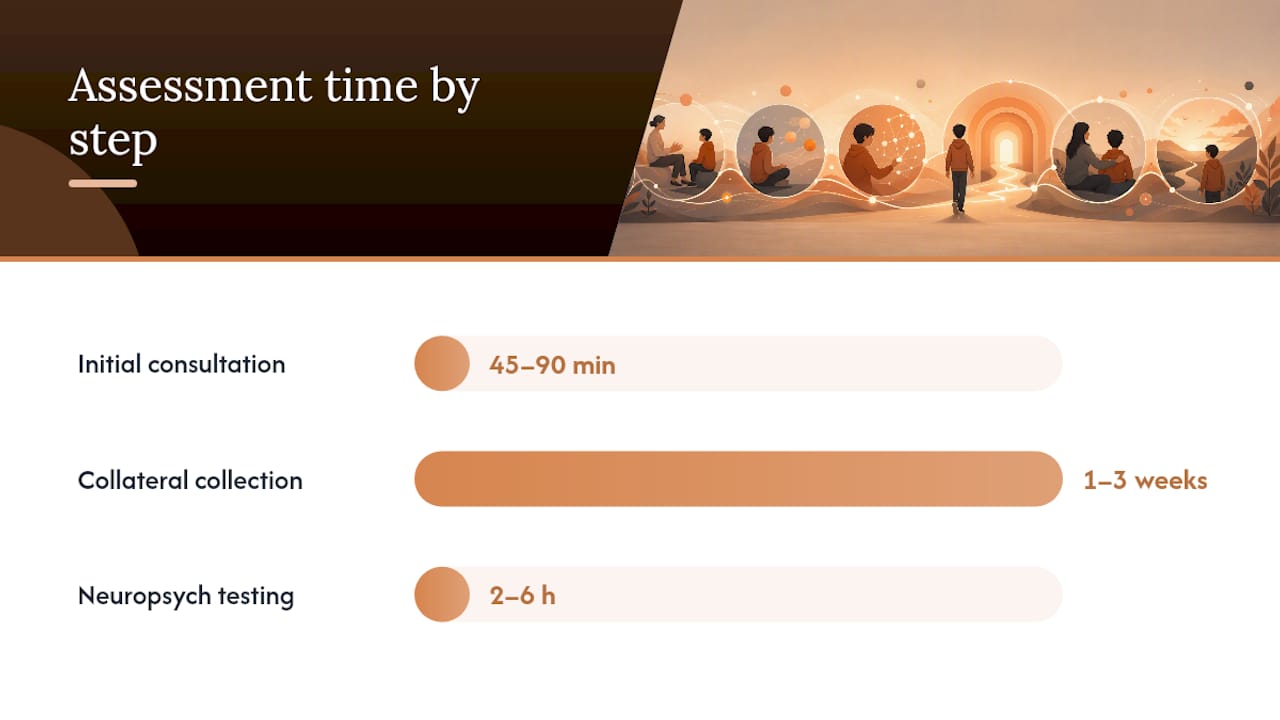
- Initial consultation (visit 1). The clinician takes a full history, reviews prior records, and identifies what collateral information is needed. Duration: 45–90 minutes.
- Collateral collection (between visits). Rating scales are sent to parents, teachers, partners, or employers. School records, prior evaluations, and medical records are gathered. This step can take one to three weeks depending on how quickly informants respond.
- Follow-up visit (visit 2). The clinician reviews collateral data, completes the diagnostic formulation, discusses findings, and outlines a treatment plan. Some evaluations require a third visit if testing is ordered.
- Neuropsychological testing (if indicated). A separate referral, typically two to six hours of standardized testing administered by a psychologist. Not required for every evaluation, but recommended when a learning disorder, traumatic brain injury, or complex comorbidity is suspected.
Tests and exams you may encounter:
- Physical exam and medical history review
- Vision and hearing screening (especially for children)
- Thyroid function panel or other targeted labs
- Standardized rating scales (Vanderbilt, Conners, ASRS, ADHD-RS-5)
- Neuropsychological battery (when clinically indicated)
On costs: Evaluation costs vary considerably by provider type, geographic location, and insurance coverage. Telehealth evaluations through in-network providers are often reimbursable under major insurance plans, but coverage for neuropsychological testing varies widely. Always verify your specific benefits before scheduling. The CHADD diagnostic process resource includes guidance on navigating insurance and referral pathways.
Pre-visit checklist to speed the process:
- Gather school report cards, prior evaluations, or IEP/504 documents
- List all current medications and supplements
- Identify two to three collateral contacts willing to complete rating scales
- Write down five to eight specific examples of how symptoms affect daily functioning
- Note any family history of ADHD, anxiety, depression, or learning disorders
For a detailed adult-specific preparation guide, the Journeymhw ADHD testing process guide for adults walks through each step.
Common rating scales, screening tools, and trusted resources
Rating scales are clinical adjuncts, not diagnostic conclusions. Each instrument below serves a specific purpose and population.
- Vanderbilt Assessment Scales. Designed for children ages 6–12. Parent and teacher versions capture symptom frequency and functional impairment across home and school settings. Widely used in pediatric primary care and freely available through the American Academy of Pediatrics.
- Conners’ Rating Scales (Conners 3). Covers ages 6–18 with parent, teacher, and self-report versions. Includes subscales for comorbid conditions like anxiety and oppositional behavior, making it useful when the clinical picture is complex.
- Adult ADHD Self-Report Scale (ASRS v1.1). An 18-item self-report tool developed in collaboration with the World Health Organization. The six-item screener is widely used in primary care to identify adults who warrant a full evaluation. Available through the NIMH and APA.
- ADHD Rating Scale-5 (ADHD-RS-5). Directly maps to DSM-5 symptom language. Available in parent-rated and teacher-rated versions for children and a self-report version for adults. Useful for tracking symptom change over time during treatment.
On digital and computerized testing: NICE guideline NG87 notes that tools like the QbTest may be used as optional adjuncts for ages 6–17 in certain clinical contexts, but they do not replace specialist clinical assessment. No computerized test currently meets the standard for standalone diagnosis.
Scales support the clinical interview. They do not replace it. A clinician who hands you a questionnaire and issues a diagnosis without a structured interview and collateral history is not following established guidelines.
Authoritative resources for further reading:
- CDC — Diagnosing ADHD: clinical guidance and patient-facing summaries
- NIMH — ADHD: What You Need to Know: accessible overview of features, diagnosis, and treatment
- Merck Manual Professional — ADHD: clinical criteria summary and comorbidity guidance
When to seek a specialist evaluation and which specialist fits
A primary care provider can initiate an ADHD evaluation, but certain situations call for specialist involvement from the start.
Red flags that warrant specialist referral:
- Significant comorbidities (anxiety, depression, ASD, bipolar disorder, substance use)
- Unclear or inconsistent symptom history across settings
- Suspected learning disorder or intellectual disability
- Prior treatment with stimulants without adequate response
- Diagnostic uncertainty after an initial evaluation
- Complex developmental history or trauma background
Which specialist to choose:
- Psychiatrist. Conducts clinical interviews, makes diagnoses, and manages medication. Best choice when medication management is a likely next step or when comorbid psychiatric conditions are present.
- Psychologist. Provides psychological testing, diagnostic clarification, and behavioral therapy. Best when neuropsychological testing is needed or when medication is not the primary treatment goal.
- Neuropsychologist. Administers comprehensive cognitive and achievement testing. Best when a learning disorder, traumatic brain injury, or complex cognitive profile is suspected alongside ADHD.
- Developmental pediatrician. Specializes in children with developmental, behavioral, and learning concerns. Best for younger children with complex presentations.
NICE guideline NG87 recommends that ADHD be diagnosed only by specialists with appropriate training, and that rating scales and observations serve as adjuncts rather than the basis for diagnosis.
On telehealth: Telehealth psychiatric evaluations can meet the standard for a thorough ADHD assessment when the clinician conducts a structured interview, gathers collateral information, and applies DSM-5-TR criteria systematically. State licensing limits apply: a clinician licensed in Texas can only evaluate and treat patients located in Texas at the time of the visit, and the same applies to Colorado. In-person neuropsychological testing cannot be replicated via telehealth and requires an in-person referral when indicated.
Why DSM-5 criteria are necessary but not the whole story
The DSM-5-TR gives clinicians a shared language and a defensible threshold. That is genuinely valuable. Without it, ADHD diagnosis would vary so widely across providers that a diagnosis in one clinic would mean something entirely different in another. Standardization protects patients.
But the criteria are a floor, not a ceiling. The manual describes what symptoms look like; it does not explain why they occur, how severe they are in a given person’s life, or how they interact with that person’s specific history, culture, and circumstances. A clinician who treats the DSM-5 checklist as a finish line, rather than a starting point, is likely to miss the nuance that separates a careful diagnosis from a hasty one.
What actually matters in practice is the integration of criteria with clinical judgment. A patient who meets five of the required six inattention symptoms but has profound functional impairment across every life domain deserves a careful conversation, not a checkbox rejection. Conversely, someone who scores high on a self-report scale but whose symptoms are fully explained by untreated anxiety should not receive an ADHD diagnosis simply because the numbers align. The ADHD and anxiety overlap resource from Journeymhw illustrates exactly how easy it is to confuse the two without a thorough differential.
The most accurate evaluations we see are the ones where the clinician treats the DSM-5 criteria as a rigorous guide and the patient’s full story as the context that gives those criteria meaning.
Telehealth ADHD evaluation through Journeymhw
If you are in Texas or Colorado and want an evidence-informed ADHD evaluation without the months-long wait that often comes with in-person psychiatric referrals, Journeymhw offers virtual psychiatric evaluations built around the same DSM-5-TR criteria and multi-step process this article describes.
The process starts with an initial consultation where a licensed clinician takes a full history, identifies collateral sources, and rules out common differential diagnoses. From there, you move to a diagnostic formulation visit and, when appropriate, a structured medication management plan tailored to your presentation. Journeymhw sees adults in Texas and Colorado; verify your insurance coverage before booking, as reimbursement varies by plan. To get started, book an initial consultation and bring your collateral contacts, prior records, and a list of specific examples of how symptoms affect your daily life. That preparation makes the first visit more productive and gets you to a clear answer faster.
Sources
- CDC — Diagnosing ADHD
- PMC article summarizing DSM-5-TR ADHD criteria
- Frontiers in Psychiatry — ADHD in the DSM-5-TR: What has changed and what has not
- CHADD — The ADHD Diagnostic Process
- Merck Manual Professional — ADHD
This article provides general educational information about DSM-5 ADHD diagnostic criteria and is not a substitute for professional medical or psychiatric advice. Consult a qualified clinician for a formal evaluation and to confirm current diagnostic standards applicable to your situation.