

What Role Does Dopamine Play in ADHD?
Altered dopamine signaling contributes to core ADHD symptoms, but it does not explain the condition on its own. A 2024 review synthesizing decades of human and animal research found consistent evidence that dopamine pathways are disrupted in ADHD, yet no proof that patients share a single, uniform “low dopamine” state. Brain imaging tells a similarly mixed story: one PET study of 53 unmedicated adults with ADHD found regionally lower dopamine receptor availability compared with 44 controls, while a separate amphetamine challenge study found the opposite pattern, an exaggerated dopamine release in treatment-naive adults.
Here’s what that contradiction actually means for you or someone you care for:
- Dopamine dysfunction is real and measurable, but it looks different from person to person.
- Stimulant medications that target dopamine transport remain the most effective treatment class available, helping roughly 70% of patients who try them.
- Genetics, brain development, and other neurotransmitters all shape how dopamine problems show up as attention, impulsivity, or motivation struggles.
The rest of this guide walks through the biology, the evidence, what your medication is actually doing to your brain, and how to talk with a clinician about the option that fits your specific presentation.
Key Takeaways
Dopamine dysfunction shapes attention, impulsivity, and motivation in ADHD, but it operates through multiple distinct patterns rather than one uniform deficit, which is why personalized medication management outperforms a one-size-fits-all approach.
| Point | Details |
|---|---|
| Dopamine is necessary but not sufficient | Genetics, other neurotransmitters, and brain development all shape how ADHD presents alongside dopamine dysregulation. |
| Imaging findings vary by person | Some studies show reduced receptor availability, others show hypersensitive dopamine release, reflecting real subgroup differences. |
| Stimulants remain highly effective | About 70% of patients respond to stimulant treatment, with a number needed to treat near 2. |
| Treatment can lower long-term risk | Managed stimulant treatment is linked to reduced substance-use disorder risk compared with untreated ADHD. |
| Personalized care matters most | Journeymhw pairs virtual ADHD evaluations with structured medication management to match treatment to your specific symptom profile. |
Table of Contents
- The Dopamine Function in ADHD: A Quick Primer on the System Involved
- What the Research Actually Shows About Dopamine Levels in ADHD
- How Dopamine Signaling Translates Into ADHD Symptoms
- Treatment Targeting Dopamine in ADHD: How the Major Medication Classes Work
- What the Numbers Say About Efficacy, Side Effects, and Safety
- What Recent Dopamine Research Means for Your Treatment
- What Dopamine Doesn’t Explain About ADHD
- Getting Evaluated and Managing Medication: What to Expect
- Lifestyle Supports That Work Alongside Dopamine-Targeted Treatment
- Why This Nuance Matters More Than a Clean Answer
- How Journeymhw Approaches Dopamine-Informed ADHD Care
- Frequently Asked Questions
- Sources
The Dopamine Function in ADHD: A Quick Primer on the System Involved
Before the evidence makes sense, you need a working picture of what dopamine does and where it acts. Dopamine is a neurotransmitter that shapes motivation, reward processing, attention, and the executive functions that let you plan, inhibit impulses, and hold information in mind. It does not work like a simple volume dial. It operates through distinct receptor families, a reuptake system, and two very different modes of release, and each of those pieces shows up in ADHD research in a different way.
A short glossary worth keeping in mind as you read:
- DAT (dopamine transporter): the protein that pulls dopamine back into the neuron after it’s released, effectively ending its signal. Stimulant medications target this directly.
- D1–D5 receptors: dopamine binds to five receptor subtypes, grouped into the D1 family (D1, D5) and the D2 family (D2, D3, D4). D1-family receptors tend to support working memory and sustained focus; D2-family receptors are more involved in reward and response inhibition.
- Tonic dopamine: a slow, steady background level of dopamine that sets baseline alertness and attentional readiness.
- Phasic dopamine: rapid, short-lived bursts released in response to a reward, a novel stimulus, or an unexpected event.
- Mesocorticolimbic pathway: the dopamine circuit running from the midbrain to the prefrontal cortex and limbic structures, central to motivation and reward.
- Nigrostriatal pathway: the dopamine circuit connecting the substantia nigra to the striatum, mostly associated with movement but also implicated in habit formation.
Three brain regions come up again and again in ADHD research. The prefrontal cortex governs planning, working memory, and impulse control, the functions most visibly disrupted in ADHD. The striatum, split into dorsal and ventral portions, handles reward prediction, motivation, and movement initiation, which is why reward-based interventions often work well for ADHD symptoms. The ventral tegmental area (VTA) is the origin point for much of the brain’s dopamine supply, feeding both the prefrontal cortex and the striatum. When researchers talk about “dopamine and ADHD,” they are almost always talking about disruptions somewhere along this VTA-to-striatum-to-prefrontal-cortex circuit, not a single missing chemical.
What the Research Actually Shows About Dopamine Levels in ADHD
The evidence connecting dopamine to ADHD comes from four different scientific approaches, and each one tells part of the story rather than the whole thing.
Genetics point toward receptor and transporter variation as a real risk factor. A systematic meta-analysis found that polymorphisms in DRD5, DRD2, and DRD4, the genes coding for specific dopamine receptors, are associated with increased ADHD risk. The dopamine transporter gene, DAT1, has been studied just as heavily; certain variants appear to affect how efficiently dopamine gets cleared from synapses, which in turn affects how long a dopamine signal lingers before it fades.
Imaging studies are where the picture gets genuinely complicated. PET and SPECT scans, which use radioactive tracers to visualize receptor density and transporter activity, have produced inconsistent results across the ADHD imaging literature. Some studies find decreased dopamine receptor availability, some find increased extracellular dopamine, and others find no significant difference between ADHD and control groups at all. Part of that inconsistency comes down to methodology: sample sizes in these studies are often small, and whether participants were medication-naive or previously treated with stimulants changes the readings substantially, since stimulant history can itself alter receptor density over time.
The imaging paradox: the JAMA study of 53 unmedicated adults found lower D2/D3 receptor availability, while the amphetamine challenge study of 15 treatment-naive men found augmented striatal dopamine release. Both are legitimate findings in ADHD populations. The likely explanation is that ADHD includes multiple dopaminergic subtypes, not one signature deficit.
Challenge studies, where researchers give a controlled dose of a dopamine-releasing drug and measure the brain’s response, offer some of the clearest mechanistic insight. In one such study, 15 treatment-naive adult men with ADHD (average age just under 30) received 0.3 mg/kg of d-amphetamine while researchers tracked dopamine release using [11C]raclopride PET imaging, compared against 18 healthy controls. The ADHD group showed a markedly larger striatal dopamine response to the same dose. Critically, the men whose brains released the most dopamine in response to the challenge also performed the worst on response inhibition tasks and reported the highest inattention. That finding runs counter to the old assumption that ADHD brains are simply dopamine-starved; in this sample, it was dopamine hypersensitivity, not deficiency, that tracked with worse symptoms.
Animal models round out the picture by letting researchers manipulate dopamine genes and transporters directly. Mice engineered with reduced DAT function show hyperactivity and impulsive behavior patterns that mirror ADHD phenotypes, giving researchers a way to test causal mechanisms that human studies can only observe indirectly. These models consistently support the idea that dopamine transport and receptor signaling shape attention and impulse control, even as they can’t fully capture the complexity of a human neurodevelopmental disorder.
How Dopamine Signaling Translates Into ADHD Symptoms
The tonic-phasic model gives the clearest bridge between brain chemistry and the symptoms you actually notice day to day. Low tonic dopamine, that steady background hum, tends to correlate with poor sustained attention and difficulty staying engaged with tasks that aren’t inherently rewarding. Exaggerated phasic dopamine bursts, on the other hand, are linked to impulsivity and difficulty inhibiting responses, essentially, the brain overreacts to something novel or rewarding before executive control can step in.

Receptor subtype matters here too. D1-family receptors support the sustained neural firing patterns that working memory depends on; when D1 signaling is disrupted, people struggle to hold instructions or multi-step plans in mind. D2-family receptors are more tied to reward prediction and inhibitory control, so variation in D2 signaling shows up more as impulsive decision-making and difficulty stopping an action once it’s started.
That framework maps onto real symptom clusters clinicians see constantly:
- Someone who can hyperfocus on a video game for hours but can’t sustain attention on a work report may have relatively intact phasic response but weak tonic regulation, the reward is providing the phasic boost that compensates.
- Someone who interrupts conversations or makes impulsive purchases may be dealing with exaggerated phasic bursts overwhelming inhibitory control, consistent with the amphetamine challenge findings above.
- Someone who forgets multi-step instructions despite trying hard may have working-memory deficits tied to weaker D1-family signaling in the prefrontal cortex.
None of these map perfectly to one neurotransmitter change. But the tonic-phasic and receptor-subtype framework explains why two people with the same ADHD diagnosis can present so differently, and why one medication that works well for one person can feel wrong for another.
Treatment Targeting Dopamine in ADHD: How the Major Medication Classes Work
Every first-line ADHD medication acts somewhere along the dopamine pathway, but the mechanisms differ enough that the choice between them is rarely arbitrary. Here’s what each class actually does at the synapse.
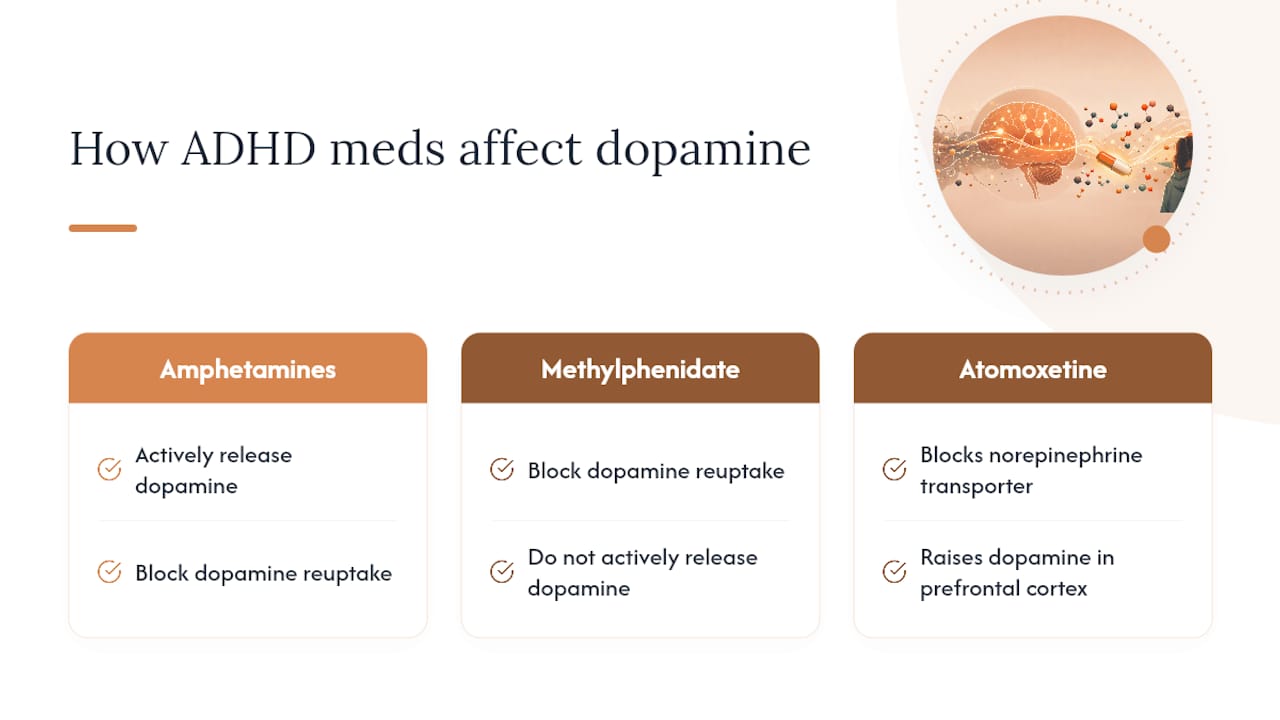
Amphetamines (including mixed amphetamine salts and lisdexamfetamine) work through a dual mechanism: they enter the neuron and reverse the direction of the dopamine transporter, actively pushing dopamine out into the synapse, while also blocking its reuptake. This makes them the most potent dopamine-releasing agents in the ADHD toolkit.
Methylphenidates (including the immediate-release and extended-release formulations) work more narrowly. They block the DAT reuptake pump without triggering active release, meaning they raise dopamine levels by preventing its removal rather than forcing it out. That mechanistic difference is part of why methylphenidates are often considered to have a somewhat gentler onset profile than amphetamines, even though both classes are highly effective.
Atomoxetine takes a different route entirely. It’s selective for the norepinephrine transporter (NET) rather than DAT, but because the prefrontal cortex has relatively few dopamine transporters and relies on NET to help clear dopamine too, atomoxetine indirectly raises dopamine specifically in that region. It’s non-stimulant, has no meaningful abuse potential, and tends to take several weeks to reach full effect.
Bupropion, technically an antidepressant used off-label for ADHD, inhibits reuptake of both dopamine and norepinephrine, giving it a milder stimulant-like effect without classification as a controlled substance.
Guanfacine and clonidine, the alpha-2 agonists, don’t touch dopamine transport directly. Instead, they strengthen prefrontal cortex signaling by acting on adrenergic receptors, which improves the neural environment in which dopamine and norepinephrine operate. They’re often used alongside stimulants or for patients who can’t tolerate stimulant side effects.
| Medication class | Mechanism on dopamine | Typical efficacy | Onset & formulations | Common side effects | Abuse/diversion potential | Typical use |
|---|---|---|---|---|---|---|
| Amphetamines | Reverses DAT, actively releases DA | High; core stimulant class | Fast onset; IR and XR available | Appetite loss, insomnia, elevated heart rate | Higher; Schedule II | Children through adults |
| Methylphenidates | Blocks DAT reuptake | High; comparable to amphetamines | Fast onset; IR, XR, patch forms | Appetite loss, jitteriness, headache | Moderate to high; Schedule II | Children through adults |
| Atomoxetine | Indirect DA increase in prefrontal cortex via NET blockade | Moderate; slower to build | Gradual, full effect in weeks | Nausea, fatigue, mild blood pressure changes | Low; non-controlled | Alternative when stimulants are contraindicated |
| Bupropion | Inhibits DA and NE reuptake | Moderate; off-label use | Gradual; daily dosing | Dry mouth, insomnia, seizure risk at high doses | Low; non-controlled | Adults, especially with comorbid depression |
| Guanfacine/clonidine | No direct DAT/receptor action; supports prefrontal signaling via alpha-2 receptors | Moderate; often adjunctive | Gradual; extended-release forms | Sedation, low blood pressure, dry mouth | Very low; non-controlled | Adjunct or alternative, all ages |
Formulation choice matters as much as drug class. Immediate-release stimulants act fast but wear off in a few hours, requiring multiple daily doses and creating more visible peaks and troughs. Extended-release versions smooth that curve out, reducing the rebound effects some patients feel as a dose wears off. Titration typically starts low and increases gradually, because the “right” dose depends on individual dopamine sensitivity, not body weight alone, which is exactly why the amphetamine challenge research above matters clinically: two patients can need very different doses for reasons rooted in their own dopamine physiology.
What the Numbers Say About Efficacy, Side Effects, and Safety
Stimulant medications are, by a wide margin, the most effective pharmacologic option for ADHD available today. Clinical summaries put response rates around 70% of patients, with a number needed to treat of approximately 2, meaning that for every two patients treated, roughly one experiences a clear, clinically meaningful improvement in core symptoms beyond what a placebo would produce. That’s a strong effect size for a psychiatric medication class.
By the numbers: stimulants help an estimated 70% of patients respond meaningfully, with an NNT near 2, according to clinical guideline summaries. Few psychiatric treatments hit that combination of effectiveness and speed.
The side-effect profile clusters predictably around dopamine’s other jobs in the body. Appetite suppression and sleep disruption are the most commonly reported issues with stimulants, since dopamine and norepinephrine signaling influence hunger and arousal regulation well beyond the prefrontal cortex. Elevated heart rate and blood pressure show up often enough that baseline cardiovascular screening before starting treatment, and periodic monitoring afterward, is standard practice. Mood changes and rebound irritability as a dose wears off are also worth tracking, particularly in the first few weeks.
The substance-use question deserves a direct answer, because it’s the one that worries patients and parents most. Untreated ADHD itself carries a higher baseline risk of developing a substance use disorder, likely tied to the same dopamine dysregulation that produces impulsivity and reward-seeking behavior. The counterintuitive finding from the treatment literature is that appropriately managed stimulant treatment is associated with a reduced long-term SUD risk compared with leaving ADHD untreated. Stimulants prescribed and monitored through structured medication management are not the same exposure as unsupervised or recreational use, and the outcome data reflects that distinction clearly.
What Recent Dopamine Research Means for Your Treatment
The 2024 Frontiers review that anchors much of this article’s evidence reached a conclusion worth sitting with: dopamine is clearly involved in ADHD, but the field has moved past the old idea that everyone with ADHD shares one uniform hypo-dopaminergic brain state. The reviewers found evidence pointing in multiple directions, decreased signaling in some regions and subgroups, increased or hypersensitive signaling in others, and argued that future research needs to focus on identifying these subgroups rather than searching for a single unifying deficit.
That shift matters practically, not just academically.
- The amphetamine challenge data showing exaggerated phasic dopamine release in some treatment-naive adults suggests a meaningfully different underlying mechanism than a simple deficiency model.
- Patients whose impulsivity stems from dopamine hypersensitivity may respond differently to titration than patients whose primary struggle is sustained attention tied to low tonic tone.
- This heterogeneity is part of why one stimulant can work well for one patient and poorly for another, even at comparable doses.
Pro Tip: Ask your prescriber what specific symptom cluster you’re targeting, sustained attention, impulse control, or working memory, since that conversation often shapes which medication class and formulation makes sense before you even start titrating.
What Dopamine Doesn’t Explain About ADHD
Dopamine is a major piece of the ADHD puzzle, not the whole picture. Treating it as the sole cause oversimplifies a condition that researchers now understand as polygenic and multifactorial. Dopamine interacts constantly with norepinephrine, serotonin, and GABA, and disrupting one system triggers compensatory changes in the others, which is part of why isolating dopamine’s exact contribution in any single patient is so difficult.
A few honest caveats worth carrying with you:
- Imaging inconsistencies aren’t just noise. They likely reflect real biological heterogeneity, small sample sizes, and the limits of current PET/SPECT ligands, which can’t distinguish every relevant receptor state.
- Medication-naive versus previously treated status changes imaging results substantially, meaning much of the older literature may be comparing genuinely different populations.
- The phrase “chemical imbalance” is a shorthand that undersells developmental, environmental, and structural contributors to ADHD, and leaning on it too heavily can make patients feel like their brain is simply broken rather than differently wired in specific, addressable ways.
Getting Evaluated and Managing Medication: What to Expect
If you suspect ADHD or you’re already diagnosed and considering medication, a structured evaluation makes the entire process smoother and safer.
What to bring to your evaluation:
- A history of symptoms across settings (work, home, school) and how long they’ve persisted, since ADHD requires childhood-onset symptoms even when diagnosed in adulthood.
- Any prior mental health diagnoses or treatments, including medications tried and how you responded.
- A family history of ADHD or related conditions, given the strong genetic contribution.
- A honest account of substance use, since this shapes both diagnosis and medication safety planning.
Clinicians typically order baseline measures before starting a stimulant: blood pressure and heart rate, weight, a sleep history, and a substance-use screen. These aren’t formalities. They establish the reference point your prescriber needs to catch side effects early and confirm the medication is a safe fit for your cardiovascular profile.
What happens after diagnosis usually follows this sequence:
- Your clinician selects a starting medication class based on your symptom profile, age, comorbidities, and any personal or family history of substance use.
- You begin at a low dose, with a scheduled follow-up, often within two to four weeks, to assess response and side effects.
- Dosage adjusts gradually based on how you respond, since individual dopamine sensitivity varies enough that the textbook dose rarely fits everyone identically.
- Ongoing psychiatric follow-up continues at regular intervals to monitor efficacy, side effects, and any need to adjust formulation or class.
Seek urgent care rather than waiting for a routine follow-up if you experience chest pain, significant heart palpitations, severe mood changes, or thoughts of self-harm after starting a new medication. Routine follow-up is appropriate for adjusting doses, managing mild side effects, or reassessing symptom control over time.
Lifestyle Supports That Work Alongside Dopamine-Targeted Treatment
Medication isn’t the only lever available, and for some patients it isn’t the first one worth pulling. Several behavioral and lifestyle interventions support the same dopamine-related functions that medications target, often as a genuine complement rather than a substitute.
- Sleep hygiene: poor sleep degrades prefrontal cortex function independent of dopamine status, and consistent sleep timing measurably improves attention regulation.
- Structured routines: external structure compensates for weaker internal executive control, reducing the cognitive load of self-directed planning.
- Aerobic exercise: regular cardiovascular activity raises baseline catecholamine activity, including dopamine, and shows meaningful effects on attention and mood regulation.
- Dietary patterns: adequate protein intake supports the amino acid precursors dopamine synthesis depends on, though diet alone won’t resolve significant ADHD symptoms.
- Behavioral therapy and executive-skills training: particularly useful for building organizational systems and self-monitoring skills that medication doesn’t teach directly.
These supports tend to work best as adjuncts to structured ADHD treatment rather than as standalone replacements for it, especially for moderate to severe presentations.
Pro Tip: Introduce one lifestyle change at a time alongside medication, rather than several at once, so you and your clinician can actually tell which change is driving improvement when you review your symptoms at follow-up.
Why This Nuance Matters More Than a Clean Answer
The temptation with any brain chemistry topic is to want a clean, single-cause story. Dopamine doesn’t offer one, and pretending otherwise does patients a disservice. What the evidence actually supports is something more useful: a handful of distinct dopaminergic patterns, some hyposensitive, some hypersensitive, that produce overlapping but mechanistically different symptoms.
That distinction should shape how you and your clinician talk about treatment. A patient whose challenge-study profile would show exaggerated phasic release is not the same clinical problem as a patient with genuinely blunted tonic tone, even though both might carry an ADHD diagnosis. Structured, ongoing medication management, the kind built around real follow-up rather than a single prescription handed over and forgotten, is what lets that nuance actually inform care instead of staying buried in a research review nobody in the exam room has time to read.
How Journeymhw Approaches Dopamine-Informed ADHD Care
Understanding the mechanism behind your symptoms only helps if it translates into a treatment plan built around you specifically, not a generic stimulant starter pack. Journeymhw provides virtual psychiatric evaluations and ongoing medication management for adults with ADHD, anxiety, and depression, with the structured follow-up that dopamine-targeted medications genuinely require to work safely.
If you live in Texas or Colorado, you can complete an ADHD evaluation from home, with a clinician reviewing your symptom history, prior treatment attempts, and baseline health measures before recommending a medication class suited to your specific presentation. Journeymhw is not an emergency service; if you’re in crisis, contact local emergency services or a crisis line right away. For routine evaluation and ongoing care, you can book an appointment directly and start the process of finding a treatment plan matched to how your brain actually responds, not just a standard first-line default.
Frequently Asked Questions
Does low dopamine cause ADHD? Not in a simple, direct sense. Research links ADHD to disrupted dopamine signaling, but studies find both decreased and increased dopamine activity depending on the brain region and patient subgroup, so “low dopamine” alone doesn’t capture the full mechanism.
How does dopamine affect ADHD symptoms specifically? Dopamine influences attention through tonic signaling and impulse control through phasic bursts. Weak tonic dopamine tone is linked to poor sustained attention, while exaggerated phasic release has been tied to impulsivity and weaker response inhibition in challenge studies.
Do ADHD medications work by increasing dopamine? Most do, though through different mechanisms. Amphetamines actively release dopamine and block its reuptake, methylphenidates block reuptake alone, and atomoxetine raises dopamine indirectly in the prefrontal cortex by blocking norepinephrine transport there.
Are dopamine receptor genes like DRD4 or DRD2 linked to ADHD risk? Yes. A meta-analysis of dopamine receptor genes found associations between DRD2, DRD4, and DRD5 polymorphisms and increased ADHD risk, supporting a genetic contribution to receptor-level function.
Can ADHD be managed without dopamine-targeting medication? Yes, for some patients. Behavioral therapy, structured routines, exercise, and executive-skills training can meaningfully support attention and self-regulation, particularly for milder presentations or alongside medication for moderate to severe cases.
Is dopamine dysfunction the only cause of ADHD? No. ADHD is polygenic and multifactorial, involving norepinephrine, serotonin, and structural brain development alongside dopamine. Framing it as a single “chemical imbalance” oversimplifies a genuinely complex neurodevelopmental condition.
This article is general information, not a substitute for advice from a qualified doctor. Consult a qualified healthcare professional about your own circumstances before acting on anything here.
Sources
- The dopamine hypothesis for ADHD: An evaluation of evidence accumulated from human studies and animal models
- Amphetamine-Induced Dopamine Release and Neurocognitive Function in Treatment-Naive Adults with ADHD - PMC
- Role of dopamine receptors in ADHD: a systematic meta-analysis