

Skip Long Colorado Psychiatry Waits, Book a Telehealth Visit in 1–6 Weeks
Most Colorado adults booking a virtual psychiatric evaluation can expect to wait a few weeks for a first appointment, with telehealth providers typically scheduling faster than in-person practices. Your actual wait depends heavily on whether a provider is accepting new patients, your insurance network, and whether you need a full evaluation or just a medication check. If you want to move faster, start with a tele-first platform today and confirm new-patient status by phone before you commit to any waitlist.
TL;DR:
- Most Colorado adults can expect a wait of between one and six weeks for a telehealth psychiatric evaluation, with shorter waits if providers specifically screen for new patients.
- Provider acceptance status, especially whether they are accepting new patients for medication management, largely determines wait times, often more than geographic or insurance factors.
- Calling practices directly and asking about immediate openings, including brief med-check slots, can significantly shorten the waiting period.
- Telehealth platforms built around virtual care typically offer faster intake than in-person clinics, which are limited by physical location and capacity.
- Insurance and provider availability are the main bottlenecks, with self-pay options sometimes providing the quickest route to initial care.
Table of Contents
- How Long Are Psychiatry Wait Times in Colorado, Really?
- Why Wait Times Vary So Much From One Provider to the Next
- A Prioritized Checklist to Get Seen Sooner in Colorado
- What Happens During Your First Virtual Psychiatric Evaluation
- Median and Typical Telehealth Wait Times for a First Appointment
- What State-Level Variation Means for Colorado Patients
- Telehealth vs. In-Person: Which Gets You Seen Faster?
- Main Causes of Delay You Should Know About
- Practical Steps to Get Seen Sooner Right Now
- What to Expect at Your First Virtual Evaluation: Timeline and Documentation
- Average Wait Times for In-Person Psychiatric Appointments in Colorado
- Urban vs. Rural Wait Times Within Colorado
- How Psychiatrist Shortages Shape Access in Colorado
- Medicaid vs. Private Insurance: How Coverage Affects Your Wait
- Emergency Psychiatric Care vs. Routine Appointment Scheduling
- How to Find a Colorado Psychiatrist Currently Accepting New Patients
- The Access Gap Nobody Talks About Enough
- Ready to Book Your Virtual Psychiatric Evaluation?
- Sources
- FAQ
How Long Are Psychiatry Wait Times in Colorado, Really?
The best national data point comes from a JAMA Network Health Forum study that surveyed mental health facilities offering telehealth. It found a median wait of about two weeks for a first telehealth appointment, with a wide range depending on the facility. Some states in that dataset saw very short waits; others had waits extending to several weeks.
A separate secret-shopper study paints a starker picture for in-person care. Researchers posing as patients found telepsychiatry appointments came through at a median of 43 days, compared to 67 days for in-person psychiatric visits. Fewer than 1 in 5 psychiatrists in that sample were even available to new patients.
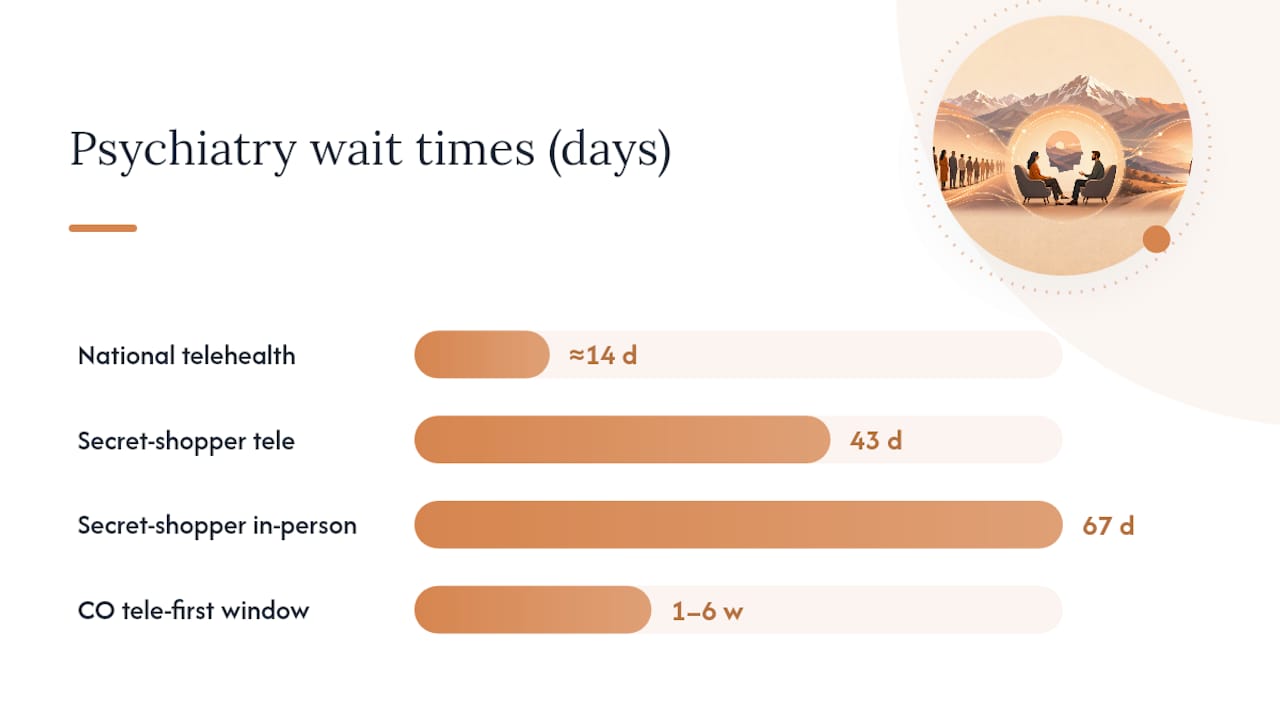
Colorado doesn’t have its own isolated wait-time study, so the honest answer is to treat these national figures as your baseline and adjust for local supply. Denver and Boulder have more psychiatric providers per capita than rural counties, but that doesn’t always translate to shorter waits, since urban demand runs high too.
Key numbers worth remembering:
- Median telehealth wait nationally is approximately two weeks, with wide variation
- Median telepsychiatry wait in secret-shopper sampling is several weeks
- Median in-person psychiatric wait in the same sampling: 67 days
- Medication management is commonly offered by many telehealth facilities accepting new patients
The realistic window: For most Colorado adults, a tele-first psychiatric evaluation lands somewhere between 1 and 6 weeks out. Providers who screen specifically for new-patient openings tend to fall at the shorter end of that range.
Why Wait Times Vary So Much From One Provider to the Next
Provider acceptance status drives more of the variation than anything else. A clinic can look fully staffed on its website and still be closed to new patients, which is the single most common reason psychiatrists gave for turning people away in the secret-shopper research cited above.
Service type matters too. Counseling slots are far easier to find than medication management slots. Among facilities in the JAMA Network Health Forum survey that accepted new patients, 97% offered counseling but only 77% offered medication management, and just 69% offered diagnostic services. If you specifically need a psychiatrist for medication rather than a therapist for talk therapy, you’re competing for a smaller pool of appointments.
A few other factors shape your personal wait:
- Metro versus rural location changes which telehealth services a facility can realistically staff.
- Private versus public ownership affects how quickly a facility adds telehealth capacity.
- Insurance network status can add days or weeks if your plan requires in-network verification before scheduling.
- Urgency level you report at intake, since some platforms fast-track patients flagged as higher risk.
Pro Tip: Ask directly whether a provider offers “brief med-check” telehealth slots. These shorter appointments often have more openings than full 45 to 60 minute evaluation slots, because they’re easier for a psychiatrist’s schedule to absorb between longer visits.
A Prioritized Checklist to Get Seen Sooner in Colorado
Getting past the “not accepting new patients” wall is mostly about how you ask, not just who you ask. Work through this order:
- Call, don’t just browse online. Ask the front desk explicitly: “Are you currently accepting new patients for psychiatric evaluation, and do you have any telehealth-only openings?” Online booking calendars often lag behind real-time availability.
- Ask about brief med-check slots specifically. These fill differently than full evaluations and sometimes open up within days rather than weeks.
- Consider self-pay or private-pay options if insurance scheduling is the bottleneck. Verifying in-network status can itself take a week or more; paying out of pocket for an initial visit sometimes gets you seen while that verification runs in parallel.
- Get on a cancellation list immediately, even at your first call. Cancellation slots are frequently how patients skip the bulk of a waitlist entirely.
- Gather your records before you call anyone. Prior diagnoses, current medication list and dosages, and any recent lab work speed up intake and reduce the chance a clinic asks you to schedule a separate records-review appointment first.
- Choose a tele-first platform over a traditional practice if speed matters most. Facilities built around virtual care are more likely to report real-time telehealth availability, according to JAMA Network Health Forum researchers, which gives self-pay and flexible patients a genuine speed advantage.
Pro Tip: Keep a one-page summary of your mental health history ready before you make your first call. Providers routinely quote faster intake dates to patients who arrive with organized records, since it removes an entire administrative step from their side.
You can review a full walkthrough of this process in our 7-step guide to starting psychiatric care quickly, which covers documentation templates and scripts for the new-patient call.
What Happens During Your First Virtual Psychiatric Evaluation
A first virtual evaluation typically runs 45 to 60 minutes. Expect a structured history review, standardized symptom scales for conditions like ADHD, anxiety, or depression, and a discussion of any medications you’ve already tried. Clinicians generally use this session to form a working diagnosis rather than a final one, especially for ADHD evaluations that may require additional screening tools.
Medication decisions often happen right at that first visit if your symptoms and history are clear enough, though some clinicians prefer to schedule a short follow-up med check within 1 to 2 weeks before finalizing a prescription plan. That short turnaround for follow-up is one advantage telehealth has over many in-person clinics.
What speeds up your intake:
- Prior psychiatric records or discharge summaries from previous providers
- A current medication list with dosages and start dates
- Any recent primary care labs, especially thyroid panels if relevant to your symptoms
- A brief written timeline of when symptoms started or changed
Patients who report safety concerns or acute symptoms are typically triaged for expedited scheduling, sometimes within 24 to 48 hours, rather than placed in the standard queue.
Median and Typical Telehealth Wait Times for a First Appointment
The clearest national benchmark remains that 14-day median from surveyed telehealth facilities, but the underlying range matters more than the single number. Some facilities in that dataset scheduled first appointments in under a week; others took over a month, largely tied to whether the facility was actively accepting new patients.
For Colorado patients specifically, that median is a reasonable starting expectation for a tele-first platform, but it assumes you’re calling a provider with open capacity. If you call three or four telehealth practices and all report closed new-patient lists, your effective wait shifts toward the higher end of that IQR, closer to five weeks, rather than the median.
The practical lesson: don’t anchor to a single number. Anchor to a range, and shop around by phone rather than assuming the first practice you find represents the market.
What State-Level Variation Means for Colorado Patients
State medians in the JAMA Network Health Forum data swung from as low as 4 days in some states to 75 days in others. Colorado wasn’t isolated as its own data point in that research, which means the honest, responsible answer is that no single confirmed statewide median exists for Colorado in the published literature.
What this variation does tell you: geography inside a state matters almost as much as the state itself. A Colorado patient near a metro corridor with several tele-first practices may see waits closer to the national 14-day median. A patient relying on a single rural clinic’s telehealth program may see waits stretching toward the upper end of the national range, simply because that clinic has fewer providers splitting the same demand.
The practical takeaway is to treat the national range as your planning window and verify actual local availability by calling more than one provider before assuming a long wait is inevitable.
Telehealth vs. In-Person: Which Gets You Seen Faster?
Telehealth wins this comparison consistently across the research. The secret-shopper study found telepsychiatry appointments came through in a median of 43 days against 67 days for in-person visits, a gap of roughly three weeks in that sample.
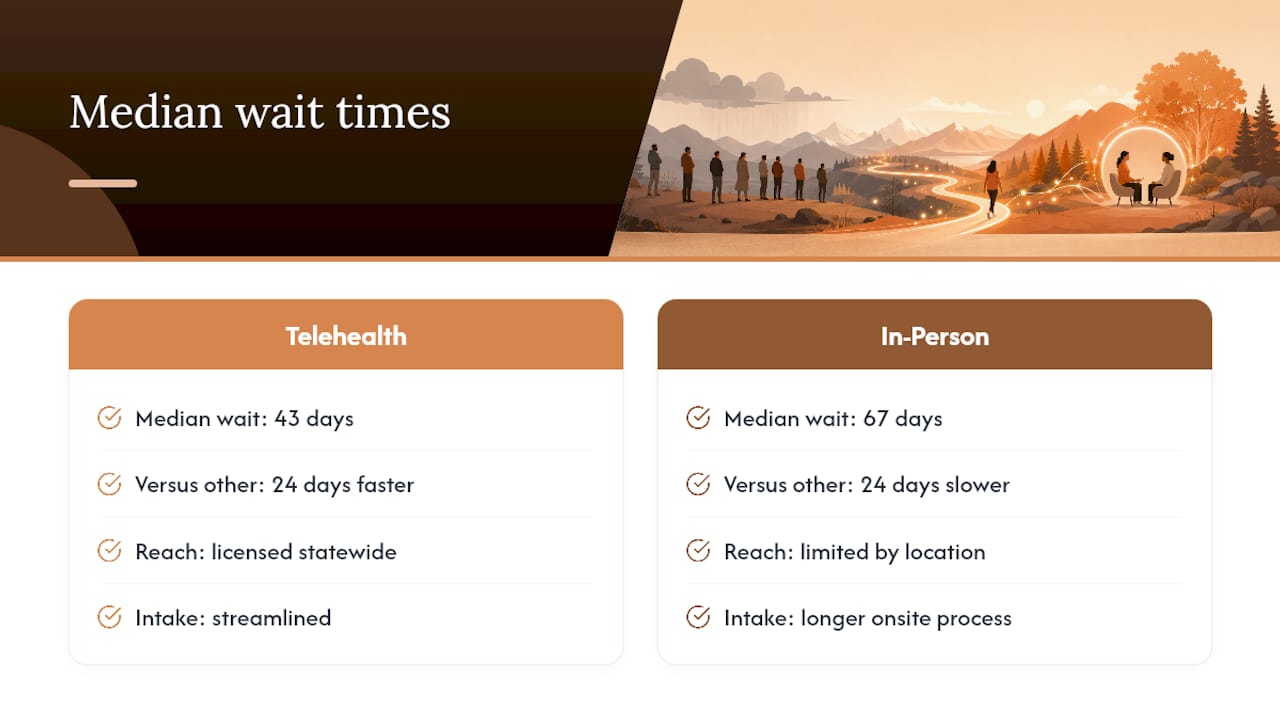
Part of that gap comes from supply. A telehealth psychiatrist licensed in Colorado can serve patients across the entire state without requiring them to travel, which widens the effective pool of available providers for any single patient. An in-person practice is capped by its physical location and local patient volume, so a full waiting room in one city doesn’t get relieved by open slots two hours away.
Part of it also comes from overhead. In-person visits typically need a physical intake process, sometimes including vitals or a longer front-desk check-in, that adds friction telehealth platforms have streamlined out of the visit entirely.
If your priority is simply getting evaluated and started on a treatment plan as fast as possible, a telehealth-first approach is the stronger bet based on the available data, though in-person care remains the right choice for patients who need hands-on physical assessment alongside their psychiatric evaluation.
Main Causes of Delay You Should Know About
Three factors explain most of the wait you’ll encounter, and understanding them helps you troubleshoot faster.
Provider not accepting new patients is the single most common reason cited in the secret-shopper research, reported in 53.9% of unavailability cases in that sample. This is a bigger barrier than the length of any published waitlist, because a closed practice has no waitlist to join at all.
Limited medication management slots compound the problem. As noted earlier, only 77% of telehealth facilities that accept new patients offer medication management, compared to 97% offering counseling. If you specifically need a psychiatrist rather than a therapist, your effective pool of open providers is smaller than general wait-time statistics suggest.
Insurance constraints add a third layer. Verifying in-network status, obtaining prior authorization for certain medications, or waiting for a referral from primary care can all add days to weeks before your first visit even gets scheduled. Self-pay patients sometimes skip this delay entirely, at the cost of paying out of pocket.
Practical Steps to Get Seen Sooner Right Now
Beyond the checklist covered earlier, a few strategic moves can meaningfully shorten your timeline. Choosing a tele-first platform over a traditional referral-based pathway is the single biggest lever, since virtual-first practices are structured around fast new-patient intake rather than fitting telehealth around an existing in-person schedule.
Alternative care pathways are worth knowing about too. Some primary care physicians can prescribe basic psychiatric medications while you wait for a specialist slot, which isn’t a permanent solution but can bridge a gap of several weeks. Community mental health centers, which often operate on a sliding fee scale, sometimes have faster intake for urgent cases even when their routine waitlists run long.
For urgent needs that don’t rise to a psychiatric emergency, ask any provider you call about same-week or next-week openings reserved for urgent (not emergency) cases. Many practices, including telehealth platforms, hold a small number of these slots separate from their general queue specifically for patients whose symptoms are escalating but not immediately dangerous.
Referral partners can also help route you toward available capacity when your usual channels are full. Resources like Building Block Resolutions’ telehealth services page outline alternate referral pathways worth exploring if your first few calls hit dead ends.
What to Expect at Your First Virtual Evaluation: Timeline and Documentation
Booking typically happens online or by phone, with most tele-first platforms confirming an appointment date within the same call or within 24 hours of an online request. The evaluation itself runs 45 to 60 minutes, covering symptom history, prior treatment, and standardized screening tools appropriate to your concern.
Documentation that speeds this process includes any prior diagnosis paperwork, a current medication list, and relevant lab results, particularly for ADHD or mood-related evaluations where baseline health markers matter. Patients who show up without this information often need a short follow-up call just to gather it, adding days to the process.
Medication management follow-up visits after that first evaluation are usually shorter, often in the 10 to 15 minute range, and scheduled every 4 to 12 weeks depending on how stable your symptoms are and whether dosage adjustments are needed. You can see how that follow-up cadence typically works in our breakdown of short virtual med-check appointments.
Average Wait Times for In-Person Psychiatric Appointments in Colorado
No isolated statewide figure exists for Colorado in the published research, but the 67-day median for in-person psychiatric visits found in the secret-shopper study is a reasonable national benchmark to apply here, especially outside the Denver metro corridor.
In-person practices face a structural constraint telehealth doesn’t: they can only serve patients within a reasonable driving distance. A psychiatrist’s office in Colorado Springs can’t absorb overflow demand from a full practice in Fort Collins the way a telehealth provider licensed statewide can. That geographic ceiling on capacity is a large part of why in-person waits run longer than telehealth waits almost everywhere researchers have measured it.
If you’re weighing in-person versus virtual care for a first evaluation, understand that choosing in-person likely means budgeting closer to two months rather than two weeks, unless you find a practice with an unusually short waitlist or an open cancellation slot.
Urban vs. Rural Wait Times Within Colorado
Denver, Boulder, and Colorado Springs have more psychiatric providers per capita than rural counties across the Eastern Plains or the Western Slope, but that density doesn’t automatically mean shorter waits. Metro demand for psychiatric care runs high enough that even well-staffed urban practices frequently report full new-patient rosters.
Rural Colorado faces a different problem: fewer providers overall, which means when a single clinic closes its new-patient list, patients may have no comparable local alternative at all. This is precisely where telehealth changes the equation most dramatically. A patient in a rural county isn’t limited to whichever psychiatrists have a physical office nearby; they can access any provider licensed to practice in Colorado, regardless of that provider’s physical location.
The practical upshot: urban patients benefit from telehealth mainly through faster scheduling and shorter follow-up cycles, while rural patients benefit through access itself, since virtual care often represents the difference between finding a psychiatrist at all and not finding one within a reasonable distance.
How Psychiatrist Shortages Shape Access in Colorado
Colorado, like most states, doesn’t have enough psychiatrists to meet demand, and that shortage shows up most sharply in the “not accepting new patients” barrier discussed throughout this guide. When fewer than 1 in 5 psychiatrists nationally are available to new patients in secret-shopper sampling, the shortage isn’t abstract. It’s the actual wall patients hit when they start calling around.
Rural counties feel this most acutely, since a shortage that’s merely inconvenient in a metro area with a dozen practices can mean zero local options in a county with one or two. Workforce shortages also concentrate the available medication management slots even further, since the same limited pool of psychiatrists has to divide time between evaluations, med checks, and existing patient follow-ups.
Telehealth doesn’t solve the underlying shortage, since it’s still the same limited number of licensed psychiatrists statewide. What it does is redistribute access more evenly, letting a patient in an underserved county reach a provider who has capacity, rather than being limited to whoever happens to have a physical office nearby.
Medicaid vs. Private Insurance: How Coverage Affects Your Wait
Insurance type changes your scheduling speed in ways that catch a lot of patients off guard. Practices accepting Medicaid sometimes carry longer waitlists, since reimbursement rates can be lower and fewer providers choose to carry large Medicaid caseloads, concentrating demand among the practices that do.
Private insurance generally offers more provider choice, but it introduces its own friction: verifying in-network status and, for certain medications, securing prior authorization can each add days before your first appointment gets confirmed. Some psychiatric medications, particularly certain stimulants for ADHD, face stricter prior authorization requirements that can meaningfully delay your first prescription even after your evaluation is complete.
Self-pay sidesteps both problems at the cost of paying full price upfront. For patients whose main goal is speed, self-pay for an initial evaluation, followed by an insurance claim for reimbursement if your plan allows it, is sometimes the fastest realistic path to a first appointment. Always confirm with your specific plan whether out-of-network reimbursement is available before assuming this route works for your situation.
Emergency Psychiatric Care vs. Routine Appointment Scheduling
Everything discussed in this guide applies to routine and urgent, but non-emergency, psychiatric care. If you or someone you know is in immediate danger, that’s a different pathway entirely and shouldn’t be handled through appointment scheduling of any kind.
For a psychiatric emergency, including active suicidal thoughts with intent or plan, call or text 988 for the Suicide and Crisis Lifeline, or go to the nearest emergency room. Colorado also operates crisis stabilization units and walk-in centers designed specifically for urgent mental health needs that don’t require a full hospital emergency room visit.
Routine and urgent-but-stable care, the kind this guide focuses on, is everything else: a first evaluation for new ADHD, anxiety, or depression symptoms, a medication adjustment, or ongoing management of a diagnosis you already have. Confusing the two pathways is a common mistake. Patients sometimes wait for a routine appointment while symptoms escalate to a point that actually warrants a crisis line call, so if your symptoms change in severity while you’re waiting for a scheduled visit, treat that as a signal to reassess which pathway you need, not a reason to wait longer for your existing appointment.
How to Find a Colorado Psychiatrist Currently Accepting New Patients
Finding an open provider comes down to verification, not luck. Start by calling rather than relying solely on a website’s “accepting new patients” badge, since these are frequently outdated. Ask the specific question: “Are you accepting new patients for psychiatric evaluation right now, this week?”
Check your insurance provider’s directory, but verify by phone, since directory listings often include psychiatrists who’ve stopped accepting that plan or stopped taking new patients altogether. Ask each practice directly whether they offer telehealth, since virtual-first availability tends to be more current and more often open than in-person slots.
Community mental health centers and telehealth platforms are generally your fastest routes to an honest, current answer, since their booking systems are often built around real-time scheduling rather than a receptionist checking a paper waitlist. You can book directly online with a tele-first provider to see real available dates rather than guessing based on a general wait-time estimate.
The Access Gap Nobody Talks About Enough
Most articles on this topic treat wait times as a fixed fact you simply have to accept, like weather. That framing undersells how much of the delay is actually negotiable. The research is consistent on this point: “not accepting new patients” beats every other cause of delay combined, which means the wait time you experience often has more to do with how many practices you called than with some fixed statewide shortage number.
What gets underestimated is how much a virtual-first model changes the math, not by adding more psychiatrists to Colorado, but by letting the psychiatrists who do have capacity serve patients regardless of what county they live in. That’s a real structural advantage, not a marketing claim. Journey Mental Health’s Colorado psychiatric services reflect this shift: a streamlined booking process built specifically to reduce the administrative lag that stretches a two-week wait into a six-week one.
The gap between what national wait-time statistics promise and what a Colorado patient actually experiences usually comes down to persistence and preparation, not chance.
— Jamie
Ready to Book Your Virtual Psychiatric Evaluation?
Journeymhw is the alternative to the wait-and-see approach that traditional outpatient scheduling forces on Colorado patients. Instead of calling five practices and hoping one has an opening, you can check real availability and book a virtual psychiatric evaluation or medication-management visit for ADHD, anxiety, or depression directly online.
Some telehealth platforms serve patients with structured plans, including discounted options designed to remove the guesswork from getting started. Patients can often book through streamlined processes and review coverage details before their first visit.
| Pathway | Typical start-time prospect |
|---|---|
| Tele-first booking options | Days to a few weeks, based on real-time availability |
| Traditional primary care referral to a specialist | Weeks to months, dependent on referral and specialist capacity |
If ADHD symptoms are your main concern, start with the Colorado ADHD treatment page to see evaluation options. For anxiety or depression, the anxiety treatment and depression treatment pages outline what a first visit covers. When you’re ready, book your appointment now and get a real date on the calendar instead of another waitlist.
This article is general information, not a substitute for advice from a qualified doctor. Consult a qualified healthcare professional about your own circumstances before acting on anything here.
FAQ
What Is the Average Wait Time for a Psychiatrist in Colorado?
There’s no isolated statewide figure for Colorado, but national research points to a median of 14 days for telehealth appointments and closer to 43 days for telepsychiatry in secret-shopper sampling, compared to 67 days for in-person visits.
Why Are Psychiatry Wait Times So Long in Colorado?
The biggest driver is provider availability, since more than half of unavailable psychiatrists in one national study simply weren’t accepting new patients, a barrier compounded by statewide psychiatrist shortages and limited medication management slots.
Is Telehealth Faster Than In-Person Psychiatric Care in Colorado?
Yes. National secret-shopper research found telepsychiatry appointments came through in a median of 43 days versus 67 days for in-person visits, largely because telehealth providers can serve patients statewide rather than being limited by physical location.
How Can I Find a Psychiatrist Accepting New Patients in Colorado Faster?
Call practices directly and ask specifically whether they’re accepting new patients and offer telehealth, since online directories are often outdated; tele-first platforms like Journeymhw typically show real-time availability rather than static waitlists.
Does Insurance Affect How Long I Wait for a Psychiatric Appointment?
Yes. Medicaid patients sometimes face longer waits due to lower provider reimbursement rates, while private insurance can add delays through in-network verification and prior authorization, and self-pay often bypasses both bottlenecks.