

Median $173: What Texans Actually Pay for a Psychiatric Evaluation
Most Texans pay within a range of negotiated rates out of pocket if they’re insured, and a somewhat higher amount if they’re paying cash. The real variable isn’t the evaluation itself, but whether your insurer covers it in full, whether the facility bills separately from the psychiatrist, and what type of visit gets coded. We’ll walk through both of the state’s pricing benchmarks and the “Insurance and billing” and “Typical price ranges” sections below before you talk to a scheduler.
TL;DR:
- Texas negotiated rates for psychiatric evaluations typically range from $153 to $214, with cash prices averaging slightly above $173 and lower than the national median.
- Billing can include separate facility fees and clinician fees, especially at hospitals, while telehealth visits usually bill only the clinician.
- Insurance coverage affects out-of-pocket costs, with many plans requiring deductibles, coinsurance, and confirming in-network status before booking.
- A comprehensive evaluation lasts 45 to 90 minutes and covers multiple areas, including history, mental status, collateral input, and a treatment plan.
- Hospital prices often list inflated gross charges, but insured patients should verify negotiated rates and request Good Faith Estimates to avoid surprise bills.
Table of Contents
- Psychiatric Evaluation Cost in Texas: The Actual Numbers
- Why Two Quotes for the Same Evaluation Can Look So Different
- How Insurance Changes What You’ll Actually Pay
- Where Texans Can Actually Get Evaluated
- What a Full Evaluation Actually Involves
- Reading Hospital Price Lists and Protecting Yourself From Surprise Bills
- Why the “Cheapest Option” Question Misses the Point
- How Journeymhw Prices Evaluations in Texas
- Sources
Psychiatric Evaluation Cost in Texas: The Actual Numbers
Across 103 Texas hospitals that publish negotiated rates for CPT code 90791, the psychiatric diagnostic evaluation cost in Texas clusters tightly. Here’s what that data actually shows:
- In-network negotiated rate: typically within a defined middle range with a specific statewide median
- Median discounted cash price: a certain typical amount for patients paying without insurance
- Gross charges: reported medians are substantially higher, though almost nobody pays that sticker price
Those figures line up closely with what you’ll find at private clinics and telehealth practices, since most bill under the same CPT code. National numbers give useful context, too. CarePriceGuide’s benchmark data puts the national median self-pay cash price at roughly $267, with a middle 50 percent range of $172 to $406. Texas runs a bit below the national cash median, which is good news if you’re comparing quotes from an out-of-state telehealth company against a Texas-licensed provider.
Quick figure: A Texas patient with insurance can reasonably expect to pay within a middle negotiated range for the evaluation itself; a cash-pay patient should expect a somewhat higher amount.
Why Two Quotes for the Same Evaluation Can Look So Different
The number you’re quoted depends heavily on who’s billing you and for what. Two separate charges often show up on one visit: a facility fee from the hospital or outpatient clinic for the space and administrative overhead, and a professional fee from the psychiatrist or nurse practitioner who actually does the assessment. A hospital-based evaluation frequently generates both bills; a private psychiatric office or telehealth visit usually generates just the clinician’s fee.
The visit type matters just as much:
- CPT 90791 covers the full comprehensive diagnostic evaluation, including history, mental status exam, and treatment planning. This is the code tied to the $153–$214 range above.
- Medication-management follow-ups use shorter, cheaper codes, since they don’t repeat the full intake.
- Community mental health centers (LMHAs/LBHAs) often charge on a sliding scale instead of standard CPT pricing.
- Telehealth visits typically bill the same CPT codes as in-person care but skip the facility fee entirely.
Pro Tip: Before you book, ask the scheduler directly: “Is this quote the facility fee, the clinician’s fee, or both?” That single question prevents most billing surprises.
How Insurance Changes What You’ll Actually Pay
Your insurance plan determines whether you pay close to that $173 median or something much lower. If you’ve met your deductible, you might owe only a copay. If you haven’t, you could owe the full negotiated rate until your deductible resets. Coinsurance then applies to whatever’s left, and going out-of-network can mean paying the provider’s full charge with no insurer discount at all.
Federal law shapes what your plan is required to cover. The Mental Health Parity and Addiction Equity Act requires many group health plans to cover mental health benefits on par with medical and surgical benefits, meaning your deductible and coinsurance structure for a psychiatric evaluation generally can’t be stricter than for a physical exam. Texas adds its own protection through SB 1107, Texas’s telehealth parity law, which requires many plans to cover virtual psychiatric visits similarly to in-person ones.
Before your appointment, verify the following with your insurer:
- Confirm whether the provider is in-network and request the estimated allowed amount
- Ask if the facility and the clinician bill separately, and whether both are in-network
- Request a Good Faith Estimate if you’re paying cash or are uninsured
Statistic to remember: Texas hospitals report negotiated rates that vary by payer, not just by provider, so the same evaluation can cost differently depending on which insurance card you hand over.
Where Texans Can Actually Get Evaluated
You have more options than a hospital psychiatry department, and the price gap between them is significant.
- Texas HHS and 2-1-1: Texas Health and Human Services directs adults to call 2-1-1 for a referral to their local LMHA or LBHA, where assessments are often free or low-cost based on income.
- Community mental health centers: LMHAs and LBHAs serve as the state’s public safety net and typically use sliding-scale fees tied to household income.
- Hospital outpatient psychiatry: Comprehensive but usually the most expensive route, since it layers a facility fee onto the clinician’s charge.
- Private practice and telehealth: Often the most transparent pricing, but confirm the provider is licensed to practice in Texas before booking. Telepsychiatry has grown fast, and not every platform serves Texas patients specifically.
Whichever route you choose, ask whether the quoted price already includes the clinician’s fee, and whether follow-up testing (like ADHD rating scales) will add to the bill later.
What a Full Evaluation Actually Involves
A comprehensive psychiatric evaluation isn’t a quick check-in. It typically covers seven areas: a detailed clinical interview, a mental status exam, your medication and medical history, collateral input from family if available, standardized rating scales when relevant, a diagnostic formulation, and a written treatment plan.
- Expect the initial evaluation to run 45 to 90 minutes, depending on complexity.
- Follow-up medication-management visits usually run 15 to 30 minutes.
- Bring a current medication list, prior mental health records, and a written symptom timeline. This alone can shave time off the visit and reduce the odds you’ll need a costly second session just to finish the history.
Reading Hospital Price Lists and Protecting Yourself From Surprise Bills
Hospital price-transparency files list three different numbers for the same service: the negotiated rate (what insurers actually pay), the discounted cash price (what self-pay patients get charged), and the gross charge (the inflated sticker price almost nobody pays). Knowing which figure you’re looking at matters, since gross charges can run double the negotiated rate for the identical service.
- If you’re uninsured or self-pay, federal rules require providers to give you a Good Faith Estimate before your visit.
- If your final bill comes in significantly higher than that estimate, you have dispute rights under the No Surprises Act.
- If a bill still seems wrong, contact the provider’s billing office first, then your insurer, before escalating to a formal dispute.
Why the “Cheapest Option” Question Misses the Point
Most people searching for evaluation pricing want a single number, and that instinct is understandable when you’re already stressed about getting care. But chasing the lowest quote often backfires. A rock-bottom cash price sometimes signals a shorter, less thorough evaluation, one that skips standardized rating scales or collateral history and leaves you needing a second visit (and a second bill) to actually get a usable diagnosis and treatment plan.
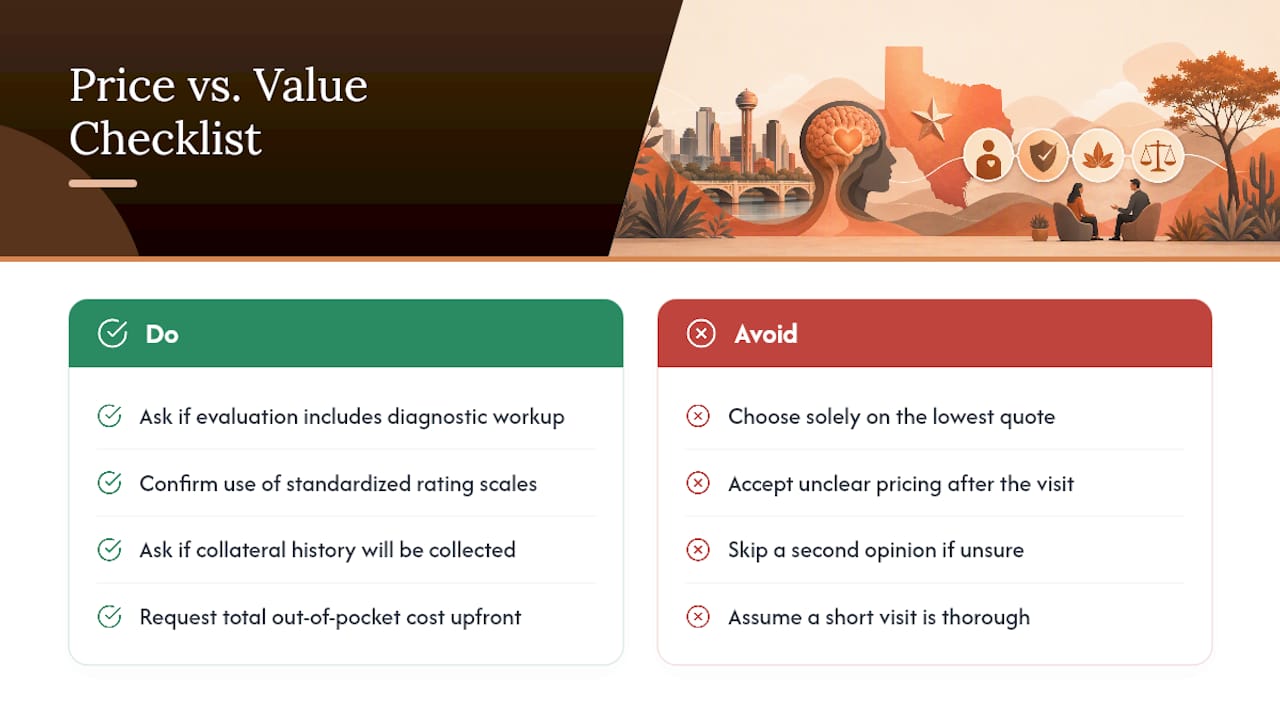
The more useful question is value per visit: does this price include a real diagnostic workup, or just a screening conversation? SAMHSA’s national survey data consistently shows that a meaningful share of adults who need mental health care never get an initial evaluation at all, often because the first phone call felt like a maze of unclear pricing. That’s the real cost. Not the $173 median, but the delay that happens when nobody tells you what you’re actually going to pay until after the appointment.
Texans deserve better than a guessing game before they even walk in the door.
— Jamie
How Journeymhw Prices Evaluations in Texas
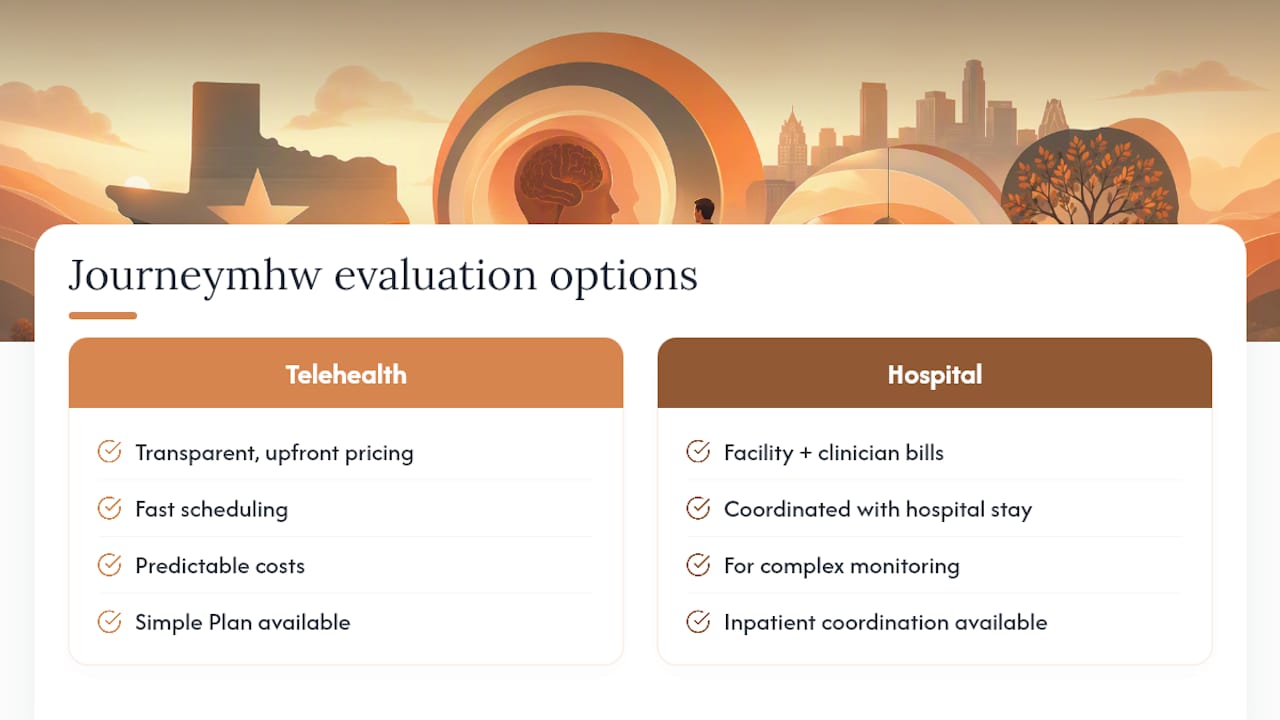
Journeymhw is the transparent alternative to the guesswork we just described. Instead of separate facility and clinician bills, or a mystery quote you only see after intake, our virtual evaluations in Texas come with clear pricing up front, including structured options like The Simple Plan for ongoing care. A telehealth evaluation fits best if you want predictable costs and fast scheduling; an in-person hospital evaluation still makes more sense if you need coordinated care alongside a hospital stay or complex medical monitoring.
If you’re ready to see what a straightforward evaluation looks like, check your eligibility and explore ADHD treatment in Texas or book directly through our Texas services page to get a visit on the calendar this week.
This article is general information, not a substitute for advice from a qualified doctor. Consult a qualified healthcare professional about your own circumstances before acting on anything here.