

Overthinking Anxiety: How to Break the Cycle
Overthinking anxiety is a pattern of repetitive, unproductive thought loops that amplify worry and increase nervous system activation without producing solutions. Clinically, this pattern is called rumination, and it appears most often in conditions like generalized anxiety disorder (GAD), obsessive-compulsive disorder (OCD), and social anxiety. Overthinking is the behavioral expression of anxiety. Anxiety is the physiological state. Understanding that distinction is the first step toward managing both. Tools like cognitive behavioral therapy (CBT) and acceptance and commitment therapy (ACT), along with apps like Headspace, are among the most studied approaches for breaking this cycle.
What is overthinking anxiety, and how does it differ from normal worry?
Overthinking anxiety is not the same as productive problem-solving. Problem-solving is goal-directed and ends when you reach a conclusion. Rumination is repetitive and circular. It revisits the same scenario without generating new insight or resolution.
Dr. Shariq Refai notes that overthinking feels like preparation but actually increases anxiety by creating a self-reinforcing loop. Your brain confuses the act of reviewing a problem with making progress on it. No progress happens. Anxiety rises instead.

A practical threshold exists for telling the two apart. Cycling through the same scenario for over 15–20 minutes without reaching new conclusions is rumination, not problem-solving. That time marker is a useful self-check you can apply right now.
Anxiety without overthinking is also possible. You can feel physically activated, restless, or tense without looping thoughts. The two overlap frequently, but anxiety is the engine and overthinking is one way that engine runs too hot.
“Overthinking is a behavioral expression of the physiological state of anxiety, amplifying cognitive urgency.” — Dr. Shariq Refai
- Productive thinking: Reaches a decision or next step within a defined window
- Rumination: Repeats the same loop, increases distress, produces no new conclusions
- Anxiety without overthinking: Physical symptoms present, but thought content is not repetitive
- Overthinking without acute anxiety: Chronic low-level worry loops, often mistaken for personality traits
Why does overthinking happen? The cognitive mechanisms behind it
Intolerance of uncertainty is the single most consistent driver of overthinking. When your brain cannot accept an incomplete answer, it keeps scanning for a perfect one. That scanning never ends because certainty rarely arrives on demand.
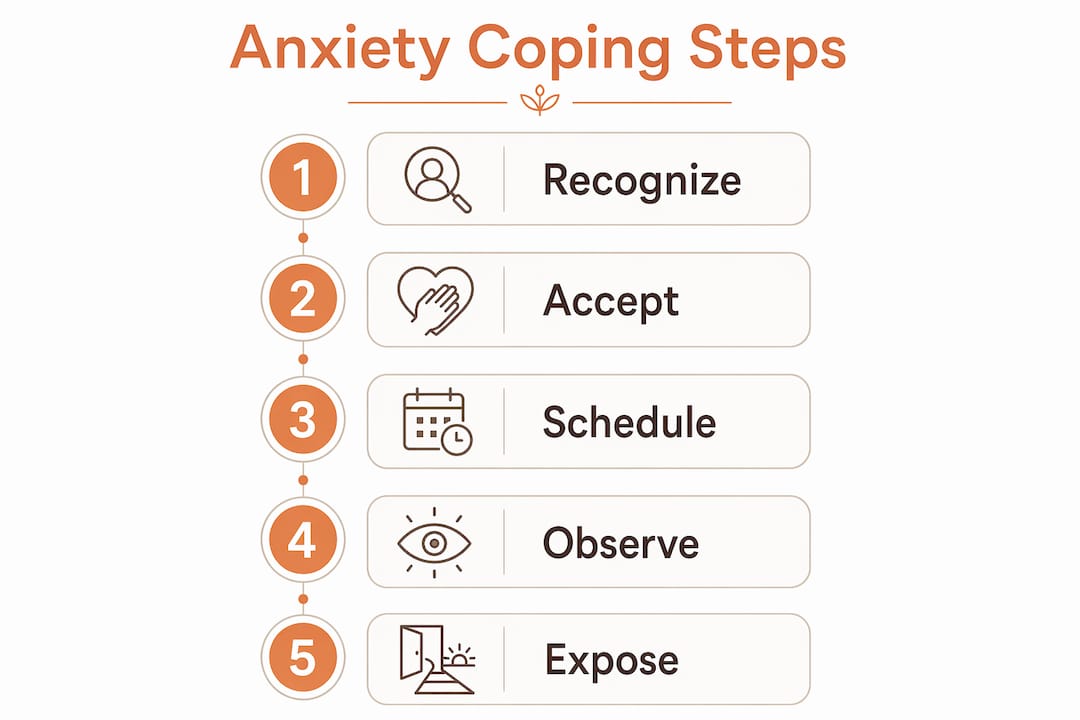
Anxiety compounds this by amplifying thought urgency. Nervous system activation makes manageable thoughts feel urgent and oversized. A minor work email becomes evidence of professional failure. A brief silence from a friend becomes proof of rejection. The thought content has not changed. The emotional weight attached to it has.
Three thought patterns show up most often in people dealing with anxious overthinking:
- Worry loops: Repetitive “what if” questions that cycle without resolution
- Catastrophizing: Jumping to worst-case outcomes and treating them as likely
- Rumination: Replaying past events to find what went wrong, without changing the outcome
CBT addresses these patterns by helping you identify and challenge distorted thinking. ACT takes a different approach. Rather than debating whether a thought is true, ACT teaches you to observe thoughts without judgment and reduce their grip on your behavior. Both models are well-supported by clinical research and are considered first-line treatments for anxiety-related overthinking.
Thought suppression, the instinct to simply push unwanted thoughts away, reliably backfires. Trying to “just stop” overthinking often worsens it because the brain interprets suppression as a threat signal. Containment works better than suppression. The difference matters practically.
Pro Tip: When a thought keeps returning, write it down in a notebook and tell yourself you will address it during your scheduled worry time. This signals to your brain that the thought has been “heard,” which reduces the urgency to keep cycling through it.
What are the most effective strategies for coping with anxiety and overthinking?
Evidence-based strategies exist for every stage of the overthinking cycle. The key is matching the right tool to the right moment.
Mindfulness and meditation
A 10-minute meditation session is clinically recommended for reducing intrusive thoughts and redirecting attention. That is a low barrier. Apps like Headspace and Calm offer guided sessions at that length. The goal is not to empty your mind. The goal is to notice when your attention has drifted to a thought loop and bring it back, repeatedly, without self-criticism.
Scheduled worry time
CBT recommends containing worry in a scheduled 15–20 minute daily window rather than attempting to suppress it throughout the day. You pick a consistent time, sit with your worries deliberately, and then close the session. Outside that window, when a worry arises, you defer it. This trains your brain to stop treating every moment as an emergency.
Cognitive defusion from ACT
Cognitive defusion is the ACT technique of observing thoughts without engaging them as facts. Instead of thinking “I am going to fail,” you practice noticing “I am having the thought that I might fail.” That small linguistic shift creates emotional distance. Research shows this technique is often easier for anxious people than directly debating negative thoughts, because it sidesteps the argument entirely.
Gradual exposure to uncertainty
Small, deliberate exposures to uncertainty train the brain to tolerate discomfort without demanding resolution. Practical examples include sending a message without rereading it five times, making a low-stakes decision without researching every option, or leaving a task slightly imperfect on purpose. Each small tolerance builds capacity for larger ones.
| Strategy | Best used when | Mechanism |
|---|---|---|
| Scheduled worry time | Thoughts intrude throughout the day | Containment, not suppression |
| 10-minute meditation | Acute thought spirals | Attention redirection |
| Cognitive defusion (ACT) | Thoughts feel like facts | Emotional distance from content |
| Gradual uncertainty exposure | Avoidance is driving loops | Tolerance building |
| CBT thought records | Distorted thinking patterns | Cognitive restructuring |
Pro Tip: Combine scheduled worry time with a brief 5-minute body scan immediately after. This helps your nervous system shift out of activation mode once the worry window closes, making it easier to move on with your day.
When does overthinking anxiety require professional support?
Overthinking becomes a clinical concern when it consistently interferes with daily functioning. The symptoms below signal that self-help strategies alone may not be enough.
- Persistent difficulty falling or staying asleep due to racing thoughts
- Inability to concentrate at work or in conversations
- Physical restlessness or tension that does not resolve with rest
- Avoiding decisions, relationships, or responsibilities to escape uncertainty
- Distress that feels disproportionate to the actual situation
- Symptoms lasting most days for six months or longer
These patterns align with GAD, OCD, and social anxiety disorder. Each condition involves overthinking as a core feature, but the triggers and content differ. GAD centers on broad life worries. OCD involves intrusive thoughts paired with compulsive responses. Social anxiety focuses on evaluation and judgment by others. A proper psychiatric evaluation distinguishes between them and guides treatment.
Therapy and medication are both effective, and they work better together than either does alone. Effective therapy changes your relationship with thoughts, focusing on acceptance rather than elimination. That shift takes time. Expecting immediate results leads to frustration and early dropout from treatment.
Adults who also experience attention difficulties alongside anxiety should consider that ADHD and anxiety frequently co-occur. The overlap between ADHD and anxiety can make overthinking harder to treat if only one condition is addressed. A thorough evaluation clarifies the picture. Understanding the anxiety and depression link is also worth exploring, since chronic overthinking raises the risk of depressive episodes over time.
Seeking professional support is not a sign that self-help failed. It is a recognition that some patterns are too entrenched to shift without structured clinical guidance.
Key takeaways
Overthinking anxiety is a treatable pattern driven by intolerance of uncertainty and nervous system activation, and structured strategies like CBT, ACT, and scheduled worry time consistently reduce its grip.
| Point | Details |
|---|---|
| Rumination vs. problem-solving | If you have looped the same thought for over 15–20 minutes without progress, you are ruminating. |
| Suppression backfires | Trying to stop thoughts by force increases their intensity; containment works better. |
| Scheduled worry time works | A daily 15–20 minute worry window reduces all-day intrusion without requiring thought elimination. |
| Cognitive defusion reduces distress | Observing thoughts as events rather than facts creates distance without debate. |
| Professional help is appropriate | Persistent sleep disruption, avoidance, or six-month-plus symptoms warrant a clinical evaluation. |
What I have learned about overthinking that most articles get wrong
People come to me expecting that the goal of managing anxious overthinking is to think less. That framing sets them up for failure from the start.
The brain generates thoughts automatically. Telling it to produce fewer of them is like telling your heart to beat less. The real goal is to change your relationship with the thoughts that do arise. ACT gets this right. CBT gets this right. Most popular advice does not.
The second mistake I see constantly is treating every thought loop as a problem to solve. Some loops exist because the underlying situation is genuinely unresolved. Others exist because the nervous system is activated and looking for a target. Learning to tell the difference is a skill, and it takes practice. You will not master it in a week.
Patience with yourself is not optional here. Progress in managing overthinking looks like noticing the loop sooner, not eliminating it entirely. That is a real and meaningful improvement, even when it does not feel like one. Celebrate the noticing. The rest follows from there.
— Jamie
Mental health support for anxiety and overthinking at Journeymhw
Managing anxious thought patterns is easier with the right clinical support behind you. Journeymhw offers virtual psychiatric evaluations and personalized treatment for anxiety, depression, and ADHD, all accessible from home without long wait times.

Adults in Texas and Colorado can access structured care through Journeymhw’s telehealth platform, including evaluation, medication management, and ongoing support. If overthinking is affecting your sleep, your work, or your relationships, a psychiatric evaluation in Texas is a concrete next step. Journeymhw’s care model is built for adults who want clear answers and a straightforward path to feeling better.
FAQ
What is the difference between overthinking and anxiety?
Anxiety is a physiological state involving nervous system activation, while overthinking is the behavioral expression of that state through repetitive thought loops. You can experience anxiety without overthinking, but the two frequently occur together.
How do I know if I am ruminating or problem-solving?
If you have been cycling through the same scenario for more than 15–20 minutes without reaching a new conclusion, you are ruminating. Productive problem-solving moves toward a decision or next step within a defined window of time.
Does mindfulness actually help with anxious overthinking?
Yes. A 10-minute meditation session is clinically recommended for reducing intrusive thoughts by redirecting attention away from thought loops. Consistent daily practice produces stronger results than occasional use.
What is cognitive defusion and how does it reduce overthinking?
Cognitive defusion is an ACT technique that involves observing thoughts as mental events rather than facts. Shifting from “I will fail” to “I am having the thought that I might fail” creates emotional distance without requiring you to debate whether the thought is true.
When should I see a professional for overthinking and anxiety?
Seek professional support when overthinking disrupts sleep, concentration, or daily responsibilities most days, or when symptoms persist for six months or longer. A psychiatric evaluation can identify whether GAD, OCD, social anxiety, or a co-occurring condition like ADHD is driving the pattern.