

Best OurInnerJourney.com Alternatives for Online Therapy 2026
If you’re looking for trustworthy alternatives to OurInnerJourney.com for online mental health therapy in the U.S., the five platforms worth your attention are BetterHelp, Grow Therapy, Talkspace, InnerJourney.life, and Journeymhw (Journey Mental Health). Each serves a distinct need, whether that’s insurance-based access, personalized therapist matching, or structured psychiatric care for ADHD, anxiety, and depression.
Here’s a quick comparison to orient your decision:
| Platform | Best For | Pricing Model | Insurance Support | Communication Methods | Therapist Matching |
|---|---|---|---|---|---|
| BetterHelp | Broad access, private pay | Subscription-based | No | Video, phone, text, chat | Automated algorithm |
| Grow Therapy | Insurance users | Per-session (insurance) | Yes | Video, phone | Insurance network matching |
| Talkspace | Flexibility, text therapy | Subscription or per-session | Yes (some plans) | Video, phone, text | Automated matching |
| InnerJourney.life | Personalized matching | Per-session | Not specified | Online and in-person | 3-step personal interview process |
| Journeymhw | ADHD, anxiety, depression | Structured plans | Not required | Video (virtual) | Provider-led evaluation |
Each platform reflects the current 2026 U.S. telehealth market, where access, affordability, and therapist quality are the three factors that most consistently determine whether someone stays in care or drops out.
Key distinctions at a glance:
- BetterHelp offers one of the largest therapist networks in the U.S., with subscription pricing that bundles messaging and live sessions, though it does not accept insurance.
- Grow Therapy is built around insurance acceptance, making it the strongest option if you want to use your existing coverage.
- Talkspace bridges text-based and video therapy, with some plans compatible with insurance and employer benefits.
- InnerJourney.life takes a human-first approach to matching, using a 3-step personal interview process to vet every therapist before recommending them to clients, along with a free rematch or full refund guarantee if the connection isn’t right.
- Journeymhw focuses specifically on psychiatric evaluation and medication management for ADHD, anxiety, and depression, with structured plans and fast appointment availability in Texas and Colorado.
Table of Contents
- How do these OurInnerJourney.com alternatives compare in depth?
- How do you choose the best online therapy platform for your needs?
- How were these platforms tested and reviewed?
- What makes Journeymhw a distinct option among U.S. telehealth providers?
- Key Takeaways
- What most people get wrong when picking an online therapy platform
- Journeymhw: structured psychiatric care when you’re ready to start
How do these OurInnerJourney.com alternatives compare in depth?
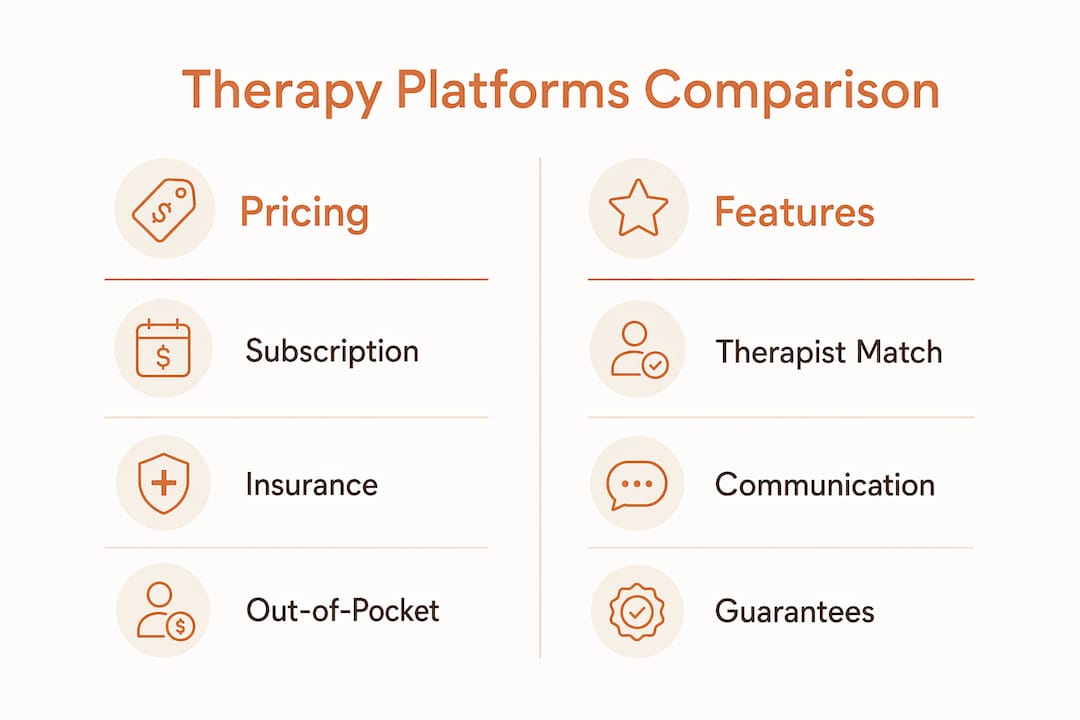
Choosing a platform based on a summary table only gets you so far. The details that actually affect your experience—including how therapists are vetted, what therapy methods are used, and what happens if something goes wrong—deserve a closer look.
Therapist credentials and matching quality
All five platforms require licensed therapists, but the matching process varies considerably. BetterHelp and Talkspace use automated algorithms that factor in your preferences and stated concerns. These systems are efficient, but they can miss nuances that a human intake conversation would catch. Grow Therapy matches you within its insurance network, which narrows the pool but keeps costs predictable.

InnerJourney.life takes a different approach. Every therapist in their network has passed a 3-step filtering process that includes a personal interview, meaning the platform’s team knows each provider on both a professional and personal level. That kind of vetting is rare in the telehealth space, and it shows up in the quality of their match recommendations. They also offer a free rematch or a full refund if you don’t connect with your assigned therapist, which removes a significant barrier for people who’ve had bad experiences with automated matching before.
Therapy platforms that allow therapist changes consistently support better outcomes, because patient-therapist fit is one of the strongest predictors of whether therapy actually works.
Therapy approaches offered
The clinical methods available across these platforms differ meaningfully. Cognitive Behavioral Therapy is the most empirically supported psychotherapy approach for anxiety and depression, and it’s available on all five platforms. Beyond CBT, here’s how the approaches break down:
- BetterHelp: CBT, DBT, mindfulness-based therapy, psychodynamic, and more, depending on the individual therapist.
- Grow Therapy: Varies by therapist; the platform spans a wide range of specialties including trauma-focused care.
- Talkspace: CBT, DBT, and mindfulness integration are common; therapist specialties vary.
- InnerJourney.life: Personalized to client needs; the matching process accounts for preferred therapeutic approach.
- Journeymhw: Focuses on psychiatric evaluation and medication management for ADHD, anxiety, and depression, with structured clinical care pathways.
Pricing and affordability
Cost is one of the most practical filters when choosing a platform. Here’s how the pricing models compare:
| Platform | Pricing Structure | Insurance Accepted | Approximate Cost Range |
|---|---|---|---|
| BetterHelp | Weekly subscription | No | Varies by plan |
| Grow Therapy | Per-session (insurance billed) | Yes | Copay or deductible applies |
| Talkspace | Subscription or per-session | Yes (select plans) | Varies by plan |
| InnerJourney.life | Per-session | Not specified | Varies by therapist |
| Journeymhw | Structured treatment plans | Not required | Plan-based pricing |
Insurance networks significantly influence platform adoption, with some platforms prioritizing coverage while others optimize for rapid access and affordability. If using insurance is your priority, Grow Therapy is the clearest choice. If you want fast access without navigating insurance, BetterHelp and Journeymhw both offer structured entry points.
User experience and common feedback
User reviews across these platforms consistently highlight three factors: ease of scheduling, therapist quality, and how well the platform handles problems when they arise. BetterHelp receives praise for its large therapist pool and messaging flexibility, though some users report inconsistent therapist quality given the scale of the network. Talkspace users appreciate the text-based option for people who find video sessions harder to access. Grow Therapy earns strong marks for insurance transparency.

InnerJourney.life’s personal matching model tends to generate positive feedback specifically around therapist fit, which is where many automated platforms fall short. The refund guarantee also reduces the risk of committing to a session with someone who isn’t the right match.
Communication methods and session flexibility
- BetterHelp: Video, phone, live chat, and asynchronous text messaging.
- Grow Therapy: Video and phone sessions.
- Talkspace: Video, phone, and text-based therapy.
- InnerJourney.life: Online sessions and in-person options, depending on therapist availability.
- Journeymhw: Virtual appointments via video, focused on psychiatric evaluation and medication management.
Privacy, data security, and cancellation policies
All five platforms operate under HIPAA requirements, which set the baseline for how your health data is handled. That said, each platform’s specific data practices, including what is shared with third parties and how long records are retained, differ. Before committing, review the privacy policy directly on each platform’s website.
On cancellation and refunds: InnerJourney.life’s free rematch or full refund guarantee is the most explicit commitment in this group. BetterHelp and Talkspace both have subscription cancellation policies, so it’s worth reading the terms before subscribing. Grow Therapy’s refund terms depend on the individual therapist and insurance arrangement.
Pro Tip: Before your first session on any platform, ask the therapist directly about their approach to CBT, DBT, or whichever method you’re interested in. A therapist who can explain their method clearly in plain language is usually one who applies it well.
How do you choose the best online therapy platform for your needs?
The right platform depends on your clinical needs, your budget, and how you prefer to communicate with a therapist. Here’s a practical framework for making that decision.
Step-by-step evaluation criteria
- Identify your primary concern. Are you managing anxiety, depression, ADHD, trauma, or relationship issues? Some platforms specialize; others are generalist. If you need psychiatric evaluation and medication, that narrows the field significantly.
- Check insurance compatibility first. If you have mental health coverage, verify whether the platform accepts your plan before anything else. Grow Therapy is the strongest option for insurance users among this group.
- Assess the matching process. Automated matching is faster; personal matching tends to be more accurate. If you’ve had a poor therapist fit before, a platform with a human-reviewed matching process, like InnerJourney.life, may be worth the extra step.
- Confirm therapist licensure in your state. Telehealth therapists must be licensed in the state where you receive care. Check that the platform’s therapists are licensed in your state before booking.
- Review communication options. If video sessions feel inaccessible due to your schedule or environment, a platform offering text-based therapy like Talkspace gives you more flexibility.
- Read the cancellation and refund policy. Know what you’re committing to financially before your first session.
- Check the privacy policy. Look specifically for what data is shared with third parties and whether you can request deletion of your records.
Therapy approach compatibility
If you’re dealing with anxiety or depression, evidence-based treatments like CBT combined with mindfulness techniques are among the most effective options available through telehealth. Ask any platform you’re considering whether their therapists are trained in the specific approach you’re looking for, and whether you can filter by that specialty during matching.
For ADHD, the clinical picture is different. Behavioral strategies help, but many people with ADHD also benefit from psychiatric evaluation and medication management, which requires a licensed psychiatric provider rather than a therapist alone. That’s a meaningful distinction when evaluating platforms.
Pro Tip: Combining professional clinical therapy with mindfulness and self-discovery tools can meaningfully improve outcomes. Platforms like Headspace or Mindful.org work well alongside clinical care, not as replacements for it.
How were these platforms tested and reviewed?
The platforms featured here were evaluated against a consistent set of criteria designed to reflect what actually matters to people seeking mental health care, not just what looks good on a feature list.
Evaluation criteria used:
- Therapist vetting and licensure: We assessed whether each platform verifies state licensure, checks credentials, and applies any additional quality standards beyond the legal minimum.
- Therapy approach breadth: Platforms were reviewed for the range of evidence-based methods available, including CBT, DBT, psychodynamic therapy, and mindfulness integration.
- Pricing transparency: We examined whether pricing is clearly disclosed before sign-up, whether insurance billing is supported, and whether session costs are predictable.
- Insurance support: Platforms were assessed on whether they accept major insurance plans, how billing is handled, and whether out-of-pocket costs are clearly communicated.
- User experience: This included platform usability, ease of scheduling, responsiveness of customer support, and how well the platform handles therapist changes or complaints.
- Session modalities: We noted which communication formats are available (video, phone, text) and whether scheduling is flexible enough to accommodate different work and life schedules.
- Data privacy and security: Each platform’s privacy policy was reviewed for HIPAA compliance, third-party data sharing, and data retention practices.
- Cancellation and refund policies: We evaluated how easy it is to cancel, what refund protections exist, and whether platforms stand behind their matching quality with guarantees.
The goal was an evaluation process that reflects real-world use, not just platform marketing. No platform paid for inclusion or placement in this article.
What makes Journeymhw a distinct option among U.S. telehealth providers?
Journeymhw occupies a specific and well-defined space in the U.S. telehealth market. Rather than offering a broad generalist therapy service, it specializes in diagnosing and managing ADHD, anxiety, and depression through structured virtual care.
What sets Journeymhw apart:
- Structured treatment plans: Journeymhw offers programs like “The Simple Plan,” a structured psychiatric care pathway designed to reduce delays between assessment and treatment. This is particularly valuable for people who’ve spent months on waitlists for in-person psychiatric care.
- Virtual psychiatric evaluations: The platform facilitates online psychiatric evaluations, not just therapy sessions. This means you can receive a clinical assessment and, where appropriate, medication management without leaving home.
- Medication management: For ADHD, anxiety, and depression, medication is often part of an effective treatment plan. Journeymhw’s medication management services are integrated into the care pathway, so evaluation and prescribing happen within the same platform.
- Fast appointment availability: One of the most consistent frustrations in mental health care is wait time. Journeymhw emphasizes quick access to appointments, which matters when someone is ready to start treatment now.
- Geographic focus on Texas and Colorado: Journeymhw’s licensed providers in Texas and Colorado are specifically positioned to serve patients in those states, with telehealth delivery that removes the need for in-person visits.
- Personalized psychiatric management: Care is tailored to the individual’s clinical profile, not a one-size-fits-all protocol. The platform’s structured approach still leaves room for personalized treatment decisions.
Journeymhw is built for people who need more than talk therapy. If your primary concern is ADHD, anxiety, or depression and you want a clear path from evaluation to treatment, including medication if appropriate, Journeymhw’s structured care model is designed for exactly that situation.
For those exploring telehealth platform features more broadly, Journeymhw’s focus on psychiatric care distinguishes it from platforms that offer therapy alone.
Key Takeaways
The strongest online therapy platform for you depends on whether you need insurance support, personalized matching, or structured psychiatric care, and no single platform is the right fit for every person.
| Point | Details |
|---|---|
| Insurance vs. private pay | Grow Therapy is the clearest choice for insurance users; BetterHelp and Journeymhw serve private-pay patients with structured access. |
| Therapist matching quality | InnerJourney.life’s 3-step personal interview process offers more precise matching than automated systems. |
| Therapy approach matters | CBT is the most empirically supported psychotherapy approach for anxiety and depression, and it is available on all five platforms. |
| Psychiatric care vs. therapy | Journeymhw specializes in psychiatric evaluation and medication management for ADHD, anxiety, and depression in Texas and Colorado. |
| Combine clinical and self-directed tools | Pairing professional therapy with mindfulness resources improves outcomes beyond what either approach delivers alone. |
What most people get wrong when picking an online therapy platform
The conventional wisdom says to compare platforms by price and therapist count. That framing misses the point almost entirely.
The single most important variable in therapy outcomes is the relationship between you and your therapist, not the platform’s feature list. A platform with 30,000 therapists and a polished app is only as good as the specific person you’re matched with. Automated matching systems are fast and convenient, but they work from self-reported preferences and keyword filters. They don’t know how you actually communicate, what you’ve tried before, or what kind of therapeutic relationship you’ve had that worked or didn’t.
That’s why platforms offering human-reviewed matching, or the ability to switch therapists without penalty, deserve more weight than they typically get in platform comparisons. The ability to course-correct quickly is a practical feature, not a minor perk.
There’s also a meaningful distinction between clinical therapy and self-discovery or mindfulness tools. Apps and personal growth sites serve a real purpose, but they don’t replace a licensed clinician for diagnosing or treating a mental health condition. The most effective approach is usually both: professional clinical care for the clinical dimension, and coping techniques and self-directed tools for the day-to-day work between sessions. People frequently underestimate how much that combination adds up over time.
Finally, don’t stay on a platform that isn’t working. The telehealth market in 2026 gives you real options. If your therapist isn’t a good fit after two or three sessions, request a change or try a different platform. Staying out of inertia is one of the most common reasons people stop therapy altogether, and it’s entirely avoidable.
Journeymhw: structured psychiatric care when you’re ready to start
Most online therapy platforms ask you to browse therapists, fill out a questionnaire, and wait. Journeymhw takes a different approach. It’s built specifically for people dealing with ADHD, anxiety, or depression who want a clear, fast path from evaluation to treatment, including medication management when clinically appropriate.
Where general therapy platforms offer broad access, Journeymhw offers clinical precision. Licensed psychiatric providers in Texas and Colorado conduct virtual evaluations and build personalized treatment plans, including structured programs like “The Simple Plan,” designed to reduce the gap between when you decide to get help and when care actually begins. Appointments are available quickly, the process is fully virtual, and you don’t need to navigate insurance to get started.
If you’re in Texas or Colorado and managing ADHD, anxiety, or depression, book your virtual appointment with Journeymhw and get a clear treatment plan in place. You can also learn more about ADHD treatment options available through the platform before you book.
Recommended
- Top 3 journeypsych.com Alternatives Providers 2026 – Journey Mental Health
- Top 6 jtihllc.com Alternatives Providers 2026 – Journey Mental Health
- Top 4 journeyofthemindmhc.com Alternatives Providers 2026 – Journey Mental Health
- Top 3 Online Therapy Providers for Online Therapy Texas 2026 – Journey Mental Health