

Mental Health Insurance Coverage in Texas & Colorado
Most health plans in Texas and Colorado are required to cover mental health and substance use disorder (SUD) treatment at the same level as physical health care. That requirement comes from two federal laws: the Mental Health Parity and Addiction Equity Act (MHPAEA) and the Affordable Care Act (ACA). Together, they set a nationwide floor that most Marketplace plans, employer-sponsored plans, and many Medicaid programs must meet.
Here is what parity means in practice:
- Cost-sharing parity: Your copays, coinsurance, and deductibles for therapy or psychiatric visits cannot be higher than what you pay for a comparable medical visit.
- No more restrictive limits: Insurers cannot apply visit caps, prior authorization rules, or medical necessity criteria to mental health benefits that are stricter than those applied to medical or surgical benefits.
Marketplace plans must cover behavioral health treatment as an essential health benefit (EHB), with no annual or lifetime dollar limits. That protection applies from day one, even if you have a pre-existing mental health condition.
Your most immediate next step: pull your Summary of Benefits and Coverage (SBC), check your in-network provider directory, and contact your state’s Department of Insurance if something looks off.
Table of Contents
- 1. What federal law actually requires for mental health coverage
- 2. How Colorado enforces parity and what it means for your coverage
- 3. How Texas enforces parity and what it means for your coverage
- 4. What services are typically covered under mental health benefits
- 5. A 7-step checklist to confirm your mental health coverage
- 6. How to appeal a denial and file a parity complaint in Texas or Colorado
- 7. How Medicaid, CHIP, Medicare, and Marketplace plans compare for mental health
- 8. What to expect for telehealth and virtual psychiatry coverage
- Key Takeaways
- A note on navigating insurance for mental health care
- Journeymhw offers virtual psychiatric care for Texas & Colorado residents
- Official sources and where to get help
1. What federal law actually requires for mental health coverage
Two laws form the foundation for mental health insurance coverage in Texas and Colorado, and understanding both tells you exactly what your insurer must do.
MHPAEA: The parity law. The Mental Health Parity and Addiction Equity Act requires that when a plan covers mental health or SUD benefits, those benefits must be offered at parity with medical and surgical benefits. Parity applies to two categories:
- Quantitative treatment limitations (QTLs): Things you can count, like visit limits or day limits for inpatient stays.
- Non-quantitative treatment limitations (NQTLs): Things that affect access without a hard number, like prior authorization requirements, step therapy protocols, and medical necessity criteria.
If your plan requires prior authorization for a psychiatric hospitalization but not for a comparable medical hospitalization, that is a parity violation. The MHPAEA parity rules apply to most employer-sponsored plans, Marketplace plans, and many Medicaid managed care programs.
ACA Essential Health Benefits. The ACA requires that all Marketplace plans and most individual and small-group plans include mental health and SUD services as essential health benefits. Pre-existing behavioral health conditions must be covered from the first day of enrollment, and plans cannot impose annual or lifetime dollar limits on those benefits.
Plans typically subject to both MHPAEA and ACA EHB requirements include:
- Individual and small-group Marketplace plans (Healthcare.gov)
- Most employer-sponsored group health plans
- Medicaid managed care plans (varies by state)
- Children’s Health Insurance Program (CHIP)
Common exceptions to watch for: Large self-funded employer plans are subject to MHPAEA but not the ACA’s EHB requirements, which means the specific services covered can vary. Short-term health plans and some grandfathered plans may have narrower protections. If you are unsure which category your plan falls into, your plan documents or your state’s Department of Insurance can clarify.
2. How Colorado enforces parity and what it means for your coverage
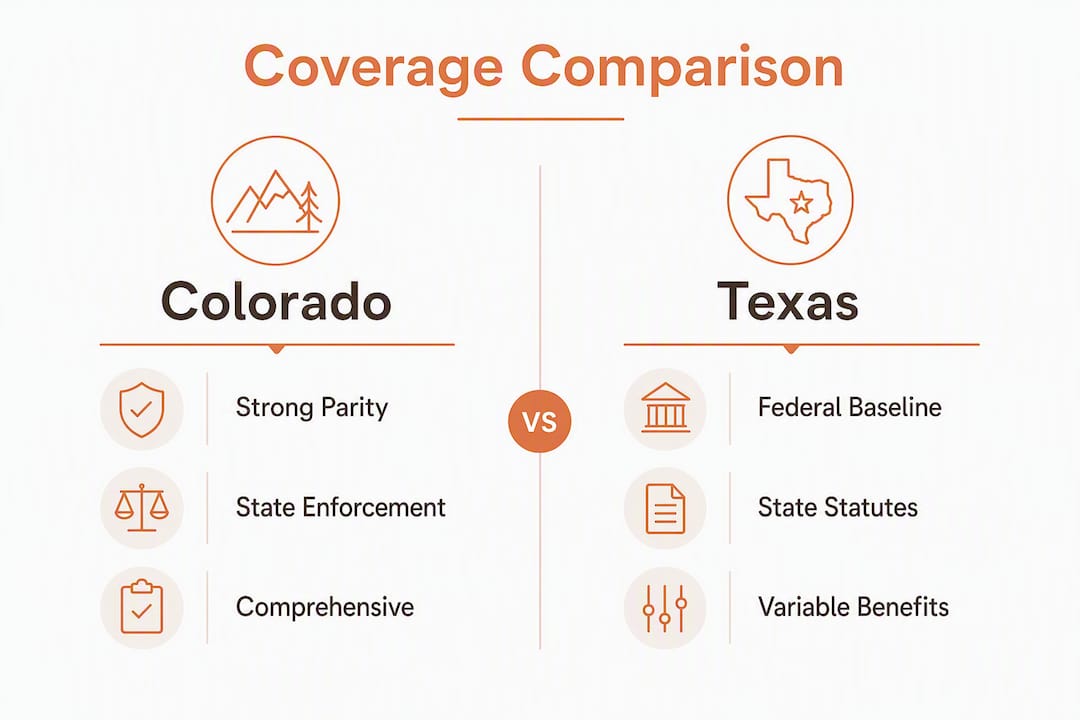
Colorado goes beyond the federal baseline. Its Division of Insurance (DORA) enforces both MHPAEA and state-specific parity laws, giving Colorado residents additional protections and a clear complaint route.

Colorado’s Behavioral Health Care Coverage Modernization Act (HB19-1269) strengthened the Division of Insurance’s authority to oversee parity compliance and extended those requirements to Health First Colorado (the state’s Medicaid program). A state law update that took effect January 1, 2026, further requires insurers to cover mental health, behavioral health, and SUD treatment at the same level as physical health care. For practical purposes, this means Colorado insurers face active state oversight on top of federal enforcement.
Parity in Colorado requires:
- Comparable copays and deductibles for behavioral health versus medical visits
- Visit limits for therapy that are no more restrictive than limits for comparable medical services
- Utilization management tools (prior authorization, step therapy) applied equally across behavioral and medical benefits
- Network adequacy standards that give you reasonable access to in-network behavioral health providers
How to confirm your Colorado coverage
Pro Tip: When you call DORA, ask specifically whether your plan has filed a parity compliance analysis. Colorado law gives the Division authority to request and review these analyses, and knowing one exists can strengthen a complaint.
DORA contact information:
- Online complaint form: Available at dora.colorado.gov
3. How Texas enforces parity and what it means for your coverage
Texas enforces mental health parity through both federal MHPAEA requirements and state statute. Texas Insurance Code, Chapter 1355 sets coverage requirements for certain mental disorders and SUD benefits under state law, requiring that insurers offering mental health benefits do so at parity with medical and surgical coverage.
Employer-sponsored plans in Texas must include mental health benefits and meet parity requirements. If your employer plan denies a mental health claim, you have appeal rights under both the plan’s internal process and state rules.
How to confirm your Texas coverage
- Identify your plan type. Is it a Marketplace plan, employer plan, or Medicaid? Each has slightly different rules and a different regulator.
- Read your SBC. Look for the behavioral health row in your benefits summary. Note the copay, deductible, and any visit limits.
- Check the in-network provider list. Search for psychiatrists, licensed counselors, and SUD treatment facilities in your area. If the list is short, that may be a network adequacy issue worth reporting.
- Confirm prior authorization requirements. Ask your insurer which services require preauthorization and how long approval typically takes.
- Get written preauthorization. For inpatient psychiatric care or intensive outpatient programs, always get written confirmation before starting treatment.
Pro Tip: When you call the Texas Department of Insurance (TDI), ask the representative to confirm whether your plan is subject to state or federal parity rules. Self-funded employer plans fall under federal ERISA oversight, which changes who handles your complaint.
Texas Department of Insurance contact information:
- Phone: 1-800-252-3439
- Online complaint form and resources: tdi.texas.gov
4. What services are typically covered under mental health benefits
Most plans that comply with federal parity and ACA requirements cover a broad range of mental health and SUD services. Knowing the typical scope helps you identify gaps or errors in your own plan.
Commonly covered services include:
- Outpatient individual and group psychotherapy
- Psychiatric medication management visits
- Inpatient psychiatric hospitalization
- Partial hospitalization programs (PHP) and intensive outpatient programs (IOP)
- Residential SUD treatment programs
- Diagnostic testing and psychiatric assessments
- Transcranial magnetic stimulation (TMS) when medically necessary
- Eye movement desensitization and reprocessing (EMDR) when medically necessary
- Applied behavior analysis (ABA) for autism spectrum disorder
- Telehealth versions of most of the above
A typical Texas commercial plan includes inpatient psychiatric hospitalization, outpatient therapy, PHP, IOP, medication management, TMS, EMDR, and telehealth services as covered benefits, reflecting standard compliant mental health coverage.
Common limitations to watch for:
- Visit caps: Some plans cap outpatient therapy at a set number of sessions per year. Under parity, that cap must match comparable medical visit limits.
- Prior authorization: Inpatient stays, PHP, IOP, and some outpatient services often require preauthorization. Denial of preauthorization is appealable.
- Medical necessity criteria: Plans can require that services meet clinical criteria to be covered. These criteria must be no more restrictive than those used for medical benefits.
- Step therapy: Some plans require you to try a lower-cost treatment before approving a more intensive one. This is legal but must be applied equally across behavioral and medical benefits.
- Provider network gaps: Even when a service is covered, finding an in-network provider can be difficult. Thin networks are one of the most common practical barriers.
Pro Tip: If your plan denies a claim citing “not medically necessary,” ask for the specific clinical criteria used to make that determination. You are entitled to that information, and it is the foundation of a successful appeal.
5. A 7-step checklist to confirm your mental health coverage
Follow these steps before your first appointment to avoid surprise bills and coverage gaps.
-
Identify your plan type and regulator. Marketplace plans are regulated by your state’s DOI. Self-funded employer plans fall under federal ERISA. Medicaid is managed by your state. Knowing this tells you where to file a complaint if needed.
-
Read your Summary of Benefits and Coverage. Your SBC and plan documents are the most actionable source for verifying covered services, cost-sharing, and visit limits. Download it from your insurer’s member portal or request it in writing.
-
Check the provider directory. Search for in-network psychiatrists, therapists, and SUD counselors. Call the provider’s office to confirm they are still accepting your insurance. Directories are sometimes outdated.
-
Confirm which services require prior authorization. Ask member services for a complete list. Get the answer in writing or note the date, time, and representative’s name.
-
Get written preauthorization before intensive treatment. For inpatient psychiatric care, PHP, or IOP, submit a preauthorization request and keep the approval letter. Starting treatment without it can result in a denied claim even when the service is covered.
-
Ask about telehealth and prescribing rules. Confirm whether virtual visits are covered at the same rate as in-person visits and whether your telehealth provider is in-network. Ask about any restrictions on prescribing controlled medications remotely.
-
Document everything. Save denial letters, preauthorization approvals, and notes from every call with your insurer. This documentation is your evidence if you need to appeal.
Questions to ask your insurer’s member services:
- “Is [specific service] covered under my behavioral health benefits?”
- “What is my copay and deductible for outpatient therapy?”
- “Does this service require prior authorization, and what are the criteria?”
- “Is [provider name] currently in-network under my plan?”
- “What is my plan’s parity analysis, and can I request a copy?”
Questions to ask your provider’s billing team:
- “Do you accept my insurance, and are you currently in-network?”
- “Will you submit a preauthorization request on my behalf?”
- “What is your billing code for this service, and is it covered under my plan?”
Pro Tip: Ask your insurer directly: “Does my plan comply with MHPAEA parity requirements for both quantitative and non-quantitative treatment limitations?” A representative who cannot answer that question is a signal to escalate to your state DOI.
6. How to appeal a denial and file a parity complaint in Texas or Colorado
A denied claim is not the end of the road. You have internal appeal rights, external review options, and the ability to file a parity complaint with your state regulator.
Step-by-step: internal appeal
- Request the denial in writing. Your insurer must provide a written explanation of the denial, including the clinical criteria used.
- Gather your documentation. Compile a timeline of care, copies of treatment plans and progress notes, and a written statement of medical necessity from your clinician. These materials materially strengthen an appeal.
- Submit your internal appeal. Most plans require you to file within 180 days of receiving the denial notice. Check your plan documents for the exact deadline.
- Request an expedited appeal for urgent situations. If you are in active treatment or facing a health risk, you can request an expedited internal review, which typically must be resolved within 72 hours.
- Wait for the decision. Standard internal appeals are generally resolved within 30–60 days, though exact timelines vary by plan. Confirm your plan’s specific deadlines in your SBC.
External review
If your internal appeal is denied, you can request an independent external review by a third-party organization. External review is available for most Marketplace and employer plans. You typically have 4 months from the date of the final internal denial to file. The external reviewer’s decision is binding on the insurer.
Filing a parity complaint
- Colorado residents: File a complaint with the Colorado Division of Insurance (DORA) by phone at 303-894-7490, by email at dora_insurance@state.co.us, or through the online complaint form at dora.colorado.gov. DORA will investigate whether your plan’s treatment of behavioral health benefits meets parity requirements.
- Texas residents: File a complaint with the Texas Department of Insurance at tdi.texas.gov or by calling 1-800-252-3439. TDI can investigate parity violations for state-regulated plans. For self-funded employer plans, complaints go to the U.S. Department of Labor.
Practical documentation tips:
- Keep a written log of every call: date, time, representative’s name, and what was said.
- Save every denial letter and preauthorization notice.
- Ask your clinician to write a detailed medical necessity letter that references your diagnosis, treatment history, and why the requested service is clinically appropriate.
- If your plan cites a specific clinical guideline to deny care, ask your clinician to respond to that guideline directly in their letter.
7. How Medicaid, CHIP, Medicare, and Marketplace plans compare for mental health
Federal parity and ACA protections apply differently depending on which type of plan you have. The table below outlines key differences across major program types.
| Program | Parity / EHBs apply? | Prior authorization | Telehealth | Notes |
|---|---|---|---|---|
| Marketplace (ACA) | Yes — full MHPAEA + EHBs | Varies by plan | Commonly covered | No annual/lifetime dollar limits; pre-existing conditions covered |
| Employer-sponsored | Yes — MHPAEA applies | Varies by plan | Varies by plan | Self-funded plans exempt from EHBs; ERISA governs complaints |
| Medicaid / CHIP | Partial — MHPAEA applies to managed care | Varies by state program | Expanding in both states | Colorado’s HB19-1269 extends parity to Health First Colorado |
| Medicare | Partial — different rules apply | Yes, for some services | Covered for mental health | Part B covers outpatient therapy; Part D covers psychiatric meds |
Colorado Medicaid (Health First Colorado) is subject to parity requirements under HB19-1269, which extended Colorado’s state parity law to the Medicaid program. Covered services include outpatient therapy, psychiatric medication management, and SUD treatment, though prior authorization requirements and provider network availability vary by managed care organization.
Texas Medicaid covers mental health services including outpatient therapy and psychiatric medication management, but the scope of covered services and network access can vary significantly by managed care plan and region. Texas Medicaid does not have the same state-level parity enhancement that Colorado added through HB19-1269.
Medicare operates under a separate framework. Part B covers outpatient mental health services, including therapy and psychiatric evaluations, at 80% after the deductible once you have met your Part B deductible. Part D covers psychiatric medications. Medicare Advantage plans may offer additional mental health benefits, but coverage varies by plan. For employer-sponsored plans designed for employers looking to build strong mental health benefits, mental health platform ROI resources can help HR teams evaluate options.
8. What to expect for telehealth and virtual psychiatry coverage
Telehealth for mental health is commonly covered under most commercial plans, Marketplace plans, and many Medicaid programs in Texas and Colorado. The key variable is not whether telehealth is covered in principle but whether the specific platform or provider you use is in-network under your plan.
Before your first virtual appointment, verify:
- In-network status of the platform and clinician. A telehealth platform can be in-network as an organization while individual clinicians within it are not, or vice versa. Ask your insurer to confirm both.
- Prescribing rules for controlled medications. Telehealth prescribing of controlled stimulants (commonly used for ADHD) and benzodiazepines may be subject to stricter state and insurer rules. Confirm both the clinician’s license in your state and your plan’s policy before your first visit.
- Whether medication management visits are covered. Some plans cover therapy visits under behavioral health but classify medication management visits differently. Ask specifically about psychiatric medication management as a covered service.
- Interstate licensure. Your telehealth clinician must be licensed in the state where you are located at the time of the visit, not just where the platform is based.
- Parity for virtual visits. Your cost-sharing for a telehealth therapy session should not exceed what you pay for an equivalent in-person visit. If it does, that may be a parity issue worth reporting.
Pro Tip: Call your insurer and ask: “Is [telehealth platform name] considered an in-network provider under my behavioral health benefits, and is the visit billed as an in-network service?” Get the answer confirmed in writing or via a reference number for the call. This single step prevents most surprise out-of-network bills.
For residents in Texas and Colorado seeking anxiety treatment online or virtual ADHD care, confirming in-network status before booking is the most important step you can take. For employers building or evaluating mental health benefits for their teams, 2026 HR guidance on employee mental health programs offers a practical framework for plan design.
Key Takeaways
Most health plans in Texas and Colorado must cover mental health at parity with physical health under federal law, and both states add enforcement tools that give residents clear complaint routes and appeal rights.
| Point | Details |
|---|---|
| Federal parity is your baseline | MHPAEA and the ACA require cost-sharing parity and EHB coverage for most Marketplace, employer, and Medicaid plans. |
| Colorado adds state enforcement | HB19-1269 and a 2026 state law update give DORA authority to enforce parity for private plans and Health First Colorado. |
| Texas has statutory protections | Texas Insurance Code Chapter 1355 requires parity for mental health and SUD benefits; TDI handles complaints for state-regulated plans. |
| Your SBC is the starting point | Read your Summary of Benefits and Coverage and check in-network status before your first appointment to avoid surprise costs. |
| Journeymhw offers virtual care now | Journeymhw provides telehealth psychiatric evaluations and medication management for ADHD, anxiety, and depression in Texas and Colorado. |
Pro Tip: Save every denial letter, preauthorization notice, and call log. If you need to appeal or file a parity complaint, that documentation is your strongest asset.
A note on navigating insurance for mental health care
The patients we see at Journeymhw often arrive having already spent weeks trying to figure out whether their insurance will cover care. They have read their plan documents, called member services, and still feel uncertain. That experience is more common than it should be, and it is one of the reasons we think it matters to be direct about what the law actually requires.
Parity protections are real and enforceable. What they do not do is make the process effortless. You may still need to push back on a denial, request documentation your insurer would rather not provide, or file a complaint with DORA or TDI to get a fair outcome. The steps in this guide are not theoretical. They are the same steps that lead to successful appeals and corrected coverage decisions.
If you are in Texas or Colorado and you are ready to get care rather than keep researching, a telehealth evaluation is often the fastest path forward. Checking your in-network status takes one phone call, and many patients find that virtual psychiatric care is covered at the same rate as in-person visits.
Journeymhw offers virtual psychiatric care for Texas & Colorado residents
Getting a psychiatric evaluation should not require a months-long wait or a long drive. Journeymhw provides telehealth psychiatric evaluations, ADHD testing, medication management, and structured treatment plans for adults with ADHD, anxiety, and depression, available entirely online in Texas and Colorado.

What Journeymhw offers:
- Initial psychiatric evaluation via secure video
- ADHD medication management for adults in Texas and Colorado
- Anxiety and depression treatment with ongoing medication management
- Annual all-inclusive care plans for patients who want predictable costs
- Insurance billing for in-network patients, with self-pay options available
Journeymhw works with major commercial insurers including Blue Cross Blue Shield, Cigna, Aetna, UnitedHealthcare, and Anthem. In-network patients are billed at their plan’s covered rate. If you prefer self-pay or your plan is out-of-network, transparent pricing is available at checkout.
Book your evaluation now and confirm your in-network status when you schedule. Appointments are typically available quickly, so you can move from coverage questions to actual care without delay.
This article provides general information about mental health insurance coverage and is not a substitute for professional legal, financial, or medical advice. Confirm current coverage rules with your insurer, your state’s Department of Insurance, or a qualified professional.
Official sources and where to get help
Use these resources to verify coverage, file complaints, or read the full statutory language for your state.
- Healthcare.gov: Mental health and substance abuse coverage — Federal explanation of EHBs, parity protections, and what Marketplace plans must cover.
- Colorado Division of Insurance (DORA): Mental/Behavioral Health and Insurance — Colorado’s primary consumer guidance page for parity, complaint filing, and plan-specific questions. Phone: 303-894-7490.
- Texas Department of Insurance: Mental Health Parity Overview — TDI’s overview of parity requirements and how to file a complaint for state-regulated plans. Phone: 1-800-252-3439.
- Texas Insurance Code, Chapter 1355 (Justia) — Full statutory text of Texas’s mental health and SUD coverage requirements.
- Colorado General Assembly: HB19-1269 (Behavioral Health Care Coverage Modernization Act) — Full text of Colorado’s parity modernization law, including Medicaid applicability.
- DORA main portal — Online complaint form and additional consumer resources for Colorado residents.
- Journeymhw: Conditions we treat in Texas & Colorado — Overview of ADHD, anxiety, and depression services available via telehealth in both states.
- Journeymhw: Book now — Schedule a psychiatric evaluation or medication management visit online.
Recommended
- Depression Treatment in Texas & Colorado | Online Depression Help & Medication – Journey Mental Health
- Anxiety Treatment in Texas & Colorado | Online Anxiety Help & Medication – Journey Mental Health
- Mental Health Treatment in Texas & Colorado | ADHD, Anxiety, & Depression – Journey Mental Health
- The Benefits of Virtual Mental Health Care for Depression, Anxiety and ADHD your guide – Journey Mental Health