

Mental Health Diagnosis Process for Adults: A Clear Guide
The mental health diagnosis process for adults is a structured clinical approach that uses interviews, medical assessments, and standardized criteria to identify conditions like depression, anxiety, and ADHD. Most adults arrive at evaluation with months or years of unaddressed symptoms. Understanding what happens at each step removes the uncertainty and helps you participate more fully in your own care. This guide covers every stage, from the first clinical interview through treatment planning, so you know exactly what to expect.
What does the mental health diagnosis process for adults involve?
A mental health diagnosis is not simply a label. It is a clinical formulation that synthesizes your medical history, psychological background, and social context into a treatment roadmap. That distinction matters because it shifts the goal from naming a condition to understanding you as a whole person.
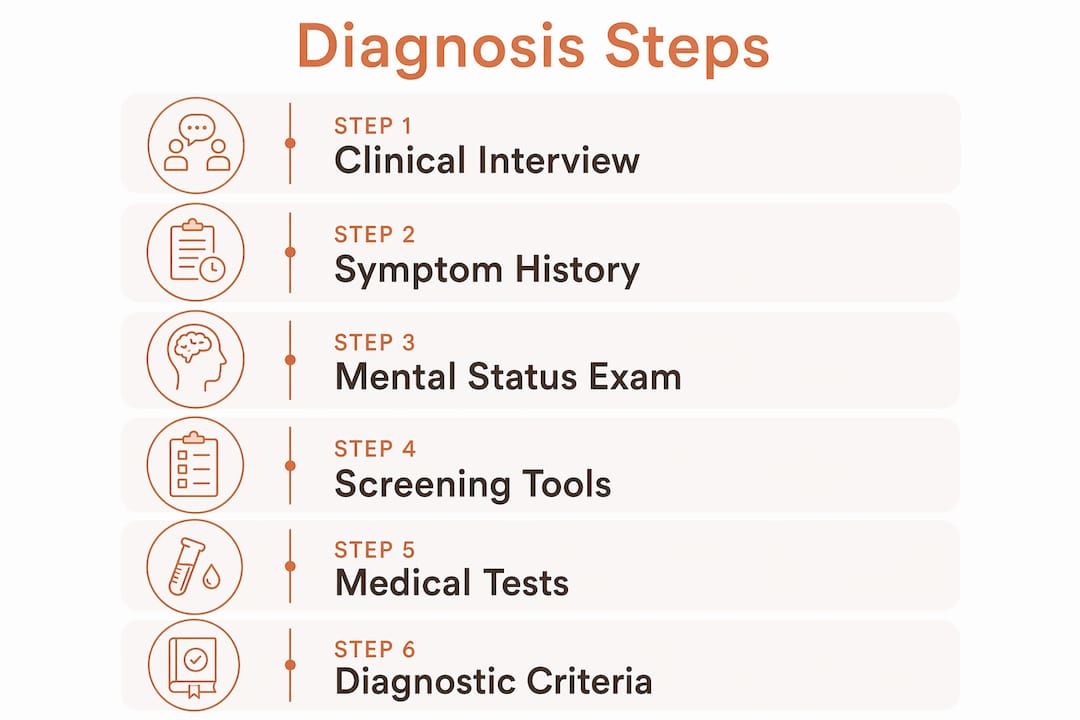
The process follows a consistent structure across most clinical settings:
- Clinical interview: A clinician asks about your current symptoms, their timeline, frequency, and severity.
- Medical and psychiatric history: You discuss past diagnoses, medications, substance use, and family mental health history.
- Mental status examination: The clinician observes your thinking, mood, speech, and behavior in real time.
- Screening tools and questionnaires: Standardized checklists measure the intensity of specific symptoms.
- Medical evaluation: Lab tests and a physical exam rule out physical causes.
- Diagnosis and treatment planning: The clinician applies DSM-5-TR or ICD-11 criteria to reach a working diagnosis and discuss next steps.
Clinicians recommend seeking a formal evaluation when symptoms persist for more than two weeks or begin to impair daily functioning. That threshold exists because short-term distress is normal, but sustained impairment signals a clinical condition.
What happens during a clinical interview and psychiatric evaluation?
The clinical interview is the core of any adult mental health assessment. A thorough psychiatric evaluation covers mood, sleep, energy, appetite, concentration, relationships, substance use, and safety. Each domain gives the clinician a different angle on what is driving your symptoms.

Symptom history and mental status exam
Your clinician will ask when symptoms started, how often they occur, and how much they affect your work, relationships, and daily routines. This is not a casual conversation. The clinician is building a timeline that helps separate a recent episode from a long-standing pattern.
The mental status examination runs alongside the interview. It evaluates your cognitive and emotional functioning in the moment, including how you speak, organize your thoughts, and respond emotionally. This exam is critical for identifying conditions like psychosis or severe depression that may not be fully captured by self-report alone.
Screening tools and collateral information
After the interview, most clinicians use standardized questionnaires. Common examples include the PHQ-9 for depression, the GAD-7 for anxiety, and the Adult ADHD Self-Report Scale. These tools quantify symptom severity and create a baseline for tracking progress over time.
Collateral information, meaning input from a partner, family member, or previous provider, adds important context. Adults with ADHD, for example, often underreport symptoms they have normalized over decades. A family member’s observations can fill those gaps.
Pro Tip: Write down your three most disruptive symptoms before your first appointment, including when they started and how they affect a typical day. Clinicians work faster and more accurately when you arrive with a clear symptom narrative.
Why do medical exams and lab tests matter for mental health diagnosis?
Physical health and mental health overlap more than most people expect. Thyroid dysfunction and vitamin deficiencies are two of the most common physical conditions that produce psychiatric symptoms, including fatigue, low mood, anxiety, and concentration problems. A clinician who skips the medical workup risks treating a thyroid disorder with an antidepressant.
Standard lab tests in a comprehensive mental health evaluation typically include:
- Thyroid function panel (TSH, T3, T4)
- Complete blood count
- Vitamin D and B12 levels
- Metabolic panel
- Drug and alcohol screening
Each test serves a specific purpose. A low vitamin D level, for instance, correlates with depressive symptoms and responds to supplementation rather than psychiatric medication. Identifying that early changes the entire treatment path.
Having recent lab results ready before your evaluation can accelerate the diagnostic process by weeks. If your primary care provider ran bloodwork in the past six months, bring those records to your first psychiatric appointment.
Pro Tip: Request a copy of your most recent lab results from your primary care provider before your psychiatric evaluation. Upload or bring them to your first appointment so your clinician can review them immediately.
How do clinicians use diagnostic criteria to reach a diagnosis?
Clinicians apply the DSM-5-TR (Diagnostic and Statistical Manual of Mental Disorders, Fifth Edition, Text Revision) or the ICD-11 (International Classification of Diseases, 11th Revision) to compare your symptoms against established thresholds. The DSM-5-TR covers more than 300 diagnostic categories, each with specific requirements for symptom type, frequency, intensity, and duration.
The table below shows how those thresholds differ across three common conditions:
| Condition | Minimum symptom duration | Key diagnostic requirements |
|---|---|---|
| Major depressive disorder | 2 weeks | 5 of 9 symptoms, including depressed mood or loss of interest |
| Generalized anxiety disorder | 6 months | Excessive worry on most days, plus 3 of 6 physical/cognitive symptoms |
| ADHD (adult) | Symptoms present before age 12 | 5 inattentive or hyperactive symptoms in 2 or more settings |
These thresholds exist to prevent overdiagnosis and to confirm that symptoms represent a true clinical condition rather than a temporary stress response.
The diagnostic process is also iterative. Clinicians often begin with a working diagnosis that may be refined as treatment progresses and more information becomes available. If your first diagnosis does not feel accurate after several weeks of treatment, that is a signal to revisit the formulation, not a failure of the process.
Why are overlapping symptoms of ADHD, anxiety, and depression so hard to untangle?
ADHD, anxiety, and depression share a significant number of symptoms, including low motivation, difficulty concentrating, irritability, and disrupted sleep. This overlap is the most common source of misdiagnosis in adult mental health care. A clinician who focuses only on the presenting complaint can easily miss a second condition running underneath it.
The key symptoms that overlap across all three conditions include:
- Difficulty concentrating or completing tasks
- Irritability and emotional reactivity
- Low energy or motivation
- Sleep disturbances
- Social withdrawal
What separates these conditions is the context of the symptoms, not the symptoms themselves. Concentration problems in ADHD are present across all settings and tasks. In depression, they appear alongside persistent low mood. In anxiety, they occur alongside excessive worry and physical tension. Clinicians use detailed history, onset patterns, and collateral information to make that distinction.
Adults who have lived with undiagnosed ADHD often develop secondary anxiety or depression as a result of years of underperformance and self-criticism. That layering, called comorbidity, is common and requires treatment that addresses both conditions. If you feel your diagnosis does not capture the full picture, asking for a second opinion or a specialist referral is a reasonable and appropriate step.
What happens after a diagnosis? Treatment planning and follow-up
A diagnosis is the starting point, not the finish line. After reaching a working diagnosis, your clinician will discuss treatment goals and options with you directly. That conversation is collaborative. You are not receiving a prescription and being sent home.
A typical post-diagnosis plan follows these steps:
- Review the diagnosis together. Your clinician explains the reasoning behind the diagnosis and answers your questions.
- Set treatment goals. Goals are specific and functional, such as improving sleep, returning to work, or reducing panic episodes.
- Choose a treatment approach. Options include medication, therapy (such as cognitive behavioral therapy), lifestyle changes, or a combination.
- Schedule follow-up appointments. Regular check-ins allow your clinician to monitor your response and adjust the plan.
- Involve additional support when needed. Family members, therapists, or specialists may join the care team depending on your situation.
Medication management and therapy referrals are not mutually exclusive. Many adults with depression, anxiety, or ADHD benefit most from both. Follow-up appointments are where the real work of refining your treatment happens, so attending them consistently matters as much as the initial evaluation.
Key Takeaways
A complete adult mental health assessment integrates clinical interviews, medical testing, standardized diagnostic criteria, and iterative follow-up to produce an accurate and actionable diagnosis.
| Point | Details |
|---|---|
| Diagnosis is a formulation | It synthesizes medical, psychological, and social history into a treatment roadmap, not just a label. |
| Medical tests are required | Thyroid panels, vitamin levels, and drug screening rule out physical causes that mimic psychiatric symptoms. |
| DSM-5-TR sets the thresholds | Symptom duration, frequency, and intensity must meet specific criteria before a diagnosis is confirmed. |
| Overlapping symptoms complicate diagnosis | ADHD, anxiety, and depression share core symptoms; context and history separate them. |
| Diagnosis is iterative | A working diagnosis may be refined as treatment progresses and new information emerges. |
What I’ve learned from watching adults navigate the diagnosis process
Adults consistently underestimate how much preparation affects the quality of their evaluation. Most people arrive at a psychiatric appointment with a vague sense that something is wrong but no clear account of when symptoms started, how often they occur, or which situations make them worse. That gap slows the clinician down and sometimes leads to an incomplete picture.
The adults who get the most out of their first evaluation are the ones who treat it like a job interview for their own care. They bring a written symptom log, a list of current medications, and any relevant lab results. They have thought about how their symptoms affect specific areas of life, not just how they feel in general.
One thing I find underappreciated is the value of persistence after a diagnosis that does not feel right. A working diagnosis is not a verdict. If you complete a course of treatment and your core symptoms remain unchanged, that is clinically meaningful information. Bring it back to your provider. Ask whether a second condition might be present. The depression vs. ADHD distinction, for example, is one that many adults only get clarity on after an initial misdiagnosis.
Treatment outcomes improve significantly when the diagnosis is accurate. Getting there sometimes takes more than one appointment, and that is completely normal.
— Jamie
Personalized mental health care through Journeymhw
Adults in Texas and Colorado now have access to psychiatric evaluations and treatment without the wait times of traditional in-person care.
Journeymhw is a telehealth platform that provides virtual psychiatric evaluations and personalized treatment for ADHD, anxiety, and depression. The process is structured and efficient, from your first assessment through ongoing medication management. Whether you are seeking ADHD treatment, anxiety treatment, or depression treatment, Journeymhw connects you with a clinician who can evaluate your symptoms and build a care plan around your specific needs. Appointments are available quickly, and the entire process happens from home. If you are ready to get clarity on what you are experiencing, book your appointment and take the first step toward an accurate diagnosis.
FAQ
What is the first step in the mental health diagnosis process for adults?
The first step is a clinical interview, where a clinician collects your symptom history, medical background, and current functioning. This conversation forms the foundation of the entire diagnostic evaluation.
How long does an adult mental health evaluation take?
A comprehensive psychiatric evaluation typically takes 60–90 minutes for the initial appointment. Follow-up sessions are shorter and focus on refining the diagnosis and adjusting treatment.
Can physical health problems cause mental health symptoms?
Yes. Thyroid dysfunction, vitamin D deficiency, and anemia are among the most common physical conditions that produce symptoms like depression, anxiety, and fatigue. Lab testing rules these out before a psychiatric diagnosis is confirmed.
What is a working diagnosis in mental health care?
A working diagnosis is an initial clinical conclusion that may be updated as treatment progresses and more information becomes available. It is a starting point, not a permanent label.
How do clinicians tell ADHD apart from anxiety or depression?
Clinicians look at the context and onset of symptoms, not just the symptoms themselves. ADHD symptoms are present across all settings from childhood onward, while depression and anxiety tend to have a more defined onset and situational pattern.