

Medication Holidays for ADHD: A Clinician-Guided Approach
A supervised medication holiday can be a reasonable option for specific, clinician-agreed reasons like side effect management or growth monitoring, but it is not safe or appropriate for everyone. If your child has severe hyperactive or impulsive symptoms, or if you or your teen has an unstable mood condition or a recent substance use history, a break carries real risk and should generally be avoided.
Prescriber involvement is not optional here. What separates a helpful medication holiday from a risky one is planning: a clear reason, a monitoring plan, and someone with clinical training watching for warning signs.
Here is what to do right now if you are considering one:
- Schedule an appointment with your (or your child’s) prescriber before making any changes to dosing.
- Bring a simple baseline log tracking mood, appetite, sleep, and behavior for at least a week or two beforehand.
- Ask directly whether your specific ADHD presentation and medication type make you a reasonable candidate.
The rest of this guide walks through the evidence, the timing decisions, and the medication-specific details that make that conversation more productive.
Key Takeaways
A supervised medication holiday can offer real benefits for specific ADHD presentations, but it requires clinician planning, baseline documentation, and clear restart criteria to be safe.
| Point | Details |
|---|---|
| Get prescriber involvement first | Never plan or start a medication holiday without your prescriber setting goals and monitoring criteria. |
| Document a baseline | Track symptoms, sleep, and appetite for one to two weeks before the break begins. |
| Match duration to the question | Use short trials for side effect checks and longer windows for growth or diagnostic questions. |
| Avoid weekend-only breaks | Repeated stopping and restarting complicates adjustment and produces unclear results. |
| Know your medication’s behavior | Stimulants offset quickly with easy restarts; alpha-2 agonists require tapering to avoid rebound effects. |
This article is general information, not a substitute for advice from a qualified doctor. Consult a qualified healthcare professional about your own circumstances before acting on anything here.
Table of Contents
- What Is a Medication Holiday for ADHD?
- Weighing the Benefits and Risks of an ADHD Drug Holiday
- Who Should Consider a Medication Holiday (and Who Shouldn’t)
- Timing and Duration: How Long Should a Break Last?
- How Different ADHD Medications Behave When You Stop Them
- Your Pre-Break Checklist: Planning a Holiday with Your Prescriber
- Managing ADHD Symptoms Without Medication During the Break
- What the Research Actually Shows About ADHD Drug Holidays
- How Journeymhw Supports Planning, Monitoring, and Restarting
- Editorial Take: What the Guidance Gets Right and Where It Falls Short
- Sources
What Is a Medication Holiday for ADHD?
A medication holiday, sometimes called a structured treatment interruption, is a planned, time-limited pause in ADHD medication that a prescriber designs and monitors for a specific clinical reason. It is not the same thing as forgetting a dose, running out of a prescription, or deciding on your own to “take a break” over a rough weekend. According to Cleveland Clinic, a true clinical drug holiday is a proactive, scheduled decision documented with a provider, built around a question the pause is meant to answer.
Clinicians typically consider a structured break for a handful of reasons:
- Growth monitoring. Stimulant medications can suppress appetite enough to slow a child’s weight and height gain, and a pediatrician may want a period off medication to see whether growth catches up.
- Side effect reassessment. Persistent appetite loss, sleep disruption, irritability, or a flattened mood can prompt a trial off medication to see how much of the symptom picture is drug related.
- Diagnostic clarity. Sometimes a prescriber wants to confirm the medication is still doing meaningful work, especially years into treatment when a child’s needs or an adult’s life circumstances have changed.
- Tolerance concerns. Occasionally a break is used to see whether reduced responsiveness reflects a dose that needs adjusting.
What a medication holiday is not: an unplanned lapse in refills, a missed dose because you forgot the bottle at home, or a unilateral decision to stop because side effects felt bad on a Tuesday. Those situations are worth calling your prescriber about too, but they carry different risks and don’t generate the kind of clean information a planned pause does. The distinction matters because a documented, intentional break lets you and your prescriber actually interpret what happens. An accidental gap in coverage just tells you the medication ran out.
Weighing the Benefits and Risks of an ADHD Drug Holiday
The honest answer is that the evidence here is mixed, and the quality of that evidence is not as strong as most parents assume. A guideline evidence review published by the National Center for Biotechnology Information concludes that withdrawing medication can worsen ADHD symptoms for some individuals while reducing medication side effects for others. There is no universal outcome. That is precisely why the guideline committee recommends individualized, clinician-led decisions rather than a one-size-fits-all protocol.
Drug holidays are common. Research on ADHD medication management estimates that between 25% and 70% of families have used them at some point, most often during summer or school vacations, according to a review of international drug holiday practices. That wide range itself tells you something: practice varies enormously by country, prescriber, and family, which is a sign the field hasn’t settled on firm rules.
Potential benefits
- Appetite recovery. Many children regain appetite and start eating more normally within days of stopping a stimulant.
- Sleep improvement. Difficulty falling asleep, a common stimulant side effect, often eases during a break.
- Growth catch-up. Longer planned breaks, particularly over a summer, have shown modest growth benefits in some studies, though the same research on international drug holiday practices notes that long-term catch-up growth can attenuate the difference over time.
- Reduced cumulative side effects. Less daily exposure to the medication can mean fewer accumulated adverse effects, including mood flattening or tics in sensitive individuals.
- Diagnostic information. Parents and clinicians get real data on how the person functions without medication, which matters for long-term treatment planning.
Potential risks
- Symptom rebound. Inattention, impulsivity, and hyperactivity often return, sometimes more intensely than baseline for a short window.
- Increased risky behavior. For older children, teens, and adults, a break can coincide with poorer judgment in situations that require sustained attention, like driving.
- Academic or occupational disruption. A poorly timed holiday during a school term or a demanding work stretch can create problems that outlast the break itself.
- Social friction. Family and peer relationships that had stabilized on medication can become strained again during a pause.
One nuance worth flagging: some clinicians report that frequent, unstructured breaks may actually prolong bothersome side effects rather than relieve them, because the body never gets the chance to adapt, according to CHADD’s clinical guidance. A single well-planned break tends to generate more useful information than repeated, casual ones.
The bottom line on evidence quality: most of what we know comes from observational studies and clinical experience, not large randomized controlled trials. Guideline consensus leans toward shared decision-making between you and your prescriber rather than a fixed protocol, because the right answer depends heavily on the individual case.
Who Should Consider a Medication Holiday (and Who Shouldn’t)
Not every ADHD presentation is a good fit for a planned break. Screening yourself against these profiles before your appointment can make the conversation with your prescriber far more productive.
- Children with mild to moderate, primarily inattentive ADHD who are experiencing clear side effects like appetite suppression or sleep trouble are often reasonable candidates. Their core symptoms tend to be less disruptive to daily function than hyperactive or impulsive presentations, which gives some room to test a break safely.
- Adults with stable routines and predictable low-demand periods (a vacation, a slower work season) may be good candidates for a short structured trial, particularly if the goal is confirming the medication still matters or identifying troublesome side effects.
- Anyone whose growth trajectory has flattened noticeably on stimulant treatment is a common candidate for a pediatrician-initiated holiday focused specifically on growth recovery.
On the other side, several profiles call for real caution:
- Severe hyperactive or impulsive presentations, or combined-type ADHD with prominent impulsivity, generally should avoid holidays. CHADD’s clinical guidance specifically flags this group as higher risk for symptom rebound and unsafe behavior during a pause.
- Recent substance use disorder history raises the stakes considerably, since impulsivity and poor judgment during a rebound period can intersect badly with recovery.
- Unstable mood symptoms or any suicidality make this the wrong time to remove a medication that may be providing meaningful stabilization, even indirectly.
- Critical school or work periods (finals, licensing exams, a demanding project cycle) are poor timing regardless of how mild the ADHD presentation is.
Age matters too. Younger children often tolerate breaks reasonably well because school demands are lower during vacations, while teens juggling driving, part-time jobs, and social independence face higher stakes when attention lapses. For adults, a 2 to 4 week structured trial tends to strike a workable balance between generating useful diagnostic information and minimizing disruption to work, according to Neurolaunch’s review of adult drug holiday practices. A 2026 consensus statement on deprescribing from the American Society of Clinical Psychopharmacology notes that prospective guidance for adults specifically remains limited, which is one more reason this decision should be individualized rather than borrowed from pediatric protocols.
Timing and Duration: How Long Should a Break Last?
Timing decisions come down to one core question: what is the break actually trying to answer, and how much time does that answer require?
Most families schedule holidays around summer break or extended school vacations, when the academic stakes of a symptom flare are lowest. This is by far the most common approach, and it lines up with when drug holidays get used most often according to the same international review cited above. A multi-week summer window gives enough time to see genuine appetite recovery, sleep pattern shifts, and, if growth is the concern, an early signal of catch-up.
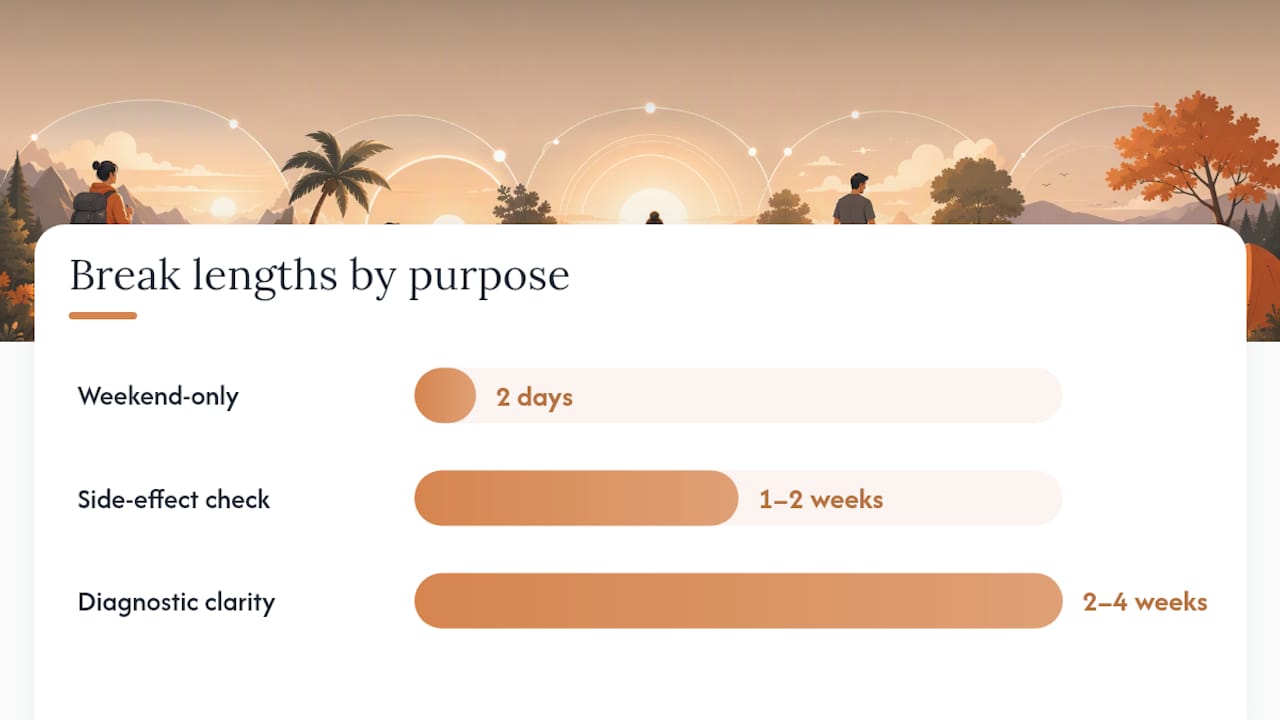
Weekend-only breaks are a different story, and most clinicians actively discourage them. Cleveland Clinic’s guidance notes that repeated stopping and restarting over weekends tends to complicate both the child’s adjustment and the quality of the information you get. If you stop Friday night and restart Monday morning, you are seeing two days of a body in flux, not a stable off-medication state. That ambiguity makes weekend holidays a poor tool for judging side effects or symptom severity, even though they remain common practice in some families.
Trial length should match the clinical question:
- Side effect relief (appetite, sleep, mood flattening): A week or two off medication is often enough to see whether those specific symptoms improve, since most stimulant side effects resolve within days of stopping.
- Growth reassessment: This typically needs a longer window, often several weeks to a full summer, since height and weight changes take time to register meaningfully.
- Diagnostic clarity in adults: A 2 to 4 week structured trial, timed to a genuinely low-demand stretch, tends to give a clearer signal than a shorter pause, according to Neurolaunch’s clinical review.
- Tolerance or ongoing-need questions: Longer school breaks give a fuller picture than a few isolated days, since attention and behavior patterns need time to settle into a new baseline.
Pro Tip: If you’re not sure how long a break should run, ask your prescriber what specific question the pause is meant to answer. The answer to that question usually tells you the minimum useful duration.
How Different ADHD Medications Behave When You Stop Them
Not all ADHD medications leave your system, or your symptoms, the same way. The class of medication changes both what to expect during the break and how the restart should be handled.
| Medication type | What happens when stopped | Restart considerations |
|---|---|---|
| Methylphenidate (short and extended release) | Leaves the system within a day; symptoms often return within days | Usually restarts at the prior effective dose without tapering |
| Amphetamine salts (mixed amphetamine formulations) | Similar rapid offset; rebound symptoms can appear quickly, sometimes with more irritability | Typically restarts without a taper, though prescribers may reassess dose |
| Lisdexamfetamine | Prodrug with a smoother offset since it must be metabolized into its active form; rebound tends to be gradual | Generally restarts at baseline dose |
| Atomoxetine (non-stimulant) | Builds up and clears slowly; stopping doesn’t cause immediate rebound but benefits fade over 1 to 2 weeks | Requires restarting from a lower dose and re-titrating, since it was originally titrated up |
| Alpha-2 agonists (guanfacine, clonidine) | Abrupt stopping can cause rebound hypertension, anxiety, or irritability | Must be tapered off, not stopped abruptly, and typically requires supervised restart |
Stimulants (methylphenidate, amphetamine salts, lisdexamfetamine) tend to offset quickly, which is exactly why they’re the medications most commonly used for structured holidays. Symptoms return fast, but so does the medication’s effect once restarted, which limits the risk of a complicated restart. Non-stimulants tell a different story. Atomoxetine takes weeks to build a full effect, so stopping doesn’t cause immediate rebound, but it also means you won’t see the benefit of stopping right away. Neurolaunch’s review of medication-specific restart planning notes that non-stimulants like guanfacine specifically require tapering to avoid rebound hypertension or anxiety, since these medications affect blood pressure regulation directly.
Pro Tip: Never stop an alpha-2 agonist like guanfacine or clonidine abruptly on your own, even for a planned holiday. These require a tapering schedule your prescriber designs specifically to avoid rebound blood pressure spikes.
If your treatment plan combines a stimulant with a non-stimulant or another medication, a prescriber-planned restart matters even more, since interaction effects and staggered timelines can complicate an otherwise straightforward break. Ask your prescriber to write out exactly which medications stop, which taper, and in what order.
Your Pre-Break Checklist: Planning a Holiday with Your Prescriber
A medication holiday works best when it is built around a written plan, not a verbal agreement you both hope you remember three weeks later. Here is a checklist to bring to your appointment.
Before the break:
- Define the specific goal: are you evaluating side effects, growth, ongoing need, or something else?
- Establish a baseline using a symptom log, behavior rating, and notes on sleep and appetite for at least one to two weeks beforehand.
- Agree on who will monitor daily behavior, whether that’s you, a teacher, a partner, or the individual themselves for adults.
- Set clear restart criteria in advance: what specific signs mean the break ends early?
- Confirm the medication-specific stop plan, including whether any medication needs tapering rather than abrupt discontinuation.
Documenting a baseline before the break and agreeing on a pre-specified restart rule dramatically reduces harm and produces more interpretable results, according to the same guideline review cited earlier. This single step is the difference between a holiday that answers a real clinical question and one that just leaves everyone guessing.
During the break, watch for:
- Escalating impulsivity or risk-taking behavior beyond what you documented at baseline.
- Sudden mood changes, especially irritability or signs of depression.
- Safety concerns at school, work, or while driving.
- Sleep or appetite changes moving in the wrong direction rather than improving.
Any of these should trigger an early call to your prescriber, not a wait-and-see approach. A holiday that starts causing more harm than the information it’s generating is a holiday that ends early, and that’s a legitimate outcome, not a failure.
After the break:
- Schedule the restart visit before the break even begins, so you’re not scrambling to get an appointment once symptoms flare.
- Decide whether the restart dose matches the prior dose or needs adjustment based on what you observed.
- Set a follow-up check-in within two to four weeks of restarting to confirm the medication is working as expected.
If titration questions come up during the restart, our guide on what to expect during ADHD medication titration walks through how dose adjustments typically work.
Managing ADHD Symptoms Without Medication During the Break
The break itself doesn’t have to mean chaos. A handful of behavioral supports can meaningfully soften the transition while medication is paused.
Sleep hygiene comes first: a consistent bedtime and wake time, even on weekends, helps stabilize attention and mood regardless of medication status. Timed exercise, ideally in the morning or early afternoon, has a real effect on focus and impulse control for many people with ADHD, and it costs nothing to try. Consistent daily routines, meals, homework, screen time at the same times each day, reduce the number of decisions and transitions that tend to trip up executive function.
External accountability tools fill in some of what the medication was doing chemically:
- Visual timers for tasks and transitions.
- Scheduled check-ins with a parent, partner, or accountability buddy.
- Written checklists posted somewhere visible, rather than mental lists.
- Calendar alerts for appointments and deadlines.
For children recovering appetite after stopping a stimulant, don’t be surprised by a noticeable increase in eating in the first week. Offer nutrient-dense snacks throughout the day rather than expecting three large meals right away, since appetite regulation can take time to normalize.
Pro Tip: If your child’s school performance or your work output starts slipping noticeably during the break, that’s a signal to loop in extra support, not just wait it out. A brief increase in therapy sessions, a coaching check-in, or a temporary classroom accommodation can bridge the gap until the break ends.
If symptoms during the break are more disruptive than expected, this is also a reasonable moment to increase therapy frequency, request temporary school accommodations, or bring in an ADHD coach for structure support. None of these replace medication, but they can meaningfully reduce the bumps.
What the Research Actually Shows About ADHD Drug Holidays
The clearest data point in this entire conversation is the prevalence figure: 25% to 70% of families have used drug holidays at some point, concentrated heavily around school and summer breaks. That range is wide because practice patterns vary enormously across countries, prescribers, and individual families, not because there’s a hidden consensus underneath it.
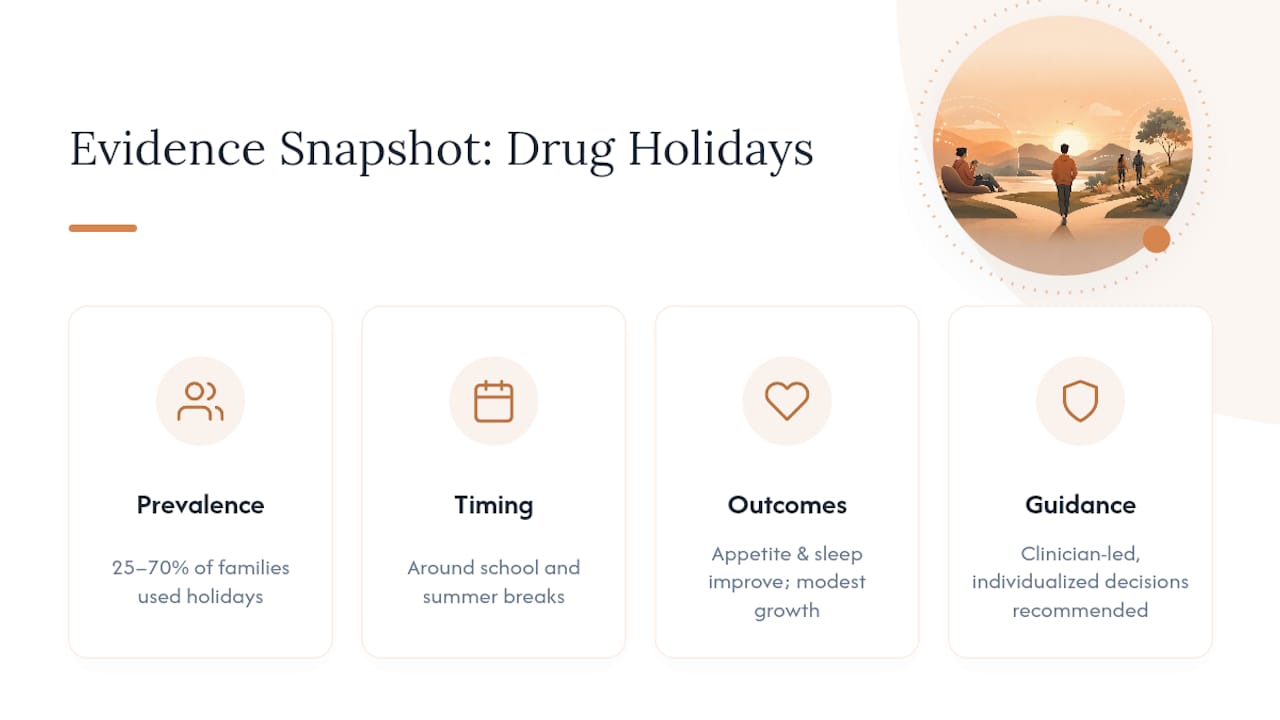
Randomized controlled trial evidence remains thin. One frequently cited weekend methylphenidate trial provides some structured data, but the field mostly relies on observational studies rather than the kind of large, controlled research that would settle debates definitively. Those observational studies do show consistent signals: appetite and sleep improve during breaks, and longer breaks show modest growth benefits, though growth catch-up over time can narrow that difference.
On the guideline side, the message is consistent across sources. The NCBI guideline review concludes that withdrawal can worsen symptoms for some people while reducing side effects for others, and recommends individualized, clinician-led decision-making rather than a standard protocol applied to everyone. Cleveland Clinic’s clinical guidance echoes this, describing structured breaks as something planned with a provider rather than a default option for anyone finding side effects annoying.
What ties all of this together: there is no evidence-backed formula that tells you exactly who should take a break, for how long, or with what expected outcome. What the evidence does support is that the decision needs to be made case by case, with a documented plan, clear goals, and a clinician tracking what happens. That’s a less satisfying answer than a fixed rule, but it’s the honest one.
How Journeymhw Supports Planning, Monitoring, and Restarting
Planning a medication holiday well requires access to a prescriber who can help you set goals, watch for warning signs, and manage the restart. Journeymhw offers virtual psychiatric evaluations and ongoing medication management for ADHD, built specifically around this kind of structured, supervised care.
A telehealth visit through Journeymhw can help you:
- Establish or review the baseline symptom, sleep, and appetite documentation your prescriber needs before a break begins.
- Set clear restart criteria and a monitoring schedule tailored to your medication and situation.
- Get follow-up visits scheduled quickly if symptoms escalate during the break or the restart needs adjusting.
- Address titration questions if your restart dose needs to change from what you were taking before.
To prepare for a telehealth visit about a potential medication holiday, bring your symptom log, a list of current medications and doses, and specific notes on the side effects or concerns driving the conversation. That preparation lets your prescriber move directly into planning rather than starting from scratch.
If you’re managing ADHD medication in Texas or Colorado and want a supervised path toward evaluating whether a break makes sense, Journeymhw’s ADHD medication management services are built around exactly this kind of ongoing, structured care.
| Service | How it supports a medication holiday |
|---|---|
| Psychiatric evaluation | Confirms whether current symptoms and history support considering a break |
| Medication management | Establishes baseline, monitors during the break, and adjusts the restart plan |
| Follow-up visits | Provides quick access if warning signs appear or the restart needs changes |
If you’re ready to talk through a supervised plan, Journeymhw’s ADHD treatment services connect you with a prescriber who can evaluate your specific situation and build a monitoring plan around it, whether that means confirming a holiday makes sense or identifying a better path forward.
Editorial Take: What the Guidance Gets Right and Where It Falls Short
The research on ADHD drug holidays supports one clear judgment: this decision should never be made alone, and it should never be made casually. Where conventional advice falls short is treating medication holidays as a simple parenting choice, something you decide over a weekend because side effects seem bad. That framing ignores how much the evidence actually varies by medication type, symptom severity, and individual history.
What’s overrated here is the idea of a “standard” break length or a universal right answer. The guideline consensus is explicit that this needs to be individualized, yet plenty of casual advice online treats a summer-long stimulant break as automatically beneficial. It isn’t, for every child, and it definitely isn’t for every adult managing a demanding job.
What matters most, and what most families skip, is the baseline documentation step. Without it, you’re guessing whether the break actually changed anything. Prioritize that conversation with your prescriber before you prioritize the calendar.
— Jamie
Sources
- Drug Holidays From ADHD Medication: International Experience Over the Past Four Decades - PubMed
- Withdrawal from pharmacological treatment and drug holidays
- Is a medication holiday an option for your child with ADHD? — CHADD
- Can You Take an ADHD Medication Holiday? — Cleveland Clinic
Recommended
- ADHD Medication Titration: What Patients and Caregivers Should Expect – Journey Mental Health
- ADHD Medication Management in Texas & Colorado | Online ADHD Prescriptions – Journey Mental Health
- A Streamlined Path to Mental Health Medication for Adults – Journey Mental Health
- Combining SSRIs and Stimulants: Safety for ADHD Adults – Journey Mental Health