

Managing ADHD, Anxiety, and Depression Together in 2026
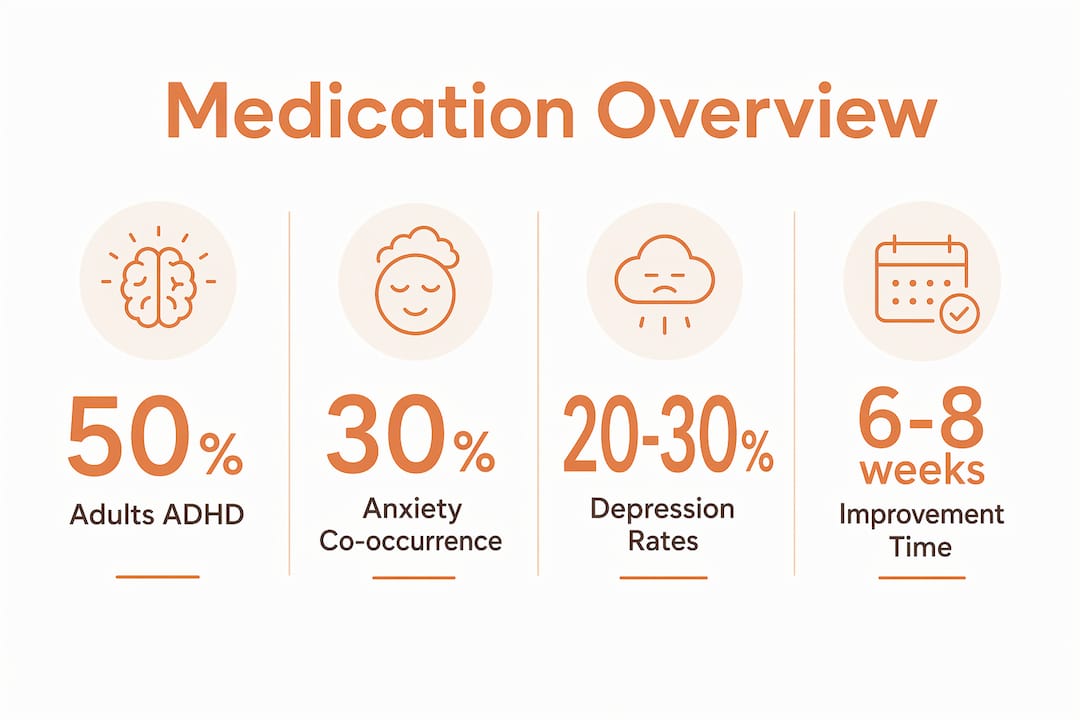
Managing ADHD, anxiety, and depression together is defined clinically as treating co-occurring or comorbid conditions that share overlapping symptoms but require distinct and coordinated interventions. Up to 50% of adults with ADHD also have an anxiety disorder, and 20 to 30% experience co-occurring depression. That level of overlap means isolated treatment rarely works. Effective management combines medication sequencing, integrated cognitive behavioral therapy (CBT), and targeted lifestyle adjustments designed specifically for the way these three conditions interact. This guide covers what actually works in 2026, grounded in clinical evidence and structured for adults who need real answers, not generic reassurance.
What makes managing ADHD, anxiety, and depression together so difficult?
The core challenge is that ADHD, anxiety, and depression produce symptoms that look alike on the surface but have different origins. Difficulty concentrating, low motivation, sleep problems, and emotional reactivity appear in all three conditions. That overlap creates diagnostic confusion and leads many adults to receive treatment for only one condition while the others go unaddressed. You can read more about how these presentations get tangled in this breakdown of overlapping symptoms across all three conditions.
The most clinically significant issue is emotional dysregulation. ADHD drives impulsive emotional responses due to executive function deficits. Anxiety amplifies those responses through chronic worry. Depression flattens motivation and adds a layer of hopelessness on top. When all three are active simultaneously, the combined effect on daily functioning is greater than the sum of its parts.

A critical misconception is that treating anxiety or depression alone resolves the full picture. Treating anxiety or depression in isolation reduces emotional distress but does not correct ADHD executive function deficits, which continue to generate real-world failures. Those failures, repeated over years, produce what clinicians call situational demoralization. Long-term untreated ADHD can cause secondary depression through exactly this mechanism. The practical implication: you need a treatment plan that addresses all three conditions at once, not sequentially.
Key symptom areas where the three conditions overlap and complicate each other:
- Attention and concentration: ADHD causes structural inattention; anxiety and depression each impair focus through rumination and cognitive slowing.
- Sleep disruption: All three conditions independently disrupt sleep architecture, compounding fatigue and worsening daytime function.
- Avoidance behavior: ADHD produces task avoidance due to poor initiation; anxiety drives avoidance of feared situations; depression reduces motivation to engage with anything.
- Self-esteem: Chronic executive dysfunction from ADHD, combined with the self-critical thinking patterns of anxiety and depression, creates a particularly damaging cycle of shame and withdrawal.
- Misdiagnosis risk: Adults with all three conditions are frequently misdiagnosed with one condition while the others remain untreated for years.
How is medication managed when treating ADHD, anxiety, and depression at once?
Medication for comorbid presentations is not one-size-fits-all. Careful selection and combination of stimulants, non-stimulants, and antidepressants improve outcomes significantly compared to single-agent treatment. The sequencing decision depends on which condition is most severe and most impairing at the time of evaluation.
Clinical guidelines recommend prioritizing mood stabilization when severe depression is present, particularly if suicidality or significant self-care failure is involved. Once the patient is stable, ADHD treatment can begin. If ADHD is the primary driver and depression appears secondary to executive dysfunction failures, treating ADHD first often lifts mood without requiring a separate antidepressant.
| Medication | Primary target | Notes for comorbid use |
|---|---|---|
| Methylphenidate (stimulant) | ADHD | Psychiatrically safe in depression; study of 6,422 adults showed no increase in suicidality |
| Atomoxetine (non-stimulant) | ADHD | Preferred when anxiety is prominent; avoids stimulant-related activation |
| SSRIs (sertraline, escitalopram) | Anxiety and depression | Combined with ADHD medications; well-tolerated in most adults |
| Bupropion (off-label) | ADHD and depression | Targets dopamine and norepinephrine; useful when both ADHD and depression need addressing |
Stimulants like methylphenidate are often avoided in anxious patients due to concerns about activation, but the evidence does not support blanket avoidance. A retrospective cohort study of 6,422 adults showed methylphenidate carries a lower risk of hospital visits and no increase in suicidality in patients with major depressive disorder. That finding matters because it gives clinicians more flexibility to treat ADHD directly even when depression is present.
Bupropion occupies a unique position in this space. It acts on dopamine and norepinephrine, the same neurotransmitter systems implicated in ADHD, while also functioning as an antidepressant. For adults who cannot tolerate stimulants or who have prominent depressive symptoms alongside ADHD, bupropion offers a single-agent option worth discussing with your prescriber. You can explore medication management options in Texas and Colorado through Journeymhw’s online psychiatric services.
Pro Tip: If a new medication worsens anxiety or sleep within the first two weeks, do not stop without consulting your prescriber. Titration adjustments, not discontinuation, are usually the right response.
What therapeutic strategies work for all three conditions at once?
Integrated CBT is the most evidence-supported therapy for managing ADHD, anxiety, and depression simultaneously, but the approach differs from standard CBT in important ways. ADHD-focused CBT uses behavioral experiments to test task initiation directly, breaking avoidance cycles through action rather than thought restructuring alone. Standard anxiety CBT focuses on identifying and challenging catastrophic thoughts. Depression-focused CBT targets behavioral activation. An integrated approach weaves all three together.
Here is a practical framework for applying integrated behavioral strategies:
- Start with a capture system. Externalizing cognitive load using a physical or digital inbox reduces the anxiety that comes from holding too many tasks in working memory. Tools like Notion, a simple notebook, or even a voice memo app work. The goal is to get tasks out of your head and into a trusted system you review daily.
- Use task chunking with a time anchor. Break any task into steps that take 10 minutes or less, then attach each step to a specific time on your calendar. This addresses ADHD task initiation problems and reduces the overwhelm that feeds both anxiety and depression.
- Apply the 5-minute rule for avoidance. Commit to working on a task for exactly five minutes. The rule works because starting is the hardest part for ADHD brains, and five minutes is low enough stakes that anxiety does not block entry. Most people continue past five minutes once they begin.
- Use body doubling for accountability. Working alongside another person, whether in person or via a virtual co-working session, significantly improves task completion for adults with ADHD. Apps like Focusmate provide structured body doubling sessions with strangers, removing the social pressure of asking someone you know.
- Practice mindfulness for emotional regulation, not relaxation. Mindfulness-based practices reduce emotional reactivity across all three conditions, but the goal is not to feel calm. The goal is to create a pause between stimulus and response. Even three minutes of focused breathing before a difficult task changes the neurological response to stress.
Pro Tip: Behavioral activation for depression works best when the activity is small and specific. “Go for a walk” is too vague. “Walk to the end of the block at 9 a.m.” is specific enough to execute on a low-motivation day.
How do lifestyle adjustments support all three conditions?
Lifestyle modifications are not optional add-ons to medication and therapy. They are foundational to reducing baseline symptom severity, and some have a stronger evidence base than most people realize.
- Sleep stabilization comes first. Sleep deprivation worsens symptoms across all three conditions simultaneously. Stabilizing sleep, meaning consistent sleep and wake times, a dark and cool room, and limiting screens 60 minutes before bed, often reduces symptom intensity enough to clarify the diagnostic picture. Clinicians at Journeymhw frequently note that patients who address sleep first respond better to medication adjustments.
- Physical activity is a direct intervention. Aerobic exercise increases dopamine and norepinephrine, the same neurotransmitters targeted by ADHD medications. Even 20 minutes of moderate activity three times per week improves executive function, reduces anxiety, and lifts mood. The effect is not subtle. For adults managing all three conditions, exercise is one of the few lifestyle changes with measurable impact on all of them.
- Green time reduces cortisol. Spending time in natural environments, parks, trails, or even a backyard, lowers cortisol and reduces rumination. Research on attention restoration theory shows that natural settings restore directed attention capacity, which is directly relevant to ADHD.
- Nutrition and blood sugar stability matter. Skipping meals or eating high-sugar foods creates blood sugar swings that worsen irritability, concentration, and mood. Eating protein-rich meals at regular intervals supports more stable neurotransmitter production throughout the day.
- Reduce unstructured screen time. Passive scrolling on social media increases anxiety and depressive symptoms in adults. It also fragments attention in ways that worsen ADHD. Structured screen use, meaning purposeful and time-limited, is the goal, not elimination.
What common challenges come up and how do you address them?
Even with the right treatment plan in place, managing multiple mental health conditions simultaneously produces predictable friction points. Knowing what to expect reduces the chance that a setback derails your progress.
- Medication side effects feel like treatment failure. Stimulants can initially increase anxiety or disrupt sleep. SSRIs can cause early activation or emotional blunting. These effects are usually temporary and dose-dependent. The response is titration, not stopping the medication.
- Symptom misattribution leads to wrong adjustments. Feeling more anxious after starting an ADHD medication does not automatically mean the medication is wrong. It may mean the dose is too high, the timing is off, or an underlying anxiety disorder needs its own treatment layer added.
- Avoidance masquerades as self-care. Canceling therapy appointments, skipping medication doses, or avoiding difficult conversations because they feel overwhelming is avoidance behavior, not rest. Recognizing this pattern is the first step to interrupting it.
- Motivational dips are not relapse. Depression creates periods of low motivation even during effective treatment. These dips are part of the condition’s course, not evidence that treatment has stopped working. Maintaining structure and routine during low periods prevents longer setbacks.
- Reassessment is part of the process. If your current treatment plan is not producing measurable improvement in functioning after six to eight weeks, that is a signal to reassess, not to give up. A good psychiatric provider adjusts the plan based on your response, not a fixed protocol.
Key takeaways
Effective management of ADHD, anxiety, and depression together requires coordinated treatment addressing medication sequencing, integrated CBT, and foundational lifestyle changes simultaneously rather than treating each condition in isolation.
| Point | Details |
|---|---|
| Comorbidity is the norm | Up to 50% of adults with ADHD have anxiety; 20 to 30% have depression alongside it. |
| Medication sequencing matters | Treat severe depression first; if ADHD drives mood symptoms, treating ADHD first often resolves them. |
| Integrated CBT outperforms standard therapy | ADHD-focused CBT combines behavioral experiments, capture systems, and task chunking for all three conditions. |
| Sleep is a clinical priority | Stabilizing sleep reduces baseline severity across ADHD, anxiety, and depression before other changes take effect. |
| Reassessment is built into good care | If functioning does not improve in six to eight weeks, adjust the plan rather than continuing unchanged. |
What I’ve learned from watching integrated treatment actually work
I have spent years reviewing how adults with ADHD, anxiety, and depression respond to different treatment approaches, and the pattern that stands out most is this: the patients who improve fastest are not the ones who find the perfect medication. They are the ones who stop treating their conditions as separate problems.
The most common mistake I see is the sequential approach. Someone gets an ADHD diagnosis, starts a stimulant, feels more anxious, and concludes the stimulant is wrong. They stop it, treat the anxiety, feel calmer but still cannot function, and then wonder why therapy is not helping. The missing piece is almost always that ADHD executive dysfunction is still generating the real-world failures that feed both the anxiety and the depression. Treating the emotional symptoms without addressing the underlying executive deficits is like treating the smoke without addressing the fire.
The other thing I want you to hear is that self-compassion is not a soft skill in this context. It is a clinical tool. Adults with ADHD have typically spent years being told they are lazy, disorganized, or not trying hard enough. That history creates a layer of shame that actively interferes with treatment engagement. Recognizing that your brain is wired differently, and that the right support can change your daily functioning, is not just reassuring. It is the foundation of sustainable recovery.
Work with a team that understands comorbidity. A prescriber who only manages ADHD medications and a therapist who only does standard CBT will not produce the same outcomes as a coordinated team that communicates and adjusts together. The ADHD and anxiety overlap is well-documented, and the treatment options in 2026 are better than they have ever been. You do not have to settle for partial improvement.
— Jamie
How Journeymhw supports adults managing all three conditions
If you are dealing with ADHD, anxiety, and depression at the same time, you need a provider who evaluates and treats all three together, not one at a time. Journeymhw is a telehealth platform serving adults in Texas and Colorado with online psychiatric evaluations, medication management, and structured treatment plans designed for exactly this kind of comorbid presentation.
You can access integrated ADHD, anxiety, and depression care from home, with quick appointment availability and a care pathway built around your specific combination of symptoms. Whether you need ADHD treatment in Texas or depression support in Colorado, Journeymhw connects you with psychiatric providers who understand how these conditions interact. Getting the right evaluation is the first step toward a plan that actually fits your full picture.
FAQ
Can ADHD cause anxiety and depression?
Yes. Long-term untreated ADHD causes secondary depression and anxiety through repeated executive dysfunction failures, a process clinicians call situational demoralization. Treating ADHD directly often reduces these secondary symptoms.
Is it safe to take stimulants if you also have depression?
Yes, in most cases. A study of 6,422 adults showed methylphenidate is psychiatrically safe in patients with major depressive disorder, with no increase in suicidality and a lower rate of hospital visits.
What therapy works best for ADHD with anxiety and depression?
Integrated CBT tailored for ADHD uses behavioral experiments and capture systems rather than cognitive restructuring alone, making it more effective for coping with ADHD and anxiety together than standard anxiety or depression CBT.
How long does it take to see improvement with combined treatment?
Most adults see measurable improvement in functioning within six to eight weeks of starting a coordinated medication and therapy plan. Reassessment at that point is standard practice, not a sign of failure.
Does treating ADHD help anxiety and depression too?
Often, yes. Treating ADHD-related executive deficits reduces the real-world failures that drive secondary anxiety and depression, frequently improving mood and reducing worry more effectively than targeting those symptoms alone.