

How Online Mental Health Intake Works: What to Expect
An online mental health intake is a structured clinical appointment, usually preceded by digital paperwork, that lets a licensed provider assess your needs, safety, and next steps via a secure, HIPAA-compliant telehealth platform. The clinician is licensed in your state, and your session is conducted over encrypted video or phone.
Here’s what to expect, quickly:
- Timeline: From your first inquiry to your first full session typically takes a few days to a week, depending on form completion and scheduling availability.
- Session length: Intake appointments usually run 45–60 minutes, covering symptoms, history, safety, and initial treatment planning.
- One thing to do right now: Complete your intake forms as soon as they arrive. Providers review them before your session, and finishing them early means your clinical hour is spent on assessment, not paperwork.
Table of Contents
- What is a virtual mental health intake, and who runs it?
- How does the virtual intake process work, step by step?
- What questions will your clinician ask during intake?
- How to prepare before your intake appointment
- What does intake cost, and how does insurance work?
- When is virtual intake appropriate, and when is in-person care safer?
- What happens after your intake session?
- Why intake quality predicts your treatment outcomes
- Key Takeaways
- What patients say actually helps during the first session
- Journeymhw makes the first step straightforward
- Useful sources for further reading
What is a virtual mental health intake, and who runs it?
A virtual mental health intake is both a clinical screening and an onboarding process. It gives a licensed provider the information needed to understand your situation, assess your safety, and recommend a care path, all without you leaving home. The term “intake” is the standard clinical term for this first structured contact; you may also hear it called an initial evaluation or a psychiatric assessment.
Several roles may be involved, depending on the practice:
- Intake coordinator: Handles scheduling, insurance verification, and form delivery. Often your first point of contact.
- Licensed therapist (LCSW, LPC, LMFT): Conducts intake for therapy-focused services, covering mental health history, symptoms, and treatment goals.
- Psychiatric nurse practitioner (PMHNP) or psychiatrist (MD/DO): Leads psychiatric intakes that include medication history, diagnostic assessment, and prescribing decisions.
State licensure matters here. Every clinician who conducts your intake must hold an active license in the state where you are physically located at the time of the session. During intake, your provider will confirm your location for exactly this reason.
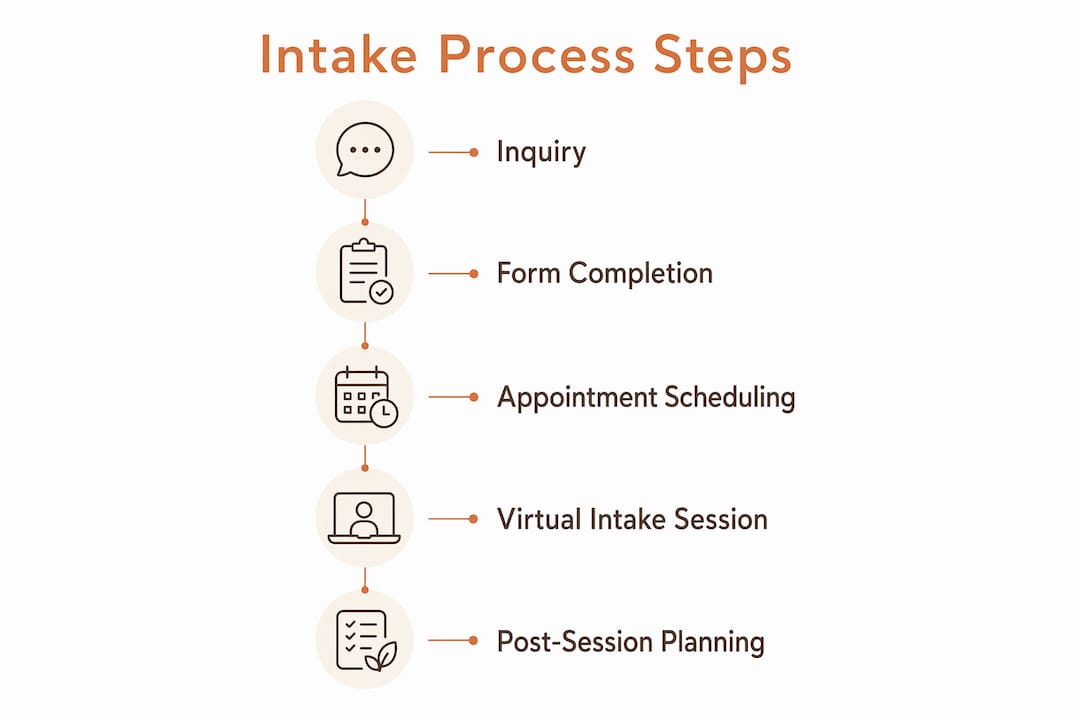
How does the virtual intake process work, step by step?
Understanding the full sequence helps you know what to prepare and what to expect at each stage.
-
Inquiry and booking. You submit a request through a website form, phone call, or referral. Most platforms send an automated confirmation with scheduling options and a link to your patient portal within a few hours.
-
Pre-screening and eligibility check. Before your appointment is confirmed, the practice verifies that a licensed clinician covers your state, that the presenting concern is appropriate for telehealth, and that you have the technology to participate. Certain high-acuity situations, like active psychosis or severe intoxication, are typically redirected to in-person or emergency care at this stage.
-
Digital paperwork. You receive consent forms, a medical and psychiatric history questionnaire, and standardized symptom screeners such as the PHQ-9 and GAD-7. These typically take 20–30 minutes to complete. Finishing them at least 48 hours before your session gives your clinician time to review them and prioritize what to address first.
-
Insurance and payment verification. The practice confirms your coverage, calculates your estimated responsibility (copay, deductible, or self-pay rate), and may collect payment information before the session.
-
The live intake session. This is the clinical core. Your provider will:
- Build rapport and explain confidentiality limits
- Review your presenting symptoms, their onset, and severity
- Conduct a safety assessment covering suicidal or self-harm ideation
- Review medications, medical history, and substance use
- Discuss initial treatment recommendations and next steps
-
Treatment matching and scheduling. Based on what the intake reveals, your clinician recommends the right format: individual therapy, psychiatric care, combined treatment, or a referral to in-person services when needed. Your next appointment is typically scheduled before the session ends.
Timing at a glance: The full process from first inquiry to completed intake session usually takes 2–7 days. The live session itself runs 45–60 minutes.
What questions will your clinician ask during intake?
Knowing what’s coming helps you answer clearly and use the time well. Clinicians follow a structured format, though the conversation feels more like a dialogue than an interrogation.
Presenting problem and current symptoms. Your provider will ask what brought you in today, how long you’ve been experiencing symptoms, and what makes them better or worse. Specific, concrete answers help, so think about onset dates and any recent changes before the session.

Mental health history. Expect questions about past diagnoses, prior therapy, hospitalizations, and any medications you’ve tried. If you’ve been in treatment before, a brief timeline of those experiences is genuinely useful.
Current medications and medical conditions. Your clinician needs a complete picture, including non-psychiatric medications, supplements, and any chronic conditions. Bring the actual bottles or a written list with dosages.
Safety assessment. Every intake includes direct questions about suicidal thoughts, self-harm, and access to means. These questions are standard and asked with care. Honest answers allow your provider to connect you with the right level of support.
Social context. Your relationships, work or school situation, housing stability, and support network all inform treatment planning. You don’t need to have everything figured out; your provider is gathering context, not judging your circumstances.
Pro Tip: Before your session, write a one-page “clinical cheat sheet”: your current medications with dosages, a short chronological list of major stressors or mental health events, and two or three specific goals for treatment. Providers consistently find this kind of preparation shortens the history-gathering phase and leaves more time for actual planning.
How to prepare before your intake appointment
Good preparation means your clinical hour is spent on assessment rather than administrative catch-up. Work through this checklist before your session.
Documents and paperwork to complete
- Telehealth consent form: Covers technology disruptions, data privacy, emergency procedures, and recording policies. Read it carefully; telehealth consent is more detailed than a standard in-person form.
- Medical and psychiatric history questionnaire: Complete this as thoroughly as possible. Gaps slow the session.
- Standardized symptom screeners (PHQ-9, GAD-7): Finish these before the session. If you don’t, some platforms let you complete them in the waiting room when you join, but doing so cuts into clinical time.
- Insurance information and financial agreement: Have your insurance card and member ID ready.
Items to have on hand
- Photo ID
- Insurance card
- Medication list with drug names, dosages, and prescribing provider
- Dates of any prior hospitalizations or significant mental health events
- Emergency contact name and phone number
Technology checklist
Review your telehealth platform setup at least 24 hours before the session.
- Confirm your device has a working camera and microphone.
- Open the telehealth link or app and run any required updates.
- Test your internet connection; a wired connection is more stable than Wi-Fi when possible.
- Use headphones to improve audio clarity and protect your privacy.
- Check that your browser or app is the version the platform requires.
Privacy checklist
- Choose a room where you can close the door and won’t be overheard.
- Let household members know you have a private appointment.
- Confirm your time zone when booking, especially if you’re traveling.
- Have a backup plan if your connection drops: your provider’s direct phone number, or a note about whether to call you or wait for you to reconnect.
Quick troubleshooting: If the video won’t load, restart the app first. If audio is cutting out, move closer to your router or switch to a wired connection. If the session link doesn’t work, call the practice directly rather than waiting.
What does intake cost, and how does insurance work?
Typical timeline and session structure
The full onboarding process from inquiry to first session typically takes several days. When intake forms are complete before the session, the full clinical session time is available for assessment. When forms are incomplete, a portion of that time shifts to administrative tasks, reducing the time available for direct evaluation and planning.

Insurance and payment
| Scenario | What to expect |
|---|---|
| In-network insurance | Copay or coinsurance applies; deductible may need to be met first. Telehealth parity laws in most U.S. states require insurers to cover telehealth at the same rate as in-person visits. |
| Out-of-network insurance | You pay the full session rate upfront; the practice provides a superbill you submit for partial reimbursement. |
| Self-pay | A flat session fee is charged; some practices offer sliding-scale rates. |
| Medicaid | Medicaid coverage for telehealth varies by state. Confirm your state’s telehealth benefit before booking. |
Insurance verification typically happens before your first session. Bring your insurance card and member ID to avoid delays.
Prescriptions and referrals
Prescriptions for non-controlled medications can often be sent electronically to your pharmacy on the same day as your intake, provided the clinician has enough information to prescribe safely. Controlled substances (stimulants for ADHD, certain anxiolytics) are subject to federal and state regulations and typically require at least one completed evaluation before prescribing, and sometimes a follow-up visit. Your clinician will explain the specific timeline at the end of your intake session.
When in-person services are needed, such as neuropsychological testing, lab work, or a higher level of care, your clinician will provide a referral and coordinate with local providers.
When is virtual intake appropriate, and when is in-person care safer?
Telehealth intake works well for the majority of adults seeking evaluation and treatment for ADHD, anxiety, depression, and many other outpatient mental health concerns. The clinical evidence supports online care as comparable to in-person care for many conditions. That said, there are clear situations where in-person evaluation is the right call.
Benefits of virtual intake
- No travel, no waiting room, no time off work for most appointments
- Access to licensed clinicians regardless of your distance from a major city
- Continuity of care when you move within a state or during travel
- Reduced stigma barrier for people who might otherwise delay seeking help
Situations that require in-person or emergency care
| Situation | Recommended action |
|---|---|
| Active suicidal ideation with a plan or means | Call 911 or go to the nearest emergency room |
| Severe intoxication or withdrawal | In-person medical evaluation; do not attempt telehealth |
| Acute psychosis or inability to participate safely | Emergency services or crisis stabilization unit |
| Medical emergency during a session | Call 911; inform your provider before disconnecting |
| Domestic violence or unsafe environment | Contact the National Domestic Violence Hotline or 911 |
Emergency protocol during a session: At the start of intake, your clinician will confirm your physical address and an emergency contact. If you disconnect mid-session and your provider has safety concerns, they will attempt to reach you by phone and, if unsuccessful, may contact emergency services at your confirmed address. This is standard telehealth safety practice, not an overreaction.
For urgent mental health needs that fall short of a 911 situation, the 988 Suicide and Crisis Lifeline is available by call or text, 24 hours a day.
What happens after your intake session?
The session ending is not the end of the process. Here’s what typically follows.
- Diagnosis and treatment discussion. Your clinician will share their clinical impressions, which may include a working diagnosis or a list of conditions being considered. They’ll explain the recommended treatment path: therapy, psychiatric medication management, combined care, or a referral.
- Next appointment scheduling. Most practices schedule your follow-up before you leave the session. For psychiatric patients, this is often a medication management visit 2–4 weeks out.
- Clinical notes and prescriptions. Your provider documents the session in a secure electronic health record. Non-controlled prescriptions are typically sent to your pharmacy the same day. Prior authorizations for certain medications can take several days to process through insurance.
- Secure portal communication. You’ll receive a summary of recommendations, any referrals, and next steps through your patient portal or a HIPAA-compliant message. Keep an eye on that channel in the 24–48 hours after your session.
- Additional assessments. If your clinician recommends neuropsychological testing or a formal ADHD assessment, they’ll explain the referral process and expected timeline. Coordination with external testing providers can take one to several weeks depending on availability.
Your treatment options are discussed collaboratively. You have the right to ask questions, request clarification on costs, and take time before agreeing to a specific plan.
Why intake quality predicts your treatment outcomes
Online CBT, both self-guided and clinician-guided, performs comparably to in-person CBT for reducing depressive symptoms across multiple systematic comparisons. That clinical equivalence depends on one thing the research consistently highlights: the quality of the initial assessment. A thorough intake means the right treatment is matched to the right person from the start.
Operationally, clinics that require intake forms to be completed at least 48 hours before the session see fewer appointments consumed by administrative tasks. When standardized screeners like the PHQ-9 and GAD-7 are submitted in advance, clinicians can prioritize risk assessment and safety planning during the live session rather than spending the first 15 minutes on data collection.
The intake also functions as your first clinical relationship. Speed and warmth in the initial response, from booking confirmation to the clinician’s opening tone, materially affect whether patients complete onboarding and attend that first session. If something feels off in the pre-intake communication, it’s worth raising directly with the practice before the appointment.
Key Takeaways
A complete, well-prepared online mental health intake typically takes 2–7 days from inquiry to first session and gives your clinician everything needed to recommend the right treatment from day one.
| Point | Details |
|---|---|
| Complete forms early | Finishing intake paperwork at least 48 hours ahead keeps the full 45–60 minute session focused on clinical assessment. |
| Know what you’ll be asked | Clinicians cover symptoms, mental health history, medications, safety, and social context — a one-page prep sheet speeds this up. |
| Test your tech in advance | Check camera, microphone, and your telehealth link at least 24 hours before the session to avoid connection issues. |
| Understand emergency limits | Acute crises (active suicidal plan, severe intoxication, psychosis) require 911 or in-person care, not telehealth. |
| Journeymhw for Texas and Colorado | Journeymhw offers virtual psychiatric evaluations, ADHD assessment, and medication management for adults in Texas and Colorado with a structured, streamlined intake process. |
What patients say actually helps during the first session
The anxiety before a first mental health appointment is real, and it’s worth naming. Most people feel some combination of relief and nervousness when they finally book. What tends to help most is preparation that removes uncertainty.
Bringing a written medication list with dosages is one of the most consistently useful things you can do. When you can hand over (or read off) exact drug names and doses, your clinician doesn’t have to spend time reconstructing that history from memory, and you don’t have to feel put on the spot. A short chronological note of major stressors or mental health events, even just a few bullet points, serves the same purpose.
Testing your technology the day before matters more than most people expect. A dropped connection in the first five minutes of a session is stressful for everyone. Logging into the platform, checking your camera, and confirming your audio takes ten minutes and removes a real source of anxiety on the day.
Advocating for yourself during intake is not only allowed, it’s encouraged. If a cost estimate isn’t clear, ask for it in writing before agreeing to a plan. If you don’t understand a diagnosis or a medication recommendation, say so. Your clinician expects questions, and the intake is the right time to ask them. You’re not being difficult; you’re being an informed patient.
Journeymhw makes the first step straightforward
Getting from “I think I need help” to an actual clinical appointment is where most people stall. Journeymhw is built to close that gap for adults in Texas and Colorado who need real psychiatric care, not a waitlist.
When you book with Journeymhw, you receive intake forms promptly after scheduling, a secure telehealth link for your appointment, and a licensed psychiatric clinician who reviews your history before the session begins. Services include virtual psychiatric evaluations, ADHD assessment and treatment, anxiety care, and depression treatment, all managed through a structured care plan designed to reduce delays between evaluation and treatment. Insurance billing and self-pay options are both available.
If you’re in Texas or Colorado and ready to move forward, book your intake appointment today. Most patients are seen within days of completing their forms.
Useful sources for further reading
- Telehealth therapy intake process guide — Covers the full workflow from inquiry to first session, including form-completion timing and consent requirements.
- Online vs. in-person CBT effectiveness (PMC) — Systematic review comparing online and in-person cognitive behavioral therapy outcomes for depression and anxiety.
- What to expect during intake (Inspira Health) — Patient-facing overview of what behavioral health intake appointments cover.
- Mental Health America screening tools — Free, confidential online symptom screeners for 30 common conditions; useful for self-assessment before booking a clinical intake.
- How a virtual mental health visit works — Plain-language explanation of telehealth visit structure and what patients should prepare.
This article is general information, not professional medical or psychiatric advice. For guidance specific to your situation, consult a licensed clinician or contact your state’s mental health authority.
Recommended
- Starting Mental Health Treatment Online: A Practical Guide – Journey Mental Health
- Online Depression Treatment: What to Expect Phase 3 – Journey Mental Health
- Your Mental Health Care Checklist for the First Appointment – Journey Mental Health
- Urgent Mental Health Care Access Steps: 2026 Guide – Journey Mental Health