

Examples of Virtual Psychiatric Treatment Plans
A complete virtual psychiatric treatment plan needs seven working parts: a diagnosis with ICD-10 code, baseline scores from a validated measure, SMART goals, specific objectives, named interventions, a review timeline, and telehealth-specific documentation (platform used, patient location, consent on file). Miss any one of those and the plan reads as incomplete to a payer, an auditor, or the clinician picking up the case next month.
Here’s a checklist you can paste directly into a template file before you draft your first plan:
- Diagnosis + ICD-10 code and presenting problem in one sentence
- Baseline score from a validated measure (PHQ-9, GAD-7, SIAS, AUDIT, or C-SSRS depending on presentation)
- Three SMART goals tied to that measure, each with a numeric target and a date
- Interventions named specifically (tele-CBT, medication management, VR exposure, an app for symptom tracking)
- Review cadence (weekly, biweekly, or monthly, stated explicitly)
- Telehealth metadata: platform, patient’s physical location at time of visit, and consent documentation
We built the templates below around that structure, and we reference Journey Mental Health’s own approach to structured virtual care throughout, because treatment plans that skip session-by-session pacing tend to collapse into documentation exercises rather than tools clinicians actually use.
Key Takeaways
A usable virtual psychiatric treatment plan pairs a validated baseline measure with SMART goals, named interventions, and telehealth-specific documentation, then revisits the measure on a fixed schedule.
| Point | Details |
|---|---|
| Anchor every goal to a measure | Use PHQ-9, GAD-7, SIAS, AUDIT, or C-SSRS with a baseline score and a numeric target. |
| Pace the plan by session | Map interventions to a 12 to 16 session arc rather than leaving the timeline open-ended. |
| Document telehealth specifics | Record platform, patient location, and consent at every visit, not just intake. |
| Revisit goals on schedule | Re-administer the primary measure every 2 to 4 sessions and adjust objectives when scores plateau. |
| Adapt, don’t copy | Journey Mental Health’s structured evaluations and follow-up build these templates into an actual course of care rather than a static document. |
Table of Contents
- What a Complete Virtual Psychiatric Treatment Plan Includes
- Writing SMART Goals for Telepsychiatry
- Sample Virtual Treatment Plan for Major Depressive Disorder
- Sample Virtual Treatment Plan for Anxiety Disorders
- Sample Virtual Treatment Plan for Adult ADHD
- Sample Virtual Treatment Plan for PTSD and Trauma
- Sample Virtual Treatment Plan for Substance Use Disorder
- Progress Monitoring and Documentation for Compliance
- Telehealth-Specific Considerations Every Plan Needs
- How to Adapt These Templates in Practice
- Journey Mental Health’s Approach to Telehealth Treatment Planning
- What Actually Makes These Templates Work
- Start With a Plan Built for Virtual Care From Day One
- Frequently Asked Questions
- Sources
What a Complete Virtual Psychiatric Treatment Plan Includes
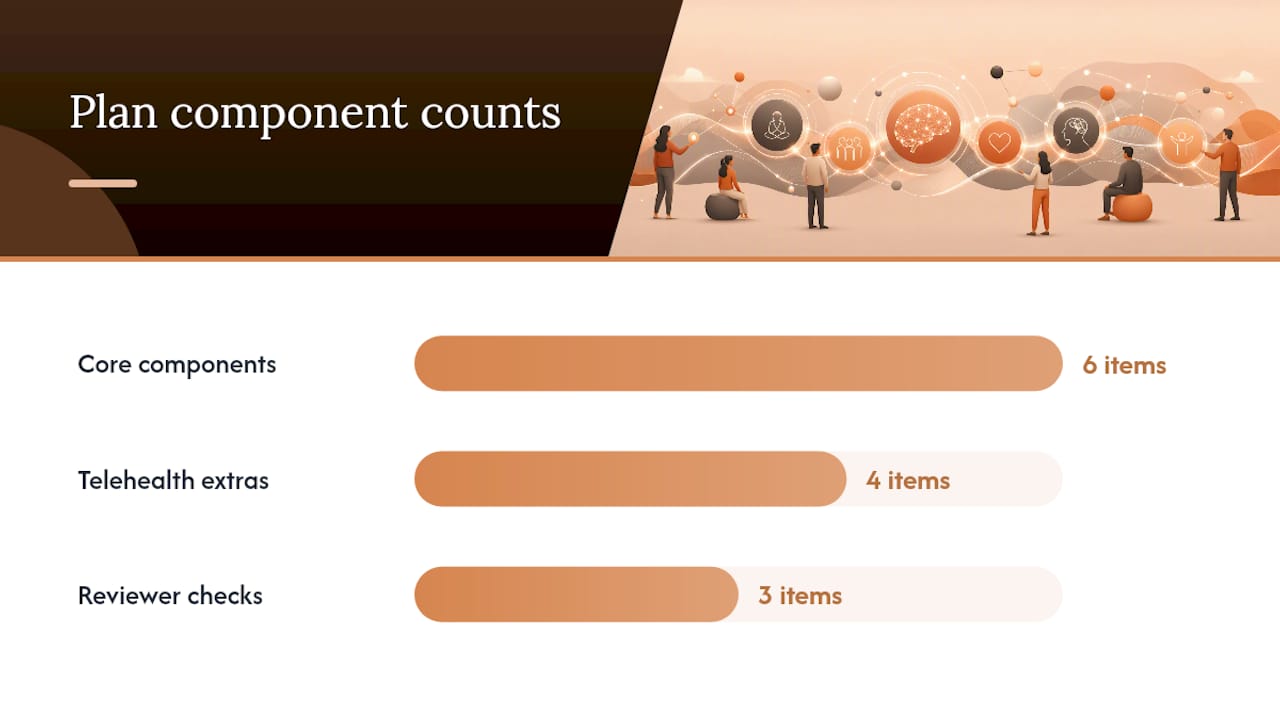
Every defensible treatment plan, virtual or in-person, rests on the same skeleton: diagnosis, baseline, goals, objectives, interventions, and a timeline. Telehealth adds a second layer on top of that skeleton, and skipping it is the single most common reason plans fail an audit.
Start with diagnosis and baseline. The plan should name the ICD-10 code, describe the presenting problem in the patient’s own language where possible, and record a score from a validated instrument. Behave Health’s treatment plan library models this well across depression, anxiety, adjustment disorder, substance use, and eating disorders, pairing each diagnosis with a baseline PHQ-9 or GAD-7 score and a realistic 60 to 90 day target.
From there, the plan needs SMART goals (specific, measurable, achievable, relevant, time-bound), short-term objectives that operationalize each goal, and named interventions. “Improve mood” is not a goal. “Reduce PHQ-9 score from 18 to under 10 within 10 weeks through weekly tele-CBT and medication management” is.
Telehealth-specific documentation is the layer general treatment-plan guides often leave out. A telehealth SOAP note example shows what this looks like in practice: recording the platform used, confirming the patient’s location at the time of the visit, noting verbal informed consent, and flagging any audio or video quality issues that affected the session. That same source recommends scheduling an in-person visit for vitals and physical exam within two to three months for patients on certain medications, since telehealth doesn’t replace every clinical touchpoint.
| Component | What it includes | Why it matters for telehealth |
|---|---|---|
| Diagnosis & baseline | ICD-10 code, presenting problem, validated measure score | Anchors medical necessity and gives a starting point for progress tracking |
| SMART goals | 2 to 3 goals with numeric targets and dates | Turns vague intent into something a payer or auditor can verify |
| Interventions | Named modalities (tele-CBT, medication management, apps, VR exposure) | Specifies exactly what care was delivered, not just that “therapy occurred” |
| Timeline & review | Session cadence and re-assessment date | Signals active, measurement-based care rather than open-ended contact |
| Telehealth metadata | Platform, patient location, consent record | Protects against compliance risk and supports continuity across visits |
Pro Tip: Reviewers scanning a plan for medical necessity look for three things fast: a named measure, a baseline number, and a target number with a date attached. If your plan has all three in the first paragraph, it survives most audits without further scrutiny.
Journey Mental Health builds its own structured treatment plan guidance around this same skeleton, which is worth reviewing if you want to see the components assembled into a patient-facing format rather than a clinical worksheet.
Writing SMART Goals for Telepsychiatry
A SMART goal for virtual care needs one more element than its in-person counterpart: the modality. Specify not just what will improve and by when, but how it will be delivered and measured remotely.
The adapted checklist looks like this:
- Specific: Name the symptom or function, not a general category (“panic attacks in grocery stores,” not “anxiety”)
- Measurable: Attach a validated score (GAD-7 from 15 to under 8, for example)
- Achievable: Set a target realistic for the modality and session frequency you’re actually using
- Relevant: Tie the goal to the patient’s stated reason for seeking care
- Time-bound: Give a specific week or date for reassessment
- Modality-specific: State whether progress is tracked via patient portal, app, or session-administered questionnaire
Three example goal snippets, each built for telehealth documentation:
Symptom reduction: “Reduce GAD-7 score from 16 to under 8 within 12 weeks through weekly video-based CBT sessions and biweekly self-report via patient portal.”
Functional recovery: “Return to full-day work attendance within 8 weeks, tracked through weekly self-report and monthly employer-coordination check-in (with patient consent).”
One practical detail worth naming a measure by, a baseline score, a target score, and a re-administration date reads as measurement-based care to anyone reviewing the chart later. Plans that describe progress only in narrative terms, without that structure, are far more likely to get flagged during a payer audit.
Objectives underneath each goal should specify who does what. “Clinician will administer GAD-7 at intake and every fourth session; patient will complete a brief mood log twice weekly via app” is audit-ready in a way that “monitor symptoms” is not.
Sample Virtual Treatment Plan for Major Depressive Disorder
Presenting problem: Persistent depressed mood, anhedonia, and fatigue for 4 months, with functional decline at work. Diagnosis: Major Depressive Disorder, moderate, recurrent (F33.1). Baseline: PHQ-9 score of 17; patient reports missing 6 workdays in the past month.
Goal 1: Reduce PHQ-9 score from 17 to under 8 within 12 weeks. Goal 2: Return to full attendance at work within 10 weeks. Goal 3: Reestablish a consistent sleep schedule (7 hours nightly, 5+ nights per week) within 8 weeks.
A 12-week course typically breaks down like this, following the pacing structure a worked CBT treatment plan example recommends: two sessions for assessment and conceptualization, two for introducing cognitive-behavioral techniques, six to eight active-treatment sessions, and two relapse-prevention sessions before discharge or plan renewal.
| Week | Focus | Measure administered |
|---|---|---|
| 1 to 2 | Intake, psychoeducation, medication initiation | PHQ-9 baseline |
| 3 to 4 | Behavioral activation, sleep hygiene | Weekly mood log |
| 5 to 8 | Cognitive restructuring, medication titration | PHQ-9 at week 6 |
| 9 to 10 | Relapse-prevention planning | PHQ-9 at week 10 |
| 11 to 12 | Consolidation, discharge or plan renewal | PHQ-9 at week 12 |
Interventions: weekly tele-CBT sessions (video), medication management with a prescriber (SSRI, monitored for side effects at each visit), and a mood-tracking app for between-session data. Journey Mental Health’s depression treatment program follows a similar structure, pairing medication management with scheduled check-ins rather than leaving follow-up open-ended.
Pro Tip: Build a quick safety check into every remote depression session, even when suicidal ideation isn’t the presenting concern. A single question like “Have you had any thoughts of harming yourself since our last visit?” documented at each visit closes a gap that’s easy to miss when you can’t observe body language through a screen.
Sample Virtual Treatment Plan for Anxiety Disorders
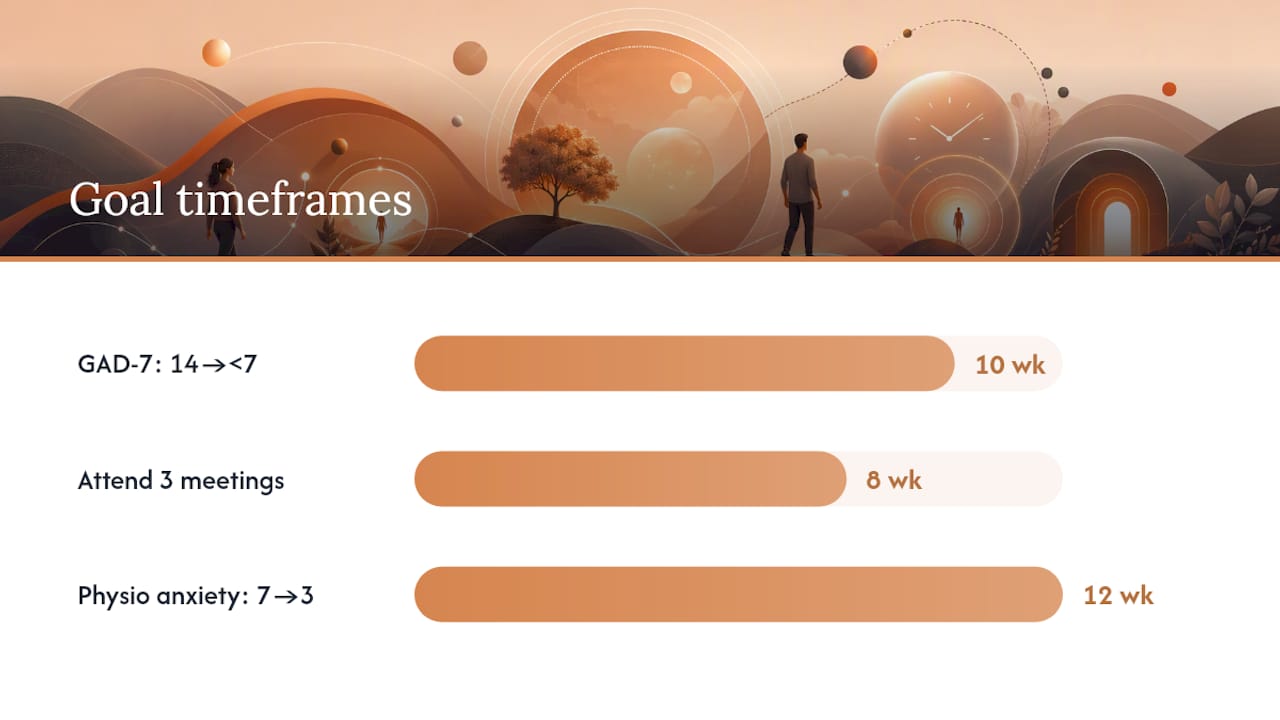
Presenting problem: Excessive worry about work performance and social situations, with physical symptoms (racing heart, sweating) that have led to avoidance of meetings. Diagnosis: Generalized Anxiety Disorder (F41.1) with social anxiety features. Baseline: GAD-7 score of 14; SIAS score elevated, consistent with moderate social anxiety.
Goal 1: Reduce GAD-7 score from 14 to under 7 within 10 weeks. Goal 2: Attend and actively participate in 3 consecutive work meetings without leaving early, within 8 weeks. Goal 3: Reduce physiological anxiety symptoms (self-rated 0 to 10 scale) from 7 to 3 during triggering situations, within 12 weeks.
An exposure hierarchy for tele-delivered or VR-assisted work looks like this, building from lowest to highest anxiety:
- Rehearsing a work comment aloud alone (anxiety rating: 2)
- Speaking up once in a small virtual team meeting (rating: 4)
- Presenting a short update in a video meeting (rating: 6)
- Attending a large in-person meeting and asking a question (rating: 8)
A three-arm randomized controlled trial found that CBT combined with VR-based exposure using 360-degree video reduced social anxiety symptoms as effectively as standard in-person CBT, with effects sustained at six-month follow-up. Dropout was notably lower in the VR-exposure arm than in the in-vivo exposure arm, which suggests some patients tolerate remote exposure formats better than the real-world alternative. Therapists can control VR scenarios remotely through casting or controller features, which keeps a clinician actively guiding exposure even when the patient is alone in the room.
| Session block | Focus | Measure |
|---|---|---|
| 1 to 2 | Psychoeducation, hierarchy building | GAD-7, SIAS baseline |
| 3 to 6 | Graduated exposure (tele or VR-assisted) | Weekly SUDS rating |
| 7 to 9 | Cognitive restructuring alongside exposure | GAD-7 at session 8 |
| 10 to 12 | Generalization, relapse prevention | GAD-7 and SIAS at discharge |
Separate research on VR self-counseling using an intimate-person avatar found greater anxiety reduction on GAD-7 than other formats in a student sample, though the evidence base here is still small and shouldn’t be treated as established practice for clinical populations yet.
Pro Tip: If you’re introducing VR exposure remotely for the first time, run a 5-minute low-stakes scenario (a quiet room, no social trigger) before the first real exposure session. It confirms the headset works and lets you gauge the patient’s baseline comfort with the format before anxiety is actually on the line.
Journey Mental Health’s Colorado-specific anxiety treatment resource covers what this looks like for patients weighing virtual versus in-person anxiety care.
Sample Virtual Treatment Plan for Adult ADHD
Presenting problem: Chronic difficulty with task initiation, disorganization, and missed deadlines at work, present since childhood. Diagnosis: ADHD, combined presentation (F90.2). Baseline: Adult ADHD Self-Report Scale score in the moderate-severe range; collateral report from a spouse confirms organizational difficulties predate adulthood.
Goal 2: Establish a consistent digital calendar and reminder system used daily within 4 weeks. Goal 3: Achieve stable medication response with minimal side effects within 6 weeks.
Objectives here lean heavily on digital tools, since executive function support translates well to app-based structure: a shared calendar app for scheduling, a task-management app with daily check-ins, and where the patient consents, brief coordination with a workplace supervisor or accommodations office.
| Visit | Focus | What’s documented |
|---|---|---|
| Intake | Diagnostic confirmation, baseline scale, collateral input | ASRS score, medical history, prior treatment |
| Week 2 | Medication initiation | Baseline vitals, side-effect checklist |
| Week 4 | Titration check | Blood pressure, heart rate, symptom scale |
| Week 8 | Response assessment | ASRS re-score, functional check-in |
| Monthly thereafter | Maintenance | Vitals, adherence check, refill coordination |
Medication management for stimulants specifically needs a vitals plan even in a virtual model, since blood pressure and heart rate monitoring can’t be fully replaced by self-report. Many telepsychiatry practices ask patients to check vitals at a local pharmacy or with a home cuff and report the numbers at each visit. Journey Mental Health’s ADHD treatment program builds this kind of monitoring into its medication-management workflow, and its practical guide to medication management covers the side-effect checks worth documenting at each visit.
Sample Virtual Treatment Plan for PTSD and Trauma
Trauma-focused care works best as a phased plan, not a flat list of goals, because stabilization has to happen before processing can safely begin.
Presenting problem: Intrusive memories, hypervigilance, and avoidance following a motor vehicle accident 6 months prior. Diagnosis: PTSD (F43.10). Baseline: PCL-5 score in the severe range; patient reports avoiding driving entirely.
Remote delivery of prolonged exposure or cognitive processing therapy is well established, though some clinicians add VR-assisted exposure for specific triggers (driving simulations, for example) where VR exposure programs are already used clinically for trauma-related presentations and framed as a cost-efficient option in some settings.
The safety plan section needs remote-specific detail that in-person plans often skip: a local emergency contact number for wherever the patient is physically located during sessions, not just the clinic’s home state, and a documented plan for what happens if a session needs to escalate to emergency services across a state line.
- Local emergency number confirmed at intake and re-confirmed if patient relocates
- Crisis contact person named and phone number on file
- Clear escalation steps if patient becomes acutely unsafe during a virtual session
- Documentation of clinician’s licensure jurisdiction and any limits on cross-state care
Pro Tip: Confirm the patient’s physical address at the start of every single trauma-focused session, not just at intake. If a crisis happens mid-session, you need to know exactly where to send help, and patients in this population sometimes travel or stay with family without mentioning it.
Sample Virtual Treatment Plan for Substance Use Disorder
Presenting problem: Escalating alcohol use over the past year, with two missed workdays and one relationship conflict attributed to drinking. Diagnosis: Alcohol Use Disorder, moderate (F10.20). Baseline: AUDIT score of 18; timeline follow-back indicates average of 4 drinking days per week.
Goal 1: Reduce AUDIT score from 18 to under 8 within 12 weeks. Goal 2: Achieve 30 consecutive days of abstinence or defined moderate use within 8 weeks. Goal 3: Establish at least one recovery support connection (peer group, sponsor, or family support) within 4 weeks.
| Component | Virtual adaptation |
|---|---|
| Baseline assessment | AUDIT, timeline follow-back, risk screening for withdrawal |
| Medication-assisted treatment | Remote prescribing where clinically appropriate, with pharmacy coordination |
| Monitoring | Self-report logs, family collateral (with consent), scheduled check-ins in place of in-person urine screens where unavailable |
| Coordination | Release of information for remote coordination with therapist, primary care, and any local recovery program |
Where in-person urine drug screening isn’t available, some telehealth practices substitute increased check-in frequency, collateral reporting from a family member, and closer medication monitoring intervals as a partial alternative, documented clearly as a limitation rather than an equivalent substitute. Medical-necessity language for the chart might read: “Patient meets criteria for moderate Alcohol Use Disorder per AUDIT score of 18 and DSM-5 criteria; virtual medication management and weekly relapse-prevention counseling recommended given absence of acute withdrawal risk and patient’s stated preference for telehealth delivery.”
Progress Monitoring and Documentation for Compliance
Measurement-based care means picking the right instrument for the diagnosis and administering it on a predictable schedule, not just when a patient happens to mention feeling worse.
| Diagnosis | Primary measure | Suggested cadence |
|---|---|---|
| Depression | PHQ-9 | Every 2 to 4 sessions |
| Generalized anxiety | GAD-7 | Every 2 to 4 sessions |
| Social anxiety | SIAS | Baseline, mid-treatment, discharge |
| Substance use | AUDIT | Baseline, monthly |
| Suicide risk | C-SSRS | Every session where risk is present |
Progress notes for telehealth visits need a few extra fields beyond a standard SOAP note: platform used, patient’s location at time of visit, confirmation of consent, and any technical issues that affected the session (a dropped connection mid-session is worth documenting if it shortened the visit). A telehealth SOAP note model demonstrates this format clearly, including a suggested in-person visit within 2 to 3 months for medication patients needing physical exam or vitals.
Medical-necessity phrasing works best when it’s specific: “Continued weekly telehealth sessions are clinically indicated given GAD-7 score of 12 (down from baseline of 18) and patient’s ongoing functional impairment at work” gives a reviewer everything they need in one sentence.
Telehealth-Specific Considerations Every Plan Needs
A remote psychiatric visit carries logistics an in-person visit doesn’t, and skipping them creates real compliance risk, not just paperwork gaps.
Start each new telehealth relationship with informed consent language specific to virtual care: “I understand this session is being conducted via secure video platform, that my clinician is licensed in the state where I am currently located, and that certain aspects of care (physical exam, vitals) may require an in-person visit.” Document that consent was given verbally or in writing at intake, and confirm it periodically, particularly if a patient’s location changes.
A short pre-visit checklist keeps sessions from derailing over tech issues:
- Confirm patient’s current physical location and state of residence
- Verify platform connection and audio/video quality before starting clinical content
- Reconfirm informed consent if this is a new platform or a new state
- Have a documented backup contact method (phone) in case video fails mid-session
Licensure is the piece most easily overlooked. A clinician can generally only treat a patient physically located in a state where that clinician holds an active license, which means documenting patient location isn’t just good practice, it’s what makes the visit legal in the first place. Documenting telehealth-specific metadata at every visit, not just at intake, protects against this risk when patients travel.
Emergency planning needs the same jurisdiction-awareness. The plan should name a local emergency number for wherever the patient is located, not the clinic’s home city, and specify escalation steps if a session reveals acute risk.
Pro Tip: Ask patients to tell you their exact address (not just “I’m at home”) at the start of any session where risk assessment is part of the visit. “Home” means nothing to a 911 dispatcher if you need to send help and don’t have the actual address on file.
How to Adapt These Templates in Practice
A template only becomes useful once you turn it into an actual session-by-session course of care, with real dates and real homework attached.
- Sessions 1 to 2: Intake, diagnostic confirmation, and baseline measure administration. Set the first SMART goal collaboratively with the patient rather than writing it unilaterally, since goals the patient helped write tend to hold up better across a 12-week course.
- Sessions 3 to 4: Introduce the core intervention (CBT technique, medication titration, or exposure hierarchy) and assign first homework tied directly to the goal.
- Sessions 5 to 9: Active treatment phase. Re-administer the primary measure roughly every third session and adjust objectives if progress is faster or slower than expected.
- Sessions 10 to 11: Begin relapse-prevention or generalization work, depending on diagnosis.
- Session 12: Final measure administration, discharge planning, or renewal of the plan with updated goals.
| Session range | What changes in the plan |
|---|---|
| 1 to 2 | Baseline established; goals drafted with patient input |
| 3 to 9 | Objectives adjusted based on measure trends |
| 10 to 12 | Goals shift toward maintenance or discharge criteria |
A short script for goal-setting in session one might sound like: “Based on your GAD-7 score today, I’d like to set a target of getting that number under 8 by week 10. Does that timeline feel realistic given what’s happening at work right now?” That kind of collaborative framing, rather than reading goals off a template verbatim, is what separates a plan a patient actually engages with from one that just sits in the chart. Revise goals whenever a measure plateaus for three consecutive administrations, and set discharge criteria explicitly (two consecutive below-threshold scores is a common benchmark) so both clinician and patient know what “done” looks like.
Journey Mental Health’s Approach to Telehealth Treatment Planning
Journey Mental Health builds its virtual care around exactly this structure: a documented diagnosis, measurable goals, and a clear review timeline, delivered through psychiatric evaluations and ongoing medication management for adults with ADHD, anxiety, and depression.
Clinician-reviewed template examples are available through Journey’s own resources, including guidance on choosing the right psychiatric care plan for your specific situation rather than adapting a generic template blindly.
A treatment plan template is a starting point, not a finished document. The version that actually helps a patient is the one rewritten around their specific baseline scores, their specific goals, and their specific timeline, not the one copied straight from a guide.
- Structured evaluations and medication management delivered entirely through telehealth
- Templates built around measurable goals rather than open-ended talk therapy language
- Coordination support for patients also seeing a therapist or primary care provider
Adapt any example here to the patient in front of you before treating it as final.
What Actually Makes These Templates Work
Most guides to treatment planning treat the template itself as the deliverable, and that’s backwards. The template is scaffolding. What makes a plan clinically useful, and what makes it survive an audit, is whether someone actually re-administers the measure on schedule and updates the goals when the numbers move.
The conventional advice on this topic focuses heavily on format: use SMART goals, include ICD-10 codes, document interventions. All true, all necessary, and all insufficient on their own. The plans that fail aren’t missing SMART goals. They’re missing the discipline of going back to the PHQ-9 or GAD-7 every few sessions and letting the score actually change what happens next. A plan that gets written once at intake and never revisited is a compliance document, not a treatment tool.
If you take one thing from every template in this piece, take the pacing column, not the goal-writing checklist. Session-by-session structure is what turns a diagnosis and a target score into an actual course of care. Clinicians who skip it tend to drift into open-ended supportive contact that’s hard to distinguish from a check-in call, and that’s a harder position to defend to a payer than almost anything else in the chart.
Start With a Plan Built for Virtual Care From Day One
Writing a strong treatment plan template is one thing. Delivering the actual evaluation, medication management, and follow-up behind it is another, and that’s where Journeymhw specializes. Unlike piecing together a plan from templates you adapt yourself, Journeymhw’s structured programs, including The Simple Plan, come with the diagnostic evaluation, prescriber follow-up, and measurement-based check-ins already built into the course of care.
If you’re a patient in Texas or Colorado looking for the clinical side of one of these templates rather than the paperwork, Journey Mental Health’s ADHD treatment program and depression treatment program both start with a virtual psychiatric evaluation that generates your actual baseline scores and goals, not a generic starting point. Book an initial evaluation to get a plan built around your own PHQ-9 or GAD-7 numbers instead of a template you have to guess at adapting.
Frequently Asked Questions
What should be included in a virtual psychiatric treatment plan? A complete plan includes the diagnosis with ICD-10 code, a baseline score from a validated measure like PHQ-9 or GAD-7, two to three SMART goals, specific interventions, a review timeline, and telehealth-specific documentation covering platform, patient location, and consent.
How often should progress be measured in telehealth psychiatric care? Most conditions call for re-administering the primary measure every two to four sessions. Suicide risk screening with C-SSRS should happen at every session where risk is present, while substance use measures like AUDIT are often checked monthly.
Can virtual treatment plans include exposure therapy for anxiety? Yes. A randomized controlled trial found CBT combined with VR-based 360-degree video exposure reduced social anxiety symptoms as effectively as standard in-person exposure, with lower dropout rates in the VR arm.
How do virtual treatment plans handle medication management? They include a vitals monitoring plan (often self-reported or checked at a local pharmacy), a side-effect checklist reviewed at each visit, and a documented schedule for in-person exams when the medication requires physical monitoring that telehealth can’t fully replace.
Do virtual psychiatric treatment plans need to address licensure across states? Yes. Clinicians can typically only treat patients physically located in a state where they hold an active license, which is why documenting the patient’s exact location at every visit matters for legal and safety reasons, not just billing.
This article is general information, not a substitute for advice from a qualified doctor. Consult a qualified healthcare professional about your own circumstances before acting on anything here.
Sources
- Treatment Plan Templates & Examples (2026) | Behave Health
- Virtual reality-based exposure with 360° video as part of cognitive behavioral therapy for social anxiety disorder: a three-arm randomized controlled trial | Frontiers
- Telehealth SOAP Note Example — Virtual Visit Guide (2026) | Wellistic
Recommended
- Your Structured Mental Health Treatment Plan Guide – Journey Mental Health
- What Is a Mental Health Treatment Plan? – Journey Mental Health
- Virtual Anxiety Treatment Benefits for Colorado Residents – Journey Mental Health
- Mental Health Treatment in Texas & Colorado | ADHD, Anxiety, & Depression – Journey Mental Health