

U.S. Providers: DEA Telemedicine Rules for ADHD, Compliance Checklist
Yes. Federal telemedicine flexibilities for prescribing stimulant ADHD medications remain extended through December 31, 2026, meaning DEA-registered providers can prescribe Schedule II–V controlled substances without a prior in-person visit when specific federal conditions are met. State law and platform documentation requirements still apply on top of the federal rule, so eligibility depends on where you live and who is prescribing.
TL;DR:
- Providers are allowed to prescribe Schedule II–V ADHD medications via telehealth without an in-person visit until December 31, 2026, if federal, state, and platform requirements are met.
- A single in-person evaluation enables indefinite telehealth prescriptions from the same provider, but documentation must include DSM-5 criteria, prior records, risk assessment, informed consent, and PDMP query.
- Providers planning to prescribe Schedule II stimulants must implement structured documentation and follow-up routines aligned with DEA and regulatory standards to avoid compliance issues.
- The DEA’s proposed rule includes new tiers of registration for permanent telemedicine prescribing, which could involve additional paperwork, caseload limits, and tighter monitoring requirements.
- Patients should verify their provider’s licensure and ensure proper documentation, as future regulations may demand stricter proof of legitimate medical purpose for continued telehealth ADHD prescriptions.
Table of Contents
- What the DEA telemedicine rules for ADHD allow right now
- Who may prescribe, and what documentation the DEA expects
- Special registrations the DEA is proposing next
- How this affects patients getting ADHD care through telehealth
- Provider compliance checklist: reducing regulatory risk now
- How Journey Mental Health builds compliance into everyday care
- Why the compliance conversation matters more than the access debate
- Start ADHD Care That’s Built Around These Rules, Not Around Them
- Where to read the actual federal rules
- Sources
What the DEA telemedicine rules for ADHD allow right now
The current framework exists because federal regulators kept renewing pandemic-era flexibilities rather than let millions of patients lose access overnight. That renewal cycle is often called avoiding a “telemedicine cliff,” and the Fourth Temporary Rule pushed the deadline to December 31, 2026.
Under that rule, a provider can prescribe stimulant medication for ADHD through telehealth if four conditions hold:
- The visit happens through a real time, two-way audio-video interactive telecommunication system.
- The prescription serves a legitimate medical purpose established during that encounter.
- The prescriber holds active DEA registration in the state where the patient is located.
- The prescription is consistent with 21 CFR part 1306, the standard governing controlled substance orders.
The HHS announcement confirms this covers stimulant ADHD medications specifically, not just lower-schedule drugs. For the exact regulatory text, the Federal Register notice above is the authoritative version, not a summary blog.
Who may prescribe, and what documentation the DEA expects
Once a patient has completed a single in-person evaluation with a provider, that same provider can then continue prescribing indefinitely through telemedicine, according to the DEA’s own guidance. That in-person visit essentially unlocks unrestricted ongoing telehealth prescribing with that specific clinician. Absent that visit, the temporary rule’s conditions govern instead.
Providers building a defensible chart should document, in this order:
- DSM-5 criteria supporting the ADHD diagnosis, recorded in the clinician’s own words rather than a checkbox.
- Prior medical records or testing results that corroborate the diagnosis.
- A substance-use and diversion risk assessment specific to stimulant therapy.
- Documented informed consent covering risks, monitoring, and refill expectations.
- A Prescription Drug Monitoring Program (PDMP) query, logged in the note before the prescription is signed.
Pro Tip: Save your PDMP query as a timestamped screenshot or export in the chart itself, not just a mental note. If a state board or DEA audit ever asks how you confirmed legitimate medical purpose, that timestamp is your strongest evidence.
Special registrations the DEA is proposing next
The DEA’s proposed rule doesn’t just extend the current setup. It sketches a permanent, three-tier registration system that will eventually replace these temporary extensions.
- Telemedicine prescribing registration, covering Schedule III–V medications for providers who never see the patient in person.
- Advanced telemedicine prescribing registration, the tier that would govern Schedule II stimulants and likely require additional criteria tied to specialty and telemedicine caseload.
- Platform registration, aimed at telehealth companies themselves, not individual clinicians.
The proposed framework also floats national PDMP reporting goals and tighter recordkeeping for any prescriber using the advanced tier. None of this is final. That’s precisely why the DEA keeps issuing temporary extensions instead of letting the rule lapse. Expect a comment period and phased rollout rather than a single cutover date once the special registration rule is finalized.
How this affects patients getting ADHD care through telehealth
If you’re a patient, the practical upside is real: a stimulant prescription obtained entirely by video visit is currently permitted under federal law, no in-person requirement, no waiting period tied to the pandemic emergency itself. But “permitted” doesn’t mean unlimited.
- Schedule II stimulants (Adderall, Vyvanse, Ritalin, and similar) can’t carry automatic refills. Each fill typically requires a new prescription.
- Your provider will likely request prior records, since a structured, DSM-5-aligned assessment works better with documented history than a self-report alone.
- Confirm your prescriber is licensed in your state, since federal telemedicine rules don’t override state licensure law.
- If you’re mid-treatment when 2026 ends, ask your provider directly whether they plan an in-person visit or expect to qualify for the advanced registration tier once it exists.
Understanding medication titration timelines also helps you set realistic expectations for follow-up frequency, since stimulant dosing rarely gets finalized at the first visit.
Provider compliance checklist: reducing regulatory risk now
A workable compliance routine has four stages, and skipping any one of them is where audits typically find problems.
- Pre-visit: Verify your DEA registration and state license cover the patient’s physical location, confirm the platform meets interactive telecommunication requirements, and verify patient identity against a photo ID.
- Evaluation: Run a structured DSM-5 assessment, request prior records or testing, and screen for substance-use risk before any prescription is considered.
- Prescribing: Query the state PDMP, document legitimate medical purpose in your own clinical language, and consider a limited initial supply rather than a 90-day fill on a first prescription.
- Follow-up: Schedule a defined return visit, document efficacy and side effects at each check-in, and retain records per the retention standards under 21 CFR part 1306.
Pro Tip: Build this into your EHR as a template, not a mental checklist. Providers who rely on memory under time pressure are exactly the ones who skip the PDMP query on a busy Friday afternoon.
How Journey Mental Health builds compliance into everyday care
Journeymhw’s psychiatric evaluations follow this same structure by design, not as an afterthought. Every ADHD assessment is grounded in DSM-5 criteria, paired with PDMP checks before any stimulant is prescribed, and followed by a defined titration and monitoring schedule rather than a one-time script.
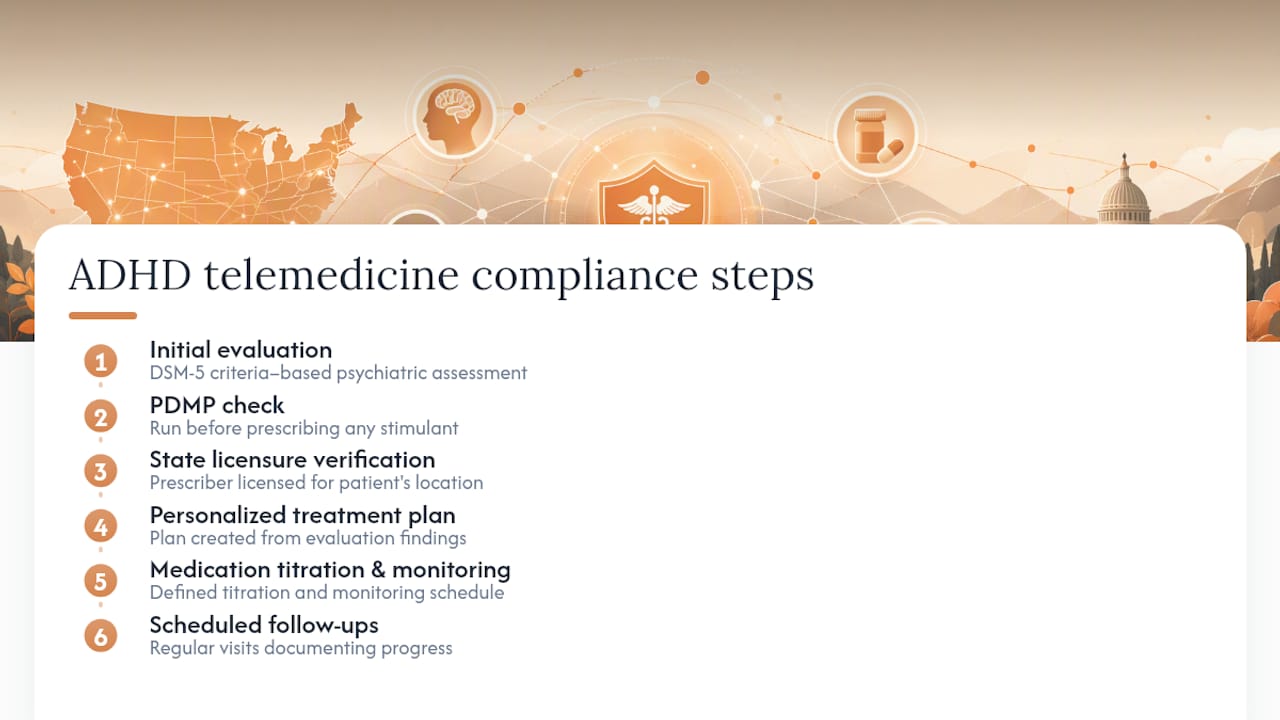
The platform serves patients in various states, with state licensure verified for each prescriber against the patient’s location at the time of the visit. A typical path runs from initial evaluation, to a personalized treatment plan, through medication titration, and into scheduled follow-ups, mirroring exactly the documentation stages regulators are watching most closely.
Why the compliance conversation matters more than the access debate
Most coverage of this topic treats the 2026 extension as a simple win for access, full stop. That framing undersells what’s actually happening. The DEA isn’t just buying time. It’s telegraphing, through the proposed special registration tiers, that permanent telemedicine prescribing will come with more paperwork, not less: PDMP reporting, possible caseload limits, and a harder line on who qualifies for Schedule II authority.
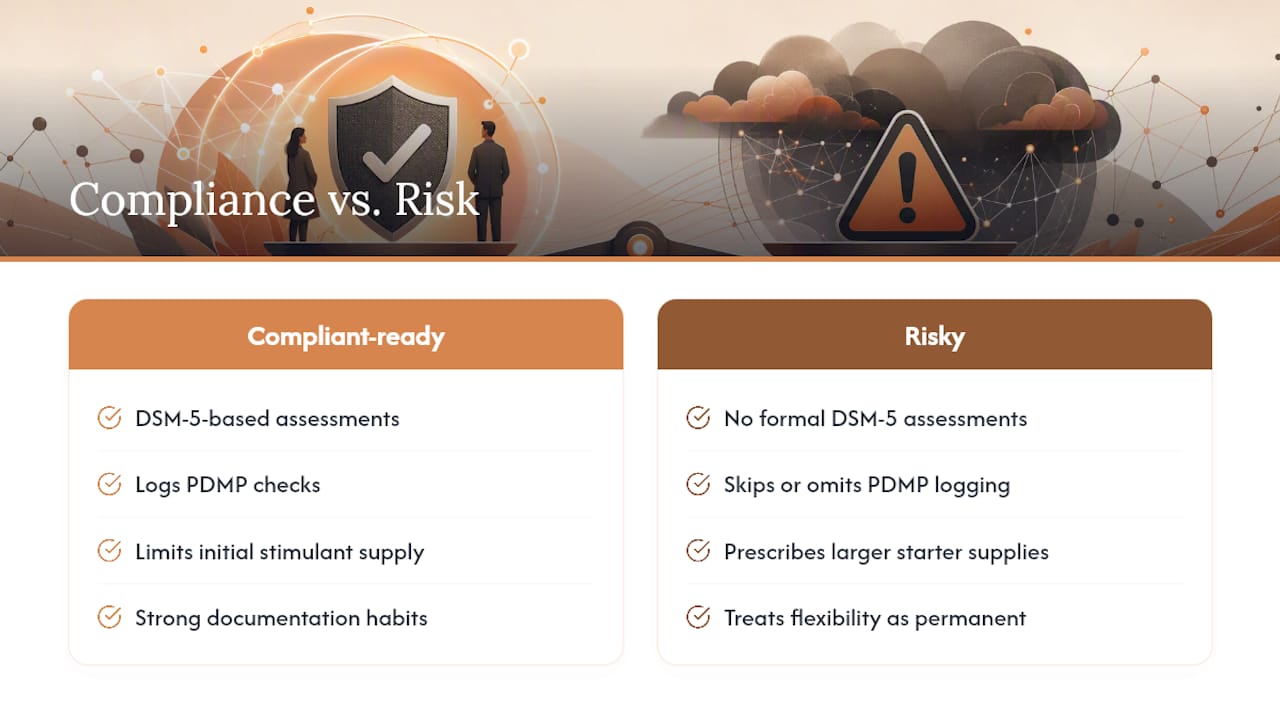
The providers who’ll navigate that transition smoothly aren’t the ones scrambling to read the final rule the week it drops. They’re the ones already running DSM-5-based assessments, logging PDMP checks, and limiting initial stimulant supplies as standard practice today, extension or not. That habit is what regulators are actually trying to enforce.
For patients, the overlooked risk isn’t losing telehealth access. It’s picking a provider who treats the current flexibility as permanent and skips the documentation that will matter if enforcement tightens. Ask about that documentation before you ask about appointment availability. It tells you more about whether your care will hold up over time.
— Jamie
Start ADHD Care That’s Built Around These Rules, Not Around Them
Journeymhw’s ADHD treatment plans were built with these exact federal conditions in mind, not adapted after the fact. That means every evaluation already includes the DSM-5 documentation, PDMP checks, and structured follow-up schedule regulators expect, so you’re not left wondering whether your prescription will hold up if the rules tighten again.
The Simple Plan bundles your psychiatric evaluation, medication management, and scheduled check-ins into one structured path, without the fragmented, one-off visits that make compliance harder to track. Texas patients can check availability through ADHD Treatment in Texas, while Colorado residents can start through ADHD Treatment in Colorado. If you’re ready to move forward, start your assessment today and get a treatment plan built to meet the federal standard from day one, not adjusted later to catch up to it.
Where to read the actual federal rules
For the regulatory text itself rather than a summary, go directly to the Federal Register’s Fourth Temporary Rule for exact conditions, and the HHS extension announcement for plain-language scope. The DEA’s telemedicine rule announcement explains ongoing prescribing after an initial in-person visit, and the IQVIA stimulant trend report provides the data behind DEA’s monitoring push.
This article is general information, not a substitute for advice from a qualified doctor. Consult a qualified healthcare professional about your own circumstances before acting on anything here.
Sources
- HHS press-room: DEA telemedicine extension 2026
- DEA press release: DEA Announces Three New Telemedicine Rules
- Federal Register: Fourth Temporary Extension of COVID-19 telemedicine flexibilities (Dec 31, 2025)
- IQVIA report on stimulant trends (commissioned by DEA)