

Small Daily Routines That Stabilize Mental Health Conditions
Protect an adequate amount of sleep in a consistent window, add a short daily walk or short burst of movement, and start each morning with a 2-minute check-in on your mood and energy. That’s the core routine. It works because these three anchors regulate the same biological systems that most mental health conditions disrupt: circadian rhythm, stress hormones, and dopamine regulation.
Give it several weeks. You’re looking for fewer mid-afternoon crashes, steadier mood swings, and sleep that feels less fragmented. The NHLBI sets an adequate amount as the baseline for adult sleep health, the American Psychiatric Association names lifestyle habits as foundational to treating mental health conditions, and UCLA Health points to daily walks as a reliable way to lower depression risk through serotonin and dopamine release.
A simple way to track your first month:
- Week 1: Set one fixed wake time. Skip the movement goal if it’s too much.
- Week 2: Add a 15-minute walk, same time each day.
- Week 3: Layer in the 2-minute morning check-in (mood, sleep, one trigger).
- Week 4: Review your notes. Look for patterns, not perfection.
Pro Tip: Anchor your new routine to something you already do without thinking, like brewing coffee or brushing your teeth. Habits that piggyback on existing behavior survive bad weeks far better than habits that need their own reminder.
Key Takeaways
Small, consistent daily routines built around sleep, movement, medication timing, and one social contact do more to stabilize mood than occasional large efforts.
| Point | Details |
|---|---|
| Protect sleep first | Keep 7 to 9 hours in a consistent window; this regulates mood and energy more than any other single habit. |
| Move for 15 to 30 minutes | A daily walk lowers depression risk through serotonin and dopamine release. |
| Tie medication to a cue | Sync doses with a meal or alarm and flag timing issues with your prescriber, not by skipping doses. |
| Adjust, don’t abandon | Shrink routines during depressive episodes and prioritize calming and sleep during anxious or manic spikes. |
| Get clinical support when needed | Journeymhw provides telehealth evaluations and medication management for adults in Texas and Colorado when routines alone aren’t enough. |
Table of Contents
- Ready-to-Use Daily Routine Templates for Mental Health Conditions
- What Every Mental Health Routine Needs to Actually Work
- How to Build the Habit and Adjust It During Episodes
- Tracking Symptoms and Knowing When to Get Professional Help
- Sources
Ready-to-Use Daily Routine Templates for Mental Health Conditions
You don’t need six new habits. You need three or four that repeat daily, sized to whatever energy you actually have. These templates work as starting points. Customize them based on your diagnosis, your work schedule, and how you’re feeling on a given day.
1. Minimal starter routine (10 minutes total) Wake at the same time daily. Take medication with breakfast, same time each day. Do a 2-minute mood check-in before checking your phone. That’s it for week one.
2. Balanced day routine (35 to 45 minutes total)
- Fixed wake time, short walk mid-morning
- Medication cue tied to breakfast or a set alarm
- One text or call to a friend or support contact
- 10 minutes of mindfulness or quiet breathing before bed
- Consistent wind-down starting 30 minutes before your target bedtime
3. Activation-management day (for anxiety spikes or hypomania) Prioritize grounding over stimulation. Cut caffeine after noon. Swap vigorous exercise for a slower walk or stretching. Protect your sleep window even if you don’t feel tired, since sleep loss often precedes or worsens manic and hypomanic episodes according to Harvard Health. Schedule a therapy check-in if one is due.
4. Sleep-focused reset day (after a disrupted stretch) Wake at your normal time regardless of how the night went. Get outside light within an hour of waking. Skip naps longer than 20 minutes. Keep the evening routine strict: same bedtime, no screens in the last 30 minutes.
On low-energy days, shrink every task. A “walk” becomes standing on the porch for two minutes. A “check-in” becomes one word in your notes app. Behavioral activation works by lowering the bar, not raising your willpower. On high-activation days, the goal flips: fewer inputs, more grounding, and protecting the sleep anchor above everything else.
What Every Mental Health Routine Needs to Actually Work
Four elements show up in nearly every evidence-based routine, and each has a minimum effective dose worth knowing.
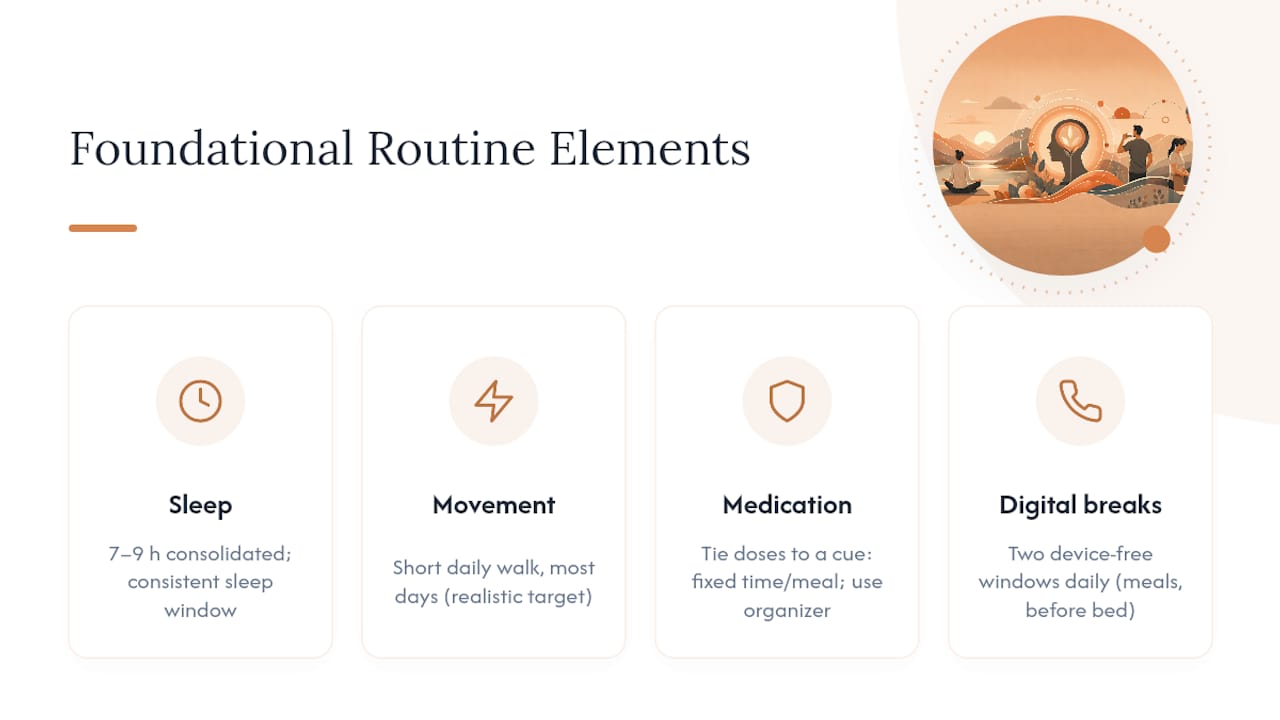
Sleep comes first because it undergirds everything else. The NHLBI recommends 7 to 9 hours of consolidated sleep within a consistent window for most adults. The consistency matters as much as the total hours. A sleep schedule that swings by three hours on weekends disrupts circadian rhythm even if the weekly average looks fine.
Movement doesn’t require a gym membership or an hour of cardio. A short daily walk lowers depression risk by triggering serotonin and dopamine release, according to UCLA Health. A short daily walk most days is a realistic target that fits inside a lunch break or a dog walk.

Medication adherence works best when it’s tied to an existing cue rather than memory alone. Set a fixed time, use a pill organizer, and sync doses with a meal or another daily anchor. If side effects or timing feel off, that’s a conversation for your prescriber, not a reason to skip doses. Journeymhw’s medication management guide covers adherence tools in more depth.
Digital breaks matter more than most people expect. Heavy passive screen use, particularly scrolling rather than active engagement, has been linked to higher anxiety and behavioral difficulties in adolescent populations, and the pattern likely extends to adults managing anxiety or depression. Scheduling even two device-free windows a day (during meals, before bed) reduces the passive scroll cycle that tends to spike rumination.
Two smaller elements round out a solid routine: one meaningful social contact daily (a call, a text exchange, a support group check-in) and basic nutrition and hydration, since blood sugar swings and dehydration can mimic or worsen anxiety and low mood.
The American Psychiatric Association frames these lifestyle interventions as foundational to both preventing and treating mental health conditions, not as an afterthought to medication or therapy. Small and sustainable beats large and occasional every time.
How to Build the Habit and Adjust It During Episodes
Start smaller than feels necessary. A two-minute version of a habit that you actually do beats a thirty-minute version you do twice and abandon. This return-over-perfection principle, described in self-regulation routine research, treats missed days as data, not failure.
- Pick one habit. Not three. One.
- Stack it onto something you already do. Morning coffee, brushing teeth, the commute.
- Run it for seven days. Track completion with a single checkmark, nothing elaborate.
- Add a micro-goal for week two only after week one feels automatic.
- Journal one line each night: what worked, what didn’t, and why.
During a depressive episode, expect to do less and forgive the gap. During an anxious spike or a manic or hypomanic period, the goal shifts from building to discharging: calming inputs, protecting sleep, and avoiding new stimulants or ambitious plans until the acute phase passes. Healthline’s guidance on bipolar routines emphasizes keeping sleep and medication timing fixed even when everything else flexes.
Pro Tip: If you work rotating shifts or care for someone else on an unpredictable schedule, anchor your routine to whichever event happens every day no matter what, like a specific meal or a commute, rather than to a clock time you can’t control.
Tracking Symptoms and Knowing When to Get Professional Help
A simple nightly log covering sleep hours, mood on a 1 to 10 scale, medication taken, one trigger, and minutes of activity gives your prescriber real data instead of a vague “I’ve been off lately.” Harvard Health notes that trigger identification is iterative. Patterns often only become visible after two or three weeks of consistent notes.
Know the difference between a rough week and a crisis:
- Sleep loss under four hours for several nights running
- Thoughts of self-harm or suicide, even passing ones
- Inability to complete basic self-care for multiple days
- Sudden, severe mood shifts paired with impulsive decisions
If you or someone you know is in crisis, contact the 988 Suicide and Crisis Lifeline by calling or texting 988, or go to the nearest emergency room. This is not something to manage alone with a routine.
A typical telehealth path looks like an initial evaluation, a follow-up within two to four weeks to assess medication response, then ongoing check-ins spaced out as things stabilize. Bring your tracking notes to every appointment. Journeymhw’s first appointment checklist walks through what to prepare beforehand.
Why starting tiny works better than starting ambitious
Most people fail at routines because they design them for their best day, not their average one, as explained in why routine is important for your mental health. A two-minute habit that survives a bad week beats a forty-minute plan that collapses after four days. Missing a day isn’t a setback worth dwelling on. Picking the routine back up the next morning is the entire strategy, and it works precisely because it asks so little of you when you have so little to give.
Support That Pairs With Your Daily Routine
A routine handles the day-to-day work, but conditions like ADHD, anxiety, and depression usually need clinical treatment alongside it, whether that’s an accurate diagnosis, a medication adjustment, or a prescriber who checks in regularly. Journeymhw offers virtual psychiatric evaluations and ongoing medication management for adults in Texas and Colorado, built around the same idea this article covers: consistent, manageable steps rather than overwhelming overhauls.
Appointments happen over telehealth, so you can complete an evaluation from home and follow up without taking a day off work. If your current routine isn’t enough on its own, or if adjusting medication timing has become a guessing game, book an evaluation and get a treatment plan that actually accounts for your daily life. For ongoing prescription support, Journeymhw’s medication management program coordinates dosing with the habits you’re already building.
Sources
- How Much Sleep Is Needed? — NHLBI
- How daily routine can boost your mental health — UCLA Health
- Psychiatry
- How to create a healthy routine with bipolar disorder — Harvard Health
Talk with your treatment team before changing medication timing or dosage. These sources are a starting point for that conversation, not a replacement for it.
This article is general information, not a substitute for advice from a qualified doctor. Consult a qualified healthcare professional about your own circumstances before acting on anything here.
Recommended
- Why Depression Affects Daily Functioning: A Clear Guide – Journey Mental Health
- A Streamlined Path to Mental Health Medication for Adults – Journey Mental Health
- Benefits of Structured Mental Health Plans Explained – Journey Mental Health
- High Functioning Depression: 10 Strategies That Help – Journey Mental Health