

10 Step Texas Clinician Telehealth Checklist for Controlled Substances
Yes, with real conditions attached. Federal rules currently let DEA-registered practitioners prescribe Schedule II through V controlled substances through a compliant telemedicine visit, and that authorization runs through December 31, 2026. Texas layers stricter requirements on top of that federal window, especially for chronic pain, and requires a Texas Prescription Monitoring Program check before any controlled substance is prescribed. Read on for the checklist that turns these rules into a daily workflow you and your practice can trust.
TL;DR:
- Federal telemedicine prescribing flexibilities are extended through December 31, 2026, but Texas enforces stricter requirements, especially for chronic pain management.
- Practitioners must conduct real-time video encounters, verify patient identity, and perform mandatory PMP checks before prescribing controlled substances in Texas.
- Prescriptions for new chronic pain patients require an in-person or video visit within the past 90 days, or the provider cannot initiate telemedicine-based treatment.
- E-prescribing is mandatory for most controlled substances, and documentation must demonstrate a legitimate medical purpose and proper recordkeeping.
- Preparing for forthcoming DEA special registration rules and nationwide PMP integrations is advisable to maintain compliance and streamline workflows.
Table of Contents
- Can Telehealth Prescribe Controlled Substances in Texas Right Now?
- What Does Texas Law Require for Controlled Substance Prescribing?
- Compliance Checklist for Every Controlled-Substance Telehealth Visit
- High-Risk Scenarios That Need Extra Safeguards
- Getting Ready for Special Registration
- Journeymhw’s Approach to Documentation and Risk Mitigation
- A Clinician’s Honest Take on Access Versus Risk
- How Journeymhw Delivers Compliant Medication Management in Texas
- Primary Sources Worth Bookmarking
- Sources
- FAQ
Can Telehealth Prescribe Controlled Substances in Texas Right Now?
The federal government has repeatedly extended the period allowing telemedicine prescribing of controlled substances without in-person visits, with the current extension keeping this flexibility in place through the end of 2026. Under this rule, a DEA-registered practitioner can prescribe Schedule II through V controlled substances via telemedicine without a prior in-person exam if the encounter meets specific conditions.
The Fourth Temporary Extension published in the Federal Register requires an interactive audio-video encounter, a legitimate medical purpose for the prescription, valid DEA registration, and compliance with 21 CFR part 1306, the federal regulation governing how controlled-substance prescriptions must be written and filled. Skip any one of those conditions and the prescription falls outside the flexibility, regardless of your intent.
The backdrop here matters for context. The Ryan Haight Act of 2008 originally required at least one in-person medical evaluation before a practitioner could prescribe a controlled substance based on a telemedicine consultation. That baseline rule never disappeared. What changed was a series of pandemic-era waivers, and now temporary extensions, that suspend the in-person requirement while conditions are met. The DEA has said clearly that these extensions exist to prevent what officials call a “telemedicine cliff,” a sudden reversion to in-person-only rules that would cut off patients mid-treatment. The DEA’s own press release on the Fourth Temporary Extension frames the extension as a bridge while the agency finalizes permanent regulations, including a Special Registration framework covered later in this piece.
A few federal specifics deserve a closer look before you build any workflow around them:
- Interactive audio-video is the default requirement. A phone call alone generally does not satisfy the telemedicine definition for controlled-substance prescribing, with narrow exceptions.
- Audio-only carve-outs exist for limited opioid use disorder (OUD) maintenance scenarios, allowing certain buprenorphine prescribing without video when video access is not feasible, but this exception is narrow and should not be treated as a general rule for other drug classes.
- Electronic prescribing for controlled substances (EPCS) is expected, not optional, for most practices with the technical capability to support it.
- Legitimate medical purpose remains the anchor standard. Every controlled-substance prescription, telehealth or not, has to trace back to a documented clinical justification.
Pro Tip: Don’t treat “federal flexibility” as a green light on its own. The Fourth Temporary Rule sets the floor for what’s federally permitted, but Texas frequently sets a higher bar. Federal compliance without Texas compliance is still non-compliance.
The Telehealth reinforces this same point from the federal health policy side, confirming that DEA-registered practitioners may prescribe Schedule II through V medications via telemedicine when the required conditions are satisfied, but it explicitly defers to state law for anything beyond that federal floor. That handoff to state law is where Texas providers need to focus next.
What Does Texas Law Require for Controlled Substance Prescribing?
Texas does not require an in-person visit to establish a valid practitioner-patient relationship through telemedicine, but it does require that the encounter meet the same standard of care as an in-person visit. That single sentence carries more weight than most providers give it. It means you need access to relevant clinical records, a real ability to evaluate the patient’s symptoms, and a workflow that would hold up under the same scrutiny as an office visit.
The Texas Medical Liability Trust’s telemedicine guidance makes this point directly: telemedicine is a modality, not a lowered standard. If a chart wouldn’t pass muster from an in-person psychiatric visit, it won’t pass muster because the visit happened over video instead.
Chronic pain: the rule that trips up the most providers
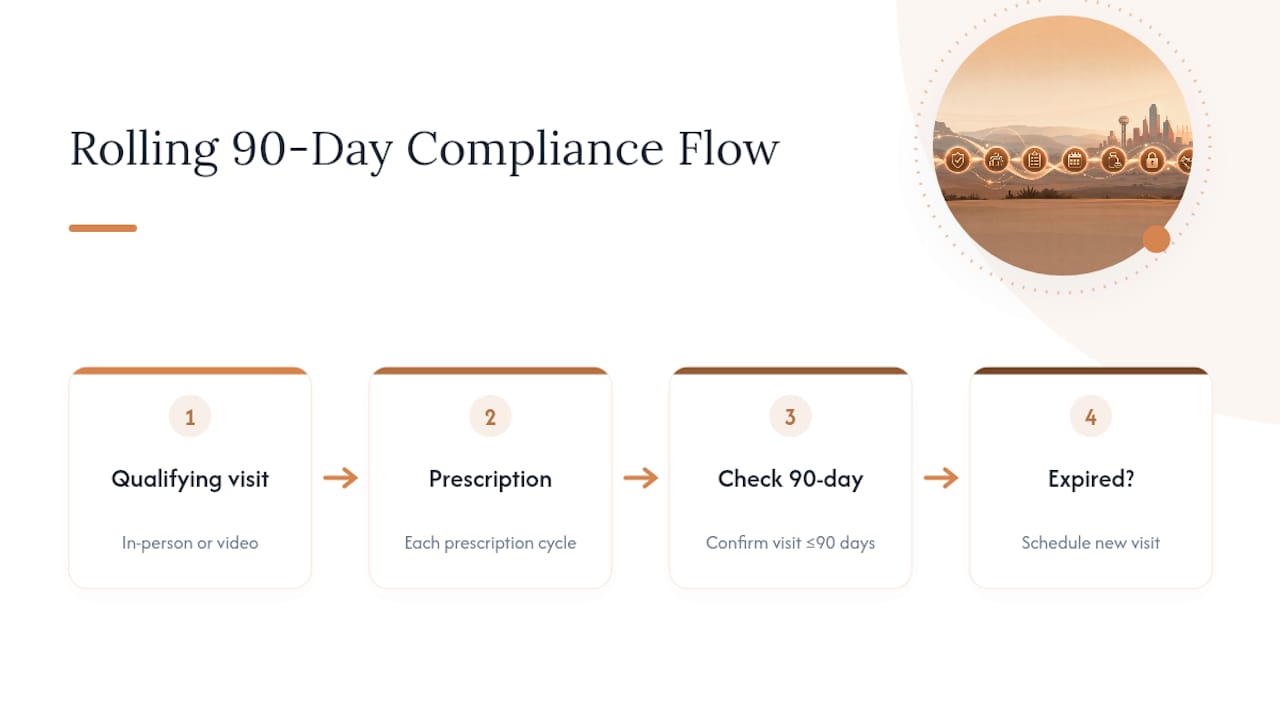
Texas Administrative Code Title 22, Section 217.24 draws a hard line around chronic pain treatment with scheduled drugs delivered through telemedicine. A provider generally cannot initiate chronic pain treatment with a controlled substance for a new patient purely through telemedicine. The exception applies only to established chronic pain patients, and even then, the patient must have had an in-person or synchronous video visit within the prior 90 days.
That 90-day window functions as a rolling clock, not a one-time checkbox. Every prescription cycle, the provider needs to confirm the last qualifying visit still falls inside that window, or schedule a new one. The full text of 22 Tex. Admin. Code § 217.24 lays out these prescription-specific conditions in detail, and it’s worth bookmarking rather than relying on secondhand summaries, since the rule gets misquoted often in general telehealth guides.
Prescription validity and the Texas Controlled Substances Act
Texas statute treats a telemedicine-issued prescription no differently than one written in an exam room when it comes to validity standards. Chapter 481 of the Texas Health and Safety Code, the Texas Controlled Substances Act, requires that every controlled-substance prescription serve a legitimate medical purpose and comply with the same recordkeeping and e-prescribing rules that apply to any other prescriber. The full statute is available through the Texas Legislature’s website, and it’s the controlling authority behind several requirements that telehealth-specific rules simply reference rather than restate.
Key statutory and regulatory requirements Texas providers need on their radar:
- PMP query is mandatory before prescribing any controlled substance, not just for suspected high-risk patients. This is one of the most frequently skipped steps in fast-moving telehealth visits.
- Prescription validity standards mirror in-person requirements, meaning date, quantity, dosage form, and refill limits must all meet the same statutory thresholds regardless of delivery method.
- E-prescribing is required for most controlled substances under both federal EPCS expectations and Texas-specific implementation rules.
- Recordkeeping obligations under Chapter 481 apply fully to telehealth visits, including documentation that supports the legitimate medical purpose standard.
- The practitioner-patient relationship must be established through a real clinical encounter, not a brief intake questionnaire alone.
Regulatory commentary from healthcare attorneys reinforces a theme that shows up throughout Texas telehealth law: when federal and state rules diverge, the more restrictive one wins. The Little Health Law Blog’s analysis of Texas telemedicine prescribing rules makes exactly this point, warning that providers who assume federal flexibility automatically satisfies Texas requirements are setting themselves up for board complaints. Texas doesn’t relax federal rules. It adds to them.
Compliance Checklist for Every Controlled-Substance Telehealth Visit
Rules only matter if they show up in your actual visit workflow. Here’s a sequence you can build into your practice’s telehealth process, step by step, for every encounter that might end in a controlled-substance prescription.
- Confirm licensure and DEA registration match the patient’s physical location. You need an active Texas medical license and a DEA registration valid for that jurisdiction. Document where the patient is physically sitting during the visit, not just their mailing address on file.
- Query the Texas PMP before you prescribe. This step happens before the prescription is written, not after. Save or screenshot the PMP result and attach it to the visit note.
- Confirm the encounter uses compliant interactive audio-video. Video needs to be real-time and two-way, with both participants visible and able to communicate naturally, except in the narrow audio-only OUD maintenance scenarios described earlier.
- Verify patient identity. A government-issued photo ID check at intake, matched against the person on screen, closes one of the most common diversion gaps in telehealth practices.
- Confirm the prescription will be transmitted through EPCS. Paper or verbal controlled-substance prescriptions create both compliance risk and diversion risk; electronic transmission through a certified EPCS platform should be your default.
- Document informed consent for telehealth specifically. This is distinct from general treatment consent. Patients should understand they’re being treated via telemedicine and what that means for follow-up care.
- Record clinical rationale tied to a legitimate medical purpose. Every controlled-substance prescription needs a documented reason that connects diagnosis to treatment choice.
- Capture medication history, including prior controlled-substance prescriptions from other providers. The PMP query supports this, but your own intake questions should too.
- Set and document a follow-up plan before ending the visit. For chronic pain patients specifically, track the 90-day clock from the qualifying visit forward.
- Flag red flags for escalation to in-person evaluation. Inconsistent history, requests for early refills, or resistance to identity verification should trigger a documented decision to require an in-person visit before continuing to prescribe.
Pro Tip: Build the PMP check into your scheduling software or EHR workflow as a required field before the prescription screen unlocks. Practices that rely on staff memory for PMP checks see far more gaps than practices that force the step technically.
Operationally, this checklist works best when it’s not just a clinician’s mental list but a shared workflow across front desk, clinical, and billing staff. Record retention policies should specify how long PMP snapshots, consent forms, and visit notes are kept, and who reviews charts periodically for chronic-pain patients approaching their 90-day deadline.
High-Risk Scenarios That Need Extra Safeguards
Some controlled-substance categories and patient situations carry more regulatory weight than others, and treating them all the same way is where practices run into trouble.
Chronic pain remains the most restrictive category in Texas telemedicine law. Outside the established-patient, 90-day exception described in Section 217.24, a Texas provider generally cannot initiate chronic pain management with scheduled drugs through a purely virtual relationship.
Buprenorphine for opioid use disorder sits in an unusual position. Federal rules have expanded flexibility significantly for OUD treatment, including the narrow audio-only allowance mentioned earlier, but Texas providers still need documented clinical justification, informed consent specific to medication-assisted treatment, and a follow-up cadence appropriate to the risk profile. Don’t assume federal generosity here removes Texas-level documentation expectations.
Stimulants and benzodiazepines carry heightened scrutiny industry-wide, largely because both classes show up disproportionately in diversion and misuse cases. Texas guidance doesn’t set a separate legal standard for these drug classes beyond the general PMP and standard-of-care requirements, but board risk guidance and liability carriers consistently flag them as categories where documentation gaps get punished hardest during audits or complaints.
Interstate patients introduce a licensure and registration layer on top of everything else. If a Texas-licensed provider treats a patient physically located in another state, that provider generally needs licensure or an applicable exemption in the patient’s state too, and must follow whichever jurisdiction’s rules are more restrictive. This is a growing area of confusion as practices scale telehealth panels across state lines.
- Chronic pain: established patients only; 90-day visit requirement; no initiation of new chronic-pain treatment purely via telemedicine.
- Buprenorphine/OUD: federal flexibility is real, but Texas-level documentation and consent standards still apply in full.
- Stimulants and benzodiazepines: no separate statutory carve-out, but expect closer audit scrutiny and stricter internal review.
- Interstate care: match registration and licensure to the patient’s physical state, and default to the stricter of the two jurisdictions when rules conflict.
Getting Ready for Special Registration
The DEA’s proposed Special Registration framework, published as a Notice of Proposed Rulemaking, would create a permanent structure for telemedicine prescribing once the current temporary extensions expire. The Federal Register notice on Special Registrations for Telemedicine outlines three distinct registration types aimed at different practice patterns, along with a concept called Limited State Telemedicine Registration that would let qualifying practitioners treat patients across state lines under specific conditions.
One detail worth flagging for planning purposes: the NPRM also floats a nationwide PDMP query requirement with a delayed effective date, giving practices a longer runway to build cross-state prescription-monitoring workflows before that piece becomes mandatory. Texas providers already comply with the in-state PMP requirement, so this mainly affects practices treating patients registered in other states.
None of this is final yet, and rules can shift before implementation. But practices that wait until a rule is finalized to build the infrastructure it requires tend to scramble. A more defensible approach is preparing now for what regulators have already signaled they want:
- Confirm your EPCS vendor supports full compliance, including identity-proofing standards that align with DEA expectations, not just basic e-prescribing.
- Build or confirm a cross-state PDMP query workflow if your practice treats patients registered in states outside Texas, anticipating the nationwide requirement even before its effective date arrives.
- Invest in identity-verification tooling beyond a simple ID photo upload, since Special Registration proposals emphasize stronger identity assurance for remote prescribing.
- Upgrade recordkeeping systems so PMP snapshots, consent documentation, and visit notes are retrievable quickly during an audit or board inquiry.
- Track registration type applicability as the rule develops, since different Special Registration categories may apply differently to psychiatric practices versus other specialties.
Practices that treat this preparation as background IT work rather than a clinical compliance priority tend to fall behind once the framework becomes mandatory. Building the infrastructure early means adjusting a workflow rather than rebuilding one under deadline pressure.
Journeymhw’s Approach to Documentation and Risk Mitigation
Every controlled-substance telehealth visit generates a decision trail, and the quality of that trail is usually what separates a defensible practice from one facing a board complaint it can’t easily answer. At Journeymhw, we’ve built our documentation approach around the assumption that every chart might eventually be reviewed by someone who wasn’t in the room.
A controlled-substance visit note should include, at minimum:
- Medical and psychiatric history relevant to the prescription, including prior treatment attempts and outcomes.
- A PDMP snapshot captured at or near the time of prescribing, not pulled from a prior visit.
- Risk-screening results, including substance use history and any relevant red flags identified during intake.
- A documented informed consent statement specific to telehealth, separate from general treatment consent.
- A clear follow-up plan, including the interval before the next visit and specific criteria that would trigger an earlier one.
On the technical side, we treat certain capabilities as non-negotiable rather than optional upgrades: EPCS for every controlled-substance prescription, secure two-way video with a reliable audit trail, and identity verification that goes beyond a self-reported name and birthdate.
Policy-wise, we set minimum follow-up intervals appropriate to the medication class, keep refill cadence conservative for stimulants and benzodiazepines specifically, and train clinical staff to recognize red-flag patterns that call for an in-person evaluation rather than another virtual refill.
Pro Tip: If your practice doesn’t have a written policy for what triggers escalation to in-person care, write one this week. “We’ll know it when we see it” is not a defensible standard when a board investigator asks how a decision was made.
A Clinician’s Honest Take on Access Versus Risk
The tension in this whole area isn’t really legal, it’s practical. Federal rules keep extending access because cutting patients off from medication-assisted care mid-treatment causes real harm. Texas rules keep tightening documentation because diversion and inadequate evaluation cause real harm too. Both pressures are legitimate, and providers who pretend one doesn’t exist eventually get burned by the other.
The most common mistake I see isn’t malicious. It’s a rushed PMP check, or an identity verification step that gets skipped when a patient is a familiar face. The fix is almost always procedural, not clinical: build the safeguard into your software so it can’t be skipped, not into your memory.
These rules will keep shifting through 2026 and beyond. Check DEA and Texas Medical Board updates quarterly, not annually.
— Jamie
How Journeymhw Delivers Compliant Medication Management in Texas
Virtual psychiatric evaluation and medication management for adults managing ADHD, anxiety, and depression are provided, with controlled-substance visits following safeguards such as PMP checks before prescribing, EPCS for controlled-substance prescriptions, identity verification at intake, and documented follow-up plans tailored to each medication class.
For patients weighing whether virtual psychiatric care can handle stimulant management responsibly, an ADHD treatment program outlines what an evaluation and ongoing medication visit involves, including follow-up intervals and refill decisions. If anxiety or depression is the primary concern, a depression treatment program follows similar documentation and identity-verification standards. Clinicians exploring referral relationships or partnership options can reach out, and patients can begin an evaluation through the ADHD treatment page to check availability and next steps.
Primary Sources Worth Bookmarking
Regulatory text moves faster than most secondary summaries can track, so keep these primary sources close:
- The Fourth Temporary Extension in the Federal Register for the current federal authorization window and conditions.
- The DEA’s press release on the extension for context on intent and upcoming rulemaking.
- 22 Tex. Admin. Code § 217.24 for Texas-specific chronic pain and prescription validity rules.
- Chapter 481, the Texas Controlled Substances Act for statutory prescription and recordkeeping requirements.
- Telehealth for the federal policy framing behind these rules.
Bookmark the Texas PMP portal and Texas Medical Board pages as well. Enforcement guidance updates there more often than most providers check.
This article is general information, not a substitute for advice from a qualified doctor. Consult a qualified healthcare professional about your own circumstances before acting on anything here.
Sources
- Fourth temporary extension of COVID-19 telemedicine flexibilities for prescription of controlled medications — Federal Register
- DEA extends telemedicine flexibilities to ensure continued access to care — DEA press release
- Telemedicine FAQs — Texas Medical Liability Trust (TMLT)
- 22 Tex. Admin. Code § 217.24 - Telemedicine Medical Service Prescriptions
- Telehealth
FAQ
Can a Telehealth Doctor Prescribe Adderall in Texas?
Yes, if the visit meets federal telemedicine conditions and Texas standard-of-care requirements, including a PMP check before prescribing and appropriate identity verification, since Adderall is a Schedule II stimulant subject to the same current federal flexibility.
Does Texas Allow Out-of-State Telehealth Therapy?
Providers treating patients physically located outside Texas generally need licensure or an applicable exemption in that patient’s state, and must follow whichever state’s rules are more restrictive when the two conflict.
Will Telehealth Be Allowed for Controlled Substances in 2026?
Yes, through at least December 31, 2026, under the current Fourth Temporary Extension, though the DEA’s proposed Special Registration framework may introduce a more permanent structure before or after that date.
Can I Prescribe Controlled Substances via Telehealth?
DEA-registered practitioners can prescribe Schedule II through V controlled substances via telemedicine when the encounter uses interactive audio-video, serves a legitimate medical purpose, and complies with both federal rules and the prescriber’s state-specific requirements, including Texas’s PMP-check and chronic-pain restrictions.