

Proven for Depression and Anxiety: Conditions Telepsychiatry Treats
Telepsychiatry can effectively diagnose and treat a wide range of psychiatric conditions including depression, anxiety disorders (such as PTSD, panic, and social anxiety), ADHD, bipolar disorder, various sleep and cognitive issues, and some substance-use concerns. Care typically includes psychiatric evaluation, psychotherapy, and medication management. Emergencies such as active suicidal intent, acute psychosis, or medical instability still require immediate in-person care.
TL;DR:
- Telepsychiatry is highly effective for depression, anxiety, ADHD, and sleep disorders, with evidence showing comparable or superior outcomes to in-person care in many cases.
- Conditions like bipolar disorder, psychotic disorders, and eating disorders require careful consideration, as telehealth may have limitations or need complementary in-person treatment.
- Regulatory rules vary by state, especially for controlled substances, making it essential to verify license and prescription protocols before starting medication remotely.
- Severe mental health emergencies, such as active suicidal ideation or acute psychosis, still require immediate in-person intervention.
- Continuity, structured follow-up, andClinical expertise are critical for successful telepsychiatry, rather than quick, one-off virtual visits.
Table of Contents
- What Conditions Does Telepsychiatry Treat?
- How Effective Is Telepsychiatry Compared to In-Person Care?
- What Services Can You Get Through a Telepsychiatry Visit?
- Who Benefits Most, and When Should You Seek In-Person Care Instead?
- What Happens During a Telepsychiatry Visit?
- How Journey Mental Health Structures Virtual Psychiatric Care
- Choosing Virtual Psychiatric Care: What Actually Matters
- Getting Started with Journey Mental Health
- Sources
What Conditions Does Telepsychiatry Treat?
If you’re wondering whether your diagnosis fits into a virtual care model, the answer is almost certainly yes, with a few important exceptions. We group conditions by category below because that’s how psychiatric evaluation actually works, and it makes it easier for you to find where you fit.
Mood disorders: depression and bipolar disorder
Depression is where telepsychiatry has its strongest track record. A 2023 systematic review and meta-analysis of randomized controlled trials covering more than 3,300 patients found no significant difference in efficacy between virtual and in-person psychiatric care across a wide range of common diagnoses, with depression standing out as an area where telepsychiatry performed particularly well. We can support you through assessment, ongoing psychotherapy, and medication titration without you ever sitting in a waiting room.
Bipolar disorder is more complicated, but manageable. Because bipolar care depends on close medication monitoring and pattern recognition over time, telepsychiatry works best when it’s part of a structured, ongoing relationship rather than a one-off visit.
Anxiety and trauma-related conditions
Generalized anxiety disorder, panic disorder, social anxiety, and PTSD all respond well to virtual therapy and medication management. PTSD deserves particular mention: clinicians who work in trauma-focused care often find that patients feel more able to open up about difficult memories from a familiar, private space rather than a clinical office. That comfort factor isn’t just anecdotal. It shows up in how consistently patients engage with treatment when they can attend sessions from home.
ADHD and neurodevelopmental conditions
Adult ADHD evaluation and medication management are now routine in telepsychiatry. A thorough virtual assessment includes a structured clinical interview, symptom rating scales, and a review of history, and it can lead directly into a treatment plan that includes stimulant or non-stimulant medication, with regular follow-up to adjust dosage and monitor side effects.
Psychotic disorders
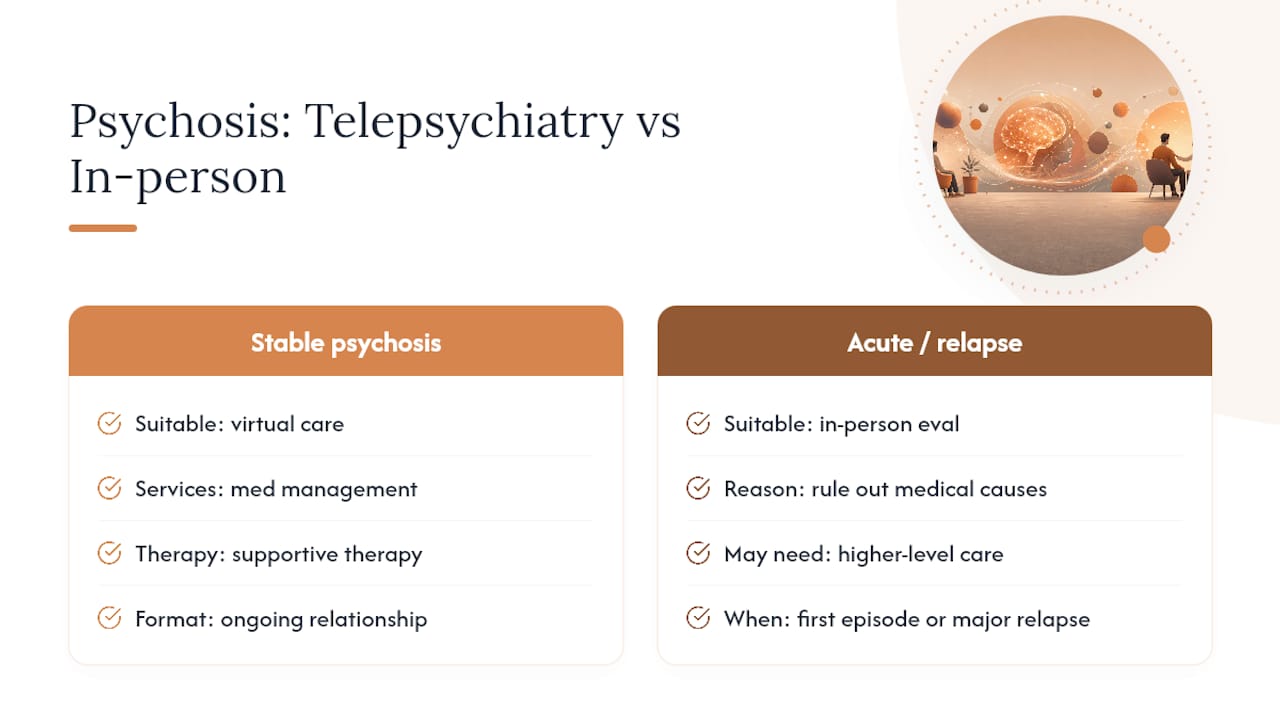
This is a category with real nuance. Patients with stable, well-managed psychotic disorders, such as schizophrenia in remission, can often continue medication management and supportive therapy virtually. But a first episode of acute psychosis, or a significant relapse, usually needs in-person evaluation, because clinicians need to rule out medical causes and may need to consider higher levels of care that a video visit can’t provide.
Substance use disorders
Telehealth supports addiction counseling, medication-assisted treatment, and ongoing monitoring in many settings, which has meaningfully expanded access for people who couldn’t otherwise reach a specialist. That said, one thematic review found notably higher dropout rates in a substance-misuse trial delivered virtually compared with in-person care, which means this population needs careful screening and a plan for escalating care if engagement slips.
Sleep disorders and insomnia
Cognitive behavioral therapy for insomnia (CBT-I) translates well to a video format, and psychiatric follow-up for sleep medication is straightforward to manage remotely.
Eating disorders
Evidence here is mixed. Some patients do well with virtual therapy and medication management, particularly for milder presentations or as a continuation of care after stabilization. Others, especially those with significant medical instability or low motivation for treatment, may need in-person or specialized program-level care that telepsychiatry alone can’t replace.
Cognitive impairment and mild dementia
Telepsychiatry is a genuinely useful tool for monitoring cognitive changes over time and supporting caregivers, who often need as much guidance as the patient does. Interestingly, one meta-analytic subgroup finding showed lower discontinuation risk for patients with mild cognitive impairment receiving virtual follow-up, suggesting the convenience factor may actually help this population stick with care longer.
How Effective Is Telepsychiatry Compared to In-Person Care?
The short answer: for most diagnoses, virtual psychiatric care holds up well against face-to-face treatment. The longer answer requires looking at which conditions the evidence covers strongly and which ones still carry more uncertainty.
By the Numbers: A meta-analytic subgroup comparison found telepsychiatry was associated with a lower discontinuation risk for mild cognitive impairment (RR = 0.552), while one substance-misuse trial showed a sharply higher dropout risk (RR = 37.41) for a virtual arm, according to a thematic review published in PMC. The gap illustrates just how much outcomes can vary by diagnosis rather than by the technology itself.
A systematic review and meta-analysis published in The British Journal of Psychiatry found telepsychiatry actually outperformed face-to-face treatment for depressive-disorder symptom improvement in six pooled studies, while results for most other conditions came out roughly equivalent. That same review flagged eating-disorder and substance-misuse data as areas of caution, since limited trials suggested possible inferiority or higher dropout for virtual formats in those specific groups.
Here’s what the evidence pattern looks like when you line it up by diagnosis:
- Depression: Strong evidence, in some analyses superior outcomes to in-person care.
- PTSD and anxiety disorders: Favorable evidence, supportive of therapy and medication delivered virtually.
- ADHD: Supportive evidence for virtual diagnostic assessment and ongoing medication management.
- Insomnia: Supportive evidence for CBT-I delivered by video.
- Eating disorders and substance use: Mixed evidence, with some studies showing higher dropout in virtual arms.
The American Psychiatric Association’s telepsychiatry toolkit is direct about what this all means for clinical practice: telepsychiatry has to meet the same standard of care as an in-person visit, full stop. That’s not a lower bar dressed up as convenience. It’s the same clinical rigor, delivered through a different channel.
One honest limitation worth naming: much of this research carries some heterogeneity in study design, and sample sizes for less common diagnoses remain small. Regulatory flexibility that expanded during the COVID-19 pandemic also shifted how telepsychiatry was practiced and studied, which means some older findings may not fully reflect current access rules. We think that’s a reason for informed caution, not a reason to dismiss the evidence, since the overall pattern across mood and anxiety disorders remains consistent.
What Services Can You Get Through a Telepsychiatry Visit?
A telepsychiatry appointment isn’t a scaled-down version of in-person care. It’s the same clinical process, adapted for video.
- Initial psychiatric evaluation. Your first visit typically includes a structured clinical interview, symptom history, screening tools, and a discussion of prior treatment, medications, and family history.
- Psychotherapy. Many practices deliver cognitive behavioral therapy (CBT), trauma-focused therapy, and dialectical behavior therapy (DBT) skills work through video, and some offer group therapy formats as well.
- Medication management. This covers starting a new medication, adjusting dosage, watching for side effects, and refilling prescriptions through e-prescribing systems built for virtual care.
- Addiction-related services. Counseling and medication-assisted treatment (MAT) can be delivered through telehealth in many settings, though state and federal rules around controlled substances still shape exactly what’s possible.
- Care coordination. When something needs a specialist, a lab test, or a level of care beyond what video allows, a good telepsychiatry provider connects you to it rather than leaving you to figure it out alone.
Pro Tip: If you’re being prescribed a controlled substance, ask upfront how your state’s rules affect your prescription. Requirements for certain medications, including stimulants used for ADHD, vary by state and can affect how often you need an evaluation.
Prescribing rules for controlled substances are one of the more state-dependent parts of telepsychiatry, and it’s worth understanding how those regulations apply to your care before you start treatment, especially if you’re managing ADHD or anxiety with medication that falls under stricter monitoring.
Who Benefits Most, and When Should You Seek In-Person Care Instead?
Telepsychiatry tends to work best for people who face real barriers to in-person visits: rural residents without a nearby psychiatrist, people with mobility limitations, parents juggling childcare, and anyone whose work schedule makes a physical office visit hard to fit in. Patients with autism or severe social anxiety often engage more comfortably from a familiar home environment, and that comfort can translate directly into better retention in treatment.
By the Numbers: The World Health Organization notes that effective psychological and pharmacologic treatments exist for many mental disorders, yet large gaps in access persist worldwide. Telepsychiatry is one of the more practical tools for narrowing that gap without requiring new clinics or new clinicians.
That said, virtual care has real practical limits:
- A stable internet connection and a private space to talk are non-negotiable for a productive session.
- State licensure rules mean your clinician must be licensed in the state where you’re physically located.
- Certain controlled-substance prescriptions carry additional state-specific requirements.
- Severe motivational or medical instability, as seen in some eating disorders, may need in-person or program-level intervention.
Some symptoms mean you should skip the video visit entirely and get help in person, right now. If you have active suicidal ideation with a plan, are experiencing acute psychosis, or have a serious medical complication tied to your mental health, call 911, contact the 988 Suicide & Crisis Lifeline, or go to your nearest emergency department. Telepsychiatry is a strong tool for ongoing care, but it isn’t built for medical stabilization in a crisis.
What Happens During a Telepsychiatry Visit?
Knowing what to expect ahead of time makes that first appointment far less nerve-wracking.
- Online intake. You’ll fill out history forms, symptom questionnaires, and insurance information before your first visit.
- Video or phone assessment. Video is preferred for clinical evaluation, since it lets the clinician observe things a phone call can’t catch. Phone visits are a reasonable substitute when video isn’t accessible.
- Treatment plan development. Your clinician builds a plan around your diagnosis, which may include therapy, medication, or both.
- Follow-up scheduling. You’ll get a plan for check-ins, whether that’s weekly therapy, monthly medication reviews, or occasional messaging between visits.
- Prescriptions and monitoring. E-prescribing sends medication orders directly to your pharmacy, and your clinician tracks side effects and progress at each follow-up.
Before your first appointment, it helps to have a quiet, private space, a written list of current medications, a rough timeline of your symptoms, and the name and number of an emergency contact on hand. Choosing a HIPAA-compliant telehealth platform also matters more than most patients realize. It’s the difference between a private conversation and one that isn’t properly protected.
How Journey Mental Health Structures Virtual Psychiatric Care
Journeymhw focuses on three of the most common reasons people seek psychiatric care: ADHD, anxiety, and depression. Care can include structured plans built around evaluation, medication management, and ongoing follow-up rather than a single disconnected visit.
- Evaluations and medication management delivered entirely online.
- Structured plans designed to improve the timeliness between reaching out and starting treatment.
- Appointment availability designed to minimize wait times.
- A role for psychiatric clinicians that includes both diagnosis and ongoing symptom tracking, not just a prescription pad.
This model reflects the same principle the evidence supports: virtual care works best when it’s structured, ongoing, and treated as real psychiatric care, not a shortcut.
Choosing Virtual Psychiatric Care: What Actually Matters
Most of the debate about telepsychiatry misses the real question. It’s not whether video visits “work.” The evidence on that is settled enough for depression, anxiety, PTSD, and ADHD. The real question is whether the provider behind the screen is built for continuity, not just convenience.
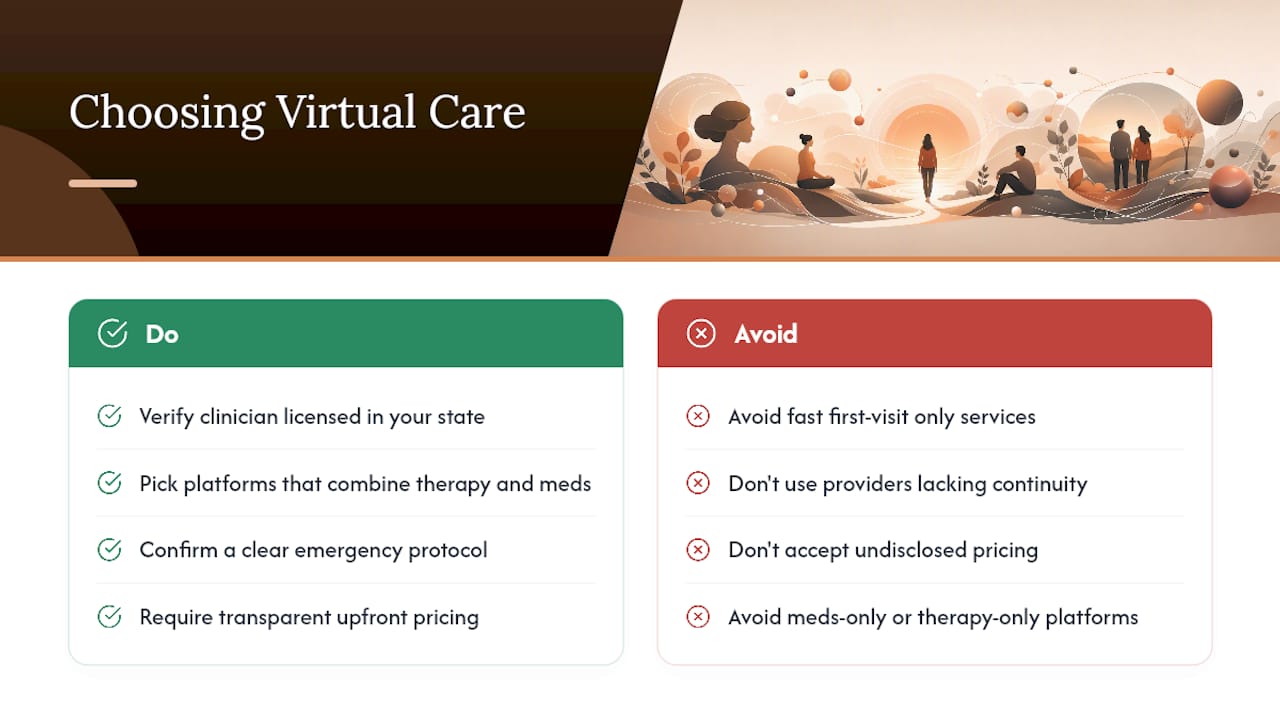
Too many virtual mental health services are optimized for a fast first visit and little else. That’s backwards. Complex conditions like bipolar disorder or treatment-resistant depression don’t respond to a single evaluation. They respond to a clinician who tracks your symptoms over months, adjusts medication with real clinical judgment, and knows when to loop in therapy or refer you to in-person care.
Before starting virtual treatment, verify three things: that your clinician is licensed in your state, that the platform combines therapy and medication management rather than offering just one, and that there’s a clear emergency protocol if you need help outside a scheduled visit. Transparent pricing matters too. If a service won’t tell you upfront what a plan costs, that’s worth noticing.
— Jamie
Getting Started with Journey Mental Health
If ADHD, anxiety, or depression is affecting your daily life, telepsychiatry services specifically addressing these conditions offer structured plans that combine evaluation, medication management, and follow-up into one continuous relationship instead of a series of disconnected visits.
Getting started may involve completing an online assessment, getting matched with a licensed clinician, and entering a treatment plan built around your diagnosis rather than a generic template. If ADHD is your primary concern, our ADHD treatment plans walk you through what evaluation, medication management, and ongoing monitoring actually look like in practice. Book your first assessment and find out what a structured, evidence-informed path to feeling better actually feels like.
This article is general information, not a substitute for advice from a qualified doctor. Consult a qualified healthcare professional about your own circumstances before acting on anything here.
Sources
- What is Telepsychiatry? | American Psychiatric Association
- Telehealth
- Telepsychiatry versus face-to-face treatment: systematic review and meta-analysis of randomised controlled trials | The British Journal of Psychiatry
- The effectiveness of telepsychiatry: thematic review | PMC (NIH)
- Mental disorders: fact sheet | World Health Organization