

People With ADHD: Keep Caffeine Below 400 mg, Space Doses 2–4 Hours
Short answer: yes, you can have caffeine while taking ADHD medication, but it is not a substitute for treatment, and mixing the two can amplify both stimulation and side effects. The risk depends on your dose, the product (coffee versus an energy drink), timing around your medication, and your personal health history. If you have a cardiac condition, are pregnant, are caring for a child or teen, or notice palpitations, anxiety, or insomnia, contact your prescriber before making any changes.
TL;DR:
- Caffeine and stimulant ADHD medications both increase arousal but through different mechanisms, and their combined effect can intensify side effects like heart rate and anxiety.
- Individual caffeine metabolism varies greatly due to genetics, making its effects unpredictable and complicating safe consumption when on ADHD medication.
- Evidence for caffeine actually improving ADHD symptoms remains weak, and it should only be considered a low-dose supplement, not a replacement for prescribed medication.
- Combining caffeine with ADHD medication frequently worsens sleep issues and increases cardiovascular risks, especially in those with pre-existing heart conditions.
- Energy drinks and caffeine supplements pose higher risks due to unpredictable ingredient loads and should be avoided by individuals on stimulant medication.
Table of Contents
- How Caffeine and ADHD Medication Interact in the Body
- Does Caffeine Actually Help ADHD Symptoms?
- Side Effects and Health Risks of Combining Caffeine With Stimulants
- Caffeine’s Effect on Drug Metabolism: CYP1A2 and Beyond
- Safe Caffeine Habits When You’re on ADHD Medication
- Extra Caution for Kids, Pregnancy, and Cardiac Conditions
- The Particular Danger of Energy Drinks and Caffeine Supplements
- What to Tell Your Prescriber About Your Caffeine Habits
- How Journey Mental Health Approaches Caffeine Questions in Medication Management
- A Clinician’s Honest Take on Coffee and Stimulant Medication
- Get Personalized ADHD Medication Guidance From Journeymhw
- Sources
How Caffeine and ADHD Medication Interact in the Body
Caffeine and stimulant ADHD medications reach the same finish line through different roads. Caffeine works mainly by blocking adenosine receptors. Adenosine is the brain chemical that builds up through the day and makes you feel drowsy, so blocking it delays that sleepy signal and creates a general sense of alertness throughout your central nervous system.
Methylphenidate and amphetamine-based medications work differently. They increase dopamine and norepinephrine availability in specific brain circuits tied to focus, impulse control, and executive function. That targeted action is why prescription stimulants can improve attention and reduce impulsivity in ways a cup of coffee simply cannot replicate.
Here is where it gets complicated. Caffeine’s adenosine-blocking effect does not stay contained to the brain regions stimulants target. It also revs up your broader sympathetic nervous system, the network responsible for heart rate, blood pressure, and the fight-or-flight response. Stimulant medications activate some of these same pathways as a side effect, even though their primary job is more targeted. When you stack the two, you are not layering two unrelated effects. You are pushing two overlapping arousal systems in the same direction at the same time, and that overlap is exactly why the combination can feel like too much.
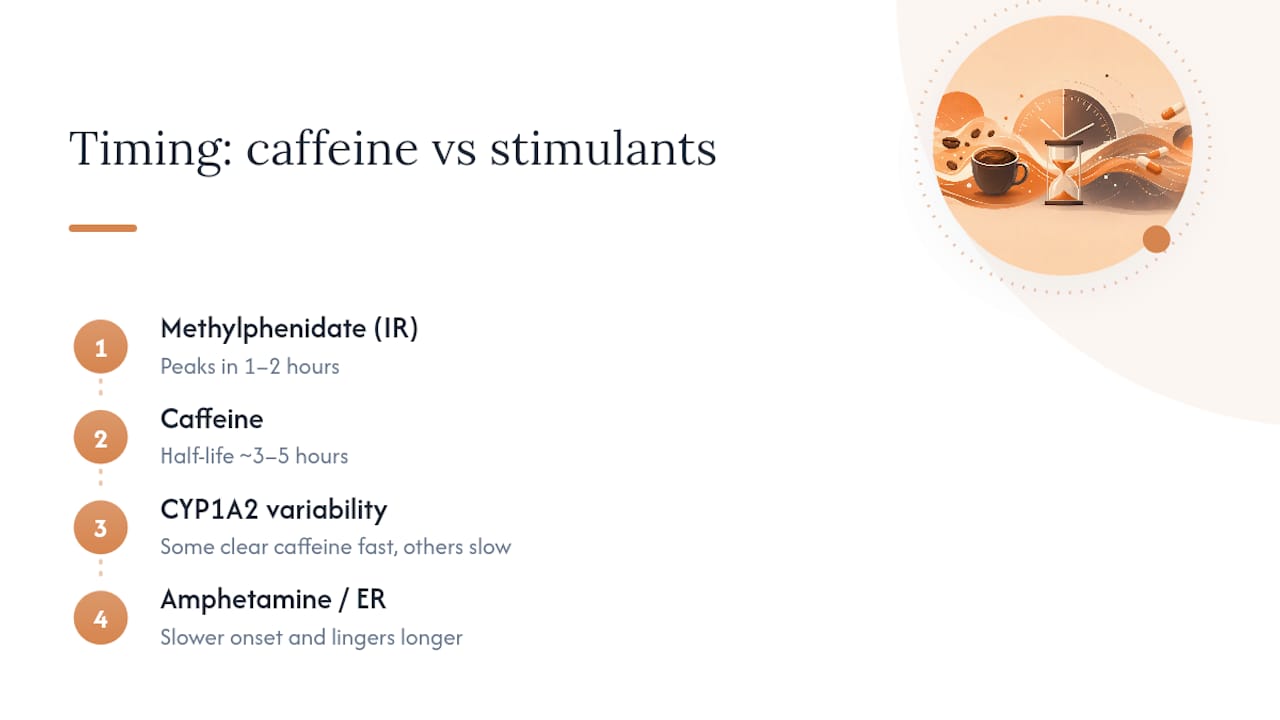
Timing and metabolism add another layer of variability. Caffeine has a half-life of roughly three to five hours in most healthy adults, though genetics can stretch that range considerably. Methylphenidate’s immediate-release forms tend to peak within one to two hours, while amphetamine salts and extended-release formulations act more slowly and linger longer. A gene called CYP1A2 controls how fast your liver clears caffeine. Some people metabolize it quickly and feel the jitters fade within an hour. Others metabolize it slowly, and a single afternoon coffee is still circulating at bedtime.
That variability matters clinically. Two people on the identical dose of the identical stimulant medication can have completely different experiences with the identical cup of coffee, because their caffeine clearance rates are not the same. This is part of why caffeine content varies enough cup to cup that it behaves less predictably than a measured prescription dose. A pharmacist measures your stimulant to the milligram. Nobody measures your coffee that precisely, and that inconsistency is a real practical reason not to lean on it for symptom control.
The bottom line on mechanism: caffeine and ADHD medications both push arousal systems upward, just from different starting points, and the body does not always distinguish cleanly between the two signals.
Does Caffeine Actually Help ADHD Symptoms?
The evidence is thinner than most casual advice suggests. Animal research has repeatedly shown that caffeine can improve attention and learning in models designed to mimic ADHD, and those findings are part of why the idea persists. But a systematic review of animal studies on caffeine and ADHD treatment found that translating those results into reliable human benefit has been inconsistent at best. Rodent brains and human ADHD are not the same problem, and dosing that works in a lab model does not map cleanly onto a person’s morning coffee routine.
Human trials tell a similarly mixed story. Some adults report a modest boost in alertness or a subjective sense of sharper focus after caffeine, particularly when medication effects are wearing off. Children and adolescents show weaker and less consistent responses, and no body of research supports caffeine as a dependable symptom-control tool for younger patients.
Clinical experts who work directly with ADHD patients are fairly unified on where this leaves things: caffeine can act as a mild, low-dose adjunct for some adults, but it is not a substitute for medications with actual evidence behind them. That distinction gets lost in casual conversation, where “coffee helps my ADHD” often means something closer to “coffee makes me feel less tired,” which is a very different claim than “coffee treats the underlying attention deficit.”
Nothing here should be read as a case for skipping medication in favor of your coffee maker. Prescription stimulants and non-stimulant ADHD medications go through structured clinical trials designed to isolate their effect on ADHD symptoms specifically. Caffeine has never gone through that same rigorous, ADHD-specific testing process, and the research that does exist points toward it being, at best, a supplement to treatment rather than a stand-in for it.
Side Effects and Health Risks of Combining Caffeine With Stimulants
The most predictable outcome of mixing caffeine with stimulant medication is more of everything, including the parts you did not want more of. Combining caffeine with stimulant ADHD medications commonly intensifies both alertness and adverse effects like elevated heart rate, anxiety, insomnia, and gastrointestinal distress. These are not rare or unusual reactions. They show up often enough that clinicians ask about caffeine intake as a matter of routine.
Common additive effects include:
- Faster resting heart rate and a noticeable pounding sensation
- Elevated blood pressure, especially with larger doses
- Jitteriness or a wired, restless feeling that is hard to shake
- Heightened anxiety or a sense of impending unease
- Difficulty falling or staying asleep
- Nausea, stomach cramping, or acid reflux
Sleep disruption deserves special attention because it creates a loop that works against you. Poor sleep already worsens attention, impulse control, and emotional regulation on its own. Caffeine-driven insomnia layered on top of stimulant medication can compound that decline, leaving you more scattered the next day and more tempted to reach for extra caffeine to compensate. That cycle can quietly undo whatever benefit your medication is supposed to be providing.
The more serious concerns sit at the cardiovascular end. If you have an existing heart condition, an arrhythmia history, or uncontrolled high blood pressure, adding caffeine on top of a stimulant is not a minor decision. Both substances increase cardiac workload, and stacking them raises the chance of a genuinely dangerous event rather than just an uncomfortable one.
Watch for these signs at home, and treat any of them as a reason to call your prescriber the same day: a racing or pounding heartbeat that does not settle within a few minutes, chest pain or tightness, fainting or near-fainting, or anxiety severe enough to interfere with normal functioning. None of these are symptoms to wait out until your next scheduled appointment.
Caffeine’s Effect on Drug Metabolism: CYP1A2 and Beyond
Caffeine does not just interact with ADHD medications directly. It also shares a metabolic pathway with a surprising number of other substances, and that shared pathway can quietly change how much caffeine is actually in your system at a given moment. The enzyme responsible is called CYP1A2, and it is one of the liver’s main tools for breaking caffeine down.
Some substances speed up CYP1A2 activity, clearing caffeine faster than usual. Tobacco smoke is the most common example, which is one reason heavy smokers often need noticeably more caffeine to feel the same effect. Other substances slow CYP1A2 down, letting caffeine build up to higher levels than the dose alone would suggest. Certain medications inhibit or induce CYP1A2 enough to meaningfully change caffeine’s concentration and effects in the body, which means the same cup of coffee can hit very differently depending on what else is in your system.
This works in both directions. Caffeine itself can raise blood levels of certain other drugs metabolized through the same pathway. Clinical literature has flagged interactions where caffeine intake increases clozapine concentrations and can augment theophylline’s effects, both of which matter if you are managing a psychiatric or respiratory condition alongside ADHD. Caffeine has also been linked to changes in lithium excretion, a detail that matters for anyone managing bipolar disorder alongside attention symptoms.
None of this means you need to memorize enzyme pathways before drinking coffee. It does mean that a medication list is not something to skim past when caffeine enters the picture. If you take any psychiatric medication beyond your ADHD prescription, including something for a comorbid condition, that combination deserves its own conversation. Readers managing both ADHD and anxiety together face a slightly more layered risk picture, since anxiety symptoms and caffeine’s stimulating effects can reinforce each other.
Checking a drug interaction database is a reasonable first step, but it is not a substitute for asking a pharmacist or your prescriber directly. Interaction databases flag possibilities; a clinician who knows your full medication list and health history can tell you which possibilities actually apply to you.
Safe Caffeine Habits When You’re on ADHD Medication
Getting this right does not require giving up coffee. It requires being more deliberate about how much you have and when you have it.
The FDA’s general guidance for healthy adults caps caffeine intake around 400 milligrams per day, roughly the amount in four regular cups of coffee. That ceiling assumes no other stimulant is in play. Once you add a prescription stimulant to the mix, a lower, more individualized limit usually makes more sense than pushing toward that 400 milligram maximum. What counts as “safe” for you personally depends on your medication dose, your own sensitivity, and how your body has responded to caffeine in the past.
Timing matters just as much as the total amount. Rather than sipping coffee throughout the day, consider front-loading your caffeine earlier and giving it space from your medication dose. Many prescribers recommend separating caffeine intake by at least two to four hours from stimulant dosing to reduce the chance that both peak in your bloodstream at the same time. Stopping caffeine intake by early afternoon also protects your sleep, which protects the very symptom control you are trying to maintain.
Practical rules worth following:
- Choose brewed coffee or tea over energy drinks or concentrated caffeine supplements, since dosing is easier to estimate and control.
- Space caffeine and your medication dose by two to four hours when possible, rather than taking them together.
- Set a personal daily ceiling below the FDA’s general 400 milligram guideline, especially in your first weeks on a new stimulant dose.
- Cut off caffeine by early to mid-afternoon to protect nighttime sleep.
- Treat a racing heart, chest discomfort, or new-onset severe anxiety as a same-day reason to call your prescriber, not something to monitor quietly on your own.
Pro Tip: Keep a simple three-day log before your next appointment. Note every caffeine source, a rough milligram estimate, what time you had it, when you took your medication, how you slept, and any symptoms that stood out. That log turns a vague “I think caffeine might be an issue” into something your prescriber can actually act on.
If you are newly adjusting your stimulant dose, this kind of tracking becomes even more useful, since titration periods are exactly when side effect patterns are hardest to interpret without a clear record.
Extra Caution for Kids, Pregnancy, and Cardiac Conditions
Some groups need a noticeably stricter approach than the general guidance above.
Children and adolescents metabolize caffeine differently than adults, and their developing cardiovascular systems are more sensitive to stimulant effects overall. The American Academy of Pediatrics advises against energy drink consumption in children and recommends conservative caffeine limits for teens, a stance that becomes even more relevant when a stimulant medication is already part of their daily routine. If your child is on ADHD medication, treating caffeine as a casual afternoon habit is not the same low-stakes choice it might be for an adult.
Pregnancy and breastfeeding introduce their own layer of complexity, since both caffeine and many ADHD medications cross into breast milk or affect fetal development differently than in a non-pregnant adult. This is not a situation to navigate with general internet guidance. A lower caffeine threshold and a direct conversation with your prescriber and OB provider matter here more than in almost any other scenario covered in this guide.
Anyone with a cardiac history, uncontrolled hypertension, or a significant anxiety disorder should treat caffeine as a variable to clear with a professional rather than adjust on their own. Combining a stimulant medication with caffeine already raises cardiac workload for a healthy adult. Layer in an existing heart condition, and that same combination carries meaningfully higher stakes. Clinicians managing these cases often choose more conservative medication doses, closer monitoring schedules, or additional cardiac screening before greenlighting any caffeine use at all.
The Particular Danger of Energy Drinks and Caffeine Supplements
Energy drinks are not just a stronger version of coffee, and treating them that way is where a lot of the real risk hides. A typical energy drink can contain caffeine loads well above a standard cup of coffee, and it rarely stops there. Many formulations add ginseng, taurine, guarana, or other stimulating compounds, plus a substantial sugar load, all layered into a single can.

That combination does not just add caffeine’s risks. Energy drinks have been linked to acute intoxication reports and risky behaviors, particularly among adolescents, a pattern serious enough that public health guidance treats them differently from coffee or tea. The extra ingredients and sugar spikes in energy drinks introduce cardiovascular and metabolic concerns that plain caffeine alone does not carry, which is why comparing an energy drink to a cup of drip coffee understates the actual gap between them.
If you are on stimulant medication, the most straightforward guidance is to avoid energy drinks and concentrated caffeine supplements entirely rather than trying to calculate a “safe” amount. The unpredictable ingredient mix makes that calculation harder than it looks, and the margin for error is smaller than with a known quantity like brewed coffee.
What to Tell Your Prescriber About Your Caffeine Habits
Your prescriber cannot adjust for something they do not know about. Come to your appointment ready to describe your actual caffeine sources, a rough daily milligram estimate, and roughly when you consume it relative to your medication dose. Mention your current sleep pattern and any side effects you have noticed, even ones that seem minor or unrelated.
Useful questions to bring: Should we shift the timing or dose of my medication given my caffeine habits? Do I need any cardiac monitoring given how much caffeine I consume? What specific symptoms should prompt me to seek urgent care rather than waiting for my next visit?
Depending on what you report, follow-up might include a vitals check at your next visit, a request to keep a symptom diary for a couple of weeks, a small adjustment to your medication timing or dose, or a referral for cardiac evaluation if anything in your history warrants a closer look. If you are also managing another psychiatric medication, this is also the right moment to raise it. Reviewing how SSRIs and stimulant medications interact alongside your caffeine intake gives your prescriber the fullest possible picture.
How Journey Mental Health Approaches Caffeine Questions in Medication Management
A thorough medication evaluation at Journeymhw does not stop at your prescription list. During telehealth visits, our clinical team reviews your caffeine and supplement habits alongside your full medication history, checks vitals, and screens for sleep disruption, since all three feed directly into how well a stimulant dose is actually working for you.
If caffeine has crept in as an informal way to manage symptoms between doses, or if you have noticed new side effects since increasing your intake, that is exactly the kind of detail worth bringing to an ADHD medication management visit. From there, we can talk through timing adjustments, dose changes, or additional monitoring as part of your ongoing care plan.
A Clinician’s Honest Take on Coffee and Stimulant Medication
Small, well-timed caffeine can genuinely help some adults get through an afternoon slump without causing problems. That much is fair to say. What concerns me more is watching patients quietly lean on coffee or energy drinks to paper over a medication dose that is not working well enough, instead of discussing medication concerns with their healthcare provider.
Caffeine is not diagnostic information, and it is not a treatment plan. If you find yourself needing more of it just to function through your day, that is a signal worth reporting, not a habit worth escalating on your own. Track it, mention it, and let your care team adjust the actual variables that matter.
— Jamie
Get Personalized ADHD Medication Guidance From Journeymhw
Generic caffeine advice can only take you so far, because your medication dose, your metabolism, and your daily habits are unique to you. Journeymhw’s telehealth psychiatric evaluations are built around that reality: instead of guessing whether your coffee habit is helping or working against your treatment, a licensed clinician reviews your full picture and adjusts your plan accordingly.
An ADHD evaluation with Journeymhw starts with a detailed review of your symptoms, current medications, and daily habits, including caffeine and supplement use, followed by a personalized treatment plan and ongoing follow-up visits to fine-tune dosing and timing as needed. If side effects have crept in, or you suspect caffeine is masking a dose that needs adjusting, that is worth raising at your next visit rather than managing alone.
Visit the ADHD treatment page to see what a first evaluation covers, or go straight to booking an appointment if you are ready to get answers specific to your situation. Texas and Colorado residents can also find state-specific details on the Colorado ADHD treatment page or the Texas ADHD treatment page.
Sources
- Effects of Caffeine Consumption on Attention Deficit Hyperactivity Disorder (ADHD) Treatment: A Systematic Review of Animal Studies — PMC
- Spilling the beans: How much caffeine is too much? — FDA
- Caffeine vs. ADHD medication: what actually works — ADD Resource Center