

Buspirone for Anxiety: What You Need to Know
Buspirone is a non-sedating, non-addictive prescription medication FDA-approved primarily for generalized anxiety disorder (GAD). Unlike benzodiazepines, it carries no risk of physical dependence or withdrawal, and unlike SSRIs, it does not typically cause sexual side effects. The brand name is BuSpar. Clinical benefit usually takes 2–4 weeks to appear, with full effect often requiring several months of consistent use. Typical therapeutic doses fall between 20–45 mg/day, with an FDA maximum of 60 mg/day.
Clinicians commonly consider buspirone in these situations:
- You have GAD and want to avoid the dependence risk of benzodiazepines
- You experienced intolerable side effects on an SSRI (particularly sexual dysfunction)
- You have a history of substance use that makes sedating medications a concern
- Your prescriber wants to augment a partial SSRI response
- You are an older adult where fall risk from sedating medications is a priority
One important caveat: Buspirone is a maintenance medication, not a rescue medication. It will not relieve acute panic in the moment. If you are looking for something to take as needed during a panic attack, buspirone is not the right tool for that role.
Key Takeaways
Buspirone is a non-sedating, non-addictive option for generalized anxiety disorder that requires 2–4 weeks to show clinical benefit and works best as a maintenance medication, not a rescue tool.
| Point | Details |
|---|---|
| Primary indication | FDA-approved for generalized anxiety disorder; not effective for panic disorder, OCD, or social anxiety |
| Onset timeline | Early effects may appear at 1–2 weeks; meaningful benefit typically requires 2–4+ weeks of consistent dosing |
| Dosing range | Therapeutic range is 20–45 mg/day in divided doses; FDA maximum is 60 mg/day |
| Key side effect | Dizziness is the most common early complaint; it is dose-related and usually transient |
| Interaction precaution | Avoid grapefruit juice and disclose all serotonergic medications to reduce serotonin syndrome risk |
| Journeymhw | Offers virtual psychiatric evaluations and buspirone medication management for adults in Texas and Colorado |
Table of Contents
- How buspirone works in the brain
- Who is buspirone actually for?
- How buspirone is dosed and titrated
- How quickly does buspirone work, and how can you tell it’s helping?
- Side effects and safety: what to watch for
- Drug interactions, precautions, and who should use caution
- How buspirone compares with benzodiazepines and SSRIs
- Monitoring, follow-up, and questions to ask your prescriber
- What to expect from telehealth medication management for anxiety
- A clinician’s perspective on starting buspirone
- Clinician-supervised anxiety care, available virtually
- Sources
How buspirone works in the brain
Buspirone belongs to a drug class called azapirone anxiolytics. Its primary mechanism is partial agonism at the 5-HT1A serotonin receptor, meaning it activates that receptor at a lower level than serotonin itself does. It also has mild effects on dopamine receptors. What it does not do is act on GABA receptors, which is the pathway benzodiazepines use to produce sedation and, over time, physical dependence.
Buspirone’s lack of GABAergic activity is the core reason it does not cause the tolerance, withdrawal, or rebound anxiety that benzodiazepines can produce with regular use.
That distinction matters practically. A patient who stops buspirone does not need a taper to avoid withdrawal seizures. A patient who takes it daily does not build tolerance that requires dose escalation just to maintain the same effect.
Two pharmacology details affect how you take it. First, buspirone has a short half-life, which is why doses are typically divided across the day rather than taken all at once. Second, it is metabolized by the CYP3A4 enzyme system, which creates meaningful drug interactions covered in a later section.
For more background on how serotonergic medications work, the serotonin and anxiety explainer from Journeymhw provides useful context.
Who is buspirone actually for?
The FDA-approved indication is the management of generalized anxiety disorder and short-term relief of anxiety symptoms. GAD means persistent, hard-to-control worry across multiple areas of life, not situational stress before a presentation or a difficult week at work. If your anxiety is primarily situational, buspirone is unlikely to be the right fit.
Where clinicians typically consider it:
- GAD as primary diagnosis, especially when a patient prefers to avoid benzodiazepines
- SSRI intolerance, particularly when sexual side effects were the reason for stopping. Buspirone does not carry that same risk, and clinicians sometimes use it as an SSRI alternative or augmentation agent
- Substance use history, where sedating or potentially addictive medications are contraindicated
- Older adults at elevated fall risk from sedation
- Augmentation, added to an SSRI when the response is partial
What buspirone does not reliably treat: panic disorder, OCD, social anxiety disorder, or PTSD. Evidence for those conditions is limited, and other medication classes have stronger support. Off-label uses, including depression augmentation and anxiety related to Parkinson’s disease, do exist but require clinician judgment and oversight.
How buspirone is dosed and titrated
Starting low and titrating slowly reduces early side effects, particularly dizziness. A common starting point is 7.5 mg twice daily, with increases every one to two weeks based on response and tolerability.

Sample titration schedule
| Phase | Dose | Notes |
|---|---|---|
| Week 1 | 7.5 mg twice daily | Starting dose; assess tolerability |
| Weeks 2–3 | 10–15 mg twice daily (20–30 mg/day) | Increase if tolerated; consider TID if short half-life is an issue |
| Weeks 4–6 | 15 mg twice or three times daily (30–45 mg/day) | Typical therapeutic range |
| If needed | Up to 20 mg three times daily (60 mg/day) | FDA maximum; only under close supervision |
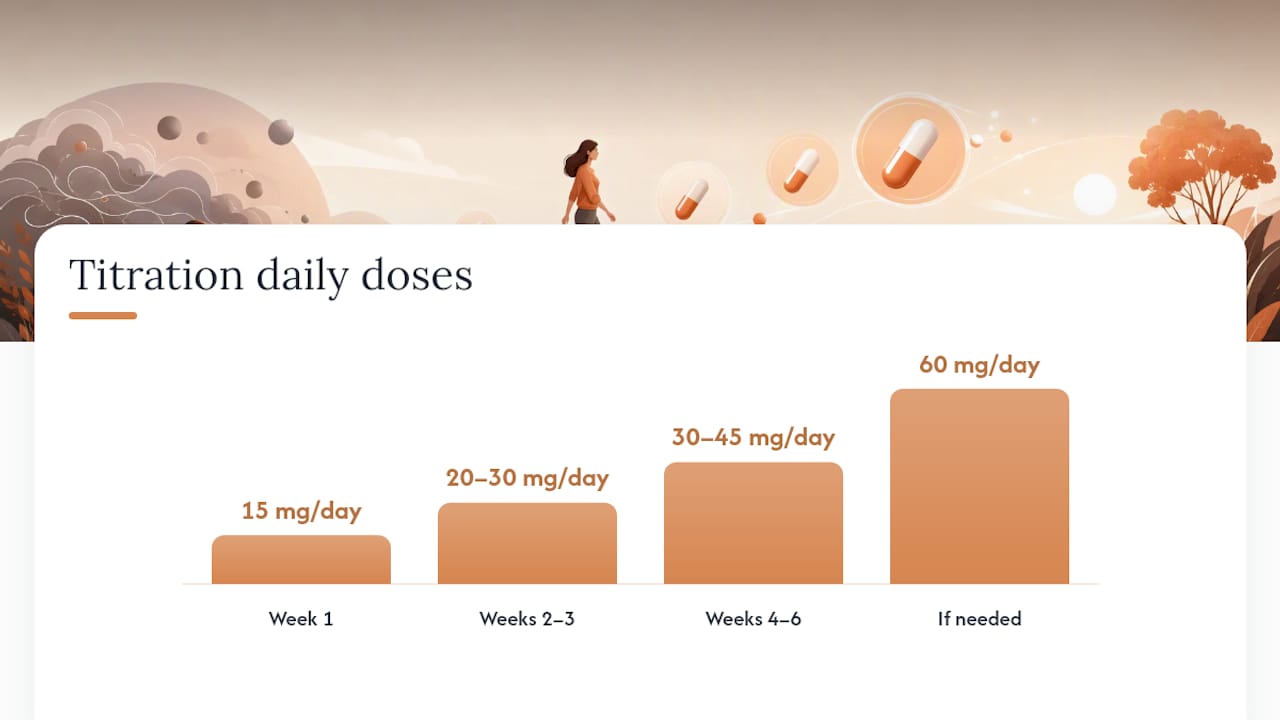
Because of buspirone’s short half-life, dividing doses two or three times daily often produces more stable blood levels than a single daily dose. Your prescriber will determine the right schedule for you.
Missed dose guidance:
- If you miss a dose and remember within a couple of hours, take it as soon as you can
- If it is close to your next scheduled dose, skip the missed one and continue your regular schedule
- Never double up to compensate for a missed dose
If you take too much: Contact Poison Control (1-800-222-1222) or go to the nearest emergency room immediately. Symptoms of overdose can include severe dizziness, vomiting, drowsiness, and blurred vision.
How quickly does buspirone work, and how can you tell it’s helping?
This is where many patients run into trouble. Buspirone does not produce the immediate calming effect that benzodiazepines do. Expecting that kind of response leads to early discontinuation before the medication has had a fair chance.
Realistic timeline:
- Weeks 1–2: Some patients notice mild early effects, such as slightly reduced tension or improved sleep. Many notice nothing yet, which is normal
- Weeks 2–4: Clearer symptom reduction typically begins, including less persistent worry and reduced physical tension
- Beyond 4 weeks: Full benefit often continues to build. Clinical benefit may take several weeks to appear, and a complete trial is often measured in months, not days
Worry and generalized tension tend to respond before panic-like symptoms do. If you have co-occurring panic attacks, buspirone alone may not address them adequately.
Tracking your response: The GAD-7 questionnaire is a practical, validated tool for measuring anxiety severity over time. Completing it before your first appointment and at each follow-up visit gives your prescriber objective data rather than relying on memory. A reduction of 5 or more points on the GAD-7 is generally considered a meaningful clinical improvement. If you have not noticed any change after 4–6 weeks at a therapeutic dose, that is worth discussing with your prescriber rather than waiting indefinitely.
Side effects and safety: what to watch for
Most side effects are dose-related and tend to be most noticeable in the first one to two weeks.
Common side effects (from MedlinePlus and a systematic review and meta-analysis):
- Dizziness and lightheadedness (the most frequently reported)
- Nausea and GI upset
- Headache
- Nervousness or restlessness
- Sleep difficulties
- Constipation and gastric distress
These effects often improve as your body adjusts. Dizziness in particular tends to be transient and dose-related.
Red-flag symptoms requiring urgent care:
Seek emergency care immediately if you experience: rapid heart rate, agitation, muscle twitching, high fever, confusion, or loss of coordination. These can be signs of serotonin syndrome, a potentially serious reaction that can occur when buspirone is combined with other serotonergic medications.
Other serious symptoms to report right away include signs of an allergic reaction (hives, swelling of the face or throat, difficulty breathing) or unusual involuntary movements.
Comparative safety notes worth knowing:
- Buspirone does not cause the physical dependence or withdrawal that benzodiazepines can produce with regular use
- It does not carry the sexual side effects (delayed orgasm, reduced libido) commonly associated with SSRIs
- It is less sedating than both benzodiazepines and many antihistamine-based anxiety options, which is clinically relevant for patients who drive or operate machinery
Drug interactions, precautions, and who should use caution
Buspirone’s CYP3A4 metabolism creates a meaningful interaction list. The Psychopharmacology Institute summarizes the key clinical considerations.
Clinically important interactions:
- Strong CYP3A4 inhibitors (e.g., ketoconazole, itraconazole, certain HIV medications, erythromycin): can significantly raise buspirone blood levels, increasing side effects
- Strong CYP3A4 inducers (e.g., rifampin, certain anticonvulsants): can lower buspirone levels, reducing effectiveness
- Grapefruit juice: inhibits CYP3A4 and can raise buspirone exposure unpredictably; best avoided
- Other serotonergic agents (SSRIs, SNRIs, MAOIs, triptans, tramadol, St. John’s Wort): combination raises serotonin syndrome risk; always disclose all medications to your prescriber
- Alcohol: though buspirone is less sedating than benzodiazepines, combining it with alcohol can still impair judgment and coordination
Special populations:
- Liver or kidney impairment: Buspirone is metabolized hepatically and renally excreted; dose adjustments or avoidance may be needed
- Pregnancy and breastfeeding: Data are limited; discuss the risk-benefit balance with your prescriber before starting or continuing buspirone during pregnancy or while nursing
- Older adults: Generally considered safer than benzodiazepines for this group, but start low and monitor carefully
Pro Tip: Take buspirone consistently with respect to meals. Food increases its absorption, so taking it sometimes with food and sometimes without can cause blood-level swings that produce breakthrough anxiety or side effects. Pick a routine and stick to it.
To reduce dizziness, consider taking dose increases at bedtime and rising slowly from sitting or lying positions, especially in the first few weeks.
How buspirone compares with benzodiazepines and SSRIs
Understanding where buspirone fits in the treatment picture helps you have a more informed conversation with your prescriber. The anxiety medication overview from Journeymhw covers the broader landscape.
Key differences across the three classes:
- Onset of action: Benzodiazepines work within minutes to hours. SSRIs and buspirone both require weeks. Buspirone is not a substitute for a benzodiazepine when rapid relief is needed
- Dependence and withdrawal risk: Benzodiazepines carry significant physical dependence risk with regular use. SSRIs carry discontinuation syndrome risk. Buspirone carries neither
- Sedation and cognitive effects: Benzodiazepines are sedating and can impair memory and coordination. SSRIs are generally non-sedating. Buspirone is non-sedating and, in limited trials, has shown small positive effects in some cognitive domains
- Sexual side effects: SSRIs commonly cause sexual dysfunction. Buspirone does not, making it a practical choice when this is a concern
- Typical clinical role: Benzodiazepines are used for short-term or rescue situations. SSRIs are first-line for most anxiety disorders. Buspirone is typically second-line for GAD, or used as augmentation when SSRI response is partial or sexual side effects are problematic
When clinicians favor each class:
Benzodiazepines remain useful for acute, short-term situations: a flight phobia, a procedure, or a crisis where rapid relief is the priority. SSRIs are the first-line choice for most anxiety disorders, including panic disorder, social anxiety, and GAD. Buspirone earns its place when dependence risk is a concern, when sexual side effects have been a barrier to SSRI adherence, or when a patient needs a non-sedating maintenance option for GAD specifically.
Monitoring, follow-up, and questions to ask your prescriber
Good medication management is not just about the prescription. It is about the follow-up.
Suggested follow-up schedule and what to report:
- 2 weeks after starting: Report early side effects, especially dizziness or GI symptoms; confirm you understand the titration plan
- 4–6 weeks: Share your GAD-7 score; discuss whether early benefit is apparent; review any new medications or supplements added since the last visit
- 3 months: Assess full response; discuss whether dose adjustment, augmentation, or a different approach is warranted
- Ongoing: Report any changes in alcohol or substance use, new prescriptions from other providers, or new symptoms
Questions worth asking your prescriber:
- What dose range are we targeting, and how will we know when we have reached it?
- How long should I give this medication before we decide it is or is not working?
- Are any of my current medications or supplements likely to interact with buspirone?
- What should I do if my anxiety spikes acutely while I am waiting for buspirone to take effect?
- What is the plan if I do not respond adequately after a full trial?
Bringing a completed GAD-7 and a current medication list to every visit makes these conversations more productive.
What to expect from telehealth medication management for anxiety
A telehealth pathway for anxiety medication follows the same clinical logic as an in-person one, with the added convenience of no commute. Here is how a typical online visit sequence works:
Before your first appointment:
- Complete a symptom questionnaire (often a GAD-7 or similar tool)
- List all current medications, supplements, and any substances you use
- Note any prior anxiety treatments and how they went
- Have recent lab results available if your primary care provider has run them
At the initial evaluation: The clinician reviews your symptom history, rules out medical causes of anxiety, discusses your treatment preferences and concerns, and explains the shared decision-making process. If buspirone is appropriate, they will walk you through the starting dose, titration plan, and what to expect in the first few weeks.
Ongoing remote management:
- Follow-up visits are scheduled at clinically appropriate intervals (typically 2–4 weeks early on, then monthly or quarterly once stable)
- Titration decisions are made based on your reported symptoms, side effects, and GAD-7 scores shared between visits
- Interaction checks are performed whenever a new medication is added
- Safety monitoring includes asking about serotonin syndrome symptoms if other serotonergic agents are in the picture
What to have ready for every visit:
- Your current GAD-7 score
- A log of any side effects and when they occurred
- Your full medication and supplement list
- Any questions about dose, timing, or what to do if symptoms worsen
A clinician’s perspective on starting buspirone
The most common challenge we see in the first weeks of buspirone treatment is not side effects. It is the expectation mismatch. Patients who have previously taken a benzodiazepine know what “anxiety medication working” feels like: a noticeable, fairly rapid shift in how they feel. Buspirone does not work that way. The change is gradual, and in the early weeks, it can be easy to conclude the medication is not doing anything.
What we typically tell patients: give it a genuine 4-week trial at a therapeutic dose before drawing conclusions. Track your GAD-7 weekly so you have something objective to look at, because subjective memory of anxiety is unreliable. And if dizziness is a problem in the first week or two, that usually settles. It is not a reason to stop.
The patients who do best with buspirone tend to be those who understand from the start that this is a maintenance medication, not a rescue tool, and who have a clear plan for what to do if acute anxiety spikes during the waiting period.
Clinician-supervised anxiety care, available virtually
If you are considering buspirone or another anxiety medication and want structured, clinician-supervised care without the wait of a traditional clinic, Journeymhw offers virtual psychiatric evaluations and medication management for adults in Texas and Colorado. We handle the full pathway: intake assessment, diagnosis, shared treatment planning, prescription management, and scheduled follow-up visits, all from your home.
Our anxiety treatment services are designed for adults who want a clear, structured process rather than a long waitlist. You will work with a licensed clinician who reviews your symptom history, discusses your options honestly, and monitors your response over time. If buspirone is appropriate for your situation, we will walk you through the titration plan and be available for follow-up as your treatment progresses. To get started, book an evaluation and we will match you with a clinician who can help.
Sources
These resources are worth bookmarking for your own research and for conversations with your prescriber:
- Buspirone systematic review and meta-analysis (PMC11004816)
- Buspirone drug info - MedlinePlus
- Buspirone (BuSpar): How It Works & Side Effects
- Treating Generalized Anxiety Disorder with buspirone – Psychiatry Consultation Line
- Buspirone Guide: Pharmacology, Indications, Dosing Guidelines and Adverse Effects | Psychopharmacology Institute
This article provides general information about buspirone and is not a substitute for professional medical advice. Always consult a licensed clinician before starting, stopping, or changing any medication, and confirm current prescribing guidelines with your provider or a primary source.
Recommended
- SSRI Medication for Anxiety: What You Need to Know – Journey Mental Health
- Serotonin and Anxiety Disorders: What You Need to Know – Journey Mental Health
- How Anxiety Medication Works: A Clear, Honest Guide – Journey Mental Health
- Anxiety Disorder Types Explained: Find What Fits – Journey Mental Health