

2026 US Benzodiazepine Telehealth Rules, DEA Window and Checklist
Yes, benzodiazepines can be prescribed through telehealth in the U.S. under current federal rules, but three qualifiers matter more than the headline. Your state may impose stricter requirements than the federal baseline, your prescriber must run a PDMP check, and every visit needs documentation showing medical necessity. Skip any of those and a telehealth benzodiazepine prescription becomes legally shaky, even where federal law allows it.
TL;DR:
- A telehealth benzodiazepine prescription remains legally risky without a recent PDMP check, documented medical necessity, and adherence to state-specific rules.
- Federal flexibilities extend through December 2026, but prescribers must meet strict conditions, including a valid medical purpose and proper recordkeeping.
- States often impose stricter requirements, such as mandatory in-person evaluations or specific modality restrictions, which override federal allowances.
- Clear documentation, including PDMP results and identity verification, is critical before prescribing, especially when travel or access issues occur.
- Providers following strict compliance integrate checks and documentation into the treatment plan to reduce future liability and patient dependence risks.
Table of Contents
- Federal Rules on Benzodiazepine Telehealth Prescribing
- Does Your State Allow Benzodiazepine Telehealth Prescriptions?
- What Documentation Do You Need Before Prescribing?
- Your Pre-Visit, During-Visit, and Post-Visit Checklist
- What Should Patients Prepare Before a Telehealth Visit?
- Why Compliant Teleprescribing Protects Everyone
- How Journey Mental Health Handles Teleprescribing Compliance
- Sources
Federal Rules on Benzodiazepine Telehealth Prescribing
The federal government’s stance on remote prescribing for controlled substances has shifted from pandemic-era emergency measures to something more structured, though still temporary. Benzodiazepines fall under Schedule IV, and prescribing them via telehealth without a prior in-person visit depends on flexibilities that Congress and the DEA keep extending rather than making permanent.
The Fourth Temporary Extension, published in the Federal Register, keeps this pathway open through December 31, 2026. It permits DEA-registered practitioners to prescribe Schedule II through V controlled substances by telemedicine when specific conditions line up. Telehealth confirms the same window and spells out what “conditions” actually means in practice.
For a benzodiazepine prescription written over telehealth to hold up, it generally needs:
- A legitimate medical purpose, established during the encounter itself
- Interactive audio-video communication meeting the standard under 42 CFR 410.78
- A DEA registration that authorizes the prescriber for that specific drug schedule
- Compliance with the recordkeeping and prescribing standards in 21 CFR Part 1306
In January 2025, the DEA also introduced three new telemedicine rules that lock in some pandemic-era flexibility while adding patient protections, including a special registration framework for platforms that never see patients in person before prescribing. This isn’t a repeal of the Ryan Haight Act’s in-person requirement. It’s an administrative bridge, renewed on a schedule, that could tighten or lapse depending on future rulemaking. Providers who treat it as permanent are setting themselves up for a compliance gap the moment the extension isn’t renewed.
Does Your State Allow Benzodiazepine Telehealth Prescriptions?
Federal rules set the floor, not the ceiling. States can, and often do, layer on stricter requirements, and a prescription that’s federally compliant can still violate state law if the provider doesn’t check first.
States generally fall into three buckets:
- Restrictive states require an initial in-person evaluation before any controlled-substance prescription, regardless of what federal flexibilities allow.
- Conditional states allow telehealth prescribing but add friction, such as mandatory audio-video (no audio-only), extra informed consent language, or shorter supply limits.
- Flexible states largely defer to the federal baseline without additional layers.
Because this landscape shifts as legislatures and medical boards update policy, don’t rely on memory or last year’s notes. Run this verification sequence for every new patient:
- Check the patient’s state medical board site for its current teletherapy across state lines prescribing policy.
- Confirm PDMP query requirements, including how recently before prescribing the check must occur.
- Verify the dispensing pharmacy’s own policies, since some pharmacies decline to fill telehealth-originated benzodiazepine scripts even when the prescription is technically legal.
- Search for any state statute specifically addressing controlled-substance telemedicine, separate from general telehealth law.
When federal and state rules conflict, follow the stricter one. Resources like the CCHP state telehealth policy tracker consolidate a lot of this, though individual board pages remain the authoritative source.
Pro Tip: Keep a one-page cheat sheet per state you treat patients in, stored in your EHR or compliance folder, listing that state’s in-person requirement, PDMP timing rule, and any modality restrictions. Five minutes now saves you from re-researching the same question every visit.
What Documentation Do You Need Before Prescribing?
Every benzodiazepine telehealth visit needs a documentation trail that would satisfy an auditor, not just a clinical note that satisfies you in the moment.
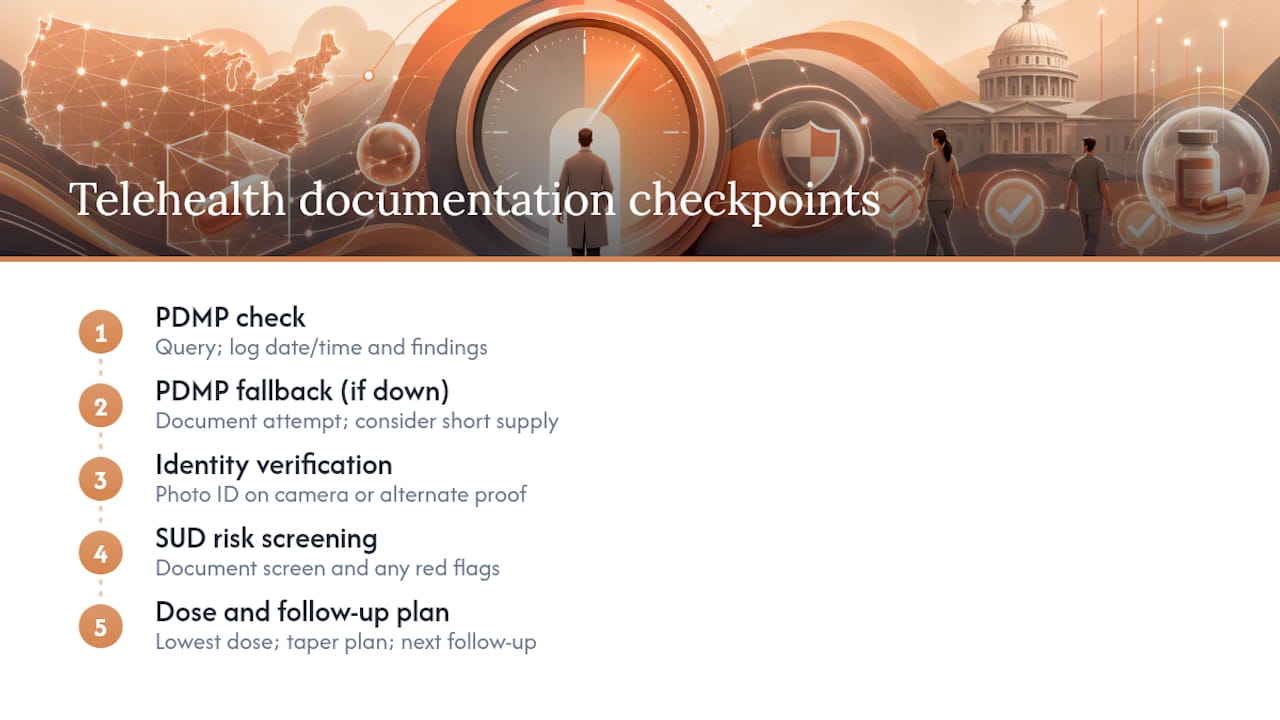
Start with the PDMP check. Query it before prescribing, note the date and time in the chart, and record what you found, including any red flags like overlapping prescriptions from other providers. If the PDMP is temporarily inaccessible, don’t skip the step and hope. Document the attempted access, and if your state’s framework permits it, consider limiting the initial prescription to a short supply while you keep trying. SAMHSA’s buprenorphine telemedicine guidance describes a comparable fallback: a seven-day supply while the PDMP check is retried before issuing anything further, with that supply counting against any total telemedicine-authorized limit.
Identity verification matters just as much. A government photo ID shown on camera is the gold standard, but when a patient lacks one, document the alternative steps you took, such as confirming identity against insurance records or prior medical history.
Screen for substance use disorder risk and note any co-prescribed opioids explicitly, since that combination carries elevated overdose risk regulators watch closely. Prescribe the lowest effective dose for the shortest reasonable duration, and if treatment will extend past a few weeks, write down a taper plan and the date of the next follow-up.
Your Pre-Visit, During-Visit, and Post-Visit Checklist
Turning these rules into a routine keeps you compliant without slowing down every appointment.
- Before the visit: Confirm you hold an active license in the patient’s physical location, verify your DEA registration covers Schedule IV substances, log into the relevant state PDMP, and confirm the visit will use an allowable communication mode.
- During the visit: Record the PDMP check timestamp, verify identity, document your clinical findings and the medical necessity for a benzodiazepine specifically, and capture informed consent in the chart.
- After the visit: Store your documentation where it’s retrievable for audit, notify the pharmacy if anything about the prescription needs context, and schedule the follow-up visit before the patient logs off.
Pro Tip: Build a short list of red flags that automatically trigger a pause: inconsistent medication history, signs suggestive of diversion, or a PDMP you can’t access with no documented workaround. When any of those appear, default to requiring an in-person visit rather than pushing the prescription through.
What Should Patients Prepare Before a Telehealth Visit?
Coming to your telehealth appointment prepared makes the process faster and helps your provider stay compliant on your behalf.
- Have a government-issued photo ID ready to show on camera, along with a list of current medications and dosages.
- Tell your provider your exact physical location at the time of the visit. State law follows where you are, not where the clinic is based.
- Expect a PDMP check before any prescription is written. This isn’t optional, and it can occasionally add a short delay while your provider confirms your prescription history.
- Ask about the treatment timeline. Most clinicians favor short-term benzodiazepine use with a clear taper plan rather than open-ended refills.
- Choose providers who are transparent about state licensure and PDMP practices, and be wary of any service promising an instant controlled-substance prescription with no evaluation.
Why Compliant Teleprescribing Protects Everyone
The rules around benzodiazepine telehealth prescribing exist because this drug class carries genuine dependence risk, and the DEA’s post-pandemic approach reflects an attempt to balance legitimate access against diversion. What gets missed in most coverage of this topic is that the paperwork isn’t bureaucratic friction. It’s the difference between a defensible clinical decision and a liability.
I’d argue the providers doing this well don’t treat compliance as a checklist bolted onto care. They treat PDMP checks and taper documentation as part of the actual treatment plan, because a patient on a benzodiazepine six months from now benefits from that same rigor. The clinics cutting corners on identity verification or state checks aren’t saving time. They’re deferring risk to a future audit or, worse, a patient who ends up dependent with no clear off-ramp.
— Jamie
How Journey Mental Health Handles Teleprescribing Compliance
If you’re weighing a telehealth provider for anxiety treatment that may involve a benzodiazepine, the practical question isn’t just “can they prescribe,” it’s “do they document it right.” Journeymhw builds structured psychiatric evaluations around exactly the safeguards this article covers: state-specific licensure, PDMP verification, and a documented rationale for every prescription.
Journeymhw currently serves patients in Texas and Colorado, and every visit follows the same pattern: a full evaluation, a documented treatment plan, and follow-up scheduled before you log off. When a benzodiazepine isn’t the safest or most appropriate option, clinicians discuss alternatives and longer-term anxiety management rather than defaulting to a quick script. If your situation calls for an in-person exam under your state’s rules, you’ll be told plainly rather than pushed through anyway. Start with an anxiety treatment evaluation to see what a compliant, structured visit actually looks like.
This article is general information, not a substitute for advice from a qualified doctor. Consult a qualified healthcare professional about your own circumstances before acting on anything here.
Sources
- Federal Register: Fourth Temporary Extension of COVID-19 Telemedicine Flexibilities for Prescribing Controlled Substances
- Prescribing controlled substances via telehealth
- DEA Announces Three New Telemedicine Rules that Continue to Open Access to Telehealth Treatment while Protecting Patients
- SAMHSA guidance on buprenorphine telemedicine prescribing