

Anxiety Disorder Types Explained: Find What Fits
The main DSM-5-TR anxiety disorder categories are generalized anxiety disorder (GAD), panic disorder, agoraphobia, social anxiety disorder, specific phobia, separation anxiety disorder, and selective mutism. Each has distinct diagnostic criteria, symptom patterns, and treatment pathways. If your symptoms have persisted for six months or more and are affecting your daily function, a clinical evaluation is the clearest next step.
- Approximately one-third of U.S. adults will experience an anxiety disorder at some point in their lifetime.
- The DSM-5-TR is the current diagnostic standard used by U.S. clinicians to identify and classify these conditions.
- Journeymhw offers telehealth psychiatric evaluations in Texas and Colorado for adults ready to get a professional assessment.
If your worry, fear, or avoidance is interfering with work, relationships, or daily life, that is a signal worth taking seriously with a clinician rather than managing alone.
Table of Contents
- What are the main anxiety disorder types explained?
- How do clinicians diagnose anxiety disorders?
- What causes anxiety disorders and who is at higher risk?
- What are the most effective treatments for anxiety disorders?
- Practical coping strategies that support your treatment
- When should you contact a clinician or emergency services?
- How does telehealth psychiatric evaluation work with Journeymhw?
- Key Takeaways
- What the conventional wisdom on anxiety treatment gets wrong
- Ready to get a psychiatric evaluation for anxiety?
- Useful sources and further reading
What are the main anxiety disorder types explained?
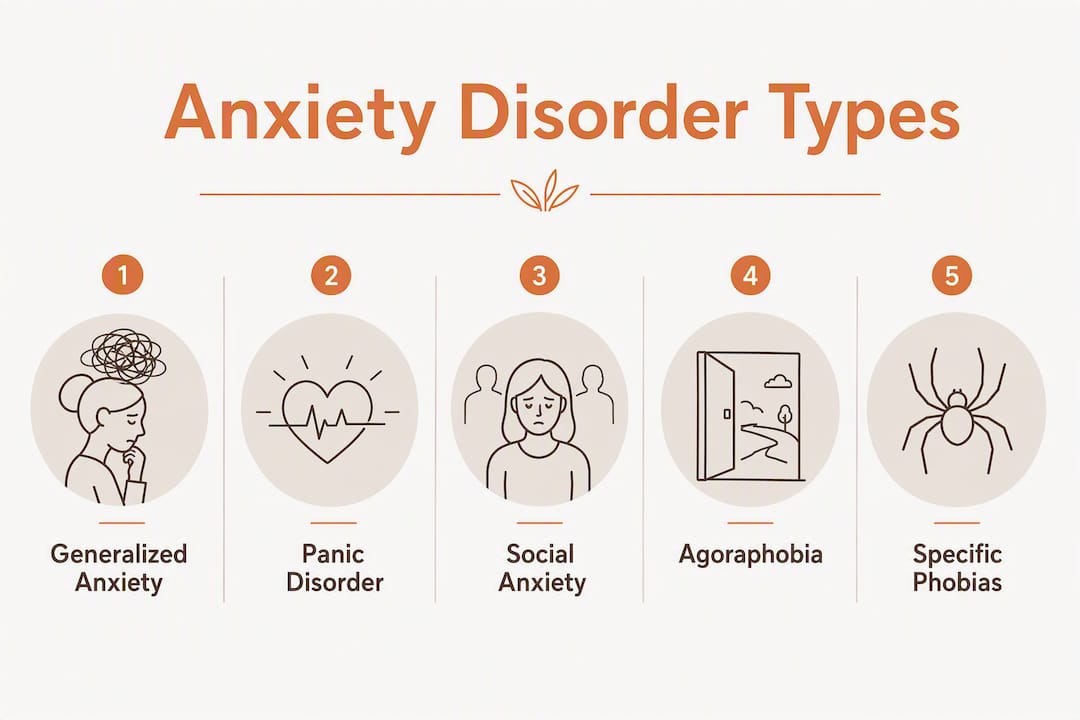
The American Psychiatric Association draws a useful clinical line between fear (a response to an immediate, present threat) and anxiety (anticipation of a future threat). That distinction matters because anxiety can feel relentless even when nothing dangerous is happening right now. Each disorder below is defined by which situations trigger that response, what thoughts accompany it, and what behaviors it drives.

| Disorder | Hallmark Symptoms | Duration / Onset Notes |
|---|---|---|
| Generalized Anxiety Disorder (GAD) | Persistent, uncontrollable worry across multiple life domains; fatigue; muscle tension; sleep disruption | Symptoms must persist >6 months; often begins in young adulthood |
| Panic Disorder | Recurrent, unexpected panic attacks; persistent fear of future attacks; avoidance of triggers | Attacks peak within minutes; diagnosis requires ongoing concern after attacks |
| Agoraphobia | Fear of situations where escape feels difficult (crowds, transit, open spaces); avoidance of those situations | Symptoms >6 months; can develop after panic disorder |
| Social Anxiety Disorder | Intense fear of social scrutiny, embarrassment, or humiliation; avoidance of social situations | Symptoms >6 months; often begins in adolescence |
| Specific Phobia | Marked fear of a specific object or situation (heights, needles, animals); immediate distress upon exposure | Symptoms >6 months; onset often in childhood |
| Separation Anxiety Disorder | Excessive distress when separated from attachment figures; worry about harm to them | Previously considered childhood-only; now recognized in adults |
| Selective Mutism | Consistent failure to speak in specific social situations despite speaking in others | Usually identified in early childhood; often school-related |
| Other/Unspecified Anxiety Disorder | Significant anxiety symptoms that do not fully meet criteria for a specific category | Used when presentations are subthreshold or mixed |
For a detailed clinical and practical guide to GAD specifically, see Journeymhw’s GAD treatment guide.
Pro Tip: ADHD and anxiety share several surface symptoms, including restlessness, poor concentration, and sleep problems. If you have both, the anxiety diagnosis can easily be missed or attributed entirely to ADHD. A clinician who screens for ADHD and anxiety overlap will give you a more complete picture.
How do clinicians diagnose anxiety disorders?
Diagnosis starts with a structured clinical interview using DSM-5-TR criteria. The clinician asks three core questions: What situation triggers the fear or worry? What thoughts accompany it? What behaviors does the person use to avoid or manage it? Answering those three questions often clarifies the specific diagnosis more than any single symptom alone.
Validated screening tools support the interview. The GAD-7 screens for generalized anxiety severity, and the PHQ-9 screens for comorbid depression, which frequently co-occurs. These are starting points, not diagnoses on their own.
Differential diagnosis is where clinical skill matters most. Medical conditions (thyroid disorders, cardiac arrhythmias, respiratory conditions) can produce anxiety-like symptoms and need to be ruled out. Substance use and certain medications can also induce or worsen anxiety. PTSD and acute stress disorder are sometimes confused with anxiety disorders, but the DSM-5-TR classifies them separately under Trauma- and Stressor-Related Disorders, which affects both coding and treatment approach.
“Anxiety disorders are highly comorbid with chronic health conditions such as cardiovascular disease, asthma, and arthritis. Clinical evaluations should consider physical comorbidities rather than viewing anxiety through a purely psychological lens.” — Merck Manuals, Overview of Anxiety Disorders
At a first psychiatric evaluation, expect to describe your symptom history, any prior treatments, current medications, and how symptoms affect your daily function. The more specific you can be, the faster the clinician can reach an accurate diagnosis.
What causes anxiety disorders and who is at higher risk?
Multiple factors interact to produce an anxiety disorder. No single cause explains it, and that is clinically relevant because treatment needs to address the full picture.
Noncontrollable risk factors:
- Genetic vulnerability and family history of anxiety or mood disorders
- Neurobiological differences in how the brain processes threat signals
- Childhood temperament (behavioral inhibition in early life predicts later anxiety)
- Trauma or adverse childhood experiences
Controllable and modifiable factors:
- Chronic stress from work, relationships, or financial pressure
- Substance use, including high caffeine intake and alcohol
- Poor sleep, which amplifies threat perception
- Avoidance behaviors that reinforce fear over time
Anxiety disorders are more prevalent in women than in men, and symptoms often begin during childhood or adolescence. Without treatment, they tend to persist and can precede depression or substance use disorders, making early intervention genuinely protective rather than just symptom-focused.
What are the most effective treatments for anxiety disorders?
The best outcomes usually come from psychotherapy, medication, or both, matched to the specific disorder and the person’s history. Clinical evidence consistently supports a combined approach tailored by a healthcare provider rather than a single-modality plan.
Psychotherapy:
- Cognitive Behavioral Therapy (CBT) targets the thought patterns and behaviors that maintain anxiety. It is the most studied psychotherapy for anxiety disorders, typically delivered over 12–20 sessions.
- Exposure therapy is a CBT component that systematically reduces avoidance by gradually confronting feared situations. It is particularly effective for specific phobias, social anxiety disorder, and panic disorder.
Medication:
- SSRIs (selective serotonin reuptake inhibitors) and SNRIs are first-line medications for most anxiety disorders. For a clear breakdown of how they work, Journeymhw’s guide on SSRI medication for anxiety covers onset, monitoring, and what to expect.
- Benzodiazepines can reduce acute anxiety quickly but are generally reserved for short-term use given dependence risk.
- Combined treatment (medication plus psychotherapy) is common and often produces faster, more durable improvement than either alone.
Timeline: Psychotherapy typically shows measurable improvement over weeks to months. Medication effects are usually assessed at 6–12 weeks for initial response. If you are not seeing improvement by that point, a follow-up with your prescriber to adjust the plan is appropriate, not a sign that treatment has failed.
Cost and access: A therapy session with an in-network provider typically costs less out-of-pocket than a psychiatry visit, though psychiatry visits are often shorter and focused on medication management. Telehealth has made both more accessible, with some platforms accepting insurance and others offering flat-rate plans.
Pro Tip: Bring a brief symptom diary to your first appointment: when symptoms occur, how long they last, what triggers them, and how they affect your function. A medication history (including what you have tried before and why you stopped) cuts the intake time significantly and helps the clinician start with a better-informed plan.
Practical coping strategies that support your treatment
Short-term coping skills can reduce immediate distress, but they work best alongside professional care rather than as a substitute for it.
Breathing and grounding:
- Try the 4-7-8 breathing technique: inhale for 4 counts, hold for 7, exhale slowly for 8. Repeat three to four cycles. This activates the parasympathetic nervous system and can interrupt a building panic response.
- For grounding, use the 5-4-3-2-1 method: name 5 things you can see, 4 you can touch, 3 you can hear, 2 you can smell, 1 you can taste. It redirects attention away from anxious thought loops.
Lifestyle habits that reduce baseline anxiety:
- Consistent sleep schedule (irregular sleep amplifies anxiety the next day)
- Limiting caffeine, especially after noon
- Reducing alcohol, which disrupts sleep architecture and increases next-day anxiety
- Scheduled “worry time” (15 minutes daily) to contain rumination rather than letting it run throughout the day
- Regular physical activity, which has well-documented effects on mood and stress regulation
Apps like Calm or Woebot can support skill practice between sessions. Use them as supplements to clinical care, not replacements. For a broader look at complementary approaches, daily spiritual practices can also support emotional regulation alongside your treatment plan.
When should you contact a clinician or emergency services?
Seek immediate medical evaluation if you experience chest pain, shortness of breath, or heart palpitations. Panic attacks frequently produce physical symptoms that feel indistinguishable from cardiac events, and a medical cause must be ruled out before attributing symptoms to panic disorder.
Seek urgent mental health care if you notice any of the following:
- Thoughts of self-harm or suicide
- Inability to care for yourself or your children due to anxiety
- Sudden, severe behavioral changes (especially in adolescents)
- Complete inability to work or leave your home
- Panic attacks occurring multiple times daily with no relief
Practical next steps:
- Call 988 (Suicide and Crisis Lifeline) for immediate mental health crisis support.
- Contact your primary care provider for a same-day or next-day appointment if symptoms are escalating.
- Use a telehealth platform for rapid psychiatric evaluation when in-person access is delayed.
- Call 911 or go to an emergency room if you are experiencing chest pain or believe you may harm yourself.
How does telehealth psychiatric evaluation work with Journeymhw?
Telehealth evaluations follow a structured process that mirrors in-person psychiatric care, with the added convenience of completing it from home. Here is what the Journeymhw pathway looks like:
- Schedule a virtual evaluation — with a licensed psychiatric clinician. Appointments are available without the long waits typical of in-person psychiatry.
Journeymhw currently serves adults in Texas and Colorado. The platform’s structured program, The Simple Plan, is designed to reduce the time between first contact and active treatment. Insurance reimbursement is available for in-network patients; fee-for-service options cover those paying out-of-pocket. For state-specific details, Journeymhw’s anxiety medication management guide for Texas covers local availability and what to expect.
Pro Tip: Before your telehealth visit, test your audio and video connection, find a private space, and have your insurance card and pharmacy information ready. Clinicians can move faster through the intake when the logistics are already handled.
Key Takeaways
Anxiety disorders are diagnosable medical conditions with effective, evidence-based treatments, and getting a clinical evaluation is the most direct path to knowing which type you have and what will help.
| Point | Details |
|---|---|
| DSM-5-TR defines eight categories | GAD, panic disorder, agoraphobia, social anxiety disorder, specific phobia, separation anxiety disorder, selective mutism, and other/unspecified are the recognized types. |
| One-third lifetime prevalence | A significant proportion of U.S. adults will experience an anxiety disorder at some point in their lifetime. |
| Medication response takes 6–12 weeks | Expect to evaluate medication effect at 6–12 weeks; early follow-ups are part of the plan, not a sign of failure. |
| Red flags require urgent action | Chest pain, suicidal thoughts, or inability to function daily warrant immediate clinical or emergency contact. |
| Journeymhw offers telehealth evaluation | Adults in Texas and Colorado can access virtual psychiatric evaluation and medication management through Journeymhw. |
What the conventional wisdom on anxiety treatment gets wrong
Most articles about anxiety disorders focus almost entirely on symptom checklists, as if naming your disorder is the destination. It is not. The harder, more useful question is what happens after you recognize yourself in a description.
The gap between “I think I have GAD” and “I have a treatment plan that is working” is where most people stall. They read extensively, try coping strategies, and wait to see if things improve on their own. Sometimes they do. More often, anxiety disorders that go without clinical evaluation persist and compound, sometimes preceding depression or substance use. Early treatment is not just about feeling better sooner. It can reduce the severity of what comes next.
There is also a tendency to treat psychotherapy and medication as competing options, as if choosing one means rejecting the other. Clinically, they address different mechanisms. Medication can reduce the physiological intensity of anxiety enough that therapy becomes more effective. Therapy builds skills that outlast medication. The combination is not a fallback for people who “really need help.” It is often the most efficient path for anyone with a moderate-to-severe presentation.
If you have been managing symptoms alone for months and your function has not improved, that is not a personal failure. It is a signal that the condition needs clinical attention.
Ready to get a psychiatric evaluation for anxiety?
Journeymhw offers virtual psychiatric evaluations and medication management for adults in Texas and Colorado, with appointments available without the extended waits common in traditional psychiatry. The process is structured and efficient: complete a symptom intake online, meet with a licensed clinician by video, and leave with a care plan that may include medication management or a therapy referral.
The Simple Plan gives you an all-inclusive annual care structure at a predictable cost, with insurance billing available for in-network patients. If you are ready to move from reading about anxiety disorders to getting a clinical answer, schedule your anxiety evaluation with Journeymhw today. Texas and Colorado residents can also review state-specific options at the Texas and Colorado anxiety treatment page.
Useful sources and further reading
The claims in this article draw from the following primary and clinical sources. Each is worth bookmarking for ongoing reference.
| Source | Key Contribution |
|---|---|
| NIMH: Anxiety Disorders | U.S. prevalence data; disorder overviews aligned with DSM-5-TR |
| WHO: Anxiety Disorders | Global prevalence; sex and age-of-onset patterns |
| APA: What Are Anxiety Disorders? | DSM-5-TR category list; fear vs. anxiety distinction |
| Merck Manuals: Overview of Anxiety Disorders | Comorbidity with chronic illness; differential diagnosis framework |
| Cleveland Clinic: Anxiety Disorders | Treatment timelines; panic attack cardiac mimicry; combined treatment evidence |
- Mayo Clinic: Anxiety Disorders covers symptoms, causes, and when to see a doctor in accessible language.
- NAMI: Anxiety Disorders provides peer-informed perspectives and community support resources alongside clinical information.
This article is general health information, not a substitute for professional medical or psychiatric advice. If you are concerned about your symptoms, please consult a licensed clinician or contact a primary care provider to discuss your specific situation.