

GAD-7's 89% Sensitivity: What an Online Anxiety Score Really Means
Validated screeners like the GAD-7 detect probable generalized anxiety with roughly 89% sensitivity and 82% specificity at the standard cutoff, which means they catch most true cases and correctly clear most people without the condition. That accuracy applies to a screening tool, not a diagnosis. Many consumer “anxiety quizzes” carry no published validation at all. If you score high on any online test, the right next step is a conversation with a licensed clinician, not a self-diagnosis.
TL;DR:
- Validated anxiety screeners like the GAD-7 have about 89% sensitivity and 82% specificity, but their accuracy varies significantly with the population’s prevalence.
- Online tests often lack proper validation and can produce false positives from medical conditions or false negatives due to mismatched instruments or underreporting.
- Screeners are only initial flags; actual diagnosis requires a structured clinical interview following established criteria like the DSM-5 or ICD.
- Data privacy concerns are critical, as many free online tests may not protect personal information or could use responses for marketing purposes.
- A positive online screening result should prompt a professional evaluation, as tools are designed to flag concerns, not to replace a diagnostic assessment.
Table of Contents
- What Validated Online Anxiety Screeners Actually Measure
- How Accurate Is an Online Anxiety Screener, Really?
- Do Online Symptom Checkers Match Clinical Interviews?
- Why an Online Anxiety Test Result Can Mislead You
- A Quick Checklist for Judging Any Online Anxiety Test
- What to Do After a Concerning Anxiety Screening Score
- How Journey Mental Health Uses Screening Scores in Virtual Care
- How Do Clinicians Actually Diagnose Anxiety Disorders?
- Why Screening Accuracy and Diagnostic Accuracy Aren’t the Same Thing
- Does It Matter Who Takes the Test and Where?
- What Happens to Your Data When You Take an Online Anxiety Test?
- Where to Verify These Anxiety Screening Accuracy Claims
- The Gap Between a Good Screener and a Good Diagnosis
- Ready to Move Past Screening and Get an Actual Diagnosis?
- Sources
What Validated Online Anxiety Screeners Actually Measure
Not every anxiety quiz you find online was built the same way, and that difference matters more than most people realize. A handful of instruments have decades of published research behind them. The rest were written by a marketing team to generate leads.
The GAD-7 (Generalized Anxiety Disorder 7-item scale) is the most widely used anxiety screener in primary care and telehealth. It asks about seven core symptoms, feeling nervous, not being able to stop worrying, trouble relaxing, over a two-week window, scored from 0 to 21. It was validated in large primary care samples and works well as a severity gauge for generalized anxiety specifically. It was not built to catch panic disorder, social anxiety, or PTSD, and using it as a catch-all misreads what it was designed to do.
The PHQ-9 (Patient Health Questionnaire, 9 items) screens for depression, but you’ll see it paired with the GAD-7 constantly in telehealth intake because anxiety and depression symptoms overlap so heavily, fatigue, sleep disruption, concentration problems show up on both. A clinician reading both scores together gets a fuller picture than either instrument alone provides.
The HADS (Hospital Anxiety and Depression Scale) was originally built for medical patients, people already dealing with a physical illness, so it deliberately avoids somatic symptoms like fatigue that could be caused by the illness itself rather than anxiety. That design choice makes it useful in settings where physical and psychological symptoms are tangled together.
The BAI (Beck Anxiety Inventory) leans harder into physical symptoms of anxiety, numbness, heart pounding, fear of dying, which makes it more sensitive to panic-type presentations than the GAD-7’s worry-focused questions.
The OASIS (Overall Anxiety Severity and Impairment Scale) is a shorter, transdiagnostic measure, meaning it doesn’t assume a specific anxiety disorder. It measures severity and functional impairment across anxiety presentations generally. Online validations of the OASIS report strong internal consistency, with Cronbach’s alpha in the 0.80 to 0.86 range, and identified clinical cutoffs that held up in tested samples.
Here’s what separates these five from a random online quiz:
- Each has a published validation study with a named sample, setting, and comparison against a clinical standard.
- Each has fixed item wording. Change a single question’s phrasing and you’re no longer administering the validated instrument, you’re administering something else that happens to look similar.
- Each has an established cutoff score tied to actual diagnostic outcomes, not an arbitrary number a developer picked because it seemed reasonable.
- Each was validated in a specific population (primary care patients, medical inpatients, college students), and that context shapes how much you should trust a result outside that population.
A disorder-specific tool matters, too. If your primary struggle is intense fear in social situations rather than generalized worry, a GAD-7 might come back moderate or even low while a social anxiety-specific instrument would flag something the GAD-7 was never built to catch. Instrument choice is part of accuracy, not separate from it.
How Accurate Is an Online Anxiety Screener, Really?
Accuracy in screening isn’t one number, it’s at least four, and understanding them changes how you read a result. Sensitivity tells you what percentage of people who truly have the condition the test correctly flags. Specificity tells you what percentage of people who don’t have the condition the test correctly clears. The GAD-7’s published figures, sensitivity around 89% and specificity around 82% at a cutoff score of 10, sound reassuring on their own. But they only tell half the story.

The two numbers that actually determine what a result means for you personally are positive predictive value (PPV) and negative predictive value (NPV), and both depend heavily on how common anxiety is in the group you belong to, called prevalence.
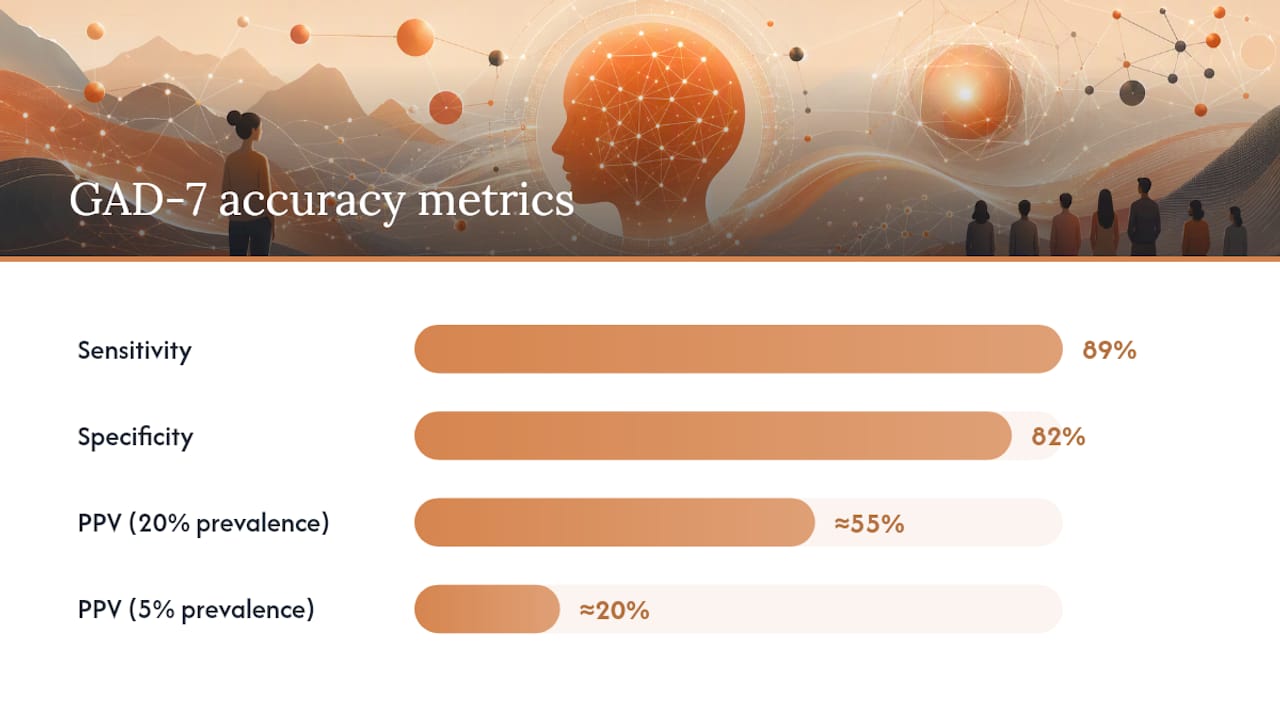
Statistic Callout: A GAD-7 score at cutoff 10 in a population where 20% of people actually have generalized anxiety disorder produces a meaningfully different real-world accuracy than the same score in a population where only 5% do, even though the sensitivity and specificity numbers never change. Prevalence, not just test quality, drives how much you should trust a single positive result.
Here’s the mechanic. Imagine screening 1,000 people in a setting where 20% (200 people) truly have generalized anxiety disorder:
- At 89% sensitivity, the test correctly flags about 178 of those 200 true cases.
- At 82% specificity, it correctly clears about 656 of the 800 people who don’t have it, but incorrectly flags 144 of them as positive.
- That gives you 322 total positive results, only 178 of which are true positives, a PPV of about 55%.
Now run the same test in a low-prevalence setting, say 5% true prevalence out of 1,000 people (50 true cases):
- Sensitivity catches about 44 of the 50 true cases.
- Specificity correctly clears about 779 of 950 people without the condition, but flags 171 false positives.
- That’s 215 total positives, only 44 of which are real, a PPV of roughly 20%.
Same test, same published accuracy, wildly different odds that a positive result actually means anxiety. This is why a positive online screen taken casually, outside a clinical context where prevalence runs higher, deserves more skepticism than the headline sensitivity and specificity numbers suggest on their own.
AUC (area under the curve) is a single number, from 0.5 to 1.0, that summarizes how well a test distinguishes people with a condition from people without it across all possible cutoff scores. Higher is better, but AUC alone tells you nothing about:
- What sample the study used (college students respond differently than psychiatric outpatients).
- What the real-world prevalence looks like in your situation.
- Whether the “gold standard” comparison was a structured clinical interview or something looser.
A test with excellent AUC in a controlled study can still perform inconsistently once it’s deployed on the open internet to a broader, more varied population. This is a core reason systematic reviews of online psychometric instruments treat published accuracy figures as context-dependent rather than universal truths.
Do Online Symptom Checkers Match Clinical Interviews?
Peer-reviewed research on this question tells a more nuanced story than either “online tools work great” or “online tools are useless.” A systematic review of 56 studies covering 62 psychometric instruments found that most paper-based mental health instruments, when adapted for web administration, correlate strongly with their original paper versions. But the review’s authors were explicit that equivalence cannot simply be assumed, some instruments shift in mean scores or internal consistency once moved online, and research coverage varies a lot from one instrument to the next. A few tools have been tested extensively online. Many others have barely been examined at all outside their original paper format.
Individual studies fill in more texture. The e-PASS (an internet-based clinical assessment program covering multiple mental disorders) was compared directly against structured clinical interviews in a validation study. For generalized anxiety specifically, agreement between e-PASS and the clinical interview came out to a kappa of approximately 0.37, which statisticians would call fair agreement, not strong. Sensitivity ranged from 0.43 to 0.86 depending on the disorder assessed, and specificity ran consistently higher, often between 0.68 and 1.00. Negative predictive values frequently topped 0.90.
That pattern, strong at ruling conditions out, weaker at confirming them, shows up again and again in this research and matters practically: a negative online result is more trustworthy than a positive one.
A separate comparative study looked at an app-based symptom checker used in real psychotherapy outpatient settings. For anxiety disorders specifically, the app’s first-listed diagnostic suggestion matched the clinical diagnosis about 53% of the time, improving to roughly 67% when clinicians counted any of the app’s top five suggested conditions as a match. That’s meaningfully lower than the app’s performance on some other diagnostic categories in the same study, underscoring that “AI symptom checker” isn’t one uniform accuracy level, it varies by condition, and anxiety has proven harder to pin down than some other presentations.
| Instrument or tool | What it was compared against | Key accuracy finding |
|---|---|---|
| GAD-7 (original validation) | Structured clinical interview | Sensitivity ~89%, specificity ~82% at cutoff 10 |
| e-PASS (internet assessment) | Clinician interview | GAD kappa ≈0.37; sensitivity 0.43–0.86; specificity 0.68–1.00 |
| App-based symptom checker (anxiety) | Clinician diagnosis, outpatient sample | First-listed accuracy ≈53%; top-5 accuracy ≈67% |
| ChatGPT-4-adapted PHQ-9/GAD-7 | Validated paper questionnaires | ICC ≈0.70–0.80; not fully interchangeable per Bland-Altman analysis |
That last row deserves its own explanation. A cross-sectional study tested whether a large language model could adapt the wording of PHQ-9 and GAD-7 questions and still produce comparable scores. The results showed moderate-to-good concordance, intraclass correlation coefficients around 0.70 to 0.80, which sounds encouraging. But the same study’s Bland-Altman analysis, a statistical method for checking whether two measurement methods can be used interchangeably, found they could not be swapped for one another reliably, and a small positive bias crept into the AI-adapted version. AI-generated adaptations of validated instruments are an active research area, not yet a replacement for the originals.
The common thread across every one of these studies: convenience samples (often college students or a single clinic’s outpatients), base rates that don’t match the general population, and shortened or reworded versions of longer instruments all introduce variability that a single published accuracy statistic won’t capture.
Why an Online Anxiety Test Result Can Mislead You
An elevated score doesn’t always mean anxiety, and a low score doesn’t always mean you’re in the clear. Both false positives and false negatives happen for identifiable, fixable-to-understand reasons.
False positives often trace back to something other than a primary anxiety disorder:
- Thyroid dysfunction, particularly hyperthyroidism, produces racing heart, restlessness, and sleep trouble that mimic anxiety symptoms almost exactly.
- Certain medications and stimulants (including excess caffeine) can trigger physical symptoms that self-report screeners interpret as anxiety.
- Acute, situational stress, a divorce, a job loss, a health scare, can spike a screener score temporarily without reflecting a persistent disorder.
- Depression and anxiety symptoms overlap so heavily (sleep problems, concentration difficulty, fatigue) that a depression-driven presentation can inflate an anxiety score.
- Hormonal shifts, including perimenopause and postpartum changes, can produce anxiety-like symptoms with a different underlying driver.
False negatives happen just as often, usually for one of three reasons:
- The wrong instrument was used for the problem. Someone with social anxiety disorder or panic disorder may score unremarkably on a generalized anxiety scale that was never designed to catch their specific presentation.
- Underreporting, sometimes intentional (stigma, fear of judgment) and sometimes unconscious (people with high-functioning anxiety often don’t recognize their own symptoms as clinically significant).
- Atypical symptom profiles, particularly in older adults and men, who statistically tend to report physical complaints rather than emotional ones, don’t map neatly onto self-report language built around “worry” and “fear.”
Design choices compound both problems. Some online quizzes alter validated question wording without disclosing it, which invalidates the published cutoffs entirely. Forced-choice answer formats (no “sometimes” option between “never” and “often”) push people toward extremes that don’t reflect reality. Mobile layouts that cram seven or nine questions onto a cramped screen increase rushed, careless answers. And a growing number of sites require account creation, sometimes with a credit card, before revealing your score, a practice that has nothing to do with clinical accuracy and everything to do with lead generation.
Pro Tip: If a “free anxiety test” won’t show you your score until you hand over an email and phone number, that’s a marketing funnel wearing a clinical costume. Legitimate validated screeners, including the ones hosted by Mental Health America, show your result immediately and tell you plainly that it isn’t a diagnosis.
A Quick Checklist for Judging Any Online Anxiety Test
Before you put any weight on a result, run the page through this five-point check. It takes about two minutes.
- Is the instrument named and citable? Look for “GAD-7,” “HADS,” “OASIS,” or another named tool, ideally with a link to the original validation study. If the test has no name at all, treat the result as entertainment, not information.
- Are the psychometric statistics published anywhere? A credible screener’s sponsoring organization can point you to sensitivity, specificity, or at minimum a peer-reviewed source. Silence on this front is a warning sign.
- Who hosts the page? A university psychology department, a hospital system, a licensed clinic, or an established nonprofit carries more weight than an anonymous wellness blog or a site clearly built to sell supplements.
- Is the scoring transparent? You should be able to see your raw score, the cutoff ranges, and what each range is meant to suggest, not just a vague “high risk” label with no explanation.
- Does the privacy policy say anything at all? Mental health data is sensitive. A site with no visible privacy policy, or one that reserves the right to sell your responses to third parties, deserves real hesitation before you enter anything personal.
Red flags worth walking away from entirely: any page that claims to “diagnose” you outright, opaque scoring with no visible math, or copy that leans harder into urgency and marketing language than clinical explanation. A validated screener describes what it measures in plain terms. A lead-generation quiz sells you a feeling.
What to Do After a Concerning Anxiety Screening Score
An elevated score is information, not an emergency, unless it comes with certain warning signs. If you’re experiencing suicidal thoughts or a level of impairment that’s stopping you from functioning day to day, call or text 988 (the Suicide and Crisis Lifeline) or go to your nearest emergency room immediately. That takes priority over everything else in this article.
For everyone else, an elevated screen is simply a prompt to get a professional opinion, exactly what the NIMH recommends when discussing self-report tools. Before your appointment, it helps to arrive prepared:
- Write down when your symptoms started and whether they’ve gotten worse, better, or stayed the same.
- Note specific triggers you’ve noticed, work stress, social situations, health worries, or nothing identifiable at all.
- List current medications, supplements, and caffeine intake, since several of these can mimic or worsen anxiety symptoms.
- Bring up any prior mental health treatment, diagnoses, or medications you’ve tried before, even briefly.
A structured mental health assessment typically follows a predictable sequence: a validated screener like the GAD-7 opens the visit, then a clinician conducts a structured interview to explore your history and symptoms in depth, followed by ruling out medical causes (thyroid panels, for example) when warranted. Only after that sequence does an actual diagnosis and treatment plan take shape. That’s also generally how a telehealth psychiatric evaluation proceeds. A screener gets you in the door quickly; a licensed clinician does the actual diagnostic work.
How Journey Mental Health Uses Screening Scores in Virtual Care
We treat an online screener the way it’s meant to be treated: a starting point, never an endpoint, as outlined in the anxiety relief digital health platform guide. When you begin an evaluation with Journey Mental Health, a validated instrument like the GAD-7 is part of your intake, but it’s reviewed by a licensed clinician alongside a structured clinical interview before anything resembling a diagnosis gets discussed.
A screening score tells us where to look. It doesn’t tell us what we’ll find. That distinction shapes every intake we run, because a number on a page can flag a concern, but only a clinical conversation can confirm what’s actually driving it.
Our intake workflow generally runs like this:
- You complete a validated screener as part of your initial assessment.
- A clinician reviews your responses alongside your reported history, symptoms, and any relevant medical context.
- We conduct a structured interview to explore what the screener alone can’t capture, timeline, functional impact, and symptoms that don’t fit neatly into a checklist.
- From there, we build a treatment plan, which may include medication management, therapy referrals, or both, tailored to what the full evaluation actually shows.
Telehealth evaluations still depend entirely on clinician judgment, and licensing is state-specific, which is why Journey Mental Health currently provides virtual psychiatric care in Texas and Colorado. A screener is one data point among several. It’s a useful, evidence-backed starting point, but the diagnosis itself comes from a trained clinician looking at your full picture, not an algorithm looking at seven answers.
How Do Clinicians Actually Diagnose Anxiety Disorders?
Screening tools exist inside a larger diagnostic framework, and understanding that framework explains why a quiz alone was never going to be the final word. In the United States, clinicians primarily use the DSM-5 (Diagnostic and Statistical Manual of Mental Disorders, Fifth Edition), while much of the rest of the world references the ICD-10 or its successor, ICD-11. Both systems define generalized anxiety disorder around a similar core: excessive, difficult-to-control worry occurring more days than not for at least six months, accompanied by physical symptoms like restlessness, fatigue, muscle tension, or sleep disturbance, plus meaningful impairment in daily functioning.
Notice what’s missing from that definition: a single number. Diagnostic criteria require clinical judgment about duration, pervasiveness, and functional impact, judgment that a seven-question screener simply isn’t built to render. A GAD-7 score of 15 tells a clinician “this person’s symptoms are likely severe enough to warrant a closer look.” It doesn’t independently satisfy the DSM-5’s six-month duration requirement or rule out that the symptoms stem from a medical condition, both of which the diagnostic criteria explicitly require clinicians to consider. Screening tools and diagnostic manuals serve different, complementary purposes, one flags, the other confirms.
Why Screening Accuracy and Diagnostic Accuracy Aren’t the Same Thing
A screening tool’s accuracy is measured against a fixed cutoff score applied to a large population, looking for statistical patterns that generally distinguish likely cases from unlikely ones. A clinical diagnosis works differently. It weighs your individual history, rules out medical explanations, considers overlapping conditions, and applies structured criteria like the DSM-5’s, all in a single conversation tailored to you specifically.
That’s why a screener with 89% published sensitivity can still miss your particular presentation, or flag something that turns out to be situational stress rather than a disorder. The screener was validated on a population; the diagnosis is about one person. As the e-PASS research illustrates, agreement between an automated online tool and a clinician’s structured interview isn’t perfect even under research conditions, kappa values in the fair range, not the near-perfect range you’d want before trusting a tool to replace a clinician entirely. Screening accuracy answers “does this pattern of symptoms resemble anxiety in general?” Diagnostic accuracy answers “does this specific person meet the clinical threshold for a specific anxiety disorder?” Those are related questions, but they are not the same question, and conflating them is where most confidence in an online result goes wrong.
Does It Matter Who Takes the Test and Where?
The instrument matters, but so does the person answering it and the conditions under which they answer. Digital literacy plays a bigger role than most people expect: someone unfamiliar with a sliding scale or an unfamiliar app interface may misread response options, skewing results in either direction. Rushing through a screener on a phone while distracted produces noisier data than sitting with it quietly for five uninterrupted minutes.

Honesty introduces its own variable. Some people minimize symptoms out of stigma or a desire to seem fine. Others, particularly in a moment of acute distress, may overreport out of genuine fear or the hope that a higher score will get them taken seriously faster. Neither pattern reflects a flaw in the instrument itself, it reflects the very human context surrounding how the instrument gets used.
Environment matters more than it seems like it should. A person answering a screener in a calm, private setting tends to reflect more accurately on the past two weeks than someone answering in a rushed or stressful moment, a waiting room, a work break, immediately after an argument. State-dependent mood can bleed into how you rate your own baseline.
None of this means self-assessment is worthless. It means a single online result, taken once, in an uncontrolled setting, should be read as a snapshot rather than a verdict. This is precisely why telehealth evaluations pair a screener with a live clinical conversation. A clinician can ask follow-up questions, clarify a confusing answer, and account for the fact that you took the test at 11 p.m. after a rough day, context a static quiz can never capture on its own.
What Happens to Your Data When You Take an Online Anxiety Test?
Mental health information is among the most sensitive data you can hand over online, and not every screening site treats it that way. Before you answer a single question, it’s worth knowing where that data goes.
Some legitimate screeners, including public health-oriented ones, are genuinely built to route your result toward professional care and handle your responses with real privacy protections. Others exist primarily to capture your email, build a marketing list, or sell aggregated data to advertisers, sometimes disclosed in fine print, sometimes not disclosed clearly at all. HIPAA (the Health Insurance Portability and Accountability Act) protects health information collected within a covered healthcare relationship, but a random quiz site that’s never established a clinical relationship with you may not fall under those protections at all.
Ethically, that gap matters. Anxiety is stigmatized enough that many people hesitate to seek help in the first place; a screening tool that mishandles their data, or worse, uses it to target them with anxiety-related advertising, exploits that vulnerability rather than addressing it. Before entering real information into any online mental health tool, check for a visible, specific privacy policy, confirm whether the platform is affiliated with a licensed healthcare provider, and be skeptical of any tool that demands payment or personal contact details before showing you anything at all.
Where to Verify These Anxiety Screening Accuracy Claims
If you want to check the research behind any of this yourself, these sources are a solid starting point. The systematic review of online psychometric instruments published in BMC Psychiatry remains one of the most thorough looks at how paper-based mental health tools perform once adapted for the web, useful if you want to understand evidence gaps across different instruments. The JMIR study on e-PASS diagnostic validity offers real kappa, sensitivity, and specificity data comparing an internet assessment tool directly against clinical interviews. For a look at how AI-adapted questionnaires currently perform, the PMC study on ChatGPT-4 and validated screeners is grounded, cautious research rather than hype. The comparative study of an app-based symptom checker shows exactly how diagnostic accuracy varies by condition category, anxiety included. And for plain-language, clinically vetted guidance on generalized anxiety disorder itself, NIMH’s public resource is the most reliable government source available to the general public.
The Gap Between a Good Screener and a Good Diagnosis
The conventional advice on this topic tends to swing to one extreme or the other: either “online tests are basically useless, only see a doctor” or “just take this quiz and you’ll know.” Both miss what the research actually supports. A validated instrument like the GAD-7 is genuinely good at what it does, catching probable cases with real, published accuracy. The problem was never the instrument. It’s the collapse of “screening” into “diagnosis” in people’s minds, a collapse that unvalidated quiz sites actively encourage because ambiguity keeps you scrolling and re-testing.
What the evidence actually supports is narrower and more useful: trust a named, validated tool’s ability to flag a concern worth exploring, and trust a licensed clinician, not an algorithm, to confirm what that concern actually is. If you take away one thing, let it be this. Prioritize instrument identity before you trust any number a screener gives you. Everything else, cutoffs, follow-up steps, how seriously to take a result, follows from that first check.
— Jamie
Ready to Move Past Screening and Get an Actual Diagnosis?
A validated screener can tell you something’s worth looking into. It can’t write you a treatment plan, and it can’t prescribe medication if that’s what actually helps. Journey Mental Health picks up exactly where the online screening leaves off, with licensed clinicians who review your intake screener alongside a real diagnostic conversation, not a follow-up quiz.
If you’re in Texas or Colorado and an elevated GAD-7 or similar score has you wondering what comes next, our anxiety treatment program is built for exactly that moment, structured virtual evaluations, medication management when appropriate, and ongoing care that doesn’t require an in-person office visit. For readers dealing with overlapping attention or focus concerns alongside anxiety, our ADHD treatment services address that overlap directly rather than treating one condition in isolation. Whether you’re closer to Houston or Denver, virtual appointments mean you can start the actual evaluation process from your own home, on a schedule that fits your week, instead of waiting weeks for the next open slot at a local practice. Book your evaluation and get a real answer instead of another score.
This article is general information, not a substitute for advice from a qualified doctor. Consult a qualified healthcare professional about your own circumstances before acting on anything here.
Sources
- Validation of online psychometric instruments for common mental health disorders: a systematic review
- Diagnostic Performance of an App-Based Symptom Checker in Mental Disorders: Comparative Study in Psychotherapy Outpatients
- Evaluating the agreement between ChatGPT-4 and validated questionnaires in screening for anxiety and depression in college students: a cross-sectional study - PMC
- Generalized anxiety disorder (GAD) - NIMH