

ADHD Working Memory Deficit: What You Need to Know
ADHD working memory deficit is defined as the brain’s reduced ability to temporarily hold and use information while completing a task. This is not forgetfulness caused by carelessness. It is a biological limitation that affects 75%–85% of children with ADHD and frequently persists into adulthood. Dr. Russell Barkley, one of the leading authorities on ADHD, frames working memory as the brain’s GPS for managing tasks and goals. When that GPS fails, the entire system of self-regulation breaks down. Understanding what is ADHD working memory deficit is the first step toward getting real support.
What is ADHD working memory deficit and how does it differ from other memory types?
Working memory is the brain’s short-term mental workspace. It holds information in mind just long enough to act on it, like remembering a phone number while you dial it or following a three-step instruction without writing it down. In ADHD, this workspace is biologically limited and prone to overload, which explains why forgetfulness is a symptom of cognitive overload, not a character flaw.
ADHD does not impair all memory equally. Short-term memory, long-term memory, and working memory each function differently, and ADHD targets them in distinct ways. Short-term memory holds information passively for a few seconds. Long-term memory stores knowledge and experiences over time. Working memory actively processes and manipulates information in real time. ADHD primarily disrupts working memory and visuospatial short-term memory, while long-term memory is affected mainly through disorganized encoding rather than retrieval failure. That means the problem is not that information cannot be recalled. The problem is that it was never stored properly in the first place.

| Memory type | Primary function | ADHD impact |
|---|---|---|
| Working memory | Holds and processes information in real time | Significantly impaired; prone to rapid overload |
| Visuospatial short-term memory | Stores visual and spatial data briefly | Often more impaired than verbal memory |
| Verbal short-term memory | Holds spoken or written information briefly | Mildly to moderately impaired |
| Long-term memory | Stores knowledge and experiences over time | Affected by encoding difficulties, not retrieval |
This distinction matters for treatment. Strategies that help with retrieval will not fix an encoding problem. That is why ADHD memory support requires a different approach than standard memory training.
What are the real-life symptoms and impacts of working memory deficit in ADHD?
Working memory challenges in ADHD show up in ways that look like laziness, defiance, or disorganization to outside observers. They are none of those things. Difficulties following multi-step instructions, forgetting tasks mid-action, and losing track of conversations are direct results of a brain that cannot hold enough information at once.
Common symptoms include:
- Forgetting what you walked into a room to do
- Losing your place in a conversation or a reading passage
- Struggling to follow instructions with more than two steps
- Starting a task and forgetting the goal before finishing
- Difficulty copying information from a board or screen
- Missing deadlines because the task slipped out of awareness
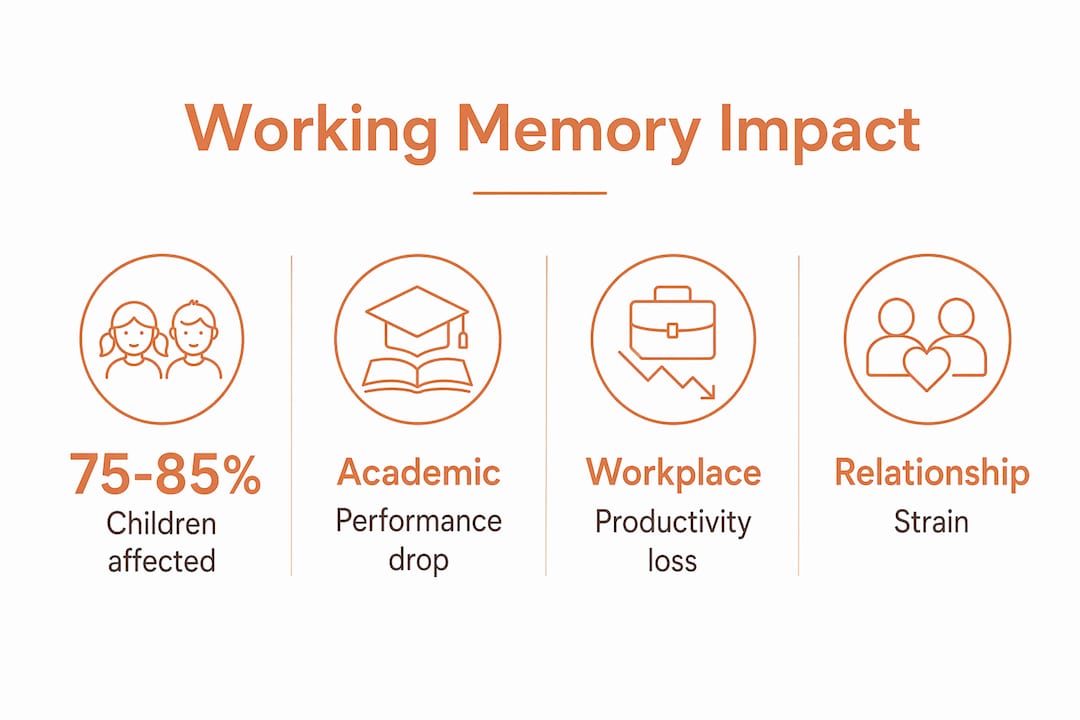
These symptoms affect academic performance, workplace productivity, and relationships. Children with ADHD may appear inattentive in class when they are actually losing track of information faster than it can be processed. Adults may miss appointments or forget commitments, which creates emotional and social strain that compounds the cognitive challenge.
The heightened cognitive load in ADHD brains means more mental effort is spent just staying focused. That effort crowds out the working memory space needed to actually process content. The result is rapid information decay, even when the person is genuinely trying.
Pro Tip: If you are a parent or educator, replace multi-step verbal instructions with written checklists. Reducing the demand on working memory at the point of instruction makes a measurable difference in task completion.
What does current research reveal about measuring and improving working memory in ADHD?
Clinicians assess working memory deficits using standardized tools. The WAIS-IV Working Memory Index measures verbal and numerical working memory in adults. The Corsi Block-Tapping task evaluates visuospatial working memory by asking individuals to replicate sequences of block taps. Research confirms that visuospatial working memory is often more impaired than verbal working memory in ADHD, which has direct implications for how classrooms and workplaces should be structured.
One of the most studied interventions is adaptive dual N-back training, a cognitive exercise that challenges the brain to track and update sequences of stimuli. Clinical trials show this training can improve working memory performance by over 200% in some participants. That result is striking, though it comes with important context. Gains from cognitive training do not always transfer to real-world tasks. The brain gets better at the training task, but that improvement does not always generalize to daily functioning.
Evidence-based strategies for supporting working memory in ADHD include:
- Adaptive cognitive training using programs that adjust difficulty in real time based on performance
- Medication management through stimulant or non-stimulant medications that improve dopamine regulation and working memory capacity
- Environmental restructuring to reduce the number of competing stimuli that overload the cognitive workspace
- Chunking information by breaking tasks into smaller units that fit within the brain’s limited processing window
- Multimodal instruction that combines verbal, visual, and written cues to reinforce encoding across multiple channels
Understanding ADHD executive dysfunction alongside working memory deficits gives a fuller picture of why these strategies work. Working memory is one component of executive function, and improving it requires addressing the broader system.
Pro Tip: When evaluating cognitive training programs, ask specifically whether the research shows transfer effects to daily tasks, not just improvement on the training task itself. Transfer is the meaningful outcome.
How can individuals and caregivers manage ADHD working memory deficits daily?
Daily management of working memory challenges in ADHD centers on one core principle: move information out of your head and into the world. Dr. Barkley calls this “externalizing” working memory. The brain cannot reliably hold the information, so you store it somewhere it can be retrieved reliably.
Paper-based systems are more effective than digital devices for many people with ADHD. Smartphones introduce their own distractions, battery failures, and synchronization problems. A paper notebook does not send notifications. A sticky note on the door does not require a password. Low-tech tools reduce the cognitive overhead of managing the tool itself.
Practical strategies that work:
- Keep a single paper notebook for all tasks and commitments, reviewed at the same time each day
- Place sticky notes at decision points, such as the front door or the bathroom mirror
- Use alarms and timers to offload time-awareness from working memory
- Build habit stacks by attaching new behaviors to existing routines
- Reduce environmental distractions by creating a dedicated workspace with minimal visual clutter
- Ask for written instructions at work or school rather than relying on verbal delivery
Managing ADHD overwhelm and working memory challenges together requires individualized approaches. What works for one person may not work for another. The goal is to find a system that reduces cognitive load consistently, not to find the perfect system.
Effective strategies also include alarms, habit stacking, and tailored routines that match the individual’s specific pattern of deficits. A child who struggles with visuospatial memory needs different supports than an adult whose primary challenge is verbal working memory.
Pro Tip: Review your external memory system at the same time every day, such as right after breakfast. Consistency turns the review into a habit, which reduces the working memory demand of remembering to check it.
Key Takeaways
ADHD working memory deficit is a biological limitation that disrupts real-time information processing, self-regulation, and daily functioning, and it responds best to external systems, structured environments, and individualized clinical support.
| Point | Details |
|---|---|
| High prevalence | Working memory deficits affect 75%–85% of children with ADHD and often continue into adulthood. |
| Encoding is the core problem | ADHD disrupts how information is stored, not just how it is recalled, making encoding support critical. |
| Visuospatial memory is most affected | The Corsi Block-Tapping task shows visuospatial working memory is often more impaired than verbal memory. |
| External systems outperform digital tools | Paper notebooks and sticky notes reduce cognitive load without introducing new distractions. |
| Clinical support improves outcomes | Medication, structured coaching, and adaptive training each address different aspects of the deficit. |
What working with ADHD memory deficits has taught me
The most common mistake I see is treating ADHD working memory deficit as a motivation problem. Parents push harder. Teachers assign more practice. Adults beat themselves up for forgetting again. None of that addresses the actual issue, which is biological, not behavioral.
What I have found genuinely useful is reframing the deficit as a capacity problem rather than a willpower problem. The brain has a smaller workspace. That is a fact, not an excuse. Once you accept that, you stop trying to fill a cup that has a hole in it and start building systems that work around the hole.
The research on dual N-back training is exciting, but I am cautious about overselling it. A 204% improvement in a lab task does not automatically mean a 204% improvement in remembering to pick up your child from school. Real-world transfer is the harder problem, and it requires real-world practice, not just cognitive exercises.
The most durable gains I have seen come from combining clinical treatment, such as medication and structured psychiatric care, with practical external systems. Neither alone is enough. Medication improves the brain’s capacity. External systems reduce the demand on that capacity. Together, they create a functional gap that people can actually live in.
If you are a parent watching your child struggle, or an adult who has spent years feeling broken, know this: the deficit is real, it is measurable, and it responds to the right support. That is not a small thing.
— Jamie
ADHD support that addresses the full picture
Working memory deficits do not exist in isolation. They connect to attention, emotional regulation, and executive function in ways that require structured, personalized care.

Journeymhw offers tailored ADHD treatment through virtual psychiatric evaluations and medication management, designed to address the cognitive and functional challenges that come with ADHD. If you are in Texas or Colorado, Journeymhw provides region-specific care through ADHD treatment in Colorado and ADHD treatment in Texas. Appointments are available quickly, and the process is built to reduce barriers, not add them. If working memory challenges are affecting your daily life or your child’s functioning, a clinical evaluation is the right next step.
FAQ
What is working memory and why does it matter in ADHD?
Working memory is the brain’s ability to hold and use information in real time while completing a task. In ADHD, this capacity is biologically reduced, which disrupts task execution, self-regulation, and daily functioning.
Can working memory deficits in ADHD improve with treatment?
Yes. Medication, adaptive cognitive training, and structured external systems each improve working memory function to varying degrees. Clinical trials show adaptive dual N-back training can improve working memory task scores by over 200%, though real-world transfer requires additional support.
How is ADHD working memory deficit different from just being forgetful?
Ordinary forgetfulness is usually a retrieval problem. ADHD working memory deficit is primarily an encoding problem, meaning information does not get stored properly in the first place, which is a neurological difference, not a character trait.
What are the best daily tools for managing working memory challenges?
Paper notebooks, sticky notes, alarms, and written checklists are among the most reliable tools. Paper-based systems avoid the distractions and technical failures that come with digital devices, making them more dependable for daily use.
Does ADHD working memory deficit affect adults as well as children?
Working memory deficits that begin in childhood frequently persist into adulthood, affecting workplace performance, relationships, and emotional regulation. Adults often develop compensatory strategies, but the underlying deficit remains without proper clinical support.
Recommended
- What Causes ADHD Executive Dysfunction: 2026 Guide – Journey Mental Health
- ADHD Emotional Dysregulation: What Adults Need to Know – Journey Mental Health
- ADHD Overwhelm in Adults: Strategies That Actually Work – Journey Mental Health
- Why ADHD treatment improves daily function in adults – Journey Mental Health