

ADHD Overwhelm in Adults: Strategies That Actually Work
ADHD overwhelm is defined as a neurological response in which the brain and nervous system reach their processing limit, triggering shutdown, avoidance, or emotional flooding. This is not a personal failing or a sign of weakness. ADDitude describes it as the brain’s signal that it needs support, and recognizing that distinction changes everything about how you respond to it. Adults with ADHD face three primary types of overwhelm: task overwhelm, sensory overwhelm, and emotional overwhelm. Each type has different triggers, and each responds to different interventions.
What causes ADHD overwhelm and how does it affect daily life?
ADHD overwhelm originates in the brain’s executive function system, which controls prioritization, sequencing, and filtering. When that system is impaired, the brain cannot sort what matters from what does not. Every task, sound, and demand arrives with equal urgency, and the result is paralysis or shutdown.
Adults with ADHD also process sensory input differently. Bright lights, background noise, crowded spaces, and even certain textures can push the nervous system past its threshold. Emotional dysregulation compounds this. The ADHD and anxiety overlap means that many adults experience irritability, panic, or shame during overwhelm episodes, which makes recovery harder.

Standard productivity advice backfires for this neurology. Telling someone with ADHD to “just prioritize your list” requires the exact skill the condition impairs. The ADD Resource Center notes that standard productivity methods often increase cognitive load rather than reduce it. That insight explains why so many adults with ADHD have tried every planner system available and still feel stuck.
Overwhelm shows up differently across settings:
- At work: Missing deadlines, freezing on complex projects, avoiding email, or snapping at colleagues after sensory overload
- At home: Dishes, laundry, and bills piling up because no single task feels manageable enough to start
- Socially: Canceling plans after a draining day, struggling to follow conversations in loud environments, or feeling emotionally flooded after conflict
Understanding ADHD executive dysfunction as the root cause removes the self-blame and points toward targeted solutions.
What are the most effective immediate strategies for ADHD overwhelm?
When overwhelm hits, the goal is nervous system regulation first and task completion second. Trying to think harder during a shutdown episode does not work. Sensory regulation restores executive function capacity more effectively than cognitive effort during those moments.
These steps work in real time:
- Do less. Remove one commitment from your day. Overcommitment is the most common trigger for task overwhelm, and reducing the load is not giving up. It is a clinical strategy.
- Break tasks into timed subtasks. Instead of “write the report,” write “open document at 10:00 a.m., write introduction by 10:20 a.m.” Specific steps with assigned times reduce the cognitive weight of getting started.
- Use a sensory break. Find a quieter, darker space. A short walk, sunglasses, earplugs, or a fidget tool can lower nervous system activation within minutes.
- Try body doubling. Working alongside another person, even silently on a video call, reduces avoidance and increases task initiation for many adults with ADHD.
- Schedule tasks on a calendar, not a list. The ADD Resource Center confirms that to-do lists without timing increase cognitive load and worsen overwhelm. Placing each task on a calendar removes the mental burden of deciding when to do it.
Pro Tip: Build a small sensory toolkit and keep it accessible at your desk. Items like noise-canceling headphones, a stress ball, or a cooling eye mask can cut recovery time from an overwhelm episode significantly.
How does CBT help with ADHD emotional overload?
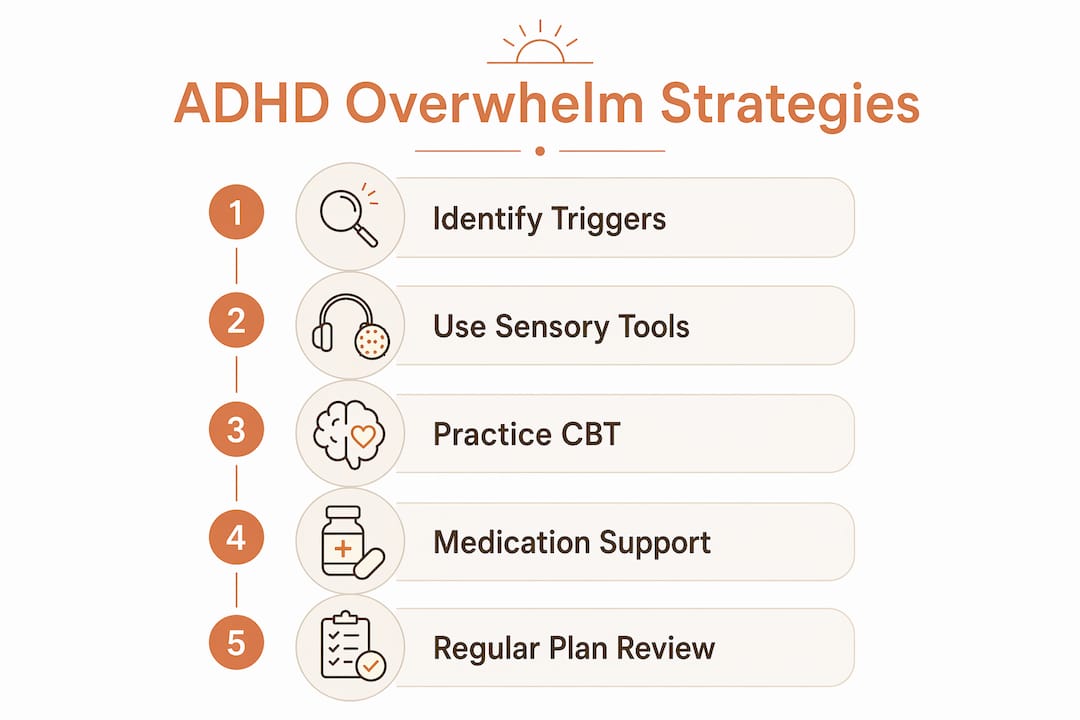
Cognitive Behavioral Therapy, commonly called CBT, is the most studied non-pharmacological treatment for adult ADHD. A 2026 meta-analysis published on PubMed found that CBT produces significant improvement in core ADHD symptoms, mood, anxiety, and executive function. That finding matters because it confirms CBT addresses the emotional overload component directly, not just behavior patterns.
The format of CBT delivery changes what it treats most effectively:
| CBT Format | Strongest Benefits |
|---|---|
| Group CBT | Core ADHD symptoms, executive function, task initiation |
| Individual CBT | Emotional regulation, quality of life, self-esteem |
| Combined formats | Broadest symptom coverage across all domains |
Complementary approaches strengthen CBT outcomes. Mindfulness reduces reactive emotional flooding. Psychoeducation helps adults recognize their own overwhelm patterns before shutdown occurs. Cognitive training builds working memory capacity over time. A 2026 literature review confirmed that multimodal non-pharmacological treatments combining CBT, mindfulness, and psychoeducation show better outcomes than any single approach alone.
CBT does have limits. The same meta-analysis noted no significant effect on self-evaluation, meaning negative self-talk about ADHD often requires ongoing therapeutic work beyond a standard CBT course. That is not a reason to avoid CBT. It is a reason to continue it.
Pro Tip: If you are choosing between group and individual CBT, consider your primary struggle. Group formats work well for building executive function skills. Individual sessions are better if emotional regulation and self-worth are your main challenges.
What medication options exist for managing ADHD overwhelm?
Medication does not eliminate overwhelm, but it raises the threshold at which it occurs. Psychostimulants are the first-line pharmacological treatment for adult ADHD. They increase dopamine and norepinephrine availability, which directly improves the executive function deficits that drive overwhelm.
For adults who cannot tolerate stimulants or have a history of substance use concerns, atomoxetine is a well-established non-stimulant alternative. Atomoxetine works by selectively inhibiting norepinephrine reuptake. It takes longer to show full effects than stimulants, typically several weeks, and it requires consistent daily dosing. Australian Prescriber’s 2026 guidance details medication monitoring protocols that apply after initiation or any dose adjustment.
Key considerations for medication management include:
- Shared decision-making: Older adults and those with cardiovascular conditions need careful assessment before starting stimulants
- Monitoring: Blood pressure, heart rate, sleep quality, and appetite should be tracked after any medication change
- Side effects: Common stimulant side effects include reduced appetite, sleep disruption, and elevated heart rate
- Combination therapy: Medication combined with CBT produces better outcomes than either treatment alone, as confirmed by the 2026 Australian Prescriber review
Medication is a tool, not a complete solution. Adults who pair medication with behavioral strategies and ADHD lifestyle treatment approaches report the most consistent improvement in daily functioning.
How to build a personalized ADHD overwhelm management plan
A personalized plan starts with a comprehensive evaluation. The ADD Resource Center emphasizes that targeted treatment planning requires identifying which type of overwhelm is most disruptive for you. Task overwhelm, sensory overwhelm, and emotional overwhelm each need different primary interventions.
A well-built plan typically includes these components:
- Immediate coping tools: Sensory toolkit, body doubling partner, and a short list of go-to sensory breaks
- Scheduling system: Calendar-based task assignment rather than open-ended to-do lists
- Therapeutic support: CBT, mindfulness practice, or psychoeducation depending on your primary symptoms
- Medication review: A psychiatrist or prescriber who understands adult ADHD and can monitor your response over time
- Environment design: Reducing sensory triggers at your workspace, such as using noise-canceling headphones or adjusting lighting
- Periodic reassessment: Overwhelm patterns change with life circumstances, and your plan should adapt accordingly
The ADHD treatment plan components that work best combine at least two of these layers. A medication-only approach leaves skill gaps. A therapy-only approach may not address the neurological capacity needed to use those skills under pressure.
Pro Tip: Schedule a monthly 15-minute review of your plan. Ask yourself which strategies you actually used and which you avoided. Avoidance is data. It tells you where the friction is and where to adjust.
Key Takeaways
Managing ADHD overwhelm requires addressing the neurological root cause through a combination of immediate coping strategies, evidence-based therapy, and, when appropriate, medication.
| Point | Details |
|---|---|
| Overwhelm is neurological | ADHD overwhelm signals executive dysfunction, not a character flaw or lack of effort. |
| Sensory regulation comes first | During shutdown, sensory breaks restore executive function faster than cognitive effort. |
| CBT format matters | Group CBT improves executive function; individual CBT better targets emotional regulation. |
| Medication raises the threshold | Psychostimulants and atomoxetine reduce overwhelm frequency by improving executive capacity. |
| Personalized plans outperform single strategies | Combining immediate tools, CBT, medication, and environment design produces the best outcomes. |
What I have learned about ADHD overwhelm after years in mental health care
The most damaging thing I see adults carry into treatment is the belief that they should be able to push through overwhelm with enough willpower. That belief is not just wrong. It actively delays recovery. When the nervous system is in shutdown, effort makes things worse, not better. The first skill worth building is the ability to recognize the early signs of overwhelm before full shutdown occurs.
I have also noticed that adults with ADHD tend to abandon strategies that work because they feel “too simple.” A sensory break feels like cheating. Doing less feels like failure. Body doubling feels like a crutch. None of those things are true. They are evidence-based responses to a real neurological state. The adults who make the most progress are the ones who stop apologizing for needing accommodations and start building systems that match how their brain actually works.
The research on managing ADHD alongside anxiety and depression reinforces what I see clinically. Overwhelm rarely travels alone. Treating it in isolation misses the full picture. Multimodal care, combining medication, CBT, and lifestyle adjustments, is not overcomplicated. It is simply accurate.
— Jamie
How Journeymhw supports adults with ADHD overwhelm
Adults in Texas and Colorado now have access to structured, virtual psychiatric care through Journeymhw. The platform offers ADHD medication evaluation and management online, with quick appointment availability and no long wait times. If you have been struggling with emotional overload, task paralysis, or sensory flooding and have not yet received a formal evaluation, that is the right place to start.
Journeymhw provides personalized treatment plans that combine psychiatric evaluation, medication management, and structured care pathways. Whether you are in Texas or Colorado, you can book an appointment from home and get a clear plan for managing your symptoms. Professional support is available, and getting an evaluation is a straightforward first step.
FAQ
What is ADHD overwhelm?
ADHD overwhelm is a neurological state in which the brain’s executive function system reaches its processing limit, triggering shutdown, avoidance, or emotional flooding. ADDitude describes it as a signal that the brain and nervous system need support, not a character flaw.
How is ADHD overwhelm different from regular stress?
Regular stress typically resolves when the stressor is removed, while ADHD overwhelm involves underlying executive dysfunction that makes recovery slower and more complex. Sensory input, task demands, and emotional triggers all interact to intensify the response in adults with ADHD.
Does CBT actually help with ADHD overwhelm?
A 2026 meta-analysis confirmed that CBT produces significant improvement in core ADHD symptoms, mood, anxiety, and executive function. Group CBT works best for task-related symptoms, and individual CBT works best for emotional regulation.
What is the fastest way to recover from an ADHD shutdown?
Sensory regulation is more effective than cognitive effort during a shutdown episode. A quiet space, reduced lighting, a short walk, or sensory toolkit items like earplugs or a fidget tool can restore executive function capacity within minutes.
Is medication necessary for managing ADHD overwhelm?
Medication is not required, but it raises the threshold at which overwhelm occurs by improving executive function capacity. Psychostimulants are the first-line option, and atomoxetine is a well-established non-stimulant alternative for adults who cannot tolerate stimulants.
Recommended
- ADHD and Anxiety Overlap Explained for Adults – Journey Mental Health
- Why ADHD treatment improves daily function in adults – Journey Mental Health
- ADHD Lifestyle Treatment Approach: Your 2026 Guide – Journey Mental Health
- ADHD Emotional Dysregulation: What Adults Need to Know – Journey Mental Health