

ADHD Masking in Women: Signs, Costs, and How to Unmask
ADHD masking in women is defined as the conscious or unconscious act of hiding ADHD symptoms to meet social expectations, and it is one of the primary reasons women receive diagnoses years later than men. The clinical term for this behavior is “camouflaging,” a concept well documented in neurodevelopmental research. Boys are diagnosed 2–3 times more often than girls in childhood, leaving many women to spend decades wondering why life feels harder than it should. If you have ever worked twice as hard as everyone else just to appear “normal,” this article is written for you.
What is ADHD masking in women and why does it matter?
ADHD masking in women is not a choice. It is a learned set of behaviors shaped by years of social feedback that rewards compliance and penalizes difference. Girls are socialized from an early age to be organized, attentive, and emotionally regulated. When ADHD makes those things difficult, many girls adapt by developing compensatory systems that hide the struggle entirely.
The result is a presentation that looks nothing like the textbook ADHD most clinicians were trained to recognize. High masking makes ADHD symptoms effectively invisible to clinicians trained in male-typical presentations. That invisibility is not a sign of mild ADHD. It is a sign of an exhausting, full-time performance.

About 60% of women with ADHD carry symptoms into adulthood, compared to roughly 30% of men. That gap reflects how differently ADHD develops and persists across genders, not how common it actually is. Late diagnosed ADHD women often describe a moment of recognition after reading about female ADHD presentations, a feeling that someone finally described their inner life accurately.
How does ADHD masking affect diagnosis and mental health in women?
Masking delays diagnosis by making symptoms invisible at the exact moment a clinician is looking for them. Women with ADHD are frequently misdiagnosed with anxiety or depression before ADHD is ever considered. Many endure years of treatments that address the wrong condition entirely. The ADHD and anxiety overlap is real, but anxiety is often a downstream effect of unmanaged ADHD, not the root cause.
The mental health costs of masking are serious and well documented. Women with ADHD face elevated risks of self-harm, suicidal ideation, and eating disorders, partly due to masking and internalized symptoms. These are not dramatic reactions. They are predictable outcomes of a nervous system under chronic, unacknowledged stress.
Common mental health consequences of masking include:
- Chronic anxiety from constant monitoring of social behavior and performance
- Depression that develops when masking fails and self-blame fills the gap
- Burnout that arrives suddenly during major life transitions such as a new job, a baby, or a relationship ending
- Eating disorders linked to emotional dysregulation and the need for control
- Impostor syndrome from succeeding outwardly while feeling internally chaotic
Pro Tip: If you have been treated for anxiety or depression without lasting improvement, ask your provider directly whether ADHD has been ruled out. Bring a written list of your symptoms across multiple settings, not just how you feel in the office.
The common misdiagnoses of ADHD, anxiety, and depression are well documented, and understanding the distinction is the first step toward getting the right support.
What are typical ADHD symptoms in women versus masking behaviors?
Female ADHD symptoms often look nothing like the hyperactive boy climbing the walls in a classroom. The presentation in women tends to be internal, emotional, and easy to rationalize away. Understanding the difference between the actual symptom and the masking behavior that covers it is how you begin to see yourself clearly.
| ADHD symptom in women | Masking behavior | Effect over time |
|---|---|---|
| Inattentiveness and mind-wandering | Over-preparing and making excessive lists | Exhaustion, perfectionism |
| Difficulty following conversations | Social scripting and rehearsing responses | Anxiety in social settings |
| Emotional dysregulation | Suppressing reactions and apologizing excessively | Emotional numbness or sudden outbursts |
| Sensory sensitivity or stimming | Hiding fidgeting, avoiding certain environments | Increased stress, sensory overload |
| Impulsivity | Hyper-controlling decisions and second-guessing | Decision fatigue, self-doubt |
| Time blindness | Setting dozens of alarms and reminders | Constant low-level panic |
Masking behaviors include over-preparing, social scripting, and suppressing ADHD expressions to perform attentiveness in work and social environments. Each behavior has a short-term payoff: you appear competent, calm, and capable. The long-term cost is a nervous system that never gets to rest.
Hyper-verbal tendencies are another symptom that often goes unrecognized. Women with ADHD may talk rapidly, interrupt without meaning to, or over-explain as a way of processing information out loud. Clinicians who are not trained in female ADHD presentations may interpret this as anxiety or personality rather than a symptom. Understanding how ADHD presents differently in adults helps both patients and providers ask better questions.
What are the hidden costs of masking ADHD long-term?
Masking is adaptive in the short term and destructive over time. Masking often serves as an unconscious survival strategy shaped by societal expectations, and it produces exhaustion and delayed authentic self-understanding. The woman who has masked successfully for 20 years has often built an entire identity around her compensatory behaviors. She does not know who she is without them.
Life transitions are the most common trigger for masking collapse. A new baby removes the structured routines that kept symptoms manageable. A promotion adds cognitive demands that exceed the capacity of even the most sophisticated compensatory system. Divorce strips away a partner who may have been quietly absorbing organizational tasks. What looks like a sudden breakdown is usually a masking system that finally ran out of capacity.
The hidden costs extend beyond burnout:
- Delayed self-knowledge: Women who mask heavily often do not recognize their own preferences, limits, or needs because they have spent years performing what others expect.
- Internalized stigma: Years of being told to “just try harder” or “be more organized” create a deep belief that the problem is a character flaw, not a neurological difference.
- Relationship strain: Partners, friends, and colleagues often only see the masked version, making authentic connection difficult.
- Career misalignment: Many high-masking women choose careers based on what they can perform rather than what genuinely suits their brain.
Pro Tip: Track your energy levels across a two-week period. Note when you feel most depleted and what social or work situations preceded that crash. Patterns in that log often reveal where masking is costing you the most.
Stimulant prescriptions for women aged 30–49 increased nearly 20% between 2020 and 2022. That rise reflects a growing recognition that many women have been managing undiagnosed ADHD for decades, not that ADHD is suddenly more common.
How can women recognize masking and move toward self-acceptance?
Recognition is the starting point, and it requires honesty about the gap between how you appear and how you actually feel. Most high-masking women describe a persistent sense of fraudulence, of performing competence rather than experiencing it. That feeling is a signal worth following.
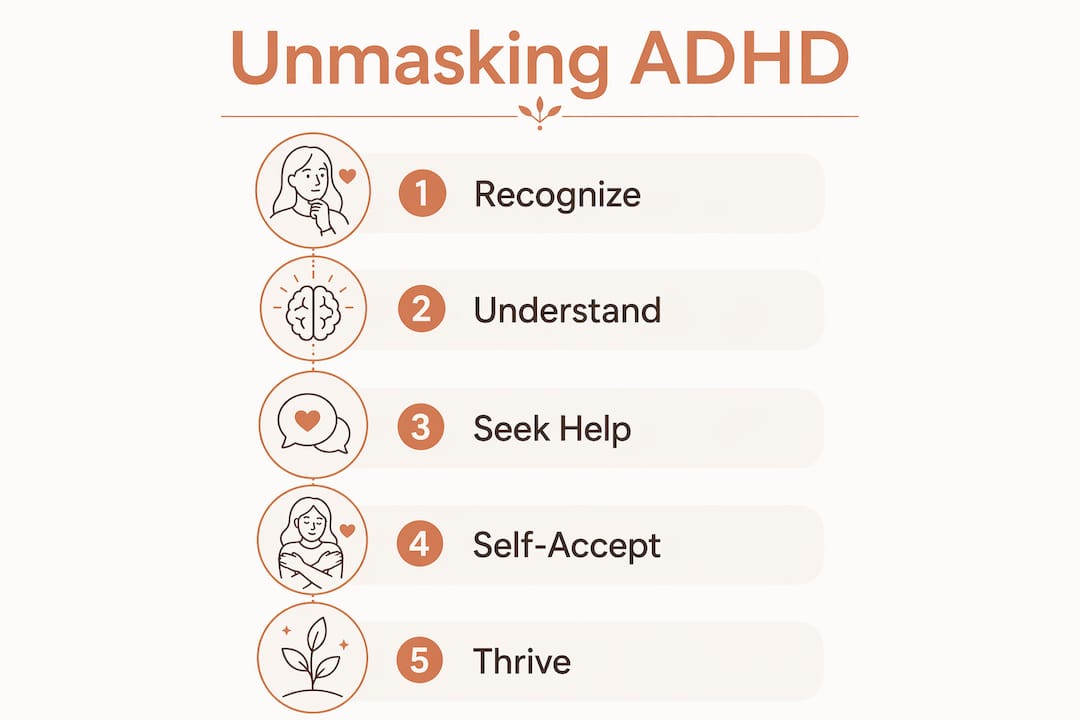
Here are concrete steps toward recognition and unmasking:
- Audit your coping behaviors. List every system you use to stay functional: alarms, color-coded calendars, rehearsed conversations, excessive note-taking. A long list is not a sign of good organization. It is often a sign of a brain working overtime to compensate.
- Seek a female-informed assessment. Ask specifically for a clinician experienced with adult female ADHD presentations. Bring documentation of symptoms across multiple settings and time periods, not just current functioning.
- Lower the perfectionism threshold deliberately. Unmasking requires nervous system retraining and a willingness to let some compensatory behaviors go, even when it feels unsafe to do so.
- Access therapeutic support. Cognitive behavioral therapy adapted for ADHD, along with ADHD coaching, helps women identify masking patterns and build self-compassion. Managing ADHD alongside anxiety and depression often requires a combined approach.
- Connect with community. Other women with ADHD provide a mirror that clinicians and partners often cannot. Online communities and support groups reduce isolation and normalize the experience.
Reducing masking temporarily increases symptom visibility but leads to less exhaustion and better overall wellbeing. That initial increase in visible symptoms is not a setback. It is evidence that the mask is coming off.
Pro Tip: Self-acceptance does not mean abandoning all structure. It means building systems that work with your brain rather than systems designed to hide it from others.
What I have learned watching women unmask ADHD
The most striking thing about working with women who are late diagnosed is not the relief they feel. It is the grief. There is real loss in understanding that decades of exhaustion were not a personal failing but a structural one. The medical system, the diagnostic criteria, the classroom, the workplace: all of them were built around a presentation of ADHD that most women simply do not have.
What I find genuinely encouraging is how quickly things can shift once the correct framework is in place. Women who spent years in therapy for anxiety or depression, without meaningful improvement, often describe a dramatic change in self-understanding after an accurate ADHD evaluation. That is not because the therapy was wrong. It is because the therapy was treating the symptom, not the source.
The idea that unmasking is dangerous because it will make you “worse” is one of the most persistent and damaging myths I encounter. Yes, symptoms become more visible when you stop suppressing them. That visibility is what allows treatment to actually work. A clinician cannot treat what they cannot see, and you cannot heal what you are still hiding.
High masking is not a milder form of ADHD. It is a more complex one. The women who appear to be functioning the best are often the ones who need support the most urgently. Seeking that support is not weakness. It is the most accurate thing you can do.
— Jamie
ADHD support for women at Journeymhw
Women who have spent years masking ADHD deserve care that actually sees them. Journeymhw offers virtual psychiatric evaluations and personalized treatment plans for adult women in Texas and Colorado, with appointments available quickly and without long wait times.
Whether you are newly questioning a diagnosis or have been managing symptoms alone for years, Journeymhw provides structured support that meets you where you are. ADHD treatment in Colorado and ADHD treatment in Texas are available online, so you can access care from home. A proper evaluation is the clearest path from exhaustion to understanding.
Key takeaways
ADHD masking in women is a complex compensatory system that delays diagnosis, worsens mental health, and requires targeted clinical recognition and treatment to address effectively.
| Point | Details |
|---|---|
| Masking delays diagnosis | Women mask symptoms so effectively that clinicians trained in male presentations often miss ADHD entirely. |
| Mental health risks are real | Unmanaged masking raises the risk of anxiety, depression, self-harm, and eating disorders in women with ADHD. |
| Symptoms differ from masking behaviors | The actual ADHD symptom and the behavior used to hide it are different things; learning to tell them apart is the first step. |
| Unmasking improves wellbeing | Reducing compensatory behaviors temporarily increases visible symptoms but leads to less exhaustion and better mental health. |
| Professional evaluation matters | A clinician experienced with female ADHD presentations is the most reliable path to an accurate diagnosis and effective treatment. |
FAQ
What is ADHD masking in women?
ADHD masking in women, clinically called camouflaging, is the practice of hiding or compensating for ADHD symptoms to meet social expectations. It includes behaviors like over-preparing, social scripting, and suppressing emotional reactions.
Why are women with ADHD diagnosed so late?
Boys are diagnosed with ADHD at rates 2–3 times higher than girls in childhood, and masking makes female symptoms invisible to clinicians trained in male-typical presentations. Many women receive their first accurate diagnosis in their 30s or 40s.
Can masking cause anxiety and depression?
Yes. Women with ADHD are frequently misdiagnosed with anxiety or depression before ADHD is recognized, and the chronic stress of masking directly contributes to both conditions. Treating anxiety or depression without addressing the underlying ADHD often produces limited results.
How do I know if I am masking ADHD?
A strong indicator is a large gap between how capable you appear to others and how much effort it actually costs you to maintain that appearance. Exhaustion after social interactions, extensive compensatory systems, and a persistent sense of fraudulence are common signs.
Is unmasking safe?
Unmasking temporarily makes ADHD symptoms more visible, which can feel unsettling. With the right clinical support, that visibility leads to more accurate treatment and significantly better wellbeing over time.