

Get Evaluated in 1–4 Weeks: ADHD Evaluation Wait Times in Texas
Most Texas adults wait a few weeks for a private-pay or telehealth ADHD evaluation, while public clinics, university training centers, and some in-network specialists often have longer waits that can extend to several months. If you need answers sooner, start your intake paperwork today, ask any provider about their cancellation list, and look seriously at telehealth options licensed in Texas. If you or someone you love is in crisis, call 911 or 988 immediately rather than waiting on any evaluation.
TL;DR:
- Private-pay and telehealth ADHD evaluations in Texas typically take one to four weeks, offering faster options than public clinics, which can wait several months.
- Rural Texas residents face longer delays due to uneven distribution of specialists, with waits sometimes extending beyond the national median of 252 days.
- Telehealth evaluations include structured interviews, rating scales, and collateral information, often completed in one to three sessions with comparable quality to in-person assessments.
- Ensuring the provider is licensed in Texas and experienced in adult ADHD is essential to avoid quick prescriptions or incomplete diagnostics.
- Completing digital intake forms early and asking about cancellation lists can significantly reduce wait times for evaluations.
Table of Contents
- How Long Is the ADHD Evaluation Wait Time in Texas?
- Why Waitlists Form: The Main Drivers in Texas
- How Telehealth Speeds Up ADHD Evaluation in Texas
- Steps to Cut Your ADHD Evaluation Wait Time Now
- Choosing a Faster Provider Without Sacrificing Quality
- What Happens During an ADHD Evaluation
- Insurance, Cost, and Payment Options in Texas
- When Not to Wait
- How Journey Mental Health Approaches Faster, Thorough Evaluations
- Balancing Speed and Diagnostic Quality
- Get Evaluated Faster With Journey Mental Health in Texas
- Sources
How Long Is the ADHD Evaluation Wait Time in Texas?
The honest answer depends entirely on which door you walk through. A national, multi-site review of neurodevelopmental assessment pathways found a median full waiting time of 252 days for adults, with a wide range (IQR 106 to 611 days) depending on the clinic and region, according to a peer-reviewed study on waiting times for neurodevelopmental assessments. That figure reflects public and specialty-clinic pathways broadly, not a Texas-specific number, but it explains why “just get evaluated” can turn into a season of waiting when you rely on the wrong pathway.
Texas offers faster lanes. Private-pay evaluations in the state typically cost between $350 and $2,500, with a typical price around $1,200, and these providers commonly schedule new patients within one to four weeks, according to Texas cost and access data from ADHDCosts. University training clinics, staffed by graduate students under licensed psychologist supervision, often offer lower fees and have moderate wait times typically lasting several weeks.
Wait time snapshot: Private-pay or telehealth: 1 to 4 weeks. University clinics: 4 to 8 weeks. Public or insurance-network specialty clinics: 6 weeks to several months, with some regions closer to the 252 day national median.
Rural Texas counties see the longest delays, largely because behavioral health specialists cluster around Austin, Dallas, Houston, and San Antonio. If you live outside a metro area, your local wait time may look nothing like the state average.
Why Waitlists Form: The Main Drivers in Texas
Texas doesn’t have enough psychiatrists and psychologists to match demand, and the ones it does have are unevenly distributed. Rural counties can go months without a single specialist trained in adult ADHD differential diagnosis, which pushes patients toward whichever urban clinic has capacity, and that clinic’s waitlist grows accordingly.
Adult ADHD evaluations are also just more complicated than most people expect. A thorough workup requires collateral information (input from a spouse, parent, or old school records), a structured clinical interview, and standardized rating scales. Texas Children’s Hospital’s evidence-based ADHD guideline is explicit that rating scales alone are necessary but not sufficient. Reaching a defensible diagnosis takes real clinician time, and clinics that do it right can’t rush ten patients through in an afternoon.
Then there’s the administrative layer. Referral triage, prior authorization for insurance coverage, and basic scheduling capacity all add friction before you ever sit down with a clinician. A referral has to be routed, reviewed, and approved before a slot even opens up, and any hiccup in that chain adds weeks. Quality-focused differential diagnosis, the kind that actually rules out anxiety, sleep disorders, or trauma masquerading as inattention, takes more upfront time but tends to prevent costly misdiagnosis down the line. That tradeoff is worth understanding before you chase the fastest possible appointment at the expense of getting it right.
How Telehealth Speeds Up ADHD Evaluation in Texas
Telehealth doesn’t cut corners on the clinical work; to understand what you can and can’t get done remotely in Texas, learn more about ADHD telehealth in Texas. It cuts the overhead. A remote provider doesn’t need you to physically occupy an exam room, which means the same clinician can see more patients across a wider geography without adding staff. That capacity shift matters most for rural Texans, who can often reach a licensed provider by video faster than they could drive to the nearest in-person specialist.
A complete telehealth ADHD evaluation typically includes:
- A structured clinical interview covering symptom history, functional impact, and family background.
- Validated rating scales completed before or during the visit.
- Collateral information gathered from a partner, parent, or old academic records.
- A review of prior treatment attempts, medications, and coexisting conditions.
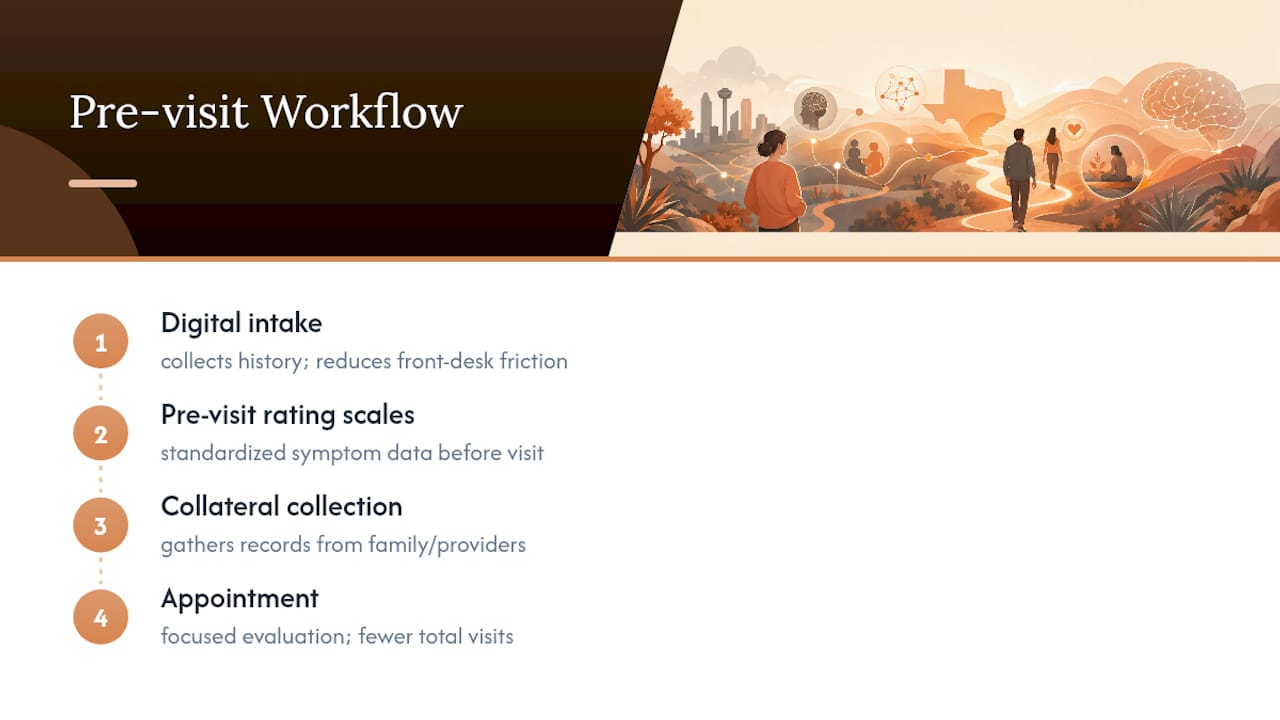
Clinics that build digital intake and pre-visit rating scales into their workflow often complete adult evaluations in one to three visits total, according to ADHD testing and diagnosis guidance from a Texas counseling clinic. That’s the same clinical bar as an in-person evaluation, just compressed into fewer, more efficient sessions.
Telehealth has real limits, though. Some patients, particularly those with suspected learning disorders, complex trauma histories, or ambiguous presentations, need a full in-person neuropsychological battery that a video visit can’t replace. And prescribing controlled substances remotely is governed by Texas telemedicine rules; Texas HHS’s telemedicine and telehealth services handbook lays out the practice standards providers must follow, and stimulant medications carry additional scheduling considerations under Texas’s controlled substances rules.
Pro Tip: Ask any telehealth provider directly whether they can prescribe stimulant medication on your first visit or whether Texas rules require a follow-up appointment first. The answer varies by provider and by medication class.
Steps to Cut Your ADHD Evaluation Wait Time Now
You have more control over your own timeline than most people realize. A few deliberate moves at the front end can shave weeks off the process.
- Finish digital intake immediately. Most delays happen because paperwork sits unfinished, not because clinicians are unavailable. Complete every form and upload past records, report cards, or prior evaluations before your first contact.
- Ask about cancellation lists. Nearly every clinic keeps one, and few advertise it. A five-minute phone call asking to be added can move you up by weeks.
- Weigh university clinics against private-pay telehealth. If cost matters more than speed, a training clinic supervised by licensed faculty is a reasonable middle path. If speed matters more, private-pay or telehealth typically wins.
- Line up collateral information early. Ask a partner, parent, or former teacher to write a short summary of your attention and behavior patterns now, before you need it. Standardized rating scales, like the ones referenced in Texas Children’s Hospital’s ADHD guideline, go faster when you’ve already gathered supporting documentation.
Pro Tip: Request the intake packet by email the same day you book, even if your appointment is weeks out. Providers often move patients who return completed paperwork early to any newly opened earlier slot.
Choosing a Faster Provider Without Sacrificing Quality
Speed only matters if the diagnosis holds up. Before you book, confirm the clinician is licensed in Texas and has specific experience with adult ADHD, not just pediatric cases. Adult presentations are messier and require a differential diagnosis that rules out anxiety, depression, and sleep disorders before landing on ADHD.
Ask directly what the process includes: how many sessions, whether they use collateral information, and whether the final report is formatted for workplace or academic accommodations if you need one. A provider who can’t describe their process clearly in one phone call is a warning sign.
Watch for these red flags:
- No clear explanation of how many visits or what tools the evaluation involves.
- Refusal to gather any collateral information from someone who knows you well.
- Pressure toward a quick prescription before a full assessment is complete.
- Vague answers about insurance acceptance, fees, or how long the written report takes.
Confirm insurance participation and typical report turnaround before you commit. A fast appointment that produces a report you can’t use for accommodations or that your insurer won’t cover isn’t actually faster.
What Happens During an ADHD Evaluation
A straightforward adult evaluation usually runs 60 to 90 minutes per session, with most patients completing the process in one to three total visits. The clinician conducts a structured interview, reviews standardized rating scales, and incorporates any collateral information you’ve provided.
A full neuropsychological battery, hours of additional testing, is only necessary when the picture is unclear: suspected learning disabilities, overlapping psychiatric conditions, or inconsistent symptom histories. Many adults with a straightforward presentation don’t need one. A structured clinical interview combined with validated rating scales and solid collateral information is often sufficient to reach a defensible diagnosis.
Written reports typically arrive within one to two weeks of your final session. From there, next steps usually include a medication discussion, a referral to therapy if coexisting anxiety or depression surfaced during the interview, or both.
Insurance, Cost, and Payment Options in Texas
Private-pay evaluations in Texas generally run $350 to $2,500, with most landing around $1,200, according to Texas market data on ADHD evaluation costs. That range buys you faster scheduling, usually one to four weeks out.
Insurance-covered evaluations through in-network psychiatrists or psychologists can lower your out-of-pocket cost significantly, but network approval and prior authorization often add weeks to the front end. Medicaid coverage exists but frequently comes with the longest waits of any pathway, since provider availability in-network is limited.
University training clinics split the difference: lower fees, supervised by licensed faculty, with moderate four to eight week waits.
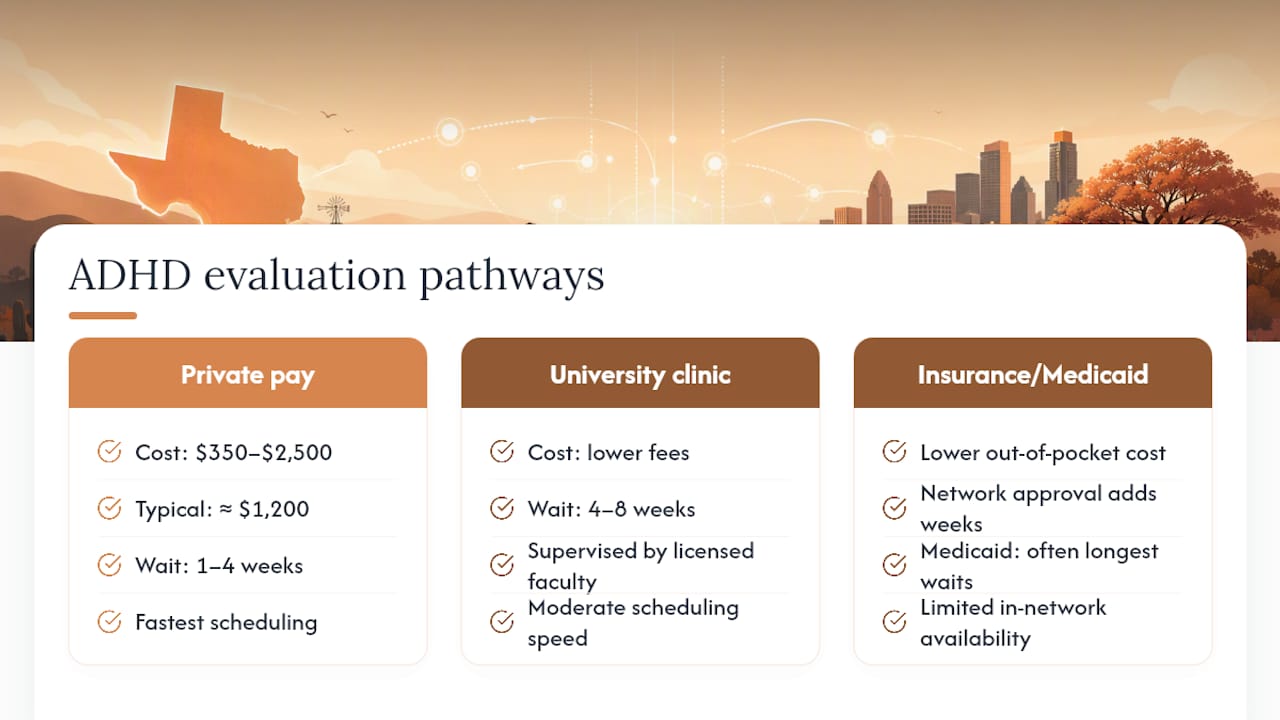
If speed is your priority and you can absorb the cost, private pay, whether in-person or via telehealth, usually gets you seen fastest and typically includes the full interview, rating scales, and a written report in one package.
When Not to Wait
If you or someone you love is having thoughts of self-harm or facing any kind of imminent danger, don’t wait for a scheduled evaluation. Call 911 or go to your nearest emergency department, or call or text 988 for the Suicide and Crisis Lifeline right away.
How Journey Mental Health Approaches Faster, Thorough Evaluations
Journey Mental Health builds its Texas intake process around the same principle: less friction up front means a faster, more complete evaluation. Digital intake, pre-visit rating scales, and collateral collection happen before your appointment, not during it, which mirrors the workflow Texas counseling clinics report shortens total visit count.
Balancing Speed and Diagnostic Quality
Fast and thorough aren’t opposites, but they require intention. A rushed evaluation that skips collateral information or rating scales risks the misdiagnosis that costs patients years down the road. The pathways that genuinely shorten wait time, digital intake, validated scales, telehealth capacity, do the compressing before the clinician ever opens the chart, not during the clinical judgment itself. That’s the distinction worth protecting.
— Jamie
Get Evaluated Faster With Journey Mental Health in Texas
Journey Mental Health gives Texas adults a direct path around the months-long public and insurance-network waitlists that stack up across the state. Where a specialty clinic might route you through referral triage and prior authorization before you’re even scheduled, Journey Mental Health’s online intake collects your history, symptom timeline, and collateral information upfront, so your virtual psychiatric evaluation can happen within weeks, not months.
The process includes a full clinical interview, standardized rating scales, medication management if appropriate, and written documentation suitable for workplace or academic accommodations, all delivered through secure video visits from home. If you’ve been putting off an evaluation because of what you’ve heard about Texas wait times, that’s exactly the gap this service was built to close. Visit the ADHD Treatment in Texas page to check current appointment availability and start your intake today.
This article is general information, not a substitute for advice from a qualified doctor. Consult a qualified healthcare professional about your own circumstances before acting on anything here.
Sources
- Peer-reviewed study on waiting times for neurodevelopmental assessments (PMC)
- ADHD Diagnosis & Therapy Costs in Texas (ADHDCosts)