

ADHD Emotional Dysregulation: What Adults Need to Know
ADHD emotional dysregulation is the difficulty in controlling intense emotions like anger, fear, and exuberance, and it is recognized as a core component of ADHD by the World Federation of ADHD International Consensus Statement. This is not a personality flaw or a separate problem layered on top of your ADHD. It is woven into the condition itself. For adults, unmanaged emotional dysregulation affects relationships, work performance, and self-esteem in ways that standard ADHD treatment often does not fully address. Understanding the specific emotions involved, how they connect to your ADHD symptoms, and what targeted strategies actually help is the clearest path to better daily functioning.
What is ADHD emotional dysregulation and which emotions are most affected?
ADHD emotional dysregulation refers to difficulty modulating the intensity, duration, and expression of specific emotions. Research published in BMC Psychiatry in 2025 found that anger, exuberance, and fear are the emotions most consistently dysregulated in ADHD. That finding matters because it narrows the target. You are not dysregulating every emotion equally. You are most vulnerable in three specific areas.

The distinction between diagnostic ADHD and trait-level ADHD also shapes the pattern. Adults with a clinical ADHD diagnosis show dysregulation across anger, exuberance, and fear. Adults with elevated ADHD traits but no formal diagnosis show elevated anger and exuberance dysregulation even after statistical adjustments. This means emotional reactivity exists on a spectrum, and you do not need a full diagnosis to experience real emotional challenges.
Anger in adults with ADHD tends to flare quickly and feel disproportionate to the trigger. Fear dysregulation often shows up as avoidance, catastrophizing, or an outsized stress response to minor setbacks. Exuberance dysregulation is less discussed but equally disruptive. It looks like impulsive excitement, overcommitting to plans, or spending beyond your means because an idea feels thrilling in the moment.
Recognizing positive emotion dysregulation like exuberance broadens the picture beyond irritability and anger. Many adults with ADHD only seek help after anger episodes, missing the role that unregulated positive emotions play in impulsive decisions and strained relationships.
- Anger: Fast onset, intense, often disproportionate to the situation
- Fear: Avoidance, catastrophizing, heightened stress sensitivity
- Exuberance: Impulsive enthusiasm, overcommitment, financial impulsivity
Pro Tip: Keep a brief daily log noting which emotion spiked, what triggered it, and how long it lasted. Tracking by emotion type reveals your personal dysregulation pattern faster than general mood journaling.
How does emotional dysregulation relate to inattention and impulsivity?
Emotional dysregulation and core ADHD symptoms like inattention and hyperactivity are related but clinically distinct. A 2026 network analysis of 532 adults found that emotional regulation difficulties showed selective associations mainly with inattention, not with hyperactivity or impulsivity dimensions. Only a portion of the connections between emotional dysregulation and ADHD symptom domains were statistically significant.
This is a critical finding for treatment. It means that successfully treating inattention does not automatically resolve emotional dysregulation. The two dimensions require parallel attention, not a sequential approach where you fix focus first and hope emotions follow.
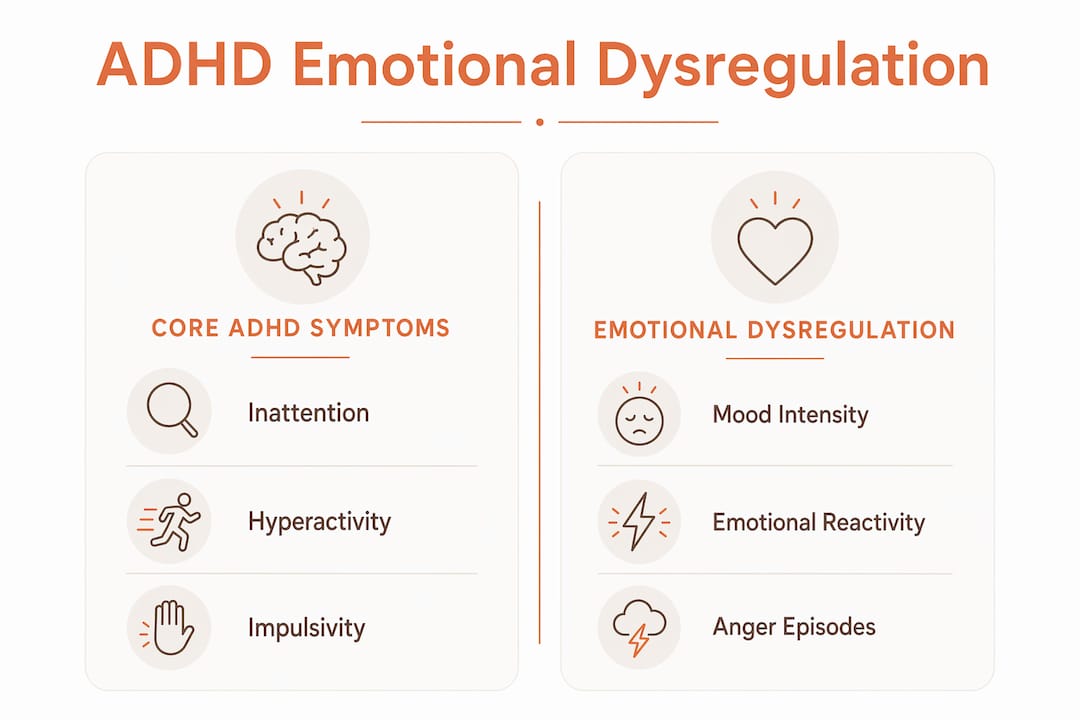
| Feature | Core ADHD symptoms | Emotional dysregulation |
|---|---|---|
| Primary link | Inattention, hyperactivity, impulsivity | Anger, fear, exuberance reactivity |
| Treatment response | Responds to stimulant medication | Requires targeted behavioral strategies |
| Assessment tools | ADHD rating scales | DERS-36, ALS-18 |
| Overlap with inattention | Defining feature | Selective, partial association |
| Clinical priority | Standard first focus | Needs independent treatment focus |
The practical implication is clear. If you are managing ADHD and still struggling with emotional outbursts or mood instability, that is not a sign your treatment is failing. It is a sign that emotional dysregulation needs its own direct treatment focus alongside your existing plan.
Pro Tip: When speaking with your clinician, ask specifically whether your treatment plan addresses emotional regulation separately from inattention. If it does not, request a review.
What assessment tools help identify emotional dysregulation in adults with ADHD?
Validated measurement tools give clinicians a precise picture of how emotional dysregulation presents in each adult. The two most widely used in current research are the DERS-36 and the ALS-18. The DERS-36 and ALS-18 measure distinct constructs. The DERS-36 captures difficulties in emotion regulation strategies, such as how well you can access coping tools when upset. The ALS-18 measures affective lability, meaning how rapidly and intensely your mood shifts.
Using both tools together gives a fuller picture than either alone. A person can score high on affective lability but have adequate regulation strategies, or vice versa. That difference directly shapes which therapeutic approach will help most.
Differential diagnosis is another reason structured assessment matters. Emotional dysregulation in ADHD overlaps with trauma, anxiety, and borderline personality disorder, but the patterns differ. In ADHD, emotional episodes tend to be short-lived and tied to executive function shifts. In trauma, they are more often tied to specific memory triggers. Accurate identification prevents misdiagnosis and misdirected treatment.
Here is how to advocate for a thorough evaluation:
- Request emotion-specific assessment. Ask your clinician to use validated tools like the DERS-36 or ALS-18 alongside standard ADHD rating scales.
- Describe your emotional episodes in detail. Note how long they last, what triggers them, and how quickly they resolve. Short, intense episodes that pass quickly are a hallmark of ADHD-related dysregulation.
- Mention any overlap with anxiety or past trauma. This helps your clinician distinguish ADHD emotional patterns from anxiety and ADHD overlap or trauma-related responses.
- Ask which regulation constructs your therapy targets. Clinicians should specify whether they are working on regulation strategies, affect lability, or both. Vague “emotional support” is not the same as targeted intervention.
- Track episodes between appointments. A simple log of trigger, emotion, intensity, and duration gives your clinician real data rather than recalled impressions.
What practical strategies help adults manage ADHD mood swings and emotional intensity?
Treating core ADHD symptoms alone does not fully resolve emotional dysregulation. Research confirms that emotional dysregulation should be monitored independently and not assumed resolved by treating inattention. Adults who address emotional regulation directly see the most functional improvement.
Physical exercise is one of the most accessible and evidence-supported tools available. Exercise reduces ADHD-related emotional dysregulation by interrupting emotional escalation and improving baseline mood stability. Even a 20-minute walk during a high-stress period can blunt the intensity of an anger or anxiety spike. Consistency matters more than intensity here.
Medication also plays a role. Atomoxetine, a non-stimulant ADHD medication, has shown benefits for emotional regulation alongside behavioral interventions. Medication works best as part of a combined approach, not as a standalone fix. Pairing it with targeted therapy produces better outcomes than either alone.
Cognitive-behavioral strategies and mindfulness practices address the regulation layer directly. The goal is not to suppress emotions but to extend the gap between trigger and reaction. Mindfulness builds awareness of the moment before escalation. CBT helps you identify and challenge the thoughts that amplify emotional intensity.
- Emotion-specific tracking: Log anger, fear, and exuberance episodes separately. Patterns by emotion type reveal individualized dysregulation profiles that generic mood tracking misses.
- Physical exercise: Prioritize daily movement, especially during high-stress periods.
- Medication review: Ask your prescriber whether your current medication addresses emotional regulation or only inattention.
- Mindfulness practice: Use brief body scans or breathing exercises at the first sign of emotional escalation.
- CBT for ADHD: Work with a therapist trained in ADHD-specific CBT to address thought patterns that amplify emotional reactions.
- Lifestyle structure: Consistent sleep, reduced alcohol, and regular meals stabilize the neurological baseline that emotional regulation depends on. For a broader view, the ADHD lifestyle treatment approach covers these factors in detail.
Pro Tip: When you feel anger or fear escalating, name the emotion out loud or in writing before responding. Labeling an emotion activates the prefrontal cortex and measurably reduces its intensity.
Key Takeaways
Effective management of ADHD emotional dysregulation requires targeting specific emotions directly, not assuming core symptom treatment will resolve emotional challenges on its own.
| Point | Details |
|---|---|
| Emotional dysregulation is a core ADHD feature | The World Federation of ADHD recognizes it among 208 evidence-based conclusions about the disorder. |
| Anger, fear, and exuberance are most affected | These three emotions show the most consistent dysregulation in adults with ADHD, including positive emotions. |
| Inattention is the primary ADHD link | Emotional dysregulation associates mainly with inattention, not hyperactivity, requiring separate treatment focus. |
| DERS-36 and ALS-18 guide accurate assessment | These validated tools measure distinct aspects of emotional regulation and lability for targeted treatment planning. |
| Combined approaches work best | Exercise, medication like Atomoxetine, CBT, and mindfulness together produce better outcomes than any single method. |
What I have learned from watching adults navigate emotional dysregulation
The most common mistake I see is adults with ADHD treating emotional dysregulation as a character problem rather than a neurological one. They apologize for their anger, feel ashamed of their impulsive excitement, and try to white-knuckle their way through emotional intensity. That approach does not work, and the research backs that up.
What does work is specificity. The adults who make the most progress are the ones who stop trying to “manage emotions” in general and start tracking which emotions spike, when, and why. Anger and exuberance have completely different triggers and timelines. Treating them as one undifferentiated problem wastes effort and produces frustration.
One myth worth addressing directly: many adults believe that if their ADHD medication is working, their emotions should stabilize automatically. That is not what the evidence shows. Emotional dysregulation has its own treatment requirements. Medication helps, but it is not sufficient on its own. Expecting it to do all the work sets you up for disappointment.
The other thing I want to say clearly is that progress is real and measurable. Adults who commit to emotion-specific tracking, targeted therapy, and lifestyle changes report meaningful improvement in their relationships and daily functioning. The path is not mysterious. It requires the right tools pointed at the right targets. Understanding how ADHD affects adult relationships can also help you see where emotional dysregulation creates the most friction in your life.
— Jamie
Specialized ADHD care that addresses emotional regulation
Adults dealing with intense mood swings, anger episodes, or emotional reactivity alongside ADHD deserve care that treats both dimensions directly. Journeymhw offers virtual psychiatric evaluations and personalized treatment plans for adults in Texas and Colorado, with a focus on diagnosing and managing ADHD alongside its emotional components.
Journeymhw’s structured care pathways address inattention, impulsivity, and emotional dysregulation together, rather than treating them as separate problems. Appointments are available quickly, and the process is designed to reduce the delays that often stand between adults and effective mental health care. Adults in Texas can access ADHD evaluation and treatment through Journeymhw’s Texas services, while those in Colorado can explore specialized ADHD care tailored to their needs.
FAQ
What is ADHD emotional dysregulation?
ADHD emotional dysregulation is the difficulty in controlling the intensity and duration of specific emotions, particularly anger, fear, and exuberance. The World Federation of ADHD recognizes it as a core component of the disorder, not a secondary symptom.
Is emotional dysregulation the same as ADHD mood swings?
Emotional dysregulation and mood swings overlap but are not identical. Mood swings describe shifts in emotional state over time, while emotional dysregulation specifically refers to difficulty managing the intensity and expression of emotions once they arise.
Can ADHD medication fix emotional dysregulation on its own?
Medication like Atomoxetine can reduce emotional dysregulation, but research shows it works best combined with behavioral interventions. Treating inattention with stimulants does not automatically resolve emotional regulation difficulties.
How do I know if my emotional challenges are from ADHD or anxiety?
ADHD-related emotional episodes tend to be short-lived and linked to executive function shifts, while anxiety-driven responses are more persistent and often tied to specific worry patterns. A clinician using tools like the DERS-36 and ALS-18 can help distinguish between the two.
What is the fastest way to calm down during an ADHD emotional episode?
Naming the emotion out loud or in writing activates the prefrontal cortex and reduces emotional intensity. Pairing that with a brief physical movement, such as a short walk, interrupts the escalation cycle most effectively.