

Treat Comorbid Sleep Issues in Adults With ADHD: Screen, Refer
Sleep disorders are common in people with ADHD, and treating them often reduces daytime ADHD symptoms on its own. At least half of children and adults with ADHD report substantial sleep problems, and the relationship runs both ways: poor sleep worsens attention and mood, and ADHD itself disrupts sleep. The right response is not more sleep hygiene tips. It’s screening for specific, treatable sleep disorders and folding that treatment into the broader ADHD care plan, with referral to a sleep specialist when symptoms point to something like sleep apnea or restless legs syndrome.
TL;DR:
- At least 50% of individuals with ADHD experience significant sleep problems, with common disorders including insomnia, delayed sleep phase syndrome, RLS, sleep apnea, and narcolepsy.
- Screening tools like the ISI, PSQI, ESS, STOP-Bang, and simple questions about restless legs can identify most sleep issues, guiding further objective testing such as actigraphy or polysomnography if needed.
- Treating specific sleep disorders with tailored approaches—like circadian adjustment for delayed sleep phase or CPAP for sleep apnea—can significantly improve ADHD symptoms and daytime functioning.
- Sleep difficulties may worsen ADHD through effects on attention, mood, and impulse control, and untreated sleep issues also increase long-term psychiatric and physical health risks.
- Sleep problems are best managed through integrated care that includes behavioral modifications, environment adjustments, medication timing, and specialist referrals when necessary.
Table of Contents
- What Sleep Disorders Commonly Co-Occur With ADHD Comorbid Sleep Issues?
- How Poor Sleep Makes ADHD Symptoms Worse
- Which Screening Tools Catch ADHD-Related Sleep Problems Early?
- Treating Insomnia, Delayed Sleep Phase, RLS, and Sleep Apnea in ADHD
- How ADHD Medications Interact With Sleep
- When It’s Time to See a Sleep Specialist
- What Happens When ADHD Sleep Problems Go Untreated
- Teaching Sleep Hygiene That Actually Fits an ADHD Brain
- Daily Habits and Bedroom Changes That Support Better Sleep
- Where Research Is Headed on ADHD and Sleep
- How Journey Mental Health Approaches Integrated ADHD and Sleep Care
- Start Addressing ADHD and Sleep Together With Journey Mental Health
- Sources
What Sleep Disorders Commonly Co-Occur With ADHD Comorbid Sleep Issues?
The range is wide because ADHD intersects with several distinct sleep conditions, each with its own mechanism and treatment path. Clinical reviews report that at least 50% of children and adults with ADHD experience substantial sleep problems, and disorder-specific rates run even higher in some samples. One large outpatient study found that roughly 60% of adults with ADHD screened positive for at least one sleep disorder, with delayed sleep phase syndrome (about 36%), insomnia (about 31%), and restless legs syndrome or periodic limb movement disorder (about 29%) topping the list.
The five conditions that show up again and again in the research on sleep disorders in ADHD each have a recognizable profile:
- Insomnia: Trouble falling asleep, staying asleep, or waking too early, often tangled with racing thoughts or difficulty winding down after a stimulating day.
- Delayed sleep phase syndrome (a circadian rhythm sleep disorder): A biological tendency to fall asleep and wake up hours later than typical, not simply a bad habit. Common in adolescents and adults with ADHD.
- Restless legs syndrome and periodic limb movement disorder: An uncomfortable urge to move the legs at night, or involuntary limb jerks during sleep that fragment rest without the person fully waking. Adults with ADHD show a significant prevalence of restless legs syndrome in some samples.
- Obstructive sleep apnea: Repeated pauses in breathing during sleep, often marked by loud snoring, gasping, or witnessed breathing pauses. Estimated at 20% to 30% in some adult ADHD populations.
- Narcolepsy: A rarer disorder involving excessive daytime sleepiness and sudden sleep attacks, sometimes misdiagnosed as ADHD-related fatigue.
Age changes the picture. Children with ADHD more often show bedtime resistance and restless legs symptoms, while delayed sleep phase syndrome becomes more prominent in teens and young adults, whose circadian rhythms already tend to shift later.
How Poor Sleep Makes ADHD Symptoms Worse
Sleep loss and ADHD symptoms feed each other in a loop that’s easy to underestimate. Fragmented sleep, whether from apnea-related oxygen dips, limb movements, or simple insomnia, disrupts the slow-wave and REM sleep stages the brain uses to consolidate attention networks and regulate mood overnight. Miss that repair work night after night, and the next day’s executive function takes the hit first.
A pattern worth knowing: in large clinic samples, sleep problems in adults with ADHD track closely with anxiety, depression, and other psychiatric comorbidity, not just with ADHD severity alone. That matters clinically because a patient who looks “treatment resistant” on stimulants may actually be dealing with an untreated sleep disorder amplified by anxiety, not a medication failure.
The daytime consequences are specific and measurable, not vague fatigue:
- Attention and working memory decline further, making an already-taxed executive system work harder for the same output.
- Impulse control weakens, which can look like a worsening of core ADHD symptoms rather than a separate sleep problem.
- Mood regulation suffers, often stacking irritability or low mood on top of existing anxiety or depression.
- Daytime sleepiness from sleep-disordered breathing or narcolepsy can mimic inattentive-type ADHD closely enough to cause misdiagnosis, which is why the CDC advises evaluating sleep and other co-occurring conditions before assuming a symptom is purely ADHD.
Circadian misalignment adds another layer. When a person’s internal clock runs a few hours behind the outside world, as in delayed sleep phase syndrome, they aren’t groggy by accident. Their brain is biologically expecting to still be asleep during the hours school or work demands alertness. Forcing wakefulness against that internal clock produces something close to chronic jet lag, and ADHD’s existing struggles with time perception and task initiation make that mismatch harder to compensate for.
Psychiatric comorbidity raises the stakes further. Anxiety in particular tends to intensify insomnia through nighttime rumination, and the overlap between ADHD and anxiety means a sleep plan that ignores anxious thought patterns will likely underperform. Treating sleep in isolation, without accounting for what’s keeping the mind active at 1 a.m., rarely produces lasting results.
Which Screening Tools Catch ADHD-Related Sleep Problems Early?
A short screening conversation catches most of what matters, and it doesn’t require a sleep lab visit to start. Clinicians managing comorbid sleep issues in ADHD rely on a small set of validated questionnaires, each targeting a different disorder:
- Insomnia Severity Index (ISI): A brief self-report scale measuring how severely insomnia affects sleep onset, maintenance, and daytime function.
- Pittsburgh Sleep Quality Index (PSQI): A broader measure of overall sleep quality and disturbance over the past month, useful as a first-pass screen.
- Epworth Sleepiness Scale (ESS): Rates the likelihood of dozing in everyday situations, flagging excessive daytime sleepiness that could point to apnea or narcolepsy.
- STOP-Bang questionnaire: An eight-item screen for obstructive sleep apnea risk, covering snoring, tiredness, observed breathing pauses, blood pressure, body mass index, age, neck size, and gender.
- Sleep Disturbance Scale for Children: A parent-report tool used in pediatric ADHD cases to flag disordered breathing, arousal problems, and initiating or maintaining sleep.
- A single-question restless legs screen: Asking directly about an urge to move the legs with uncomfortable sensations, worse at rest and in the evening, catches most RLS cases without a formal exam.
When these screens raise a flag, the next step is objective testing rather than more questionnaires. Actigraphy, a wrist-worn device that tracks movement and estimates sleep and wake patterns over one to two weeks, gives a low-burden picture of real-world sleep timing. It’s particularly useful for confirming delayed sleep phase syndrome, since it shows the actual sleep window rather than a remembered estimate. Polysomnography, an overnight, lab-based sleep study, is reserved for suspected sleep-disordered breathing, unexplained parasomnias, or periodic limb movements needing confirmation. A Multiple Sleep Latency Test, which measures how quickly a person falls asleep across several scheduled daytime naps, is the standard tool when narcolepsy is suspected.
Pro Tip: Bring a two-week sleep log or actigraphy printout to your next appointment. Subjective reports of sleep quality in ADHD can be misleading, since some people underestimate how little they’ve actually slept, while others feel exhausted despite a technically adequate sleep duration.
Certain signs warrant urgent referral rather than a wait-and-see approach: witnessed breathing pauses or gasping during sleep, severe daytime sleepiness that causes microsleeps while driving, sudden muscle weakness triggered by strong emotion (a possible sign of cataplexy in narcolepsy), or restless legs symptoms severe enough to prevent falling asleep most nights. Any of these deserves a sleep medicine consult sooner rather than later.
Treating Insomnia, Delayed Sleep Phase, RLS, and Sleep Apnea in ADHD
Generic sleep hygiene advice, like avoiding screens before bed, often falls flat for people with ADHD, and it’s worth saying plainly: behavioral sleep interventions have to be adapted to fit executive-function challenges, not just handed over as a checklist. Standard advice assumes a level of planning and follow-through that ADHD frequently disrupts. Here’s a more workable path through the four most common comorbid conditions.
1. Behavioral adaptations for insomnia
Simplify stimulus control rather than layering on complex routines. A single consistent cue, such as dimming lights and putting the phone in another room at the same time each night, works better than a ten-step bedtime protocol that requires sustained self-monitoring. For children and teens, a parent or partner acting as an external cue, essentially a human alarm for the wind-down routine, often succeeds where a self-directed plan fails.
2. Circadian strategies for delayed sleep phase syndrome
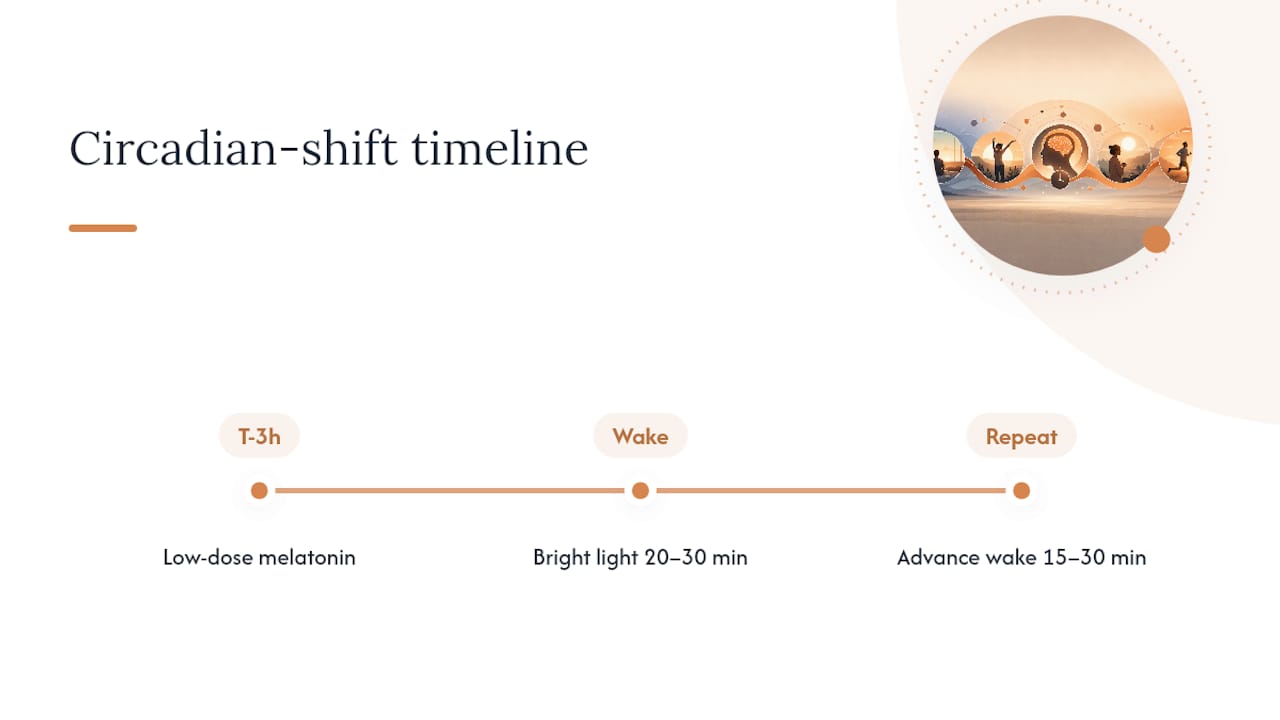
This is where timing precision matters most, and it’s also where sleep hygiene alone tends to fail. Melatonin dosing for delayed sleep phase works differently than melatonin dosing for ordinary insomnia. For circadian shifting, low-dose immediate-release melatonin taken about three hours before the desired sleep time, not right at bedtime, helps signal the internal clock to shift earlier. Pairing that with 20 to 30 minutes of bright light exposure shortly after waking helps anchor the new schedule, and advancing wake time gradually, by 15 to 30 minutes every few days rather than all at once, makes the shift sustainable instead of triggering a rebound to old patterns.
3. RLS and PLMD basics
Iron deficiency, even at levels that don’t register as clinical anemia, is closely tied to restless legs syndrome, so a ferritin level is a reasonable starting point before other treatment. If iron repletion doesn’t resolve symptoms, a sleep medicine or neurology referral for medication options is the next step, since RLS treatment sits outside standard ADHD prescribing.
4. The OSA pathway
A positive STOP-Bang screen or witnessed breathing pauses should lead to a home sleep apnea test or in-lab polysomnography, depending on symptom severity and other health factors. Confirmed obstructive sleep apnea is typically treated with continuous positive airway pressure (CPAP) therapy, and in select cases, an ENT evaluation for anatomical contributors. Treating the apnea often produces a fast, noticeable improvement in daytime attention, sometimes before any ADHD medication adjustment is even needed.
Across all four conditions, adherence is the real obstacle, not knowledge. Simple external supports tend to outperform willpower-based plans: a loud, physically separate alarm rather than a phone snooze button, a lighting timer that dims the bedroom automatically rather than relying on remembering to do it, and a shared calendar or accountability check-in with a partner, parent, or friend during the first few weeks of a new sleep schedule. None of these are complicated. They work because they remove the step where ADHD tends to derail a plan: remembering to execute it consistently, night after night, without a prompt.
How ADHD Medications Interact With Sleep
Stimulant medication and sleep have a more complicated relationship than “stimulants cause insomnia,” and that oversimplification leads to some avoidable medication changes. In some patients, a long-acting stimulant formulation actually improves sleep indirectly by smoothing out end-of-day rebound symptoms, the irritability and hyperactivity that can flare as a shorter-acting dose wears off in the evening. In others, later dosing or a longer-acting profile keeps stimulating effects active too close to bedtime and delays sleep onset.
Before concluding a medication is the problem, clinicians typically run a structured trial of dose and timing adjustments, since the same stimulant can behave differently depending on when it’s taken and which formulation is used. That means:
- Adjusting the timing of the last dose earlier in the day, sometimes by just an hour or two, before assuming the medication itself is incompatible with good sleep.
- Comparing short-acting and long-acting formulations, since one may produce a smoother evening transition than the other for a given person.
- Considering nonstimulant ADHD medications when stimulant timing changes don’t resolve the sleep disruption.
- Using clonidine or guanfacine, which have mild sedating effects, for stimulant-related bedtime difficulty, rather than reaching for a sedative-hypnotic, which clinical reviews advise avoiding as a routine solution given dependence risk and limited evidence in this population.
Any of these changes should happen in conversation with the prescribing clinician, not through self-adjustment, and tracking a sleep log or actigraphy data during a medication trial gives both patient and clinician an objective record instead of relying on memory of “how last week felt.” For readers managing ADHD medication timing and prescriptions alongside sleep concerns, that record is often what turns a vague complaint into a specific, actionable adjustment.
When It’s Time to See a Sleep Specialist
Certain signs mean a referral to sleep medicine should happen alongside ongoing ADHD care, not instead of it. The two tracks run in parallel, not in sequence.
Referral is warranted when:
- Snoring is loud and habitual, or a bed partner reports witnessed breathing pauses, gasping, or choking during sleep.
- Restless legs symptoms are severe enough to delay sleep onset most nights despite iron repletion.
- Daytime sleepiness is excessive and unexplained by sleep duration alone, raising concern for narcolepsy.
- First-line circadian strategies, timed melatonin and morning light, fail to shift a delayed sleep pattern after several weeks of consistent effort.
Depending on the concern, a sleep specialist may order a home sleep apnea test, an overnight in-lab polysomnography, a Multiple Sleep Latency Test for suspected narcolepsy, or iron studies for RLS. None of this requires pausing ADHD treatment. The most effective approach keeps ADHD medication and follow-up visits on schedule while sleep testing is arranged, and shares a current medication list with the sleep team, since some ADHD medications affect sleep architecture and interpretation of test results.
What Happens When ADHD Sleep Problems Go Untreated
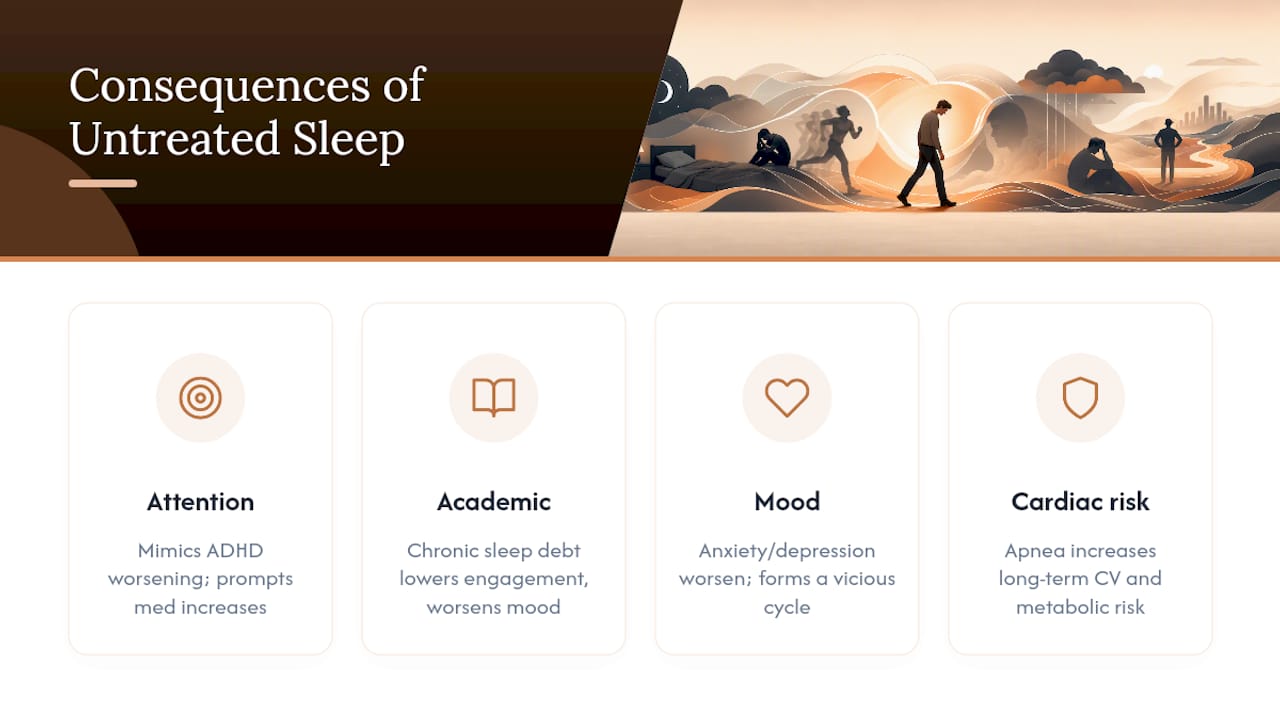
Left unaddressed, comorbid sleep disorders in ADHD don’t just cause tired mornings. They compound over months and years into problems that are harder to untangle later. Chronic sleep fragmentation from untreated sleep apnea or restless legs syndrome keeps the attention and mood systems in a persistent deficit state, which can look indistinguishable from worsening ADHD and lead to medication increases that don’t actually address the root problem.
Academic and occupational performance often bear the longest-lasting cost. A student with undiagnosed delayed sleep phase syndrome forced into early school start times accumulates a sleep debt that no amount of daytime coffee or stimulant adjustment fully offsets, and that pattern of chronic under-sleeping in adolescence has been linked to broader difficulties with mood and academic engagement over time.
Psychiatric comorbidity tends to deepen, too. Anxiety and depression, already elevated in ADHD, both worsen with chronic sleep deprivation, and the relationship becomes circular: poor sleep intensifies mood symptoms, which in turn make sleep harder to protect. Untreated sleep apnea carries its own separate long-term cardiovascular and metabolic risks, entirely apart from its effect on attention.
The reassuring flip side is that these outcomes are largely preventable with timely identification. None of the disorders discussed here are untreatable. The risk lies specifically in the gap between symptom onset and diagnosis, which tends to be longer in ADHD populations because sleepiness and inattention get attributed to ADHD by default.
Teaching Sleep Hygiene That Actually Fits an ADHD Brain
Standard sleep hygiene advice assumes a level of consistency that ADHD makes genuinely harder to sustain, so patient and caregiver education needs a different starting point. Instead of a long list of rules, the most effective approach picks two or three changes and builds them into existing routines rather than adding new ones.
For children, caregivers get better results anchoring the bedtime routine to something that already happens reliably, like right after a bath or right after brushing teeth, rather than introducing a separate new step. Visual schedules, a simple picture chart showing the order of bedtime steps, reduce the executive-function load of remembering what comes next.
For teens and adults, the education that sticks tends to focus on light exposure and timing consistency over willpower-based rules. Explaining why morning light exposure matters for circadian timing, rather than simply saying “get more light,” gives people a reason to prioritize it even on low-motivation days. Caregivers of teens with delayed sleep phase syndrome benefit from understanding that the pattern is physiological, not a discipline problem, which changes the conversation from conflict to collaboration on timing strategies.
The most useful single piece of education across ages: sleep problems in ADHD usually need a targeted fix for a specific disorder, not just “better habits.” Framing it that way keeps patients and families from cycling through generic advice that was never going to solve a circadian or breathing problem in the first place.
Daily Habits and Bedroom Changes That Support Better Sleep
Environment does a lot of the work that willpower can’t, particularly for a brain that struggles with sustained self-regulation at the end of a long day. A few structural changes tend to outperform behavioral resolutions because they don’t require remembering anything at 10 p.m.
Keeping wake time consistent, even on weekends, protects circadian stability more than any single evening ritual, since sleeping in on Saturday effectively resets the body’s clock and makes Monday morning harder. Morning light, ideally outdoors within the first hour of waking, reinforces that same stability and is especially valuable for anyone managing delayed sleep phase tendencies.
In the bedroom itself, removing the phone rather than just silencing it eliminates the temptation entirely, since ADHD’s difficulty with in-the-moment inhibition makes “I’ll just check quickly” a common trap even with good intentions. A cool, dark room supports the natural drop in core body temperature that accompanies sleep onset, and blackout curtains matter more for people with delayed sleep phase syndrome, since morning light leaking in can undercut a carefully timed wake schedule.
Caffeine timing deserves specific attention in ADHD, since many people rely on it to manage daytime attention. Cutting it off by early afternoon, rather than just “not right before bed,” accounts for caffeine’s six-hour-plus half-life and its outsized effect on already-fragile sleep onset.
Where Research Is Headed on ADHD and Sleep
Several open questions still limit how precisely clinicians can tailor sleep treatment in ADHD, and it’s worth naming them honestly rather than presenting the field as settled. Researchers still don’t fully understand why circadian rhythm disruption is so disproportionately common in ADHD, whether it’s a shared underlying neurobiology or a downstream effect of ADHD’s impact on daily routine consistency.
Studies on how stimulant medication timing and formulation affect long-term sleep architecture, beyond the first few weeks of a dose adjustment, remain limited, which is part of why current guidance leans on structured trial-and-adjustment rather than a fixed protocol. There’s also a gap in research specifically testing whether treating a comorbid sleep disorder changes long-term ADHD medication requirements, something many clinicians observe anecdotally but that hasn’t been rigorously quantified.
On the treatment side, interest in circadian-targeted approaches beyond melatonin, including more precise light therapy protocols and chronotherapy techniques that gradually shift sleep timing, continues to grow. Investigational and pharmacologic approaches to sleep more broadly are an active area, and readers interested in the research landscape around sleep-focused pharmacologic agents can find a useful overview of where that field currently stands, separate from established ADHD-specific treatment.
How Journey Mental Health Approaches Integrated ADHD and Sleep Care
Sleep problems and ADHD symptoms rarely improve in isolation, which is why sleep questions belong inside the ADHD evaluation itself, not as a separate afterthought. At Journey Mental Health, that means asking about sleep patterns, screening for red flags like loud snoring or restless legs symptoms, and factoring medication timing into the treatment plan from the start of care, delivered through telehealth appointments that fit around a patient’s actual schedule.
There are limits worth being upfront about. Diagnosing obstructive sleep apnea or narcolepsy requires objective testing, home sleep apnea testing, in-lab polysomnography, or a Multiple Sleep Latency Test, that a virtual psychiatric visit can’t perform directly. When symptoms point that direction, the appropriate next step is a referral to a sleep medicine specialist, while ADHD medication management continues without interruption in the meantime.
That coordinated approach, treating what can be addressed through psychiatric care while referring out for what requires specialized testing, reflects how integrated mental health treatment is supposed to work: one clinician looking at the whole picture instead of sleep and ADHD being managed by two teams that never talk to each other.
— Jamie
Start Addressing ADHD and Sleep Together With Journey Mental Health
If sleep problems have been muddying your ADHD symptoms for years, the fastest path forward is an evaluation that treats them as connected, not a coincidence you’re expected to manage separately. Virtual psychiatric evaluations and ongoing medication management for adults with ADHD are available with structured treatment plans built around your actual daily schedule instead of a one-size-fits-all protocol.
A telehealth visit is the right starting point for adjusting medication timing, screening for sleep-related red flags, and building a plan that accounts for anxiety or mood symptoms alongside ADHD. When testing for sleep apnea, restless legs syndrome, or narcolepsy is needed, referral coordination can occur while keeping ADHD care on track in the meantime. Visit the ADHD treatment page to see current appointment availability, or check the Colorado or Texas service pages for state-specific details, and schedule an evaluation to get sleep and ADHD symptoms addressed in the same conversation.
This article is general information, not a substitute for advice from a qualified doctor. Consult a qualified healthcare professional about your own circumstances before acting on anything here.
Sources
- Managing comorbid sleep issues in patients with attention-deficit/hyperactivity disorder - PMC
- CDC — Other concerns and conditions associated with ADHD