

Depression vs ADHD symptoms explained for adults
If you’ve been told you have depression but treatment never quite works, there’s a real chance ADHD has been part of the picture all along. Understanding depression vs ADHD symptoms explained clearly can be the difference between years of partial treatment and a care plan that actually fits. These two conditions share enough surface-level features that even experienced clinicians miss the distinction. For adults in Texas and Colorado navigating virtual mental health care, getting this right from the start means better outcomes, fewer relapses, and care that addresses what’s actually driving your symptoms.
Table of Contents
- Understanding depression symptoms in adulthood
- Key symptoms and characteristics of adult ADHD
- Comparing and contrasting depression and ADHD symptoms
- Navigating diagnosis challenges: burnout, overlap, and misdiagnosis
- Practical tips for managing and seeking treatment for ADHD and depression
- Why understanding the subtle differences in depression and ADHD symptoms changes everything
- Start your virtual mental health journey for ADHD and depression
- Frequently asked questions
Key Takeaways
| Point | Details |
|---|---|
| Depression core symptoms | Depression involves persistent low mood, loss of interest, and physical symptoms lasting two weeks or more. |
| Adult ADHD traits | ADHD in adults causes lifelong attention issues, restlessness, and executive function challenges. |
| Symptom overlap | ADHD and depression share mood and focus symptoms, complicating diagnosis without clinical assessment. |
| ADHD burnout differs | ADHD burnout results from overextension and improves with rest, unlike pervasive depression. |
| Integrated treatment needed | Effective care for comorbid ADHD and depression requires coordinated, multi-faceted approaches. |
Understanding depression symptoms in adulthood
Depression is not just feeling sad. In clinical terms, major depressive disorder requires at least 5 of 9 core symptoms present nearly every day for a minimum of two weeks. That distinction matters enormously when comparing it to other conditions.
The nine core symptoms recognized by DSM-5 criteria include:
- Persistent depressed mood most of the day, nearly every day
- Loss of interest or pleasure in activities once enjoyed (anhedonia)
- Significant weight change or appetite disruption
- Sleep disturbances, either insomnia or sleeping too much
- Fatigue or loss of energy nearly every day
- Feelings of worthlessness or excessive guilt
- Difficulty concentrating, thinking clearly, or making decisions
- Psychomotor changes, meaning slowing down or agitation others can observe
- Recurrent thoughts of death or suicidal ideation
What surprises many adults is how physical depression can feel. About 60% of people with depression report physical or “vegetative” symptoms such as sleep disruption, appetite changes, and extreme fatigue as the most disabling part of the illness. You may not even identify your primary experience as sadness. You may just feel heavy, unmotivated, and physically worn down.
“Depression does not always look like crying. For many adults, it looks like exhaustion, disconnection, and an inability to find joy in things that used to matter.”
This depression symptoms overview is foundational. Without it, it’s easy to misattribute these physical and emotional experiences to burnout, thyroid issues, or even ADHD. Accurate identification of depression’s profile is the first step toward correct care. If you are in Texas, depression treatment in Texas is accessible virtually through structured psychiatric evaluations.
With a clear picture of depression symptoms, we can contrast these with ADHD’s hallmark traits next.
Key symptoms and characteristics of adult ADHD
Adult ADHD looks nothing like the hyperactive child bouncing off classroom walls. In adults, the condition is far more internal and often invisible from the outside. Adults with ADHD frequently struggle with sustained attention, organization, restlessness, impulsivity, and emotional regulation in ways that interfere with work, relationships, and self-care.
The most common ADHD symptoms comparison points for adults include:
- Difficulty sustaining focus on tasks that feel unstimulating, even important ones
- Chronic disorganization and trouble managing deadlines or priorities
- Inner restlessness, a persistent sense of needing to do something without being able to settle
- Impulsive decision-making, interrupting others, or acting without considering consequences
- Emotional dysregulation, including intense frustration, rejection sensitivity, and mood shifts that come and go quickly
- Executive dysfunction, meaning trouble starting tasks, shifting between them, or following through
- Hyperfocus, the ability to intensely concentrate on high-interest tasks for hours while neglecting everything else
Notice that concentration difficulties appear on both the depression and ADHD lists. This is exactly where the confusion starts. The key difference is that in ADHD, concentration problems are selective and tied to stimulation level, not mood state. A person with ADHD can focus intensely on the right activity. A person with depression often cannot find interest or focus regardless of the task.
ADHD is also a lifelong condition. Its symptoms typically trace back to childhood, even if they weren’t recognized or diagnosed. This long developmental history is a major diagnostic clue that separates it from depression. For a deeper look at adult ADHD symptoms and treatment, personalized virtual care is available in both Texas and Colorado.
Pro Tip: If your focus and motivation problems have been with you as far back as you can remember, even during periods when your mood was generally fine, ADHD belongs on the table as a diagnosis worth exploring.
Now that both conditions have been outlined, let’s examine symptom overlaps and differences for clearer differentiation.
Comparing and contrasting depression and ADHD symptoms
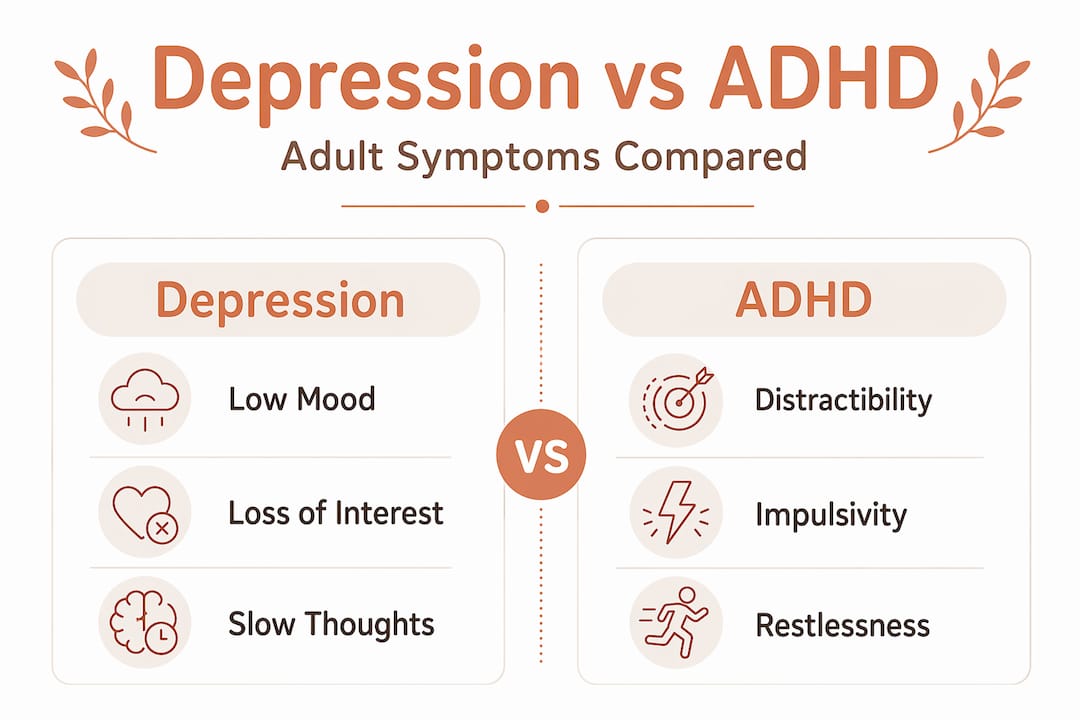
This is where understanding ADHD and depression gets genuinely complex. ADHD and depression share symptoms like mood swings, concentration issues, and restlessness, but they differ in duration, triggers, and physical symptom profiles. Knowing where they overlap and where they diverge is the core of any ADHD vs depression characteristics analysis.

Side-by-side symptoms comparison
| Symptom | Depression | ADHD |
|---|---|---|
| Low mood | Persistent, daily, weeks-long | Episodic, tied to frustration or boredom |
| Concentration problems | Pervasive, task-independent | Selective, tied to stimulation level |
| Fatigue | Major feature, physical and cognitive | Often from poor sleep or overstimulation |
| Motivation loss | Broad, affects most activities | Task-specific, less global |
| Emotional shifts | Slow, sustained low mood | Rapid, intense, short-lived reactions |
| Sleep disruption | Common, both insomnia and hypersomnia | Often from racing thoughts at bedtime |
| Onset | Can begin at any age | Childhood onset (even if undiagnosed) |
| Response to positive events | Minimal or absent pleasure | Mood can lift quickly with stimulation |
Key differentiators to watch
When using a symptoms checklist for ADHD and depression, focus on these distinguishing signals:
- Duration and pervasiveness. Depression requires symptoms nearly every day for two or more weeks. ADHD mood issues are more reactive and short-lived.
- Childhood history. Did these patterns show up before adulthood, in school performance or behavior? ADHD usually leaves a trail.
- Response to stimulation. Can you engage and focus when something genuinely interests you? If yes, that pattern is more consistent with ADHD than depression.
- Physical symptom burden. Profound fatigue, appetite changes, and slowed movement are more characteristic of depression.
- Anhedonia vs. interest-dependent engagement. True depression often removes pleasure even from activities you used to love. ADHD rarely does this.
It’s also worth knowing that comorbid depression in adults with ADHD may stem from shared genetic vulnerabilities, meaning the two conditions can and often do co-occur. Co-occurring ADHD and depression require coordinated care that addresses both simultaneously. Treating only one rarely produces lasting relief. For more on differentiating ADHD and depression symptoms in a clinical context, virtual evaluation is the most practical starting point.
Navigating diagnosis challenges: burnout, overlap, and misdiagnosis
One of the most clinically tricky presentations is ADHD burnout. It closely mimics depression and catches both patients and providers off guard. ADHD burnout shares surface symptoms with depression but typically follows prolonged stress and improves with rest, unlike depression, which persists regardless of rest or circumstances.
Adults who have spent years masking or compensating for undiagnosed ADHD often reach a breaking point. The result looks like:
- Complete exhaustion and mental flatness
- Withdrawal from responsibilities and relationships
- Emotional numbness or irritability
- Loss of motivation to do anything
These are also core depression symptoms. The difference lies in the backstory and the response. ADHD burnout follows a recognizable pattern of sustained overeffort, and it lifts when the pressure decreases. Depression does not follow that pattern.
“Patients who respond partially to antidepressants but keep relapsing are often carrying undiagnosed ADHD that was never part of the treatment picture.”
Emotional dysregulation adds another layer of confusion. In ADHD, emotions spike fast and resolve fast. This can look like mood disorder characteristics to an untrained eye. But the rapid cycling in ADHD is reaction-driven, tied to specific events, and tends to resolve within hours rather than persisting for days or weeks.
Pro Tip: Keep a simple daily log noting when low mood or concentration issues appear, what triggered them, and how long they lasted. This kind of record is one of the most useful tools you can bring to a clinical assessment for ADHD and depression because it reveals patterns that a single appointment cannot capture.
Practical tips for managing and seeking treatment for ADHD and depression
Once you understand how to differentiate ADHD and depression, the next step is taking action. Here’s a practical framework for adults in Texas and Colorado who are ready to move from confusion to clarity:
- Document your symptom history. Note when problems started, whether they trace back to childhood, and what makes them better or worse.
- Request a comprehensive evaluation. Don’t settle for a quick appointment that only addresses current mood. A thorough assessment considers developmental history, cognitive patterns, and all co-occurring symptoms.
- Ask about comorbid conditions. If you have been treated for depression and results have been incomplete, specifically ask whether ADHD has been ruled out.
- Engage with virtual care options. Virtual mental health care in Texas and Colorado has expanded significantly, making it easier to access specialists who understand the nuances of overlapping conditions.
- Stay consistent with treatment. Whether that means medication, therapy, behavioral strategies, or all three, consistency matters especially when managing co-occurring ADHD and depression.
Additional management strategies that support better outcomes:
- Build structure into your daily routine to reduce executive dysfunction’s impact
- Communicate symptom changes to your provider as they happen, not just at scheduled appointments
- Work with a provider who treats both conditions, not just the louder one
- Avoid self-diagnosing or adjusting medication without clinical guidance
Integrated approaches for ADHD and depression produce better outcomes than treating each condition in isolation. The research is clear on this. For targeted support, ADHD treatment in Texas through virtual care offers a direct path to assessment and personalized medication management.
Pro Tip: Bring your symptom diary to your first virtual evaluation. Providers can move faster toward an accurate diagnosis when they have concrete behavioral data rather than relying solely on self-report in the moment.
Why understanding the subtle differences in depression and ADHD symptoms changes everything
Here is the part that rarely gets said plainly: treating only depression when ADHD is also present is one of the most common reasons adults stay stuck in a revolving door of partial improvement and relapse. Treating only visible depression symptoms without addressing underlying ADHD causes only partial relief and frequent relapses. We see this pattern repeatedly.
The issue is that ADHD’s emotional dysregulation, that fast, intense flood of frustration or rejection sensitivity, is consistently underidentified. Providers may document it as mood instability and reach for a mood stabilizer or antidepressant. The antidepressant helps the mood floor. But the impulsivity, distraction, and functional breakdown continue. The patient still feels like they’re failing at life, just with slightly less sadness about it.
This is why we believe that symptom-silo thinking, treating only what you can see on the surface, is the real barrier to lasting improvement. Adults in Texas and Colorado deserve evaluations that look at the full picture: mood, attention, behavior, history, and how all of it interacts.
Virtual care models are well-positioned to support this kind of integrated evaluation. Multiple sessions, documented symptom tracking, and collaborative care between prescribers and therapists can address the complexity these conditions require. Exploring the relationship between ADHD and depression is not a luxury. It is the foundation of treatment that actually works.
Pro Tip: If you’ve had multiple depression treatment attempts without lasting success, request a formal evaluation that specifically includes ADHD screening. This single step changes the diagnostic and treatment trajectory for a significant number of adults.
Start your virtual mental health journey for ADHD and depression
You now have a clear framework for understanding what separates and connects these two conditions. The next step is working with a team that knows how to act on that knowledge.
At Journey Mental Health, we specialize in virtual psychiatric care for adults in Texas and Colorado who are navigating ADHD, depression, or both. Our evaluations are designed to capture the full picture, not just the most obvious symptoms. We offer personalized treatment plans that include medication management, behavioral guidance, and structured follow-up so your care adapts as your needs change. Whether you’re seeking mental health support in Texas and Colorado, need a clearer picture of your ADHD treatment options, or are ready to start depression treatment in Texas, we make access simple, fast, and effective from your home.
Frequently asked questions
How can I tell if my symptoms are due to depression or ADHD?
Distinguishing the two requires assessing symptom patterns and duration. Depression typically shows persistent low mood, anhedonia, and physical symptoms lasting at least two weeks continuously, while ADHD reflects lifelong patterns of attention difficulty and executive dysfunction that don’t depend on mood state. A formal evaluation is the most reliable way to tell them apart.
Can adults have both ADHD and depression at the same time?
Yes, co-occurring ADHD and depression are common in adults, and comorbid presentations have genetic underpinnings that make integrated treatment, rather than treating each condition separately, the most effective approach.
What is ADHD burnout and how is it different from depression?
ADHD burnout develops after prolonged overexertion managing ADHD demands and typically improves with rest and reduced stress, while clinical depression is a persistent mood disorder that does not resolve with rest alone and requires targeted treatment.
Are virtual mental health services effective for treating ADHD and depression?
Virtual care is an effective and accessible option for adults managing ADHD and depression, offering psychiatric evaluations, medication management, and therapy from home, particularly for adults in Texas and Colorado where in-person specialist access can be limited.